A drone the size of a microwave oven, carrying a few hundred grams of explosive, can cripple an armoured vehicle worth several million dollars. The Marines understood this earlier than most. The system they built to defeat it, the Marine Air Defense Integrated System (MADIS), does not look like the answer the US Army arrived at. The Army packed every effector and sensor it needed into one Stryker A1 and called it SGT STOUT. The Marines deliberately split the same job across two Joint Light Tactical Vehicles, designating them Mk1 and Mk2. To anyone reading from a distance the choice looks like a doubling of cost for a fraction of the protection. It is not. It is a doctrinal expression of how the Marine Corps expects to fight: dispersed, expeditionary, hard for the adversary to locate, and harder to destroy in a single kinetic blow.
This piece walks the MADIS section as the Marines actually fight it as one weapon system distributed across two trucks, not two separate vehicles with separate jobs. It covers manning, the sensor layer, the Modi II soft-kill, the kinetic stack, the engagement flow, the graceful-degradation properties of the pair under combat loss, and the wider air-defence network the section feeds into.

Image: US Marine Corps work, public domain. Via Wikimedia Commons, file Marine_Air_Defense_Integrated_System_(MADIS)_Mk1_and_Mk2.jpg.
_Mk1_and_Mk2.jpg)
1. Manning the pair: six Marines, one mission
A MADIS section is two JLTVs and six Marines. Both vehicles are crewed identically at the seat-position level with three Marines per truck: driver, vehicle commander, and LAAD Gunner. The driver moves the vehicle and runs the secondary observation. The vehicle commander handles tactical communications, airspace coordination, and engagement authority. The LAAD Gunner runs every sensor and weapon on the deck.
The LAAD Gunner is the enlisted Marine trade: Marine Occupational Specialty 7212, Low Altitude Air Defense Gunner, trained at the Basic Gunner Course at Twentynine Palms, California. Per the Marine Corps Credentialing Opportunities On-Line (COOL) trade description, the 7212 LAAD Gunner is responsible for the employment and maintenance of all equipment and weapon systems inherent to a LAAD Battalion. That language matters. There is no separate “sensor operator” trade in the LAAD community. The same Marine, qualified to the same standard, operates the radar, the electronic-warfare suite, the command-and-control interface, and the 30 mm cannon. The difference between the Mk1 LAAD Gunner and the Mk2 LAAD Gunner is workload, not qualification.
In the typical section construct one of the two vehicle commanders carries the section-lead duties for the pair, usually a sergeant or staff sergeant in the lead seat with a junior non-commissioned officer (NCO) or selected lance corporal in the second. Section-level coordination flows through the lead commander to the wider battery and battalion. Operating arrangements at the small-unit level give the section a degree of doctrinal flexibility: the pair can split temporarily to cover a wider arc, then re-cohere for a coordinated engagement when the threat picture demands it.
This unified-MOS construct is one of the less visible reasons the two-vehicle architecture works. Because both crews are trained to the same trade standard, a section that loses one vehicle is not left with an under-qualified crew on the survivor. Either LAAD Gunner can be moved into the other seat and continue the engagement.
2. The sensor layer: the Mk2 builds the long-range picture
The Mk2 carries the only sensor that is unique to it: the RPS-62 radar. The other sensor channels (EO/IR imaging integrated into the Protector RS6, and the SNC Modi II passive radio-frequency (RF) receiver) are duplicated on the Mk1, but the radar is on the Mk2 alone. That is the reason the Mk2 is described as the eyes and the brain of the pair. The combination of the RPS-62, the EO/IR, and the Modi II RF picture produces a fused fire-control track that the Mk1 cannot build on its own, and the Mk2 LAAD Gunner therefore runs the section’s primary detection-and-classification work even though both crews are trained to the same standard.
2.1 The RPS-62 radar
The primary sensor is the DRS RADA RPS-62, an S-band, four-panel, active electronically-scanned-array (AESA) pulse-Doppler radar. The RPS-62 is the counter-unmanned-aircraft-system (C-UAS) and very-short-range air-defence (VSHORAD) variant in the Enhanced Compact Hemispheric Radar (eCHR) family, a compact, software-defined, hard-mounted panel-radar product line manufactured by DRS RADA Technologies (the Israeli-origin radar house acquired by Leonardo DRS in 2022). Four antenna panels are distributed around the vehicle to give the Mk2 continuous 360° hemispheric coverage: the forward-arc panel is mounted on the front of the vehicle cab itself (where it partially obscures one of the front windows), and the remaining three panels are positioned on rear and side aspects to fill out the hemisphere. The software-defined architecture means the same hardware can be re-tasked between counter-UAS, active-protection, and perimeter-surveillance roles via firmware load. The Mk2 runs the RPS-62 software profile specifically, optimised for the small-drone air-surveillance problem.
Per manufacturer-published data (DRS RADA via the Defence and Security Equipment International (DSEI) exhibition, 2019, RADA Chief Executive Officer (CEO) Dubi Sella, reported by EDR Magazine) the radar detects nano-unmanned aerial vehicles (UAVs) out to roughly 3 km, Shahed-class medium drones out to 15 km, and helicopters and fast-jets between 15 and 22 km depending on radar cross-section and aspect. These are detection ranges. The cannon’s effective engagement envelope is shorter: nominally 0.5 to 5 km against the low-slow-small target set, with the optimum band against a Shahed-class target sitting at 3 to 4 km. The radar sees further than the cannon shoots, which is exactly what the engagement chain requires: a settled track in hand before the engagement window opens.
The nano-drone class is what the RPS-62 was built to find. Nano- and micro-class UAVs sit at a radar cross-section in the order of 0.01 m² or smaller, often the size of a hand-launched commercial quadcopter. They fly low and slow. They sit inside the radar clutter of foliage, sea state, urban multipath, and bird traffic. They are increasingly the dominant threat to dispersed Marine Littoral Regiment posture in the Pacific island chains, to forward bases inside the Weapons Engagement Zone, and to convoy movement in contested terrain. The detection step is the choke point in the engagement chain: if the radar cannot resolve a nano-class UAV through clutter at 3 km, the cannon, the missile and the EW suite have nothing to engage.
The RPS-62 hits that detection-class target through three engineering choices that distinguish it from the older RPS-42. First, gallium-nitride (GaN) solid-state amplifiers in the transmit chain, which produce a stronger and cleaner radar return than the gallium-arsenide (GaAs) generation used in the RPS-42. Second, digital adaptive beamforming across the four-panel AESA, which lets the Mk2 LAAD Gunner’s fire-control software shape multiple simultaneous beams, reject clutter on a per-cell basis, and run higher track capacity against saturation drone swarms. Third, a four-dimensional (4D) pulse-Doppler architecture that produces range, azimuth, elevation and radial velocity for every track simultaneously, rather than scanning through them as a legacy mechanically-rotated radar would. Against the small-RCS detection problem the cumulative effect is cleaner returns through clutter and multipath (the conditions that define littoral and urban operations), greater simultaneous track capacity, and electronic counter-countermeasures (ECCM) margin against an adversary who is jamming back.
Because the Mk2’s BLOS C2 gateway sits directly on top of the radar, those higher-quality tracks flow straight into the networked command-and-control system. Better tracks shared into CAC2S, MACCS and JADC2 mean the MADIS section can engage threats detected by distant sensors (AN/TPS-80 G/ATOR, Sentinel A4, F-35 sensor feeds) with higher confidence in the cue, and adjacent MADIS sections can pre-tune their own Modi II suites against the same protocol signature without re-detecting the threat themselves. The improvement starts as sensor quality at the section level and shows up as a network effect at the battery and regiment level.
A nomenclature note for the editor or technical analyst reading along: the RPS-62 is the eCHR variant, distinct from the newer aCHR (Advanced Compact Hemispheric Radar) whose C-UAS variant carries the three-digit RPS-620 designation. Both are also distinct from the older Multi-Mission Hemispheric Radar (MHR) family, which contains the legacy RPS-42 (the designation that appears in some pre-2025 trade press for MADIS Mk2 and reflects the low-rate-initial-production / developmental configuration). The full-rate production MADIS Mk2 accepted by the US Marine Corps (USMC) on 15 December 2025 carries the RPS-62. CHR family and MHR family are separate product lines from the same manufacturer, and the RPS-42 to RPS-62 transition is a generational capability jump for the MADIS programme, not a cosmetic redesignation.
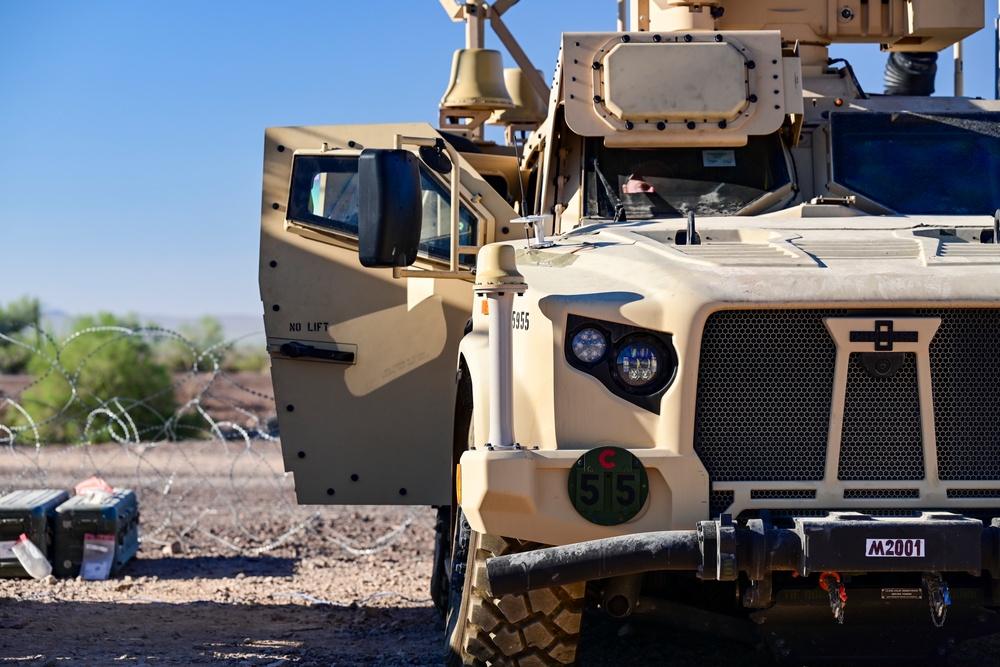
Photo: Neil Mabini, Naval Surface Warfare Center, Corona Division. US Defense Visual Information Distribution Service (DVIDS) asset 8090724. Public domain.
2.2 The EO/IR sensor
The second channel is electro-optical and infrared imaging. An EO/IR sensor is integrated into the same Kongsberg Protector RS6 remote weapons station that carries the cannon. Once the RPS-62 produces a track, the camera slews automatically onto the target. The Mk2 LAAD Gunner sees the image, and visual classification follows (drone or bird, hostile or friendly, weaponised or commercial). The EO/IR also functions independently of the radar where the threat picture allows it, and it provides the post-engagement assessment when the cannon or the Stinger has done its job.
Specific original equipment manufacturer (OEM) gimbal-product attribution for the EO/IR sensor varies across open-source reporting and is not a load-bearing claim here; the sensor function is what matters. Where definitive primary-source attribution is needed for a downstream publication, USMC Program Executive Office (PEO) Land Systems or Kongsberg are the right routes.
2.3 The Modi II passive RF channel
The third channel is the Sierra Nevada Corporation (SNC) Modi II electronic-warfare suite operating in its sensing mode. Modi II listens passively across the small-unmanned-aircraft-system (small-UAS) frequency space, looking for the drone’s own command-and-control link, its telemetry, and its video downlink. That tells the Marines what type of drone they are looking at: a consumer DJI airframe will emit on known commercial protocols and frequencies; a hardened mil-spec autopilot will look quite different. Modi II’s onboard library matches the signature.
The Mk2 LAAD Gunner runs all three channels through a single fused fire-control picture. The radar gives the geometry, the camera gives the visual, and the RF receiver gives the protocol signature. By the time the engagement decision is made, the system has cross-checked the threat across three independent sensor modalities. False alarms are filtered out before any effector is committed.
3. The Modi II soft-kill: first response, ammo-free, stealthy
Once a drone is classified as hostile, the engagement sequence opens with electronic warfare rather than kinetics. The Modi II is the first effector for two reasons that matter to Marine doctrine and to the engagement economics.
The cost. A 30 mm proximity-fuzed round runs in the high single thousands of dollars per shot, and a typical kinetic intercept burns two to five of them. The Modi II engagement burns electrons off the JLTV’s bus. There are no consumables, no resupply, no magazine count to manage. Against a saturated swarm, the cannon’s per-vehicle magazine is the binding constraint; the Modi II is not magazine-limited.
The signature. A 30 mm engagement gives the MADIS position away from a kilometre or more, through muzzle flash, audible report, and airburst detonations downrange. A Modi II engagement is radio-frequency only, and in a dispersed Marine Littoral Regiment (MLR) posture that signature trade matters. The whole operating concept of Force Design 2030 and Expeditionary Advanced Base Operations (EABO) rests on the adversary not knowing exactly where the Marines are.
3.1 The Thor lineage
The Modi II did not arrive in the C-UAS mission set new. It is the production successor to SNC’s earlier Thor II (AN/PLT-5) and Thor III (AN/PLQ-9) man-pack Counter-Radio-Controlled Improvised Explosive Device (CREW) jammers that defeated radio-controlled IEDs (RC-IEDs) in Iraq and Afghanistan. Same software-defined heart, same waveform architecture, re-pointed at small-drone command links rather than radio-controlled fuzes. The system is configured for man-pack, vehicular, fixed-site, and airborne applications from the same hardware core; the MADIS installation is the vehicular variant.
The CREW heritage has operational consequences that survive the re-pointing onto drones. The same waveform library that defeated radio-controlled fuzes in Iraq and Afghanistan can attack radio uplinks and radio-controlled triggers on any munition that depends on a radio path to function. In practice, the Mk2’s primary mission is drone command-and-control disruption, but the section’s soft-kill envelope extends into the subset of incoming threats that carry a defeatable radio path: some loitering munitions, some radio-uplinked artillery, certain modern rocket and mortar fuzes with course-correction or air-burst data-link. Generic kinetic Rockets, Artillery and Mortars (RAM) with purely mechanical or proximity-only fuzing are outside the envelope; the projectile is unaffected by jamming. The radio-link envelope is the operational distinction that matters, and inside it Modi II gives the section an effector that does not consume 30 mm rounds.
SNC does not publish Modi II’s specific frequency coverage in open source. The relevant small-UAS C2 and telemetry band of interest spans roughly the 433 MHz Industrial, Scientific and Medical (ISM) band up through the 5 GHz video-downlink range, covering ISM, Wi-Fi-derived, Bluetooth-derived, and most consumer-and-light-military C2 protocols.
3.2 The soft-kill techniques
Modi II attacks the drone in four progressively more aggressive ways depending on the protocol signature the Mk2 LAAD Gunner has identified:
- Command-link jamming. Narrowband interference targeted at the drone’s specific control frequency. The operator loses control authority; the drone defaults to its fail-safe behaviour (hover-in-place, return-to-home, or controlled descent depending on autopilot programming).
- Global Positioning System (GPS) spoofing. False navigation signals fed to the drone’s GPS receiver. The drone thinks it is somewhere else, flies the wrong way, or believes it has reached a waypoint and lands.
- Video downlink disruption. The operator loses visual on the drone and can no longer fly it manually.
- Wideband barrage jamming. If surgical attacks fail, saturate the relevant band with noise and force the drone’s fail-safe.
Both Mk1 and Mk2 carry Modi II suites. The Mk2 typically runs the primary EW engagement because the radar and the protocol-signature picture both live on the Mk2. The Mk1’s Modi II is a second jammer, useful for spatial coverage in dispersed positions, for redundancy, and for adding RF power against a hard target the Mk2’s single jammer cannot resolve. The two suites coordinate over the inter-vehicle data link to avoid mutual interference.
If the soft-kill resolves the engagement, the drone is hovering, returning home, or settling to the ground within seconds. No round is fired. No position is given away.
3.3 Where the EW runs out
Modi II is not a complete solution. Autonomous drones flying inertial-only profiles have no C2 to jam. Fibre-optic-link drones, a Ukrainian battlefield innovation of 2024–2026, have no radio link at all. Hardened mil-spec waveforms and frequency-hopping mesh networks resist jamming. Drones using inertial-measurement units plus computer-vision terrain-matching do not depend on GPS and ignore spoofing. This is the technical reason the cannon still exists on both Mk1 and Mk2: for the threats the EW cannot resolve.
4. The kinetic stack
The Marines build for the cases the EW cannot resolve. The kinetic stack is structured as a main weapon, a supporting weapon, and a missile layer.
4.1 The XM914E1 main armament: identical on both vehicles
The main armament is identical on both Mk1 and Mk2: a Northrop Grumman XM914E1 30 mm chain gun on a Kongsberg Protector RS6 remote weapon station. The XM914E1 is the Marine-specific variant of the M230LF, the ground-vehicle derivative of the M230 chain gun that has armed the AH-64 Apache since 1986. The Marine variant differs from the US Army’s XM914 (which arms SGT STOUT on the Stryker A1) in two specific ways:
- The XM914E1 uses a percussion primer rather than the Army’s electric primer. The electric primer is inherited from the Apache M230 lineage; the Marine percussion primer is a Marine-specific cartridge choice.
- The XM914E1 uses a single-feed magazine, rather than the Army’s dual-feed configuration that Northrop Grumman unveiled in October 2024 and that the Stryker integration introduced into production from 2025–2026.
The Marine and Army 30 × 113 mm cartridges are not interchangeable at the cartridge level even though the projectile family is shared (XM1211 high-explosive proximity (HEP), XM1198 high-explosive dual-purpose self-destruct (HEDP-SD), XM1223 multi-mode proximity airburst (MMPA), and XM1225 armour-piercing explosive (APEX)). Both services run parallel production streams that cannot cross-feed in a contingency. The barrel, the chamber, and the projectile family are common to both variants; the firing-pin and primer interface is not. This is a material industrial-base finding that has not been widely reported in the open-source record.
On the ground-vehicle integration the cannon’s cyclic rate is approximately 200 rounds per minute, with single-shot, controlled-burst, and full-automatic modes. Effective range against the small-UAS target set is between 2 and 5 km with the optimum band against a Shahed-class target sitting at 3 to 4 km. The exact per-vehicle magazine load is not published in the open-source record by Northrop Grumman, Kongsberg, Leonardo DRS, or the relevant US Army or USMC public-affairs offices. The AH-64 Apache comparator is 300 rounds with the Robertson auxiliary fuel tank fitted (the US Army standard configuration); the SGT STOUT and MADIS Mk1 per-vehicle loads have not been published.
The cannon programme itself is on contract. USMC Marine Corps Systems Command awarded Northrop Grumman an Indefinite Delivery / Indefinite Quantity (IDIQ) contract worth up to $81.03 million on 3 June 2021 for delivery of up to 300 XM914E1 chain guns, spares, training and associated engineering services in support of MADIS Increment 1. Work runs at Northrop Grumman’s Mesa, Arizona facility with an estimated completion date of 31 May 2026. The 300-cannon ceiling is consistent with a programme of approximately 190 system-pairs (Mk1 and Mk2 each carrying one XM914E1 on a Protector RS6) plus a reasonable spares and replacement-attrition factor.
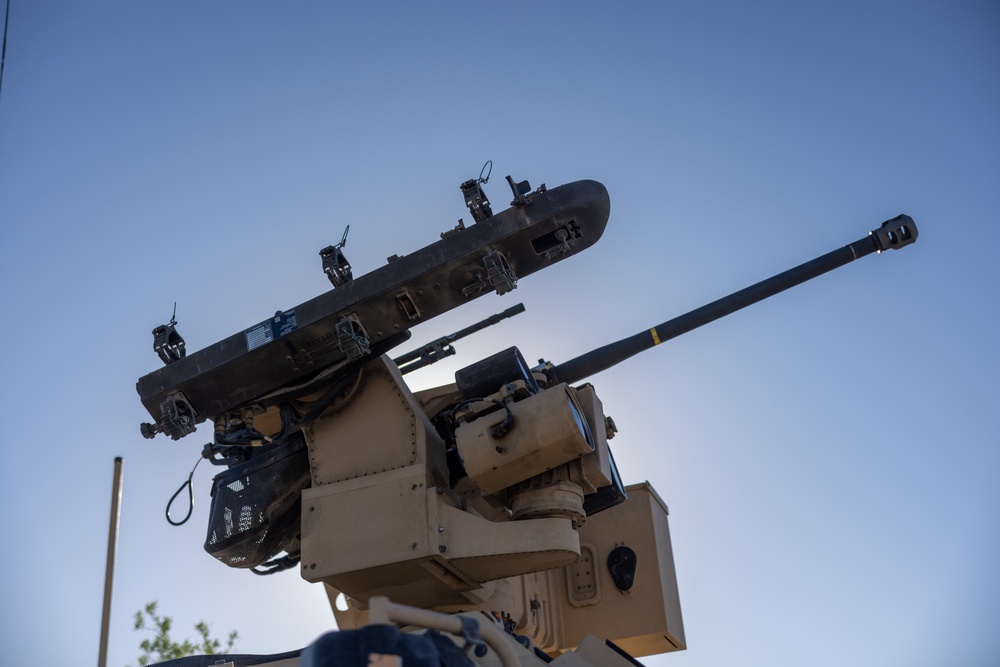
Photo: LCpl Samantha Devine, U.S. Marine Corps / MAWTS-1. DVIDS 9358075. Public domain.
4.2 The M240C supporting armament: identical on both vehicles
The supporting armament is also identical on both vehicles: an M240C 7.62 mm general-purpose machine gun, the coaxial variant of the M240 family, mounted on the same Protector RS6. The M240C designator (specifically the coaxial / right-feed variant) is identified by Kongsberg in the July 2023 RS6 RWS production statement. The M240C is the close-in self-defence weapon, used against ground threats inside the cannon’s minimum range or against an ultralight UAS the 30 mm cannon would be over-matched against. It shares the same fire-control bus as the cannon, so the RPS-62 radar cue can drive it. But 7.62 mm is not a primary counter-UAS effector: too light a projectile, no airburst, much shorter effective range than the 30 mm against the same target.
A note on the secondary armament that is worth flagging for any analyst comparing the production-standard Mk2 against older trade-press descriptions: some pre-2025 sources (the US Naval Institute (USNI) Proceedings April 2020 in particular, and the Missile Defense Advocacy Alliance MADIS profile) describe the Mk2 as carrying an M134 Minigun rather than an M240C. That framing reflects an earlier developmental / low-rate-initial-production (LRIP) “buggy-era” configuration and the L-MADIS Polaris MRZR-class lighter variant. The full-rate production Mk2 accepted by the USMC on 15 December 2025 carries the M240C on the same Protector RS6 mount as the Mk1, per the Kongsberg production statement.
4.3 The Stinger missile layer: Mk1 only
The missile layer is on the Mk1 only. A two-round FIM-92 Stinger Air-To-Air Launcher (ATAL) is mounted on the Mk1 alongside the Protector RS6, with dismount reload Stingers carried in the cargo bed for the LAAD section to feed back into the launcher after engagement. The ATAL is a Raytheon/RTX product line originally fielded on the AH-64 Apache for the helicopter’s air-to-air Stinger capability, and the MADIS Mk1 integration is identified by Kongsberg as an “integration kit for the STINGER Air-To-Air Launcher (ATAL)” on the RS6 RWS. The Stinger covers the longer-range engagements the 30 mm cannot reach: cruise-missile-class targets, low-flying fixed-wing aircraft, helicopters, and the harder end of the Group 3 UAS class. The Mk2 does not carry Stinger; if the engagement calls for a missile shot, the Mk2 cues the Mk1.
The two-tube fit is doctrinal, not capacity-limited by the chassis or the RS6. The Marine Corps LAAD construct treats the on-vehicle launcher as one element of a deeper section magazine that includes the dismount reload Stingers. A 4-tube SVUL-family pod would have been technically straightforward to integrate (the SVUL line is the launcher fitted to the legacy US Army Avenger), but the doctrinal payoff sits in the reload tempo, the lift envelope of the JLTV chassis under the CH-53K external-lift constraint, and the procurement-rationing logic of the broader FIM-92 inventory. The ATAL selection on MADIS aligns the Marine launcher with the Apache product line, simplifying spares and qualification.
4.4 Side-by-side configuration
| Feature | MADIS Mk1 (kinetic vehicle) | MADIS Mk2 (sensor / EW vehicle) |
|---|---|---|
| Chassis | Joint Light Tactical Vehicle (JLTV) | Joint Light Tactical Vehicle (JLTV) |
| Crew | Driver + vehicle commander + LAAD Gunner (MOS 7212) | Same |
| Remote weapon station | Kongsberg Protector RS6 | Kongsberg Protector RS6 (same) |
| Primary cannon | XM914E1 30 mm (percussion primer, single-feed) | XM914E1 30 mm (same) |
| Coaxial MG | M240C 7.62 mm (coaxial variant per Kongsberg) | M240C 7.62 mm (same) |
| EO/IR | Integrated in Protector RS6 | Integrated in Protector RS6 |
| Modi II EW | Full suite | Full suite (primary EW node by virtue of the radar picture) |
| C2 integration | Inter-vehicle data link + CAC2S / MACCS / JADC2 / BLOS upward | Inter-vehicle data link + CAC2S / MACCS / JADC2 / BLOS upward (same) |
| Stinger missile | Two-round FIM-92 Stinger Air-To-Air Launcher (ATAL) integration kit on RS6 + dismount reload Stingers in cargo bed | None |
| Radar | None | DRS RADA RPS-62 (eCHR family), four-panel S-band AESA, 360° hemispheric |
| Visual giveaway | Two-round ATAL Stinger launcher mounted at the front of the vehicle | Four RPS-62 radar panels distributed around the vehicle: one mounted at the front of the cab (partially obscuring a front window) for forward-arc coverage, the remaining three on rear and side mounts for the full 360° hemisphere |
| Engagement role | Primary kinetic prosecutor (30 mm + Stinger) | Sensor + EW + cueing; self-engages with 30 mm as required |
5. The pair as a tactical unit: how an engagement actually flows
A hostile drone enters the section’s airspace. The engagement chain unfolds in the following order, typically within single-digit seconds at the optimum range.
Detection. The RPS-62 finds the drone at between 1 and 15 km depending on target class. The Mk2 LAAD Gunner sees the track appear on his fire-control console. The radar passes range, bearing, elevation, and velocity into the fire-control picture.
Classification. The Mk2’s EO/IR camera slews automatically to the radar track. The Mk2 LAAD Gunner sees the visual image; the picture is good enough to distinguish a drone from a bird and a hostile airframe from a civilian one. In parallel, Modi II runs passive RF detection on the drone’s command link and identifies the protocol signature. Three independent sensor channels (geometry, image, RF) agree on a hostile drone before the engagement opens.
Soft-kill first. The Mk2 LAAD Gunner selects the right Modi II technique against the identified protocol (command-link jamming, GPS spoofing, video disruption, or barrage). For a consumer airframe or a lightly-militarised threat, the engagement typically resolves within seconds. The drone hovers, returns home, or settles to the ground. No round is fired, no position is given away, no ammunition is consumed.
Kinetic if unresolved. If the EW does not resolve the engagement (autonomous flight, fibre-optic link, hardened waveform) the section goes kinetic. The Mk2 LAAD Gunner pushes the full target track to the Mk1 LAAD Gunner over the inter-vehicle tactical data link. Both LAAD Gunners now see the same track on their consoles; the section leader on the lead vehicle has engagement authority. Geometry and loadout drive which vehicle prosecutes and with which effector.
- 30 mm cannon from the Mk1. If the threat is in the cannon envelope (0.5–5 km) and the Mk1 has the better line of sight, the Mk1 LAAD Gunner takes it. The Protector RS6 slews onto the track; the fire-control system computes the ballistic solution and the proximity-fuze setup; the cannon fires a short controlled burst of 3 to 5 rounds; the airburst rounds detonate at the optimum miss distance of 2 to 5 m from the drone; the drone is killed.
- Stinger from the Mk1. If the threat is at the edge of the cannon envelope, a harder target, or moving fast enough that the cannon is the wrong tool, the Mk1 takes it with a Stinger. Single missile launch from the two-round ATAL, infrared-guided seeker, drone destroyed at longer range. The dismount Stinger reload is then loaded back into the launcher by the LAAD section for the next engagement.
- 30 mm cannon from the Mk2. If the Mk1’s line of sight is blocked, the cannon is overheated, or the Mk1 is committed elsewhere in the formation, the Mk2 self-engages. The Mk2 has its own Protector RS6 with its own XM914E1 cannon and M240C coaxial. The radar that found the target is on the Mk2, so the engagement geometry is at its tightest from the Mk2. The Mk2 LAAD Gunner switches his console from sensor mode to gunner mode and engages directly on his own radar cue.
The whole sequence, from radar detection to drone hit, typically completes in single-digit seconds for an engagement at the optimum range. The two vehicles fight as one weapon system because the data link carries everything the engagement chain needs across them: the radar that produces the picture is on the Mk2; the missile launcher that extends the kill chain to longer range is on the Mk1; the cannon, the M240C, the EO/IR, and the EW suite exist on both.
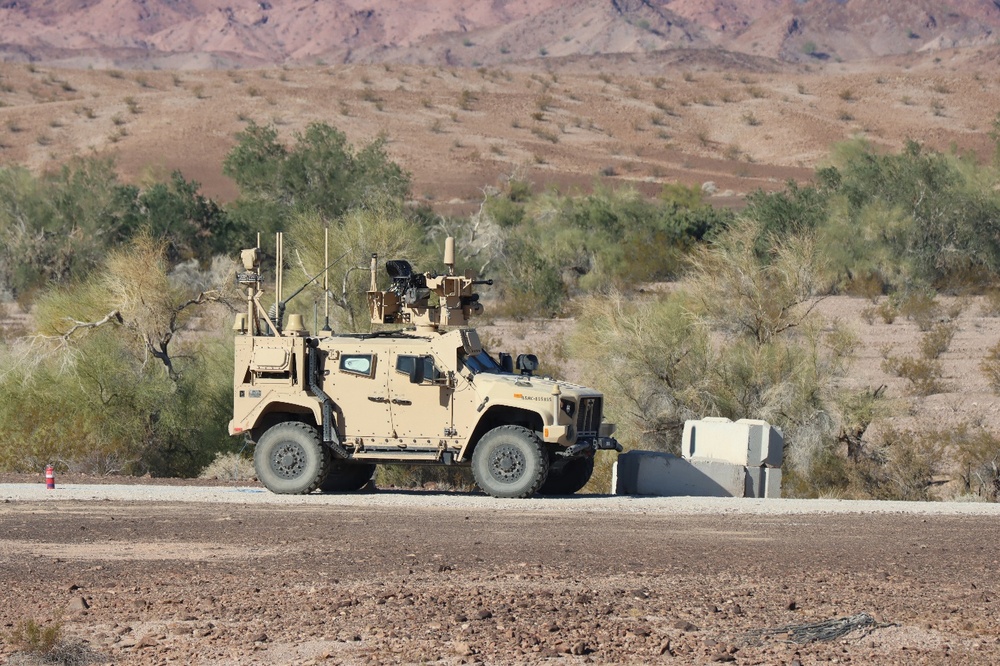
Photo: Virginia Lambinicio, U.S. Marine Corps Systems Command. DVIDS 8195916. Public domain.
6. Graceful degradation: what survives a combat loss
The architectural choice to split the system across two vehicles costs the Marines two crews, two fuel chains, two maintenance pipelines, two sets of spares. The payoff is that the section degrades gracefully under combat loss rather than catastrophically. This is the design feature that makes the two-vehicle architecture defensible in a way the Army single-vehicle integration is not.
Both vehicles intact, link up. Full pair operation. The Mk2 detects, classifies, and runs EW; the Mk1 prosecutes the kinetic engagement with the appropriate effector. The Mk2 also provides area defence and rear-aspect engagement using its own cannon when the Mk1 is committed elsewhere.
Link dropped, both vehicles intact. Each vehicle falls back to its own EO/IR picture for engagement. The Mk1 retains the Stinger missile layer; the Mk2 retains the radar-cued 30 mm. The pair loses the cueing-from-Mk2-to-Mk1 advantage but neither vehicle is reduced to a single effector. Both can engage threats their EO/IR can see.
Mk2 lost, Mk1 intact. The Mk1 retains its XM914E1 cannon, its M240C coaxial, its EO/IR, its Modi II EW suite, and its two-round ATAL Stinger launcher plus the dismount reloads. What it loses is the long-range radar picture; early warning shortens to the EO/IR’s visual-acquisition range. Higher-echelon network tracks (Sentinel A4 at battery level, F-35 datalink feeds, AWACS) and Modi II’s passive RF bearing-and-classification on incoming drone C2 emissions provide partial detection. The Mk1 can still execute the full kill chain (soft-kill, 30 mm kinetic, Stinger) at short-to-medium ranges. Long-range early warning is degraded but the vehicle remains lethal.
Mk1 lost, Mk2 intact. The Mk2 retains its full sensor and EW picture (RPS-62, EO/IR, Modi II), plus its own XM914E1 cannon and M240C coaxial. What it loses is the Stinger missile layer. Kinetic engagement against the harder or longer-range threat is constrained to the cannon envelope only. The EW-first doctrine continues to work; the section keeps its detection-and-soft-kill primary mission and degrades only in its long-range kinetic engagement option.
This is the doctrinal payoff for the two-vehicle architecture. The US Army’s SGT STOUT integration packs the whole stack into one Stryker A1 hull: a single point of failure under a catastrophic kinetic hit. A similar hit on one MADIS vehicle does not produce the same outcome.
7. The wider architecture: the pair feeds the air-defence net
The MADIS section’s tactical picture does not stay on the pair. Both vehicles are integrated upward into the Marine air-defence command picture through four C2 layers, with the Mk2 typically running the primary C2 node because the radar picture originates there but with the Mk1 carrying the same network interface:
- Common Aviation Command and Control System (CAC2S): Marine aviation C2.
- Marine Air Command and Control System (MACCS): broader Marine air-defence network.
- Joint All-Domain Command and Control (JADC2): inter-service framework.
- Beyond Line-of-Sight (BLOS) networking for over-the-horizon connectivity.
A MADIS section conducting an EW engagement against a drone in the Philippines is simultaneously pushing its track picture, its Modi II protocol signature, and its radar return into the Marine air-defence net. Higher-echelon sensors can correlate the signature. Adjacent MADIS sections in the same operational area can pre-tune their own Modi II suites to the same threat. Adjacent batteries, brigade fires cells, and joint air-defence assets get a shared situational picture they would not have if MADIS operated as a standalone point-defence node.
The pair also receives from above. Sentinel A4 radar tracks at battery level, F-35 datalink feeds, Airborne Warning and Control System (AWACS) pictures, and counter-UAS battle-management cues all flow down into the Mk2’s fire-control picture. The Mk2’s RPS-62 finds the local threat; the wider network tells the section about threats over the horizon and about threats other sensors have already classified.
7.1 The artificial-intelligence-enabled command layer above the section
The Marine air-defence command picture is no longer a paper map and a radio voice channel. Counter-UAS C2 above the section is increasingly carried by artificial-intelligence-enabled (AI-enabled) fusion systems that take in sensor returns from multiple platforms, correlate them across radar, EO/IR, RF, and intelligence feeds, classify the tracks against a threat library, and route them onto the available effectors. The Marines do not run the system the British Army runs, but the architectural pattern is the same. The United Kingdom’s Project Asgard is the closest published equivalent: a six-layer kill-web in which forward sensors (Apache and F-35) push targeting-grade tracks onto a tactical mesh, an AI fusion layer (Anduril’s Lattice for any-sensor-to-any-effector routing, Helsing’s Altra for target identification and prioritisation) correlates the picture, and a human at the brigade fires cell authorises the engagement on the effector best suited to the geometry, the cost, the time, and the proportionality of the engagement.
The MADIS pair sits at the sensor end of an analogous architecture in the Marine context. The Mk2’s RPS-62 radar produces four-dimensional (4D) tracks. The Modi II RF receiver on both Mk1 and Mk2 produces protocol-classification metadata. The EO/IR sensors on both vehicles produce visual confirmation. That fused output is pushed upward into the Marine air-defence net, where the AI-enabled C2 layer correlates the picture across multiple MADIS sections, F-35 tracks shared via the Multifunction Advanced Data Link (MADL) and Link 16, Sentinel A4 returns, and the wider joint counter-UAS picture. The system does not pull the trigger. It compresses the time between the contact appearing and the human being ready to authorise the engagement. The Mk1 and Mk2 LAAD Gunners, and the section leader on the lead vehicle, retain the engagement authority that applies the rules of engagement, the proportionality check, and the discrimination call.
For analysts watching the broader trend, the lesson from Project Asgard is that the binding constraint on an AI-enabled kill-web is rarely the AI. It is the forward sensor that classifies the contact in the first place, and the disciplined human-authority interface that releases the effector. MADIS, with the RPS-62 on the Mk2 and the LAAD Gunner at the console, is built around that constraint. The radar, the EW suite, the EO/IR, and the cannon are real and material. The AI sits on top of them as the routing layer, not as the discriminator. (ISC’s 24 May 2026 analysis of Project Asgard walks the same architectural logic from a UK perspective.)
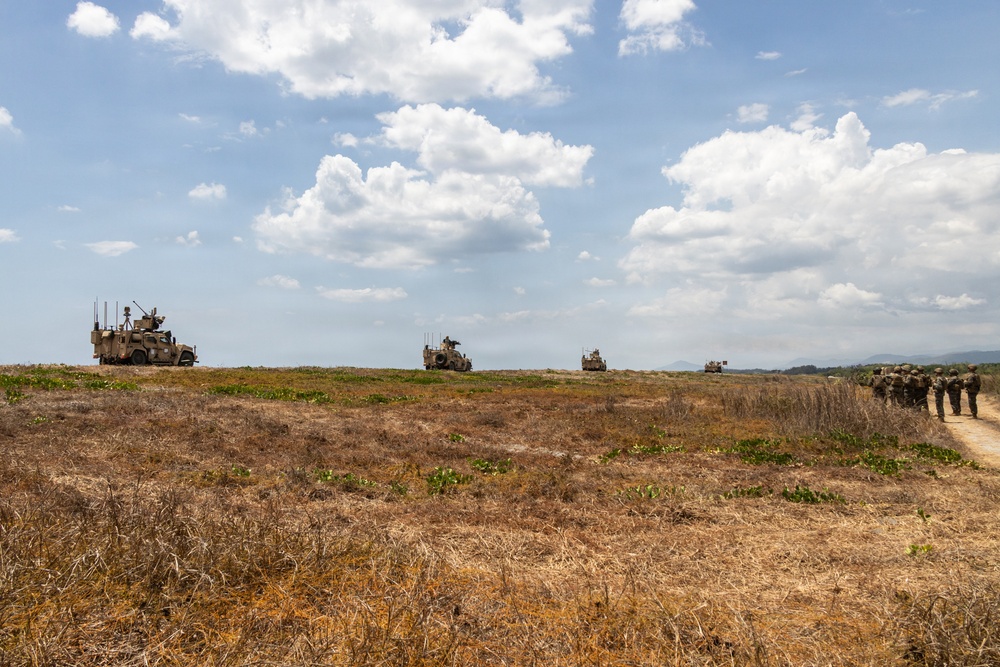
Photo: Sgt Atticus Martinez, U.S. Marine Corps. DVIDS 9647453. Public domain.
8. The architectural choice and what it costs
The Marines chose a two-vehicle pair over the single-vehicle SGT STOUT integration the Army adopted because the two services have different logistical-deployment problems. The Army Brigade Combat Team rolls into theatre on rail, road, and strategic airlift. The Marine Littoral Regiment under Force Design 2030 is built to be inserted by amphibious shipping, by heavy-lift rotary-wing aviation, and by landing craft onto beaches that may not have port infrastructure at all. Those two transport models impose very different size-and-weight constraints on every vehicle the formation deploys.
8.1 The lift constraint, set out in numbers
The platform comparison is the place to start because the numbers are publicly known and they drive the architecture.
| Platform | Combat weight | Practical lift |
|---|---|---|
| JLTV (MADIS Mk1 or Mk2) | ~7.4 tonnes (combat-loaded) | Single Sikorsky CH-53K King Stallion sling load; internal in Lockheed Martin C-130 Hercules, Boeing C-17 Globemaster III, and Lockheed C-5 Galaxy strategic-airlifter aircraft; Landing Craft Air Cushion (LCAC); Light Amphibious Warship (LAW); roll-off from amphibious shipping |
| Stryker A1 Double-V Hull (DVH) (SGT STOUT) | ~17 tonnes (DVH variant) | Internal in C-17 / C-5 only. Will not sling-load under CH-53K, will not roll into a LAW-class vessel within its lift envelope |
The numerical gap is decisive. A CH-53K King Stallion has an external lift capacity in the region of 16 tonnes and can move a single MADIS JLTV (or a pair under the right rigging) across hundreds of nautical miles between island advanced bases. The same helicopter cannot move a 17-tonne Stryker A1 under any condition. Landing-craft and surface-connector capacity favours the JLTV by a wide margin in any embarked formation built around a Marine Expeditionary Unit or a Marine Littoral Regiment, where deck-space and lift-cycle counts are the binding planning constraint.
The implication is the architecture. If the Marines had tried to package the same sensor-and-effector stack onto one armoured hull the way the Army did, the resulting vehicle would either weigh roughly the same as a Stryker A1 and lose all of its expeditionary mobility, or it would weigh significantly less and lose either the radar or the cannon or the missile layer to make the budget work. Splitting the load across two JLTV-sized platforms is what keeps each vehicle inside the 8-tonne expeditionary lift envelope while preserving the full radar-plus-cannon-plus-missile-plus-EW combat capability across the section.
8.1a The Marine deployment chain: which aircraft moves MADIS
Inside the Marine logistical support chain MADIS moves on three different aircraft sets depending on the phase of the deployment. The pattern below is published in USMC aviation doctrine and is observable in 3rd Marine Littoral Regiment movement-to-theatre packages, Balikatan exercise embarkation, and 31st Marine Expeditionary Unit forward-deployed operations from III Marine Expeditionary Force (MEF).
| Deployment phase | Primary aircraft | Secondary aircraft | Operational context |
|---|---|---|---|
| Tactical / Expeditionary | Sikorsky CH-53K King Stallion (external sling-load) | Lockheed Martin C-130J Super Hercules / KC-130J (internal) | Island-hopping inside the First Island Chain; EABO insertion and recovery; movement between expeditionary advanced bases |
| Strategic deployment | Boeing C-17 Globemaster III (internal) | Lockheed Martin C-130J Super Hercules | Initial movement into theatre from continental United States or rear basing |
| Sustainment | Lockheed Martin KC-130J Super Hercules (internal, plus aerial-refuelling cycle) | Lockheed Martin C-130J Super Hercules | In-theatre resupply, vehicle movement between bases, crew rotation |
The CH-53K King Stallion is the primary tactical lifter for MADIS movement inside the Marine logistical support chain. The aircraft is Sikorsky’s heavy-lift production successor to the CH-53E Super Stallion, fielded with HMH-461 (the first operational Marine Heavy Helicopter Squadron) reaching Full Operational Capability in 2024. The aircraft has an external lift capacity sufficient to carry a combat-loaded JLTV across the operationally relevant distances between island advanced bases, and a single CH-53K can move two JLTVs over short distances under appropriate rigging. CH-53K production rate, fleet size, and forward-basing distribution between Marine Aircraft Group (MAG) 29 (East Coast), MAG-16 (West Coast) and 1st Marine Aircraft Wing (MAW) Okinawa together set the rate at which a Marine Littoral Regiment can move a MADIS section into and between EABs.
The fixed-wing complement is the C-130J Super Hercules family. The standard C-130J carries internal cargo into airstrips the CH-53K cannot reach in one bound, and the KC-130J variant adds the aerial-refuelling role that extends the rotary-wing reach of the section. Strategic movement from continental United States or a rear-area airhead uses the larger Boeing C-17 Globemaster III as the primary lifter, with the C-130J handling shorter-range tactical legs of the same chain. The result is a deployment architecture that does not depend on a single aircraft type: lose the CH-53K through availability or threat, and the section can still move on a C-130J; lose C-17 throughput, and the C-130J handles the tactical lift while the CH-53K covers the last-mile leg into the EAB.
The fundamental point is that MADIS is designed to fit inside the Marine logistical support chain rather than depending on US Air Force strategic airlift. The Army SGT STOUT, by contrast, is too heavy for the CH-53K and does not fit inside the C-130J; it depends on the C-17 / C-5 strategic-lift chain for movement and cannot use the rotary-wing leg at all. That is the practical operational consequence of the weight gap documented in §8.1.
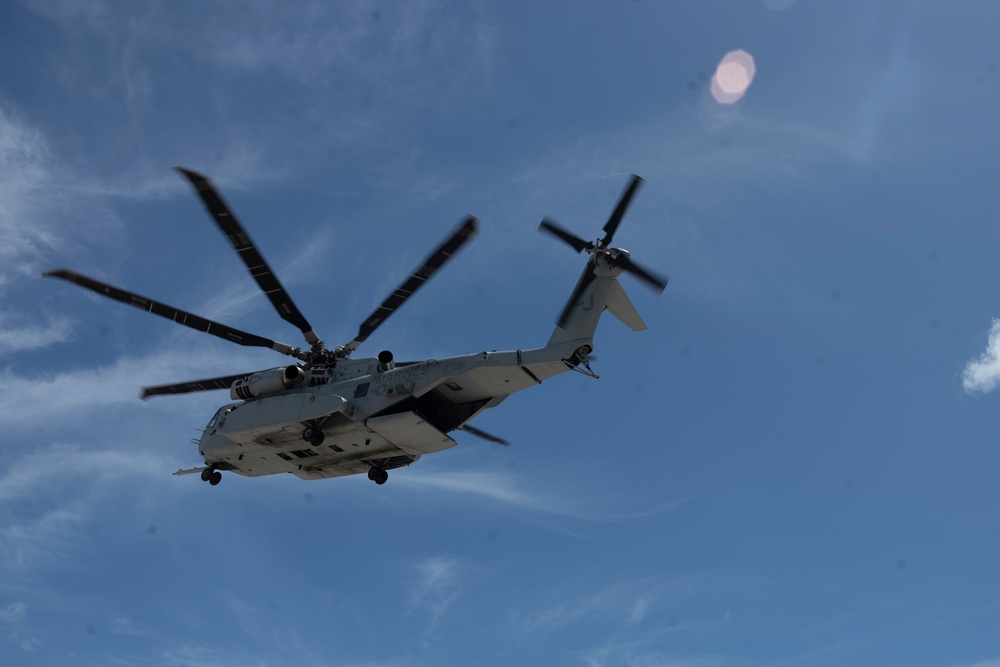
Photo: Cpl. Mya Seymour, U.S. Marine Corps / 2nd Marine Aircraft Wing. DVIDS 9231038. Public domain.
8.2 The Force Design 2030 operating concept
The Marine Littoral Regiment is the formation built around exactly this constraint. The Marines designed the MLR for small, dispersed, expeditionary advanced bases (EABs) in the Pacific island chains under the Expeditionary Advanced Base Operations (EABO) concept. EABs are designed to be the size of a few tactical positions, not a battalion encampment, and to be movable between bases on a timescale shorter than the time the adversary takes to locate and target them. The MADIS section has to be carried into and between EABs by the same lift envelope as everything else the Marines bring with them. The JLTV pair fits that envelope. The Stryker A1 does not.
The cost is real. Two vehicles need two crews, two fuel chains, two maintenance pipelines, two sets of spares. The Marine Corps absorbs that cost because the operating concept (small, dispersed, hard-to-find expeditionary advanced bases under Force Design 2030) is the binding planning assumption. When the Mk1 and Mk2 fight together, the doctrinal payoff is sensor-shooter separation plus survivability. When they fight apart, each vehicle still has its own cannon, its own M240C coaxial, its own Modi II EW suite, its own EO/IR, and its own BLOS C2 interface. The architecture degrades gracefully under combat losses. The single-vehicle Stryker integration does not have that property.
Whether the cost of two vehicles is justified by the survivability gain and the lift gain is a doctrinal judgement that splits the two services. The Marines and the Army both arrived at honest answers to different operational questions. The Marines have made theirs.
9. ISC commentary
The most under-reported aspect of MADIS is that it is genuinely a paired system at the architectural level, not at the marketing level. Many integrated counter-UAS systems sold as “layered” or “networked” really mean a vehicle with a radar bolted to a vehicle with a gun, connected by a tactical radio. MADIS goes further. Both vehicles carry an identical Protector RS6 with the same 30 mm cannon and the same M240C coaxial. Both vehicles can engage the same target. The architectural division is at the longer-range layer (the Stinger and the radar), not at the close-in cannon layer. The result is a section that is materially harder to neutralise with a single kinetic hit than the Army single-vehicle equivalent.
The second under-reported point is the Marine percussion-primer choice. The Army XM914 fires electrically-primed cartridges; the Marine XM914E1 fires percussion-primed cartridges. Same projectile family. Same chamber. Same barrel. Different cartridge case at the primer interface. In a contingency, the two services cannot cross-feed each other’s 30 mm stocks at the cartridge level. The published Army inventory-gap arithmetic (440,000 to 745,000 rounds shortfall against the SGT STOUT fleet’s sustained-rate requirement) covers the Army electric-primed stock only. The USMC MADIS programme draws from a parallel, percussion-primed cartridge line that uses the same projectile-manufacturing tooling but cannot interchange at the cartridge level. The inventory pool effectively splits into two non-interchangeable streams. That is an industrial-base story not captured in the original 5 May 2026 piece on the 30 mm round.
The third under-reported point is the Modi II lineage. The same SNC waveform architecture that defeated radio-controlled IEDs in Iraq and Afghanistan has been re-pointed at small-drone command links. The Thor II / Thor III legacy gives the system the most mature waveform library in US service for the C2-disruption mission, not as a marketing claim but as a verifiable history of operational use against a similar problem class. The C-UAS engineering provenance is a quiet advantage over newer entrants in the market.
10. Open questions and verification paths
Three points where the open-source record is thinner than is ideal for a definitive analytical product. These do not undermine the configuration described above but are worth flagging for editors, analysts, and procurement planners using this article as a reference.
- EO/IR gimbal product attribution, in active transition. The integrated EO/IR on the Protector RS6 has been described variously in open source: Lockheed Martin family in some references, Ascent Vision (Teledyne FLIR) family in others, and as a Kongsberg-integrated sight in the RS6 product literature itself. The sensor function described in this article does not depend on which specific gimbal is fitted, but the current fit is in any event being replaced: USMC Marine Corps Systems Command issued an RFI on SAM.gov on 11 May 2026 for a TRL 8/9 commercially available EO/IR optic for MADIS with the additional capability of laser designation (responses due 3 June 2026). The RFI confirms MADIS is formally designated a Family of Systems (FoS) and signals the visible start of the Increment 2 / next-increment capability path. Definitive current-fit attribution direct from USMC PEO Land Systems or Kongsberg would tighten the historical record; the upgrade path is the more material forward-looking story.
- Per-vehicle 30 mm magazine load. Not published by Northrop Grumman, Kongsberg, Moog, Leonardo DRS, the US Army, or the USMC. The Apache comparator is 300 rounds with the Robertson auxiliary fuel tank fitted (US Army standard). The 250 to 400 round figure that appears in some secondary reporting is plausible but not manufacturer-attested at the time of writing.
- Stinger launcher tube count and product designator, resolved by primary source. Older trade-press summaries (Army Recognition, USNI Proceedings April 2020, and others) describe the Mk1 as carrying a “four-round Stinger pod” or “four-round launch pods”. That descriptor is a propagated misattribution. The Kongsberg Defence US production statement of 10 July 2023 (re-published by Seapower / Navy League) identifies the launcher specifically as the “STINGER Air-To-Air Launcher (ATAL)”, integrated as a kit on the Protector RS6 RWS. ATAL is a Raytheon/RTX product line originally fielded on the AH-64 Apache for the helicopter’s air-to-air Stinger capability and is intrinsically a two-tube launcher. The four-tube SVUL family used on the legacy US Army Avenger is a separate product line and not the launcher fitted on MADIS. Per-vehicle Stinger magazine therefore = 2 tubes on the RS6 ATAL fit + dismount reload Stingers carried in the JLTV cargo bed. This is the article’s working anchor and is verifiable against the Kongsberg statement and the available DVIDS imagery (where the launcher clamp geometry is visible).
- Engagement-time figures. The “single-digit seconds” engagement-chain timing is the ISC editorial inference from the published cyclic rate of the cannon (200 rpm), the typical kinetic engagement of 3 to 5 rounds, the proximity-fuze setup time, and the inter-vehicle link latency. Specific timing under operational conditions has not been published and would require direct LAAD-community sourcing to attribute definitively.
- Vehicle-interior and operator-station imagery. Open-source DVIDS searches at the time of writing did not surface usable imagery of the LAAD Gunner’s in-cab operator station, the RPS-62 radar console, the Modi II control surface, or the fused fire-control display that the Mk2 Gunner watches during an engagement. The vehicle-interior view is consistently outside the camera framing in the available exercise and integration-test photography. Definitive attribution of the console layout, display hierarchy, and operator workflow would need to come direct from USMC Program Executive Office Land Systems or the LAAD-community training pipeline at Twentynine Palms. The functional description of the three-channel fused picture (radar + EO/IR + Modi II) in §2 is sound; the physical console layout that delivers it is not in the open-source record at the resolution useful for a technical article.
11. References & further reading
Schema in brief. Reliability: A completely reliable (primary source, official body, no record of bias); B usually reliable; C fairly reliable; D not usually reliable; E unreliable; F reliability cannot be judged. Accuracy: 1 confirmed by other independent sources; 2 probably true; 3 possibly true; 4 doubtful; 5 improbable; 6 truth cannot be judged.
11.1 Primary US Government / USMC (section tier A-1, item ratings A-1 throughout)
- US Marine Corps COOL — MOS 7212 Low Altitude Air Defense (LAAD) Gunner. [A-1] Official US DoD trade description; confirms unified MOS for radar, EW, C2, and weapon-system operation. cool.osd.mil
- PEO Land Systems / DVIDS, “Rapid Innovation, Real-World Impact: Marines Unveil First Full-Rate Production of MADIS”, 15 December 2025. [A-1] FRP acceptance, training pipeline, “weapon platforms” (plural) language. Direct USMC program office authorship. dvidshub.net
- DVIDS image gallery 8090714 — System Integration Test of the Marine Air Defense Integrated System, Yuma Proving Grounds, 27 September 2023. [A-1] Official US DoD public-domain imagery; Mk1 and Mk2 frames with confirmed metadata. dvidshub.net
- marines.mil, “New air defense system advances Corps’ air dominance”, USMC HQ press release. [A-1] Paired Mk1/Mk2 doctrine and operating concept; official Service-level publication. marines.mil
11.2 Manufacturer technical data (section tier A-2, item ratings A-2 throughout)
- DRS RADA Technologies, Air Defense Radars product family. [A-2] First-party manufacturer product literature. eCHR (RPS-60 / RPS-62 / RPS-64) and aCHR (RPS-600 / RPS-620 / RPS-640) product line; MHR / xMHR family distinction. drsrada.com
- Leonardo DRS, Multi-Mission Hemispheric Radar (MHR) product page. [A-2] First-party manufacturer. Confirms the MHR family contains the legacy RPS-42; separate from the eCHR / aCHR family containing the RPS-62. leonardodrs.com
- Leonardo DRS, Advanced/Enhanced Compact Hemispheric Radar (eCHR / aCHR) product page. [A-2] First-party manufacturer. Current RPS-62 fit on FRP MADIS Mk2. leonardodrs.com
- Northrop Grumman, 30 × 113 mm Bushmaster Chain Guns product page. [A-2] First-party manufacturer. XM914 and XM914E1 designations, M230LF lineage. northropgrumman.com
- Northrop Grumman, Evolution of the M230 Bushmaster Chain Gun. [A-2] First-party manufacturer. Apache lineage; ground-vehicle derivative timeline. northropgrumman.com
- Kongsberg Defence, Protector Remote Weapon Station product family. [A-2] First-party manufacturer. Protector RS6 medium-calibre RWS hosting the XM914E1 + M240C fit on both MADIS Mk1 and Mk2. kongsberg.com
- Kongsberg Defence US, “USMC Preparing for Full Rate Production of MADIS RWS”, Johnstown, Pennsylvania, 10 July 2023, re-published by Seapower Magazine (Navy League of the United States). [A-2] First-party manufacturer production-milestone statement. Authoritative anchor for the launcher product designator: “The KONGSBERG RS6 RWS for MADIS RWS includes the XM914E1 30mmx113mm percussion-primed cannon with a co-axial M240C (7.62mm) machine gun, an integration kit for the STINGER Air-To-Air Launcher (ATAL) and provisions for future C-UAS defeat systems.” Named programme officials: William Dixon (MADIS Project Manager, Kongsberg Protech Systems USA) and Eskild Aas (Director US PROTECTOR Programs). Confirms two-tube ATAL fit, M240C coaxial designator, and the modular future-effector path. seapowermagazine.org
- Sierra Nevada Corporation, Modi II Dismounted ECM press release. [A-2] First-party manufacturer. $73.2M USMC contract for 581 systems; Thor II (AN/PLT-5) and Thor III (AN/PLQ-9) lineage; software-defined ECM architecture configured for man-pack, vehicular, fixed-site and airborne use. sncorp.com
- Sikorsky (Lockheed Martin), CH-53K King Stallion product page. [A-2] First-party manufacturer. Heavy-lift production successor to the CH-53E Super Stallion; external lift capacity, fuel-and-payload envelope, sea-state and high-altitude lift specifications. Primary tactical lifter in the Marine logistical support chain for JLTV-mounted MADIS sections moving inside the First Island Chain. lockheedmartin.com
- DVIDS image asset 9231038 — “U.S. Marines with 2nd DSB execute external lifts with a JLTV”, by Cpl. Mya Seymour, Marine Aircraft Group 29, 2nd Marine Aircraft Wing, Naval Air Station Key West, Florida, 30 July 2025. [A-1] Public-domain operational imagery confirming HMH-461 CH-53K King Stallion conducting external sling-load of a JLTV. dvidshub.net
- DVIDS image asset 4860691 — “CH-53K King Stallion Lifts JLTV”, by LCpl Shannon Doherty, HQMC Communication Directorate, Naval Air Station Patuxent River, Maryland, 18 January 2018. [A-1] Public-domain historical record of the first CH-53K JLTV external-lift capability demonstration. dvidshub.net
11.2a US Government primary procurement sources (item ratings A-1)
- US Department of Defense contract announcement — XM914E1 chain gun IDIQ to Northrop Grumman, 3 June 2021. [A-1] USMC Systems Command awards a five-year IDIQ contract worth up to $81.03 million for delivery of up to 300 XM914E1 30 × 113 mm chain guns, spares, training and associated engineering services to Program Manager Ground-Based Air Defense for the MADIS Increment 1 programme. Work performed in Mesa, Arizona; estimated completion 31 May 2026. Reported via Shephard Media (B-2). shephardmedia.com
- USMC Request for Information — EO/IR Optic for MADIS Family of Systems, 11 May 2026. [A-1] USMC Marine Corps Systems Command RFI on SAM.gov for integration of an Electro-Optical/Infrared optic onto rapidly re-deployable ground and mobile platforms to meet detect, track, identify and laser-designate requirements for MADIS. Target maturity: TRL 8/9 commercially available optics. Threat envelope: Group 1–3 UAS. Operating conditions: all-weather, on the move and at the halt. Response deadline: 3 June 2026. Confirms MADIS as a formally designated “Family of Systems (FoS)” and confirms an active Increment 2 / next-increment capability path. SAM.gov opportunity ID
ba10d13b52d145719bddb74775c165f6. sam.gov
11.3 Trade press & analytical sources (section tier B-2, item ratings vary)
- Paolo Valpolini, “DSEI 2019: Rada, two new radars from Israel”, EDR Magazine, 10 September 2019. [B-2] Specialist defence trade press; figures attributed direct to RADA CEO Dubi Sella, so manufacturer-grade content carried by a B-rated outlet. Manufacturer-published RPS-62 specifications; eCHR / aCHR nomenclature distinction; manufacturer-published detection ranges. edrmagazine.eu
- Breaking Defense, “Eyeing export orders, Northrop unveils counter-UAS Bushmaster M230LF dual-feed gun”, 10 October 2024. [B-2] Established US defence trade press with named editorial standards. Dual-feed introduction context for the SGT STOUT XM914 variant; reinforces the Marine XM914E1 single-feed distinction. breakingdefense.com
- Future Warfare Magazine, “Deliveries of full-rate production MADIS now underway for the USMC’s air defences”, December 2025. [B-3] Specialist defence trade press, less established editorial track record than Tier B-2 publications; rating accordingly. FRP delivery cadence. fw-mag.com
- Defense News, “Drone hunter-killer MADIS vehicles now being produced for Marines”, 16 December 2025. [B-2] Established US defence trade press. FRP acceptance context. defensenews.com
- Army Recognition, “U.S. Marines Field First Production MADIS Mobile Air Defense to Counter Drone and Airborne Threats”, 2025. [B-3] Aggregator-style defence trade press; useful for corroboration but not as a load-bearing primary citation. Production-standard configuration reporting. armyrecognition.com
- Wikipedia, M230 chain gun. [C-2] Tertiary, but used here only for technical specifications that are themselves cited on the Wikipedia page to A-2 manufacturer literature (Meggitt 12-PAK 1,200 rounds, Robertson auxiliary fuel tank 300 rounds, M230LF 200 rpm). Treated as a citation aid, not a primary authority; the underlying manufacturer references are the load-bearing sources. en.wikipedia.org
11.4 ISC Defence Intelligence cross-references (section tier ISC-derived)
- ISC Defence Intelligence, One Vehicle or Two: SGT STOUT, MADIS, and the Counter-Drone Architectural Split, 21 May 2026. [ISC-A-2] ISC publication built on an A-1/A-2 source chain documented in its own AFR. Companion piece on the SGT STOUT vs MADIS architectural divergence. integratedsynergyconsulting.com
- ISC Defence Intelligence, SGT STOUT, MADIS & the 30 mm Counter-Drone Round: XM1211, XM1223 and the Inventory Gap, 5 May 2026 (V3, amended 7 May 2026). [ISC-A-2] Industrial brief on the 30 × 113 mm production base, the 440,000–745,000 round Army inventory gap, and the primer non-interchangeability with the Marine XM914E1 stock. integratedsynergyconsulting.com
- ISC Defence Intelligence, Three 30 mm Drone Killers: AMPV-30 Is Not a Duplicate, 21 May 2026. [ISC-A-2] BAE Systems’ AMPV-30 prototype and the 30 × 173 mm vs 30 × 113 mm calibre distinction. integratedsynergyconsulting.com
- M230 / XM914 Key Specifications Quick Reference (ISC internal reference document). [ISC-A-2] Built on Northrop Grumman A-2 product literature and the Santamaria PdM Maneuver Ammunition Systems briefing (LTC Paul Santamaria, 14 September 2022, PAO# 682-22, Approved for Public Release; A-1). Primary authority on the XM914 / XM914E1 primer and feed-system distinction. Available on request.
Open source / unclassified. AI-assisted analysis. Compiled by Steven Sawyers MIExpE VR, Founder & Defence Consultant, Integrated Synergy Consulting. Contact: [email protected]. Imagery: Wikimedia Commons (US Marine Corps public-domain work) and DVIDS (US DoD public domain). Reference trust ratings (NATO STANAG 2022 Reliability A–F / Accuracy 1–6) are a stipulation of the ISC referencing system and are stated at item level in §11; the per-claim audit trail sits in the Article Facts Report.