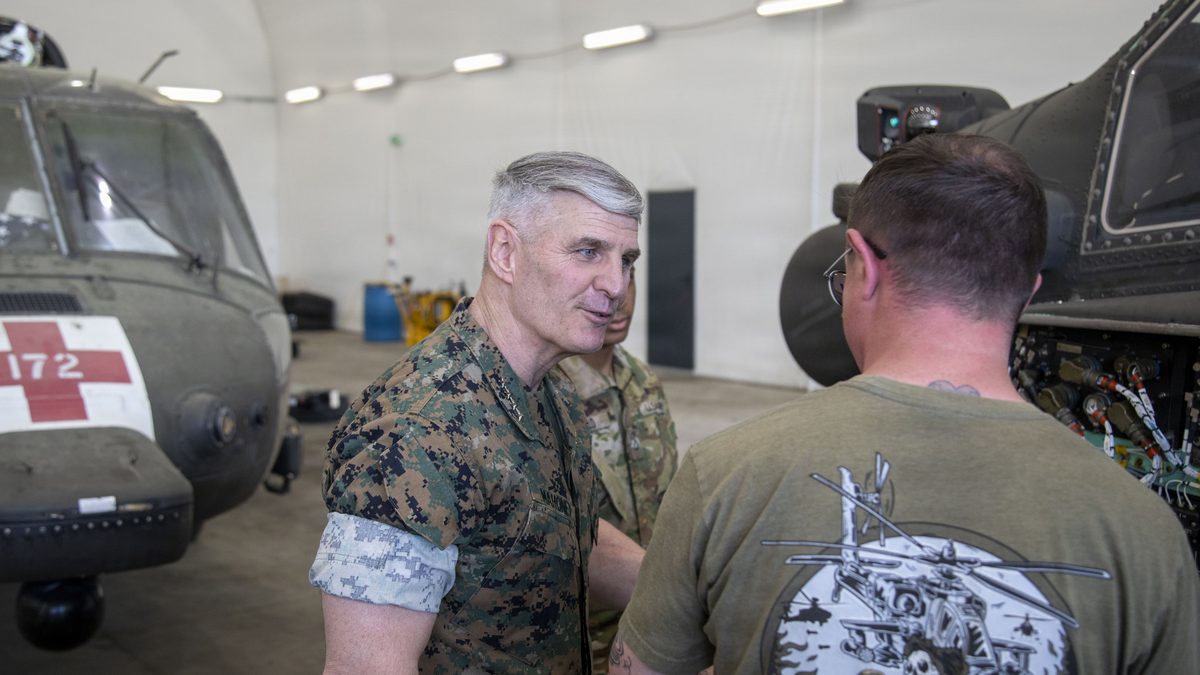
Photo: Staff Sgt. Dean Johnson, US Army, 3rd Combat Aviation Brigade, 3rd Infantry Division. VIRIN 260520-A-BY519-1692. Source: DVIDS (public domain).[15] The appearance of US Department of Defense visual information does not imply or constitute DoD endorsement.
The headline misreads the architecture
Most coverage of Project Asgard leads with the drones. The DART 250 250-kilometre one-way effector, the HX-2 strike drone and the autonomy-on-the-loop debate are the visible parts of the programme, and the press releases organise themselves around them. The figures are real. The British Army’s Chief of the General Staff, General Sir Roly Walker, has said the system compresses the targeting chain from “hours or even days” to “seconds or minutes”, with prototypes already exercised on the eastern flank during NATO Exercise Hedgehog in May 2025 and at corps level on Exercise Arrcade Strike in London this month.[1][2][7]
But the architecture beneath the marketing has a different centre of gravity. In an Asgard-cued engagement the most fundamental decisions (what the contact actually is, whether the engagement is permissible, what the priority order is against three other tracks, what the proportional response looks like) are still made by human aircrew operating multi-spectral sensors that the loitering munitions cannot match. The British Army’s most capable forward intelligence platforms in 2026 are the AH-64E Apache and the F-35 Lightning. The right way to read Asgard, from a Weapons, Ordnance, Munitions and Explosives (WOME) standpoint, is as a network that lets those crewed sensors call effectors at depth, not as a network in which the drones themselves do the seeing.
The programme is also part of a broader Army construct. Asgard sits inside the Forward Land Forces (FLF) framework that organises Britain’s contribution to NATO’s eastern flank, and it is explicitly designated by the Army as a Tactical Recce-Strike Complex: find at range, decide at machine speed, strike before the adversary can move or mass. The initial buy of TrellisWare radios in 2025 went to the 4th Armoured Brigade Combat Team (4 Armd Bde CT, the formation also referred to in MoD material as the 4th Light Brigade), which is the unit that anchors the UK contribution on Operation CABRIT and was the first to run Asgard in the field.
How the kill-web actually works, in plain English
Strip the acronyms for a moment and the architecture is straightforward to describe.
An Apache pilot or an F-35 pilot looks at the world through a stack of sensors at once: a radar that picks targets out of the ground clutter, an electro-optical and infrared camera that gives the pilot a high-resolution moving image, an electronic-warfare receiver that detects the radar emissions of enemy systems, and on the F-35 a 360-degree distributed aperture system that watches the whole sky around the aircraft. The aircraft’s onboard computer combines all of that into a single picture before anything leaves the airframe. When the pilot sees something worth engaging, a tank column, an artillery battery, a radar truck, they classify it. That classification, with its position, its identity, and the pilot’s confidence rating, then leaves the aircraft via Link 16 on the Apache or via MADL on the F-35.
The classified contact now lives on a NATO-wide air picture that every Link 16 participant can see in real time. But the ground force, including the section commander on a ruggedised Samsung handset and the brigade fires cell choosing which weapon to fire, is not on Link 16. It is on the TrellisWare TSM mesh that runs Asgard’s Dismounted Data System. So a translator (a Joint Terminal Attack Controller terminal, a brigade fires cell node, or in future an airborne gateway pod) picks up the air-picture contact and pushes it onto the ground mesh in a format the mesh can carry. That translation step is the load-bearing hop the rest of this article keeps returning to.
Once the contact is on the ground mesh, the AI does the part of the work that humans find slow. Anduril’s Lattice software looks at every contact in the picture and matches it to the available effectors: a 250 km loitering munition like the DART 250, a 100 km strike drone like the HX-2, a 70 km Vulcano artillery round from an RCH 155, or a JAGM missile from the same Apache that spotted the target. Lattice picks the one that best fits the target type, the ground, the priority of the engagement, and the time available. Helsing’s Altra does the same job on a narrower question, identifying and prioritising targets within drone seeker feeds. SitaWare provides the operations-and-intelligence backbone that holds all of it in one shared map.
What the AI does not do is pull the trigger. The Apache crew, the F-35 pilot, the JTAC, or the brigade commander still authorises every lethal engagement. The AI’s job is to compress the time between the contact appearing and the human being ready to authorise. The human’s job is the same as it has been for a century: to be sure of the target, the rules of engagement, the proportionality, and the consequences before the round goes downrange. The pace of the cycle changes; the discrimination authority does not.
That, in plain text, is the kill-web. The rest of this article fills in the technical detail and the WOME implications.
The forward sensors: what Apache and F-35 actually deliver
The British Army holds 50 AH-64E Apache attack helicopters across 3 and 4 Regiments Army Air Corps, recently completed as a fleet transition by Boeing and the Ministry of Defence. Each airframe carries the Longbow fire-control radar, which can detect more than 1,000 targets, classify 256 of them, and prioritise the top 16 in seconds. The Modernized Target Acquisition Designation Sight (M-TADS) gives the crew a stabilised electro-optical and infrared picture at engagement ranges that exceed the round most adversaries can return. The aircraft is Link 16 native: track-quality data is shared in real time with any other Link 16 participant in the battlespace, which on a NATO eastern-flank scenario means RAF Typhoons, E-7 Wedgetail, US fighters, naval air-defence pickets and any Link 16-equipped ground terminal. Manned-Unmanned Teaming at Level 4 lets the Apache crew control a UAS flight path and sensor pointing from the cockpit. The helicopter becomes the brain; the UAS becomes the extended sensor head.[9][10]

The F-35 Lightning, in the F-35B variant the UK already operates and the F-35A variant announced under the 2025 Defence Investment Plan (contract signature not yet at public stage in all reporting), takes that fusion further. The aircraft’s ASQ-242 communications, navigation and identification suite operates six physical link paths simultaneously. The most consequential is the Multifunction Advanced Data Link (MADL), a stealth-friendly directional waveform that lets F-35s share targeting-grade pictures between themselves without surfacing on a non-stealth network. The aircraft’s distributed aperture system, AN/APG-81 active electronically scanned array radar, AN/ASQ-239 electronic warfare suite, and the AAQ-37 EOTS pod are fused on board into a single operator picture before any data leaves the airframe. For deep-target identification at stand-off ranges, the F-35 sees things in classes of detail that no Unmanned Aerial System in the UK inventory matches.[8]
Link 16: the air-domain spine
Both the Apache and the F-35 reach Asgard through Link 16, the NATO Tactical Data Link J standard (STANAG 5516), and understanding what Link 16 is and is not is necessary to read the rest of the architecture honestly. Link 16 operates in the 960–1,215 MHz UHF aeronautical band on a Time Division Multiple Access (TDMA) frame, with frequency-hopping across approximately 51 channels and Class 1 (SECRET-cleared) encryption. Each participating platform carries either a JTIDS (Joint Tactical Information Distribution System) terminal or, on more recent fleets including UK F-35, the MIDS-LVT (Multifunctional Information Distribution System, Low Volume Terminal). Every participant broadcasts a Precise Participant Location and Identification (PPLI) message on its assigned time slots, and that automatic position-broadcast is the mechanism by which the shared NATO air picture is built and continuously updated.[13]
The waveform multiplexes a great deal onto one shared resource. J-series messages cover surveillance tracks (J3), platform and system status (J2), electronic warfare data (J7), engagement coordination (J10), and weapons-quality target updates (J11), and digital voice channels (Voice A and Voice B) ride alongside the data. A NATO fighter, an AWACS, a Type 45 destroyer, a Patriot fire unit, a Wedgetail, and a UK Apache can all see each other on the same picture without explicit handshaking, provided each is in time-slot range of at least one other participant and provided the network has been initialised against the same GPS time reference.
Two characteristics of Link 16 matter for the Asgard story. It is the assumed spine of every contemporary NATO air engagement, so any kill-web that wants to integrate the air domain at all has to start there. But it was designed in the 1980s for cooperative air defence, a few dozen fast jets and an AWACS sharing tracks at a few tens of kilobits per second, not for a corps-level network pushing data to ruggedised Samsung handsets at section level. Time-slot allocation is finite (a J Series Time Slot Block carries roughly 222 bits per slot, with each participant assigned a fixed fraction of the 128-second epoch). Bandwidth is modest by 2026 standards (typical sustained throughput per participant sits between 28.8 and 115.2 kbps). The waveform is line-of-sight, with practical air-to-air range around 300–500 km depending on altitude. Asgard’s Trellisware TSM mesh on the Dismounted Data System sits at a different layer altogether: higher bandwidth, mesh-routed rather than TDMA, optimised for ground-level use, and built around different message structures.
| Property | Link 16 (air-domain spine) | TrellisWare TSM (Asgard DDS backbone) |
|---|---|---|
| Standard | NATO STANAG 5516 / TADIL-J | Proprietary (TrellisWare), exported under ECCN 5A991 |
| Topology | TDMA, fixed time-slot allocation | MANET, mesh, Barrage Relay (non-routing flooding) |
| Sustained throughput per participant | ~28.8–115.2 kbps | 50+ Mbps single-hop (HD video capable) |
| Range (single hop) | ~300–500 km air-to-air, line-of-sight | ~42 km ground (standard); ~330 km long-range mode |
| Frequency band | 960–1,215 MHz UHF aeronautical | Multi-band: L-UHF, U-UHF, L/S-band (225 MHz–2.6 GHz) |
| Multi-hop | Not native (relay via E-3 / E-7 only) | Native, self-forming, self-healing |
| Network scale (single channel) | Constrained by time-slot allocation | 800+ nodes demonstrated flat in a single 1.2 MHz channel |
| Voice | Voice A and Voice B digital channels | Up to 32 dedicated talk groups, low-latency |
| Designed for | Cooperative air defence, 1980s | Dismounted infantry and special operations MANET, 2010s |
| Role in Asgard | Air-domain spine: Apache, F-35, Typhoon, Wedgetail, Type 45, allied air | Tactical-edge backbone: section to brigade, Dismounted Data System |
The TSM contract is also larger than the Asgard prototype buy suggested. The initial procurement of around 800 TSM radios for Project Asgard (mostly the TW-860 Spirit handheld, with some larger TW-950 Shadow and TW-135 models for vehicle and command-post use), identified by Janes, was followed in March 2026 by a TrellisWare press release confirming the British Army had selected the company (via UK partner BlackTree Technologies) to deliver more than 5,000 radios across the 4th Armoured Brigade Combat Team and beyond, under a programme designated Project EXPANSE.[14] The TSM waveform sits alongside an optional Katana NB narrowband waveform for low-data-rate / extended-range conditions, and is the same waveform family the US Special Operations Command and parts of the US Army have used for the better part of a decade. The Barrage Relay technique, on which the network depends, is a patented form of efficient flooding that avoids the routing-table overhead that breaks conventional MANET designs at scale, and explains how TSM holds 800-plus nodes in a single RF channel with sub-second join times and network merge under five seconds.
The choice of TSM over a more conventional NATO tactical waveform was also driven by direct observation from Ukraine. Russian electronic-warfare units have systematically degraded or jammed legacy software-defined radios across the front line since 2022, and the Ukrainian forces that have adapted best are those running mesh waveforms with high frequency-hop counts, low-probability-of-intercept structures, and minimal routing-table footprint. TSM matches that profile. Asgard’s designers state in industry briefings, and Janes has reported, that the Ukraine lessons learned were decisive in selecting TSM as the mesh layer for the British Army’s first network-native brigade.
That mismatch is why the gateway hop matters. The Apache’s Link 16 tracks have to be translated into something the TSM mesh can carry before a section commander’s handset can see them. Today the bridge sits in a Joint Terminal Attack Controller (JTAC) terminal or a brigade fires cell. Northrop Grumman’s Airborne Gateway is the proven MADL-to-Link 16 translator that the RAF demonstrated against Typhoon in 2024, and it is the obvious candidate to bring stealthy F-35 tracks into the Asgard picture at corps level without surfacing them on a non-stealth network.[8] The long-term plan, trailed in industry briefings but not yet published as an architecture, is closer to a dedicated gateway pod that translates at altitude rather than at the JTAC terminal.
The six layers in one diagram
Why the drones are the carriers, not the seers
The DART 250 (Modini, UK, 250 km range, 85 kg, GT500 turbojet) and the HX-2 (Helsing, software-defined, up to 100 km range) are real capabilities, and they will be expended in volume. But they sit at a specific point in the kill-web, and not the one the press narrative implies. They are neither the primary sensor nor the primary discriminator. In plain language they do two things.
First, they are effectors called by the forward platforms once a target has been seen, classified and prioritised. Apache or F-35 develops the track. Helsing’s Altra software or Anduril’s Lattice command-and-control layer routes the call. A DART 250, an HX-2, a 155 mm Vulcano round, or a JAGM from the same Apache is then prosecuted at depth, at range, or in volume, whichever the algorithm has weighed best against the trade between cost, time and survivability.
Second, they are forward sensor-extensions pushed into airspace where the crewed platform should not persist: into active integrated air-defence coverage, against a deception-rich background, or for last-mile confirmation of a hand-off target. In that role the drone is the carrier of the crewed force’s eyes rather than a substitute for them.
This is not a marginal point and it matters for ordnance planning. A one-way attack drone is, by design, a single-pass platform optimised for terminal flight. Its onboard sensor suite is built for last-mile guidance, not for the persistent multi-spectral fusion that an Apache crew or an F-35 pilot brings to the same airspace. The HX-2 has a richer sensor return because Altra does autonomous target detection and identification from the seeker feed, and Helsing has trialled the system with UK forces in Kenya during 2025, but the seeker is still a single-modality camera operating at low altitude, vulnerable to obscuration, weather, deception, camouflage and concealment in ways that the Apache’s M-TADS and the F-35’s fused picture are not.[12] Loitering munitions can be cued where helicopters and fast jets cannot go, massed where crewed platforms cannot be massed, and lost when the operator cannot be. Those are real advantages and they explain why an open-source-reported procurement tranche of DART 250 rounds (industry reporting puts the figure at around 400 rounds against a contract value of roughly £7.5 million; exact volumes are not officially confirmed) has been pushed to the Op CABRIT Task Force in Estonia. They do not mean the drones see better. They see less well, more briefly, and through a narrower aperture.[5]
The sensor-versus-carrier matrix
| Capability | AH-64E Apache | F-35 Lightning | HX-2 | DART 250 |
|---|---|---|---|---|
| Role in kill-web | Primary forward sensor + effector | Primary deep sensor + effector | Brigade-level cued effector / forward sensor-extension | Deep-strike effector called by sensors |
| Sensor fidelity | Longbow radar; M-TADS EO/IR; 1,000+ targets, 256 classified, top 16 prioritised | Fused AESA + DAS + EOTS + ASQ-239 EW: single integrated picture | Single-modality EO seeker; AI-aided ID via Altra | Terminal-flight seeker only |
| Persistence | Multi-hour station holding | Multi-hour, stand-off | Minutes-to-an-hour loiter | Single pass: no persistence |
| Discrimination authority | Aircrew on board, in real time | Pilot on board, in real time | Operator on the loop with AI cue | Operator on the loop with AI cue |
| Battle damage assessment | Returns and re-observes | Returns and re-observes | Partial: if it survives | None: expended on target |
| Data link | Link 16 native | MADL + Link 16 (Block 4 Tx expanding) | TSM via Lattice | Onboard INS: GPS-denied tolerant |
| Cost class | Tens of millions per airframe | Tens of millions per airframe | Mid five-figure to low six-figure per round (est.) | Mid five-figure per round (est.) |
Before Asgard it might take hours or even days. Now it takes seconds or minutes to complete the digital targeting chain. Project Asgard proves we can do things differently.
— General Sir Roly Walker, Chief of the General Staff, July 2025[1]WOME implications
1. Stockpile arithmetic at the effector end
A reported DART 250 tranche of the order of 400 rounds in-theatre, plus a brigade-level HX-2 buy, plus the JAGM rounds drawn from the Apache magazine, plus 155 mm Vulcano-class precision rounds for the RCH 155 fleet (72 ordered, KNDS, May 2026), aggregates into a meaningful explosive storage problem that no single source presents in one picture. The DART 250 warhead Net Explosive Quantity is not in the open-source record, and is the single most important DATA GAP the WOME community needs closed before a Field Ammunition Storage Area footprint for an Asgard-enabled formation can be calculated under DSA 03.OME. The precise procurement volumes themselves are a secondary DATA GAP that constrains the planning assumption.
2. Insensitive Munitions compliance
Any munition designed for forward storage under threat of indirect fire must meet STANAG 4439 Insensitive Munitions criteria, with energetic fill qualified under AOP-7 Edition 3. Neither the DART 250 warhead nor the HX-2 payload has a public IM signature. The JAGM warhead and the 155 mm Vulcano family are AOP-7 qualified through their parent programmes, but the new loitering effectors are not yet on the same public record.
3. Residual ordnance and ERW liability
Recce-strike at 250 km depth produces a deep-area unexploded ordnance liability that NATO doctrine does not yet handle well. A DART 250 with a fuze malfunction or a graze impact becomes Abandoned Explosive Ordnance in territory the firing force may never physically recover. Article 4 of CCW Protocol V places that Explosive Remnants of War clearance obligation on the eventual controlling authority. Loitering-munition reliability figures are not in the public domain; even a 2–3 per cent dud rate across a brigade buy aggregates into a sizeable post-conflict clearance commitment for which neither the UK nor the host nation has yet costed a position.
4. Aircrew competence on algorithm-cued tracks
This is the implication that follows directly from putting the crewed force at the front of the kill-web. If the Apache crew and the F-35 pilot are the discriminators, the trigger-pull authority on an algorithm-nominated track sits with them and not with a remote operator looking at a seeker feed. That changes the training pipeline, the standing operating procedures, and the rules of engagement card the aircrew carries. The Defence Doctrine note that codifies this, in whatever form it eventually takes, has not been published. Neither AQAP-2110 (the workhorse Allied Quality Assurance Publication for production and design) nor the AC/326 ammunition safety regime currently incorporates machine-recommended targeting into its competence model. That is a gap in the standards architecture, not in the airframe.
5. The autonomy boundary
UK Stop Killer Robots filed a formal objection in September 2025 noting that statements by senior officials had at the same time conceded the system was “technically capable of running without human oversight,” and that the absence of any agreed legal definition of meaningful human control (the term was coined by NGO Article 36) meant the policy boundary was being held by convention rather than by regulation.[8b] Reading Asgard as a crewed-led architecture sharpens the answer to that objection: the human is not just on the loop, the human is the loop, because the crewed sensor is what makes the engagement permissible. That is a stronger ethical position than the one the press narrative implies.
What to watch next
The British Army has trailed a second corps-level Asgard iteration for the second half of 2026, scaling autonomy deeper into the detection-and-identification chain while keeping human authority on the engagement decision. The procurement signals to track at the next Defence and Security Equipment International cycle in September 2026 are the published technical data sheets for the DART 250 warhead and HX-2 payload variants, and the gateway architecture that takes F-35 MADL and Apache Link 16 tracks into the Asgard land backbone without ad-hoc JTAC bridging. Watch in parallel for an MoD policy line refresh on the autonomy boundary in response to Article 36 and Stop Killer Robots.
For NATO planners on the eastern flank, the binding constraint moves with the architecture. If the press reading is right and the drones do the seeing, the constraint is autonomous-target-recognition reliability. If the architectural reading in this article is right and the crewed force does the seeing, the constraint is Apache and F-35 availability, aircrew training throughput, and the depth of the magazine that feeds the effectors the crewed force calls. The second framing is the harder one because it forces the resourcing conversation back onto airframes, pilots, and 155 mm rounds rather than onto software releases. It is also the more honest one.
One more point follows from the architecture. Compressed engagement cycles do not reduce the demand on the human in the chain. They raise it. Every round expended at machine speed depends on a crewed sensor having got the identification, the rules-of-engagement check, and the proportionality call right on the first pass, because there is no opportunity to do any of them twice. That is a training-pipeline and aircrew-throughput problem, not a software problem, and it is the part of the Asgard story the marketing material consistently underplays.
References
- UK Ministry of Defence press release, “Fundamental lethality shift for British Army spearheaded by novel targeting tech Asgard,” July 2025. gov.uk
- UK Defence Journal, “Army to test ASGARD digital strike network at corps level,” May 2026. ukdefencejournal.org.uk
- Defence-Industry.eu, “Helsing involved in British Army’s ASGARD project to improve targeting and battlefield effectiveness,” 2025. defence-industry.eu
- British Army, “New technology unveiled that will increase British Army lethality,” 2025. army.mod.uk
- Militarnyi, “British Modini introduced a Dart 250EW jet drone to destroy electronic warfare systems,” 2026. militarnyi.com
- The Register, “British Army rolls out £86M AI-ready battlefield gear,” 10 February 2026. theregister.com
- Forces News, “Project Asgard: The targeting technology driving a shift in lethality for British Army.” forcesnews.com
- UK Defence Journal, “RAF demonstrate Multifunction Advanced Data Link interoperability between F-35B and Typhoon,” 2024; Wikipedia, “Lockheed Martin F-35 Lightning II” (ASQ-242 / MADL reference). ukdefencejournal.org.uk
- UK Stop Killer Robots, “UK crossing the line as it implements use of AI for lethal targeting under Project Asgard,” 4 September 2025. ukstopkillerrobots.org.uk
- Vertical Magazine, “Inside the British Army’s cutting-edge AH-64E Apache fleet.” verticalmag.com
- Royal United Services Institute, “A Rebirth for the British Army’s Apache Fleet.” rusi.org
- Future Warfare Magazine, “The British Army tests the Helsing HX-2 in Kenya,” 2025. fw-mag.com
- NATO Standardization Office, “STANAG 5516, Tactical Data Exchange (Link 16)”; US DoD MIL-STD-6016F Tactical Data Link J Standard; NATO Communications and Information Agency public guidance on Link 16 / MIDS-LVT. nso.nato.int
- TrellisWare Technologies press release, “UK Ministry of Defense Selects TrellisWare Technologies, Leading Waveform Developer To Deliver More Than 5,000 Radios,” 20 March 2026 (Project EXPANSE, 4th Light Brigade); TrellisWare TSM Waveform Datasheet, 2023; Janes, “British Army purchased around 800 TrellisWare Technologies TSM waveform radios for Project Asgard.” trellisware.com · datasheet (PDF)
- DVIDS asset image:9702460 (VIRIN 260520-A-BY519-1692), “Vice Chairman of the Joint Chiefs of Staff visits rotational V Corps unit in Poland,” photographer Staff Sgt. Dean Johnson, 3rd Combat Aviation Brigade, 3rd Infantry Division, published 20 May 2026. Public domain (17 USC sec.105). Reused under editorial use with DoD non-endorsement disclaimer. dvidshub.net/image/9702460
- DVIDS asset image:9674268 (VIRIN 260509-M-JE159-1345), “MCAS Cherry Point celebrates America’s 250 years of legacy,” photographer Chief Warrant Officer Akeel Austin, Marine Corps Air Station Cherry Point, published 9 May 2026. Public domain (17 USC sec.105). Reused under editorial use with DoD non-endorsement disclaimer. dvidshub.net/image/9674268
ISC commentary
The Asgard story is being told around the unmanned end of the chain because the unmanned end is photogenic. Headline figures (250 km, AI-cued, autonomous targeting) move political and budget conversations. The operational reality, on the eastern-flank scenario the Army is exercising against, is that the kill-web works because Apache crews and F-35 pilots are looking at the target before the algorithm cues the effector. Strip out the crewed sensors and Asgard becomes a sophisticated routing system for guesses. The WOME community should plan accordingly. Stockpile, IM and ERW questions matter because the effectors are real and will be expended in volume. Aircrew competence on algorithm-cued tracks matters because that aircrew is still the discriminator. Both are old-fashioned ordnance-discipline problems wearing new clothes.