BAE Systems handed the US Army’s 1st Cavalry Division two prototype counter-drone vehicles at the end of April 2026, and the standard analyst response was to ask why. The US Army already fields one 30 mm counter-drone system, SGT STOUT, the M-SHORAD Increment 1 on the Stryker A1 with the electrically-primed dual-feed XM914 cannon on a Moog RIwP mount. The US Marine Corps fields the other, MADIS, a JLTV pair: the Mk1 carries the percussion-primed single-feed XM914E1 on a Kongsberg Protector RS6 RWS together with a four-round Stinger pod, and the Mk2 carries the RPS-42 S-band radar, Modi II EW suite, and an M134 Minigun for self-defence with no 30 mm cannon. Both services fire the same XM1211 / XM1223 / XM1225 projectile family from M230LF-lineage cannons, although the Army electric primer and the Marine percussion primer make the cartridges non-interchangeable. Both systems are in production. So why does the US military need a third 30 mm drone killer, and why does the Army in particular need a second one when MADIS, sitting on the other side of the joint-force line, is still being fielded?
The short answer is that “three 30 mm drone killers” is a misleading way to count. BAE’s AMPV-30 fires a 30 mm round, yes, but not the same 30 mm round. The cartridge is different, the cannon is different, the radar is different, the chassis is different, and the doctrinal slot the vehicle is built to occupy is different. The first two systems sit in the Army and Marine Corps air-defence orders of battle as outer-layer protection for the formation. The AMPV-30 is something else: organic close-in counter-UAS protection sitting inside the maneuver companies themselves. It complements SGT STOUT; it does not replace it.
This piece walks the AMPV-30 in detail: what BAE actually delivered, what it actually carries, and how it differs from SGT STOUT in calibre, radar, chassis and distribution. It then turns to the procurement-model story: a self-funded prototype delivered in ten months under Defense Secretary Pete Hegseth’s wartime-footing challenge, evaluated under General Randy George’s Transformation in Contact 2.0 initiative, with no programme of record and no Army-stated requirement. And it closes with the question that matters for industrial-base planners: if all three systems survive the procurement gauntlet, what does the resulting counter-UAS layer actually look like, and what does it cost?
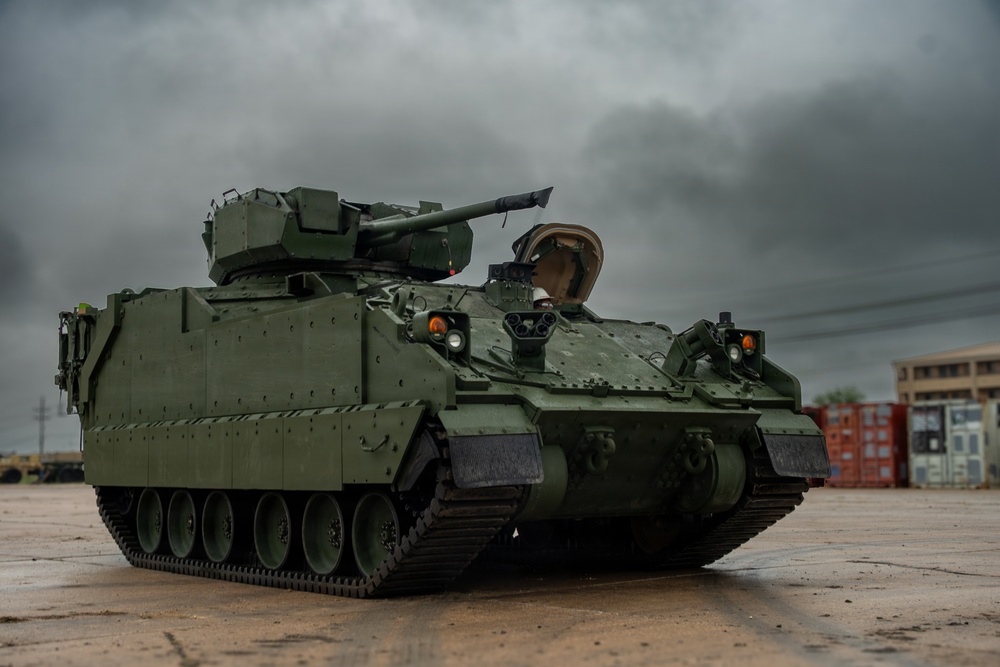
Photo: SPC Michelle Lessard-Terry, 1st Cavalry Division. DVIDS 9651156. U.S. Army public domain.
- 30 × 113 mm B, the shorter round. Fired by the M230 chain gun on AH-64 Apache and by the M230LF family on ground platforms: the XM914 (electric primer, dual-feed) on SGT STOUT and the XM914E1 (percussion primer, single-feed) on MADIS Mk1. Proximity-fuzed XM1211 HEP, XM1223 MMPA and XM1225 APEX are this family. Muzzle velocity in the 800–850 m/s band; effective range against UAS to roughly 2 to 3 kilometres. The Army and Marine variants are not ammunition-interchangeable.
- 30 × 173 mm, the longer round. Fired by the Mk 44 Bushmaster II (US Army designation XM813) on the Stryker Dragoon M1296 and now on the AMPV-30. Programmable-airburst Mk 310 HEAB-T (High Explosive Air Burst – Tracer, also designated PABM-T) is this family. Muzzle velocity ~1,080–1,090 m/s; effective range against small UAS in the 3 to 5+ kilometre band.
Two NATO 30 mm rounds. Same calibre designation. Different cartridge case, different propellant volume, different chamber pressure, different fuze technology, different production line. When this article refers to “the 30 mm” round on a given system, the calibre that matters is the one with three digits in front of the “mm”.
1. What BAE actually delivered
The 1st Cavalry Division at Fort Hood, Texas, received two AMPV-30 prototypes from BAE Systems on or around 30 April 2026, the date stamp on the DVIDS imagery first published by the division’s public-affairs detachment. William Sheehy, BAE’s Vice President of Ground Maneuver Platforms, confirmed the delivery in a social-media post, stating that the company had identified the gap, organised its own resources and built two vehicles in ten months without waiting for a government contract to fund the work. Ten months from concept to soldiers’ hands compares with five or more years for a standard Major Defense Acquisition Programme.
The Army’s response was careful. A spokesperson told The War Zone that the AMPV-30 was “an internal research and development type effort from BAE Systems” and that the vehicles were “not something the Army procured, nor is there a requirement for the system at this time.” That distinction matters. Social-media posts from the 1st Cavalry Division had already prompted widespread reporting suggesting the Army had fielded a new AMPV variant, which is not the case. What the Army has done is evaluate a company-funded prototype against an articulated capability problem, which is what Transformation in Contact 2.0 was designed to enable.
The Transformation in Contact initiative, originally driven by General Randy George as Chief of Staff of the Army, was deliberately structured to break the conventional acquisition cycle. Prototypes are placed directly with operational units, evaluated in a field environment over weeks or months, and either matured into requirements or discarded. The first version of the programme focused on light brigade combat teams, including the 101st Airborne and the 25th Infantry Division; Transformation in Contact 2.0 expanded the model to armoured and divisional formations, with the 1st Cavalry Division’s 1st and 2nd Armored Brigade Combat Teams confirmed as participants. The funding ask attached to the 2.0 expansion is in the order of $1 billion. BAE built the AMPV-30 specifically as a candidate for that evaluation pipeline.
The Defense Secretary’s contribution to the timeline matters too. Pete Hegseth had publicly challenged the defence industry to operate on a wartime footing and to bring solutions to current battlefield threats rather than wait for the next acquisition cycle. BAE’s self-funded ten-month delivery is, on its own terms, an industrial answer to that challenge. Whether the Army responds with a programme of record is a separate question, which the Army has so far declined to answer.
2. What the AMPV-30 actually carries
The vehicle’s host chassis is the standard BAE Armored Multi-Purpose Vehicle, the tracked replacement for the M113 family that has been in service across Armored Brigade Combat Teams since the early 1960s. BAE won the AMPV competition in 2014 under a $383 m engineering and manufacturing development contract; the full-rate production contract was awarded in 2023 at approximately $797 m; the programme of record is roughly 3,000 vehicles to replace the M113 fleet across ABCTs over the late 2020s and early 2030s. Five baseline variants are in production: general purpose transport, mortar carrier, mission command, medical evacuation, and medical treatment. None of those baseline variants carries a weapon heavier than a vehicle-mounted machine gun. The AMPV-30 represents a fundamentally different role for the chassis: an active counter-UAS effector sitting in a column previously composed of support variants.
The turret bolted onto the AMPV-30 is the Kongsberg MCT-30, the Medium Caliber Turret in the 30 mm family from the Norwegian remote-weapons specialist. The MCT-30 is the same turret family the US Army already fields on the Stryker Dragoon (M1296), the 30 mm infantry carrier variant of the Stryker that has been operating with the 2nd Cavalry Regiment at Vilseck, Germany, since late 2017. The MCT-30 houses the Northrop Grumman Mk 44 Bushmaster II autocannon, designated XM813 Linkless Autocannon in the form Project Manager Maneuver Ammunition Systems briefed publicly in September 2022. This is a 30 × 173 mm chain gun, the larger of the two 30 mm cartridges in widespread Western service: NATO 30 × 173 mm, not the 30 × 113 mm of the M230LF / XM914 family.
That cartridge distinction is the single most important technical fact in this entire piece, and the one most often glossed over in the “the Army already has SGT STOUT” objection. The 30 × 173 mm is a longer, heavier, more energetic round. Effective range against UAS is materially longer; terminal effects are heavier; the round is more capable against the upper end of Group 3 UAS and into loitering-munition-class threats. The 30 × 113 mm XM914 on SGT STOUT, by contrast, was chosen because the M230LF derivative is light enough to share a remote weapons station with a four-round Stinger pod and an EO/IR ball on a Stryker A1 turret. Range and energy were traded for compactness and dual-effector integration. Both choices are valid, but they are not interchangeable.
The kinetic round of choice on the AMPV-30 is the Mk 310 HEAB-T (High Explosive Air Burst – Tracer, also designated Mk 310 PABM-T), produced by Northrop Grumman and by General Dynamics Ordnance and Tactical Systems (GD-OTS). The round is a 30 × 173 mm cartridge with a typical loaded mass in the 670–860 g band, a projectile mass of roughly 365–388 g, a muzzle velocity around 1,080–1,090 m/s, and a chamber pressure on the order of 345 MPa, substantially more energetic than anything in the 30 × 113 mm XM1211 / XM1223 / XM1225 family. The terminal effect against a small UAS is similar in outcome to the proximity-airburst behaviour of the XM1211 on SGT STOUT, but the mechanism is quite different.
The XM1211 carries a self-contained radio-frequency proximity fuze that detects the target’s return inside the round itself, runs onboard clutter-discrimination algorithms, and initiates the warhead at the optimum miss distance. The Mk 310 does none of that. It carries a programmable electronic time-of-flight fuze set externally by the gun’s fire-control system. The MCT-30’s muzzle-velocity radar measures each round as it leaves the barrel; the fire-control computer calculates the time-of-flight to the desired burst point in front of the target; inductive coils at the muzzle write that time onto the round’s fuze in flight. On command, the fuze ejects a cone of sub-projectiles in the desired direction. The MCT-30’s fire-control offers three programmable modes (airburst, point-detonate, and point-detonate-delay) plus a “String of Pearls” multi-burst option that walks several airburst events along the trajectory.
For the counter-UAS mission the practical consequence is a longer effective engagement range against small drones (the 3 to 5+ kilometre band in benign atmospheric conditions, against the 2 to 3 km band typical of the 30 × 113 mm XM1211 envelope), with materially more terminal-effect margin against the upper end of Group 3 UAS and into Shahed-class loitering-munition territory. Same airburst principle, different physics, different range envelope.
The industrial-base footing matters as much as the ballistics. The Mk 310 family is documented publicly in the GD-OTS 30 × 173 mm Ammunition Suite pamphlet (2016, still the most authoritative open-source technical reference for the round), and the production line that supplies the Mk 310 is the same line that supplies the rest of the 30 × 173 mm family the Stryker Dragoon has been consuming since 2018. Adding AMPV-30 to that production base scales an existing line. It does not stand up a new one.
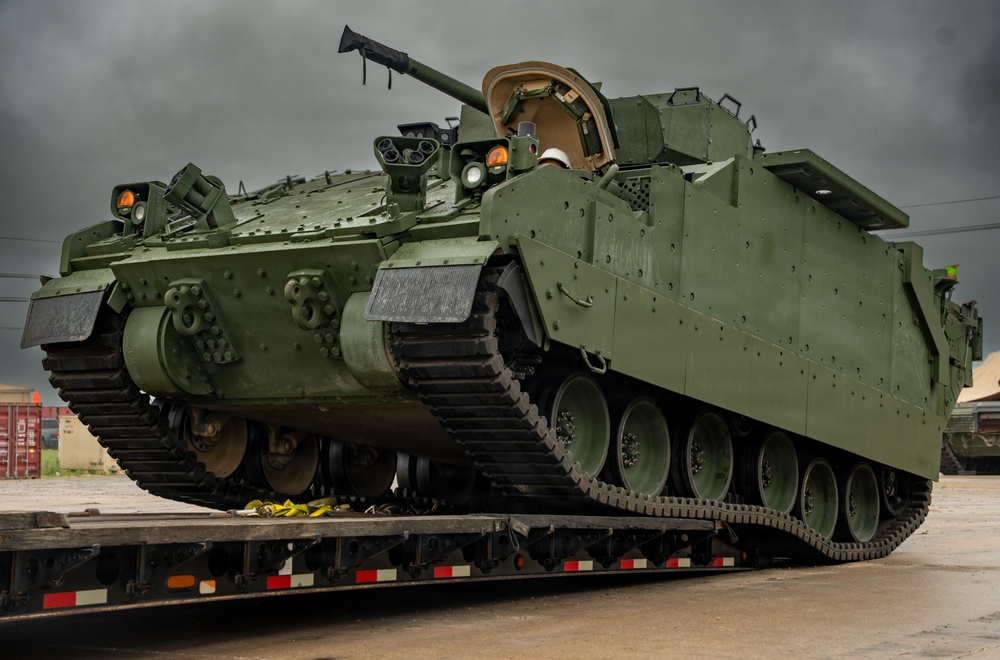
Photo: SPC Michelle Lessard-Terry, 1st Cavalry Division. DVIDS 9651153. U.S. Army public domain.
The detection layer comes from Echodyne’s EchoShield, a Ku-band electronically scanned array (ESA) radar with what the company calls a “cognitive” software-defined operating mode. EchoShield is materially smaller and lighter than the four-panel RPS-42 / Multi-Mission Hemispheric Radar architecture used on MADIS Mk2 and SGT STOUT respectively. It fits inside the AMPV-30 superstructure without a tall external mast, trading the longer-range hemispheric coverage of the S-band four-panel solution for compactness, electrical-power efficiency, and the ability to be re-tasked between radar modes in software rather than firmware. In a C-UAS mission set it emphasises short-range drone detection close to the ground and along the horizon, with the ability to track hundreds of airborne objects simultaneously and cue the turret’s EO/IR sensor for terminal classification. The Army does not yet appear to have an EchoShield-specific contract on the public record; a $490 m IDIQ frequently cited in the trade press is the US Air Force’s SUADS contract under Trust Automation (August 2025), not an Army programme.
Crew is two, sharing a common crew station inside the AMPV hull, one fewer than SGT STOUT and four fewer than a complete MADIS pair, although both of those numbers reflect different operational concepts rather than crew-workload comparisons. The two-Soldier crew assesses the operability of a vehicle that is intended to operate as one variant within an ABCT’s broader fleet, not as a stand-alone air-defence asset. That distinction shapes everything that follows.
3. Why the 30 × 173 mm choice is not duplication
The case for the AMPV-30 rests on three propositions. None of them are obvious from the outside, and none of them survive being conflated with the SGT STOUT story.
3.1 Different round, different industrial base, different ballistics
The 30 × 113 mm XM914 and the 30 × 173 mm Mk 44 Bushmaster II share a calibre designation and very little else. Cartridge case length differs by sixty millimetres. Propellant volume differs accordingly. Muzzle energy, range, and terminal effect against a given target are all materially higher for the larger round. The ammunition production base is also entirely separate. The XM914 line consumes XM1211, XM1198, XM1223 and XM1225 cartridges produced by Northrop Grumman on a 30 × 113 mm tooling base. The Mk 44 line consumes Mk 310 PABM, Mk 258 APFSDS-T, and a wider European-NATO 30 × 173 mm family that includes Rheinmetall AHEAD and the Skyranger 30 cartridges. The two ammunition pools cannot be cross-fed at the round level.
From an industrial-policy perspective that distinction cuts both ways. On the cost side it means two separate production lines, two separate spares chains, two separate qualification programmes inside the Army’s logistics network. On the resilience side it means two separate single-source vulnerabilities are de-risked: a disruption to the Northrop Grumman 30 × 113 mm line (whether from a critical-materials shortage, a Holston Army Ammunition Plant energetics issue, or an L3Harris proximity-fuze bottleneck) does not stop the Army’s 30 × 173 mm Mk 310 deliveries. Diversification has a cost, but it also has a real strategic value in a contested-supply environment, and the Army does not appear to have argued the point publicly either way.
3.2 The 30 × 173 mm is already in Army service
The Stryker Dragoon (M1296) entered service with the 2nd Cavalry Regiment in Vilseck, Germany, in late 2017, and has been operating across additional Stryker Brigade Combat Teams since. The Dragoon is an Stryker Infantry Carrier Vehicle re-roled with the same MCT-30 turret and the same Mk 44 Bushmaster II 30 × 173 mm chain gun that BAE has now bolted onto the AMPV-30. The Army has spent the last seven years training crews on the round, qualifying the ammunition under safe-storage and transport rules, fielding the production base, and building the spares network. AMPV-30 is therefore not introducing a new cartridge into the Army’s logistics chain; it is putting an existing Army cartridge on a different host. That changes the cost calculus.
What AMPV-30 adds is the counter-UAS variant of a round that is already in service for an anti-light-armour role on the Dragoon. The Mk 310 PABM does not have to be a new development; it is a 30 × 173 mm airburst evolution of the existing family. The Army does have to procure Mk 310 specifically (the public position on stock levels is unclear), but the round is built on a production line the Army has already qualified for the Dragoon. That gap is materially smaller than the gap between the Army today and a brand-new cartridge.
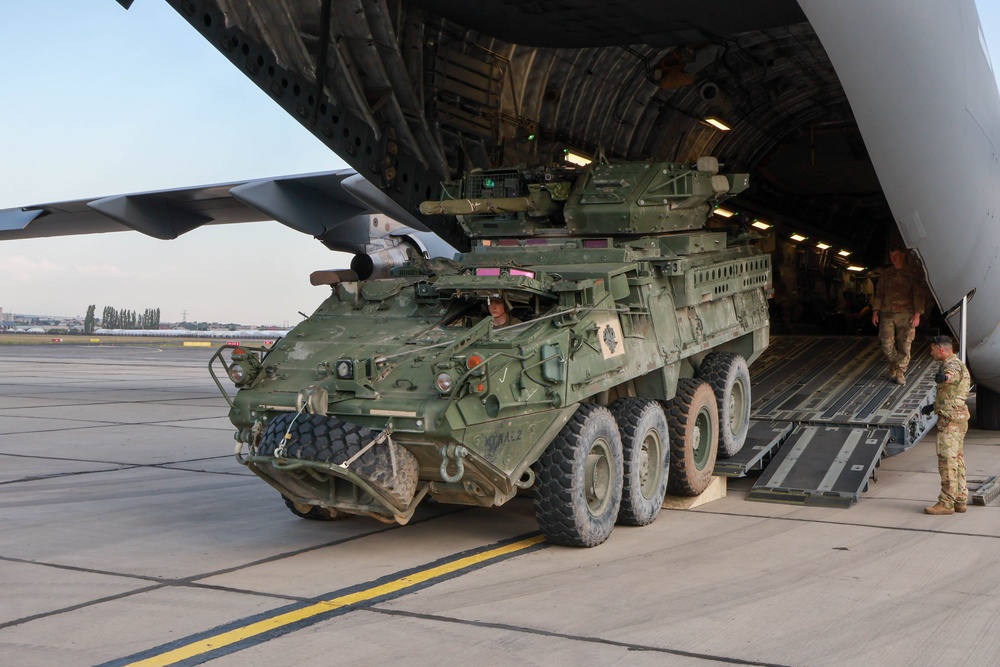
Photo: CPT Vira Miller, 22nd Mobile Public Affairs Detachment. DVIDS 8536237. U.S. Army public domain.
3.3 Different chassis, different distribution model
The platform under SGT STOUT is the Stryker A1, a wheeled infantry carrier with Double-V Hull protection. Inside an Armored Brigade Combat Team, SGT STOUT does not sit alongside the Bradley M2A4 and the M1A2 SEPv3; it sits within the ADA battalion, deployed forward by the brigade fires cell when the air picture demands it. Two hundred and thirty SGT STOUT systems across the entire US Army cannot cover every armoured battalion in every brigade, let alone every maneuver company. The protection is real but the distribution is sparse.
The AMPV is a tracked vehicle from the same M113-replacement family that already populates the ABCT’s support echelon. Every ABCT receives AMPVs by default under the 3,000-vehicle programme of record. If BAE’s AMPV-30 becomes a sixth variant alongside the existing five, an ABCT could field counter-UAS protection inside every maneuver company, in the same column as the Bradleys, with the same speed, with the same protection, sharing the same fuel and the same mechanic. That changes the doctrinal problem the system is trying to solve.
What SGT STOUT cannot do, the AMPV-30 might. SGT STOUT engages threats the brigade air-defence cell hands it. AMPV-30 engages threats the company already sees. The two systems operate at different levels of the same ABCT’s kill chain. A company commander faced with an FPV drone bearing in on a Bradley platoon at fifteen hundred metres does not have time to call the brigade fires cell, request a SGT STOUT detachment, wait for it to deploy, and watch it engage. The AMPV-30 sitting two vehicles back in the same column does have time.
4. The doctrinal gap, in operational terms
The fight that produced the AMPV-30 is happening in Ukraine, and to a lesser extent in the Red Sea and the Levant. Russian and Ukrainian forces have spent three years discovering what a sub-thousand-dollar quadrotor with a forty-millimetre grenade strapped to it can do to a five-million-dollar tank, and to the unprotected infantry around it. The Ukrainian solution has been distributed: thousands of small electronic-warfare emitters, dedicated counter-UAS teams at company and platoon level, and an emerging family of small kinetic effectors built around 12.7 mm and 14.5 mm heavy machine guns with proximity-fuzed rounds. The Russian solution has been similar in shape if less effective in execution. Neither side has solved the problem at the outer-layer ADA level, because the threat does not operate at that level.
The US Army has watched this carefully. SGT STOUT was designed before the Ukrainian FPV-drone problem hit its current scale; it is optimised for the Shahed-class and Group 3 UAS threat at 2–5 km. The MADIS pair is engineered with the same threat envelope in mind for the USMC. Both systems give the formation a credible answer to the heavier end of the C-UAS spectrum. Neither system, in its current numbers and distribution, can put a counter-FPV effector inside every armoured company across every ABCT in the US Army. There are simply not enough of them.
An AMPV-30 at the company level closes that distribution gap. The 30 × 173 mm Mk 44 firing Mk 310 PABM has effective range against small UAS out to at least three or four kilometres in a benign atmosphere, with terminal-effects margin against the larger Group 3 threats the FPV class is starting to merge with. The EchoShield radar gives the vehicle local situational awareness without requiring brigade-level cueing. The two-Soldier crew can operate the turret while the AMPV-30 moves with its parent company, in the same column as the Bradleys and Abrams the company is built around.
The operational problem here is not the one SGT STOUT solves. The Stryker-based system answers the question of what defends the BCT from heavier aerial threats while the BCT manoeuvres. The AMPV-30 answers the question of what defends the maneuver company from the cheap, proliferated, close-in aerial threats the BCT-level system cannot be in every place to engage. Both questions are real, and both answers may be worth funding.
5. EchoShield and the cognitive-radar approach
Echodyne’s EchoShield deserves a section on its own because the radar paradigm matters as much as the cannon. The four-panel RPS-42 / Multi-Mission Hemispheric Radar architecture on MADIS Mk2 and SGT STOUT is an S-band pulse-Doppler system optimised for longer-range hemispheric surveillance, with the antenna geometry split across four 90° faces to deliver continuous 360° coverage. The system is excellent at what it was built for. It is also large, heavy, electrically demanding, and requires an external mast or substantial roof mounting.
EchoShield takes a different approach. It is a Ku-band (15.4–16.6 GHz) ESA radar, software-defined and physically small enough to integrate inside the AMPV-30 superstructure rather than on a tall mast. Echodyne describes it as a “cognitive” radar, meaning it adapts its waveform and dwell allocation in real time based on the current threat picture rather than running a fixed search pattern. The trade-off against the four-panel S-band approach is range, since Ku-band falls off faster than S-band against small targets. The trade-back-in is multi-mode flexibility, faster re-tasking, and a much smaller form factor.
The Echodyne design philosophy maps cleanly onto the AMPV-30 operational concept. The vehicle is not trying to provide outer-layer surveillance for the brigade; the target use-case is local awareness for the company. Local awareness needs to see drones at one to four kilometres, not at fifteen to thirty. Ku-band and ESA are the right tools for that range. The hardware footprint matters because the AMPV-30 still has to be a fightable vehicle alongside the Bradleys; bolting a four-panel S-band mast onto it would compromise the platform’s ability to traverse cluttered terrain, fit inside the BCT’s rail and road movement envelope, and survive small-arms fire.
One question the publicly available information does not yet answer is how EchoShield ties into the BCT’s integrated air-defence picture. SGT STOUT plugs into the Sentinel A4 and the IBCS / Patriot architecture through a defined kill-chain. An AMPV-30 sitting inside a maneuver company needs at minimum to push its track picture upward to the company commander, ideally to the battalion fires cell, possibly into the brigade IADS. Whether EchoShield includes the messaging infrastructure to do this, and what its latency profile looks like against the broader Army C2 layer, is one of the questions Transformation in Contact 2.0 is presumably designed to surface.
6. The procurement-model story
Set the technical detail aside for a moment and look at the procurement narrative. Defense Secretary Pete Hegseth challenged the defence industry to operate on a wartime footing. BAE Systems responded by self-funding a counter-UAS variant of a vehicle already in production. Ten months from concept to two delivered prototypes is not impossible but it is unusual. The standard Army acquisition cycle would have spent that ten months on an Analysis of Alternatives, with no hardware in evidence at the end of it. BAE chose to spend its own money on the assumption that getting hardware in front of Soldiers fast would be more persuasive than a paper proposal that took five years to mature.
That assumption may or may not be correct. The Army’s public position is cautious: an R&D-funded BAE effort, not an Army procurement, no requirement at this time. The War Zone’s reporting is even more cautious, framing the social-media coverage as having misrepresented an evaluation as a fielding decision. Both positions are accurate. They are also compatible with a future in which the AMPV-30 does become a programme of record once Transformation in Contact 2.0 produces a requirement document, and Congress funds it. The Army does not commit to procurement on the basis of a vendor demonstration; it commits on the basis of a validated capability gap, a vetted technical solution, and a budget line. AMPV-30 has the technical solution. The validated gap and the budget line are still in progress.
What is genuinely different about the BAE move is the financial bet behind it. Building two prototypes of this kind is not cheap; the bill almost certainly runs into eight figures of company-funded internal R&D, and the opportunity cost of the BAE engineering team that produced it is non-trivial. BAE has made that bet because the company calculates that the AMPV chassis is already in production at scale, the MCT-30 turret is already in production at scale, the Mk 44 cannon is in production at scale, and the EchoShield radar is in production at scale. The marginal cost of producing AMPV-30 at full rate is small if the Army wants it. The risk BAE has taken is that the Army may decide it does not want it, or that the budget pressure between SGT STOUT, MADIS-pool munitions, AMPV baseline variants, and the rest of the ABCT modernisation portfolio leaves no room for a sixth AMPV variant. The risk is real but bounded.
Whether this procurement model scales depends on whether the Army actually closes the loop on this prototype. If AMPV-30 becomes a programme of record by FY27 or FY28, the next BAE-class company will run the same play on the next gap. If the prototypes go back to the factory floor in early 2027 with no follow-on, the industry signal will be that self-funded prototyping is not worth the risk. Either way, the answer to Hegseth’s challenge for this specific gap depends not on what BAE does next but on what the Army does next.
7. Where this leaves the three-system question
Strip the misframing out and what the US has, or could have, is a layered counter-UAS architecture rather than three competing systems.
SGT STOUT sits at the BCT-level outer-protection layer: the integrated kill chain across 30 × 113 mm cannon, Stinger missiles, hemispheric radar and Modi II EW suite, with crews trained as air-defence specialists and the vehicle commanded by the brigade fires cell. It engages Shahed-class and the harder end of the UAS threat at 2–5 km. The 230-system programme of record produces an enduring outer-layer capability across the active Army’s armoured formations.
MADIS sits at the USMC organic-to-the-MLR layer with the same kinetic and EW stack on a distributed JLTV pair, in support of Expeditionary Advanced Base Operations across the Pacific island chains. The 190-pair programme of record gives the Marine Corps a system its doctrine actually needs.
AMPV-30, if funded, would sit at the ABCT maneuver-company layer: 30 × 173 mm cannon plus EchoShield, gun-only against the lighter and closer-in threats, with a vehicle that already moves and fights with the Bradley platoons it protects. It would not be a replacement for SGT STOUT but the layer below it.
The Army’s real decision is not whether to fund AMPV-30 instead of SGT STOUT but whether to fund a two-layer ABCT air-defence stack at all. Layered approaches have historically delivered better operational outcomes than single-layer approaches, particularly against threat sets that have both heavy and light components, which the modern counter-UAS problem clearly does. The cost is not trivial: a fully fielded AMPV-30 variant would add hundreds of vehicles to a fleet that already has 3,000 chassis programmed, plus the Mk 310 PABM stock and the EchoShield electronics and the crew training overhead. Whether the Army can afford both SGT STOUT and AMPV-30 inside the same FY27–FY30 procurement window is a budget question, not a technical one.
NATO allies face a related choice. The 30 × 173 mm round is already the European standard on Skyranger 30, on the Rheinmetall AHEAD platform, and on a long list of Continental ground systems. If the AMPV-30 becomes the US Army’s ABCT-internal counter-UAS standard, the cartridge case for cross-Atlantic 30 mm ammunition interoperability becomes much stronger than it currently is. That has procurement-policy implications for NATO that the US Army has not (yet) drawn out in public.
8. Open questions and data gaps
- Mk 310 PABM stock position and unit cost. Northrop Grumman produces the round but the Army-specific stock figures and the unit-cost band are not in the public record.
- EchoShield Army-specific contract. The widely-cited $490 m IDIQ is a US Air Force SUADS contract under Trust Automation. No Army-specific EchoShield IDIQ has surfaced publicly. Funding source for the AMPV-30 evaluation radars is not clear.
- AMPV-30 unit cost. BAE has not disclosed a target unit price. On the basis of the AMPV baseline (~$3–4 m per vehicle) plus the MCT-30 turret and EchoShield premium, an indicative band of $5–7 m is plausible. Materially below SGT STOUT’s $12.89 m per system, materially above the bare AMPV baseline.
- Pk against the FPV-class threat. Whether Mk 310 PABM at the 1–4 km range delivers an acceptable probability of kill against a 1–3 kg quadrotor or hexacopter has not been characterised in open-source reporting.
- Integration with the BCT IADS. Whether EchoShield’s track picture pushes to the company commander, the battalion fires cell, the brigade IADS, or all three, is the operational integration question Transformation in Contact 2.0 should produce an answer to.
- Crew sustainment. Two-Soldier crews running radar, gun, and vehicle simultaneously is a tighter manning footprint than SGT STOUT’s three. The doctrinal viability of that compression in a multi-day fight has not been characterised publicly.
- Programme-of-record decision timing. The Army has not indicated when (or whether) TIC 2.0 will produce a procurement decision on AMPV-30. The most plausible window is FY27–FY28 if at all.
9. ISC commentary
The headline question, why a third 30 mm drone killer when the US military already has two, is the wrong question to ask, because the three platforms are not equivalent, the three rounds are not interchangeable, and the two systems already in service belong to different services with different doctrines. Of the two existing systems, only one is the Army’s. MADIS is a Marine Corps system supporting Marine Littoral Regiments under EABO and is not available to support the Army’s Armored Brigade Combat Teams. The right question is whether the Army wants to fund a two-layer ABCT air-defence stack of its own, with SGT STOUT covering the outer layer and AMPV-30 covering the inner one, or whether it prefers to bet entirely on the SGT STOUT-led outer layer and accept the close-in protection gap.
The Ukrainian and Russian experience strongly suggests the close-in gap is the harder operational problem of the two. The light, cheap, distributed FPV threat has hit armoured formations in ways the outer-layer air-defence architecture cannot fully solve at the numbers required. An AMPV-30 sitting inside every armoured company would close that gap in a way SGT STOUT alone never could. The procurement cost is real but not enormous against the broader ABCT modernisation budget, and BAE has done most of the engineering work on its own dime.
The interesting industrial-policy angle is that AMPV-30 would diversify the Army’s 30 mm portfolio across two separate ammunition production bases. The downside is not negligible: two cartridges means two spares chains, two qualification programmes, two crew training pipelines. But it is also not a sunk cost, because both bases already exist in Army service. The Mk 44 line supplies the Stryker Dragoon now. Adding AMPV-30 to it scales an existing line rather than standing up a new one. The XM914 line supplies SGT STOUT now. Maintaining it sustains an existing line. Neither base requires the kind of standing-start investment a brand-new programme would.
The Army has, to its credit, already named the trade-off in public. PdM Maneuver Ammunition Systems told the National Defense Industrial Association in September 2022 that multiple Product Managers integrating medium-calibre weapons onto separate platforms, without a unified Technical Data Package, was producing “numerous weapon variants” and “Multiple Configuration Issues” the Army itself was working to manage. That concession is three and a half years old and predates the AMPV-30 debate entirely. Reading it back into the current decision, the Army cannot pretend it does not see the proliferation risk; it has documented the risk on its own letterhead. The question is whether the operational gain of a 30 × 173 mm maneuver-company layer is worth carrying the configuration-management cost the Army has already accepted on the Stryker Dragoon side.
For NATO allies the AMPV-30 model is also worth watching, because the platform configuration (tracked chassis, MCT-30 turret, 30 × 173 mm cannon, airburst munition, cognitive small-form-factor radar) sits very close to what Rheinmetall’s Skyranger 30 already provides. If the US Army adopts AMPV-30 at scale, the case for transatlantic 30 × 173 mm ammunition standardisation between US ABCT formations and European armoured formations becomes materially stronger, recovering a Cold War style of interoperability bet. It would not be the worst outcome.
Hegseth’s wartime-footing challenge produced a real industrial response in this case. Whether that response becomes the new normal depends on whether the Army closes the procurement loop. BAE has done its part. The next move is the Army’s.
10. References & further reading
10.1 Manufacturer technical data (Tier A-2)
- General Dynamics Ordnance and Tactical Systems (GD-OTS), “30 × 173 mm Ammunition Suite” pamphlet, public release 2016. Authoritative technical reference for the Mk 310 HEAB-T programmable air-burst round, including projectile mass, muzzle velocity, fuze architecture, “String of Pearls” multi-burst capability, and the wider 30 × 173 mm family. The single best open-source source for the Mk 310 ballistic and fuze data cited in this article.
- Northrop Grumman, “30 × 173 mm Bushmaster II Ammunition Suite Product Brochure”. Mk 310 HEAB-T / PABM-T (programmable air-burst), Mk 258 APFSDS-T, and the wider 30 × 173 mm family for the Mk 44 Bushmaster II. cdn.northropgrumman.com
- Northrop Grumman, Bushmaster Chain Guns: 30 × 173 mm product page. Mk 44 Bushmaster II / XM813 specifications. northropgrumman.com
- NavWeaps, Mk 44 Bushmaster II technical reference. Dual-feed mechanism, primary/secondary ammunition handling, electronic control unit, dimensioned line drawing. Classic technical-pamphlet detail for the cannon as installed on the MCT-30. navweaps.com
- Echodyne, EchoShield product page. Ku-band ESA cognitive radar; software-defined; C-UAS Mission Set. echodyne.com
- Kongsberg Defence, Protector Medium Caliber Turret (MCT-30) product information. Remote weapons station hosting the Mk 44 Bushmaster II. kongsberg.com
10.2 Official US Government / DoD primary sources (Tier A-1)
- LTC Paul Santamaria, Product Manager Medium Caliber, PM Maneuver Ammunition Systems, JPEO Armaments & Ammunition, “PdM MAS Medium Caliber Product Overview”, 14 September 2022, PAO# 682-22, Approved for Public Release. Primary-source US Army briefing identifying the XM813 Linkless Autocannon, the XM1182 HEAB-T multi-mode 30 × 173 mm airburst round (“Being fielded to Stryker ICV-A1-30mm”), the XM1170 APFSDS-T depleted-uranium variant, and the Army’s self-identified “Multiple Configuration Issues” arising from multiple Product Managers integrating medium-calibre weapons onto separate platforms without a unified Technical Data Package. The single best open-source US Army primary source for the 30 × 173 mm airburst-round status as of late 2022. Contact panel: COL Paul Alessio (PM MAS); LTC Paul Santamaria ([email protected]). Reproduced in this article’s working-files archive.
- DVIDS imagery, “The 1st Cavalry Division tests prototypes of the new AMPV 30mm”, 30 April 2026, Fort Hood, Texas. Photographer SPC Michelle Lessard-Terry, 1st Cavalry Division. dvidshub.net
- US Army, “Army awards full rate production contract for AMPV”, 2023. Full-rate production decision; 3,000-vehicle programme objective. army.mil
- DefenseScoop, “Army updating brigades transforming in contact”, March 2025. Background on TIC 2.0 under Gen Randy George. defensescoop.com
- Defense One, “Army wants to put $1B Transformation in Contact 2.0”, March 2025. TIC 2.0 funding ask; expansion to armoured / divisional formations. defenseone.com
10.3 Trade press & analytical sources (Tier B-2)
- Wikipedia, “Mk 44 Bushmaster II” (open encyclopedia, content rated Tier C-2 but underlying sources are largely Tier A-2 GD-OTS and Northrop Grumman pamphlets). Useful single-page index of the full 30 × 173 mm cartridge family (Mk 238 HEI-T/SD, Mk 239 TP-T, Mk 258 APFSDS-T, Mk 264 MPLD-T, Mk 266 HEI-T, Mk 310 PABM-T, Mk 317 TPDS-T, and the GAU-8/A PGU-13/14/15 family the Mk 44 inherits). Confirms the cannon's effective range envelope (3,000 m land application, 5,100 m naval), muzzle velocity 1,080 m/s with HEI-T, mass 160 kg, and the XM813 derivation of the Army Stryker Dragoon variant. Linked Wikimedia Commons photographs of representative 30 × 173 mm rounds are available on the same page for visual comparison with the 30 × 113 mm family. en.wikipedia.org/wiki/Mk_44_Bushmaster_II
- Breaking Defense, “AMPV-30 heading to TIC 2.0 with hopes to get the Army thinking”, May 2026. Primary trade-press coverage of the BAE prototype delivery and the TIC 2.0 evaluation context. breakingdefense.com
- The War Zone (TWZ), “No, the Army isn’t fielding new AMPV armored vehicles with 30mm cannons”, May 2026. Important caveat: the prototypes are an R&D effort, not a fielding decision. twz.com
- Defence Blog, “BAE Systems delivers its self-funded AMPV ‘Drone Killer’ to the Army”, May 2026. defence-blog.com
- Army Recognition, “US Army equips AMPV with 30mm cannon for armored units”. defence-blog.com
- The Defense Post, “Echodyne radar counter-drone”, April 2026. Background on the EchoShield deployment context. thedefensepost.com
- Defense News, “Stryker Dragoon background”. Background on the 30 × 173 mm precedent in Army service since 2017–2018 (2nd Cavalry Regiment Vilseck). defensenews.com
- GlobalSecurity.org, M1296 Stryker ICV-D profile. Stryker Dragoon technical reference. globalsecurity.org
- Ronkainen on X (formerly Twitter), AMPV-30 / RT-20 turret commentary. Specific technical detail on two-Soldier crew station and PABM evaluation context. x.com/ronkainen7k15
10.4 ISC Defence Intelligence cross-references
- ISC Defence Intelligence, One Vehicle or Two: SGT STOUT, MADIS, and the Counter-Drone Architectural Split, 21 May 2026. Companion piece on the SGT STOUT vs MADIS architectural divergence within the same 30 × 113 mm effector stack. integratedsynergyconsulting.com
- ISC Defence Intelligence, SGT STOUT, MADIS & the 30 mm Counter-Drone Round: XM1211, XM1223 and the Inventory Gap, 5 May 2026 (V3, amended 7 May 2026). Industrial brief on the 30 × 113 mm production base, the 440,000–745,000 round inventory gap, and the critical-materials chokepoints. integratedsynergyconsulting.com
Open source / unclassified. AI-assisted analysis. Compiled by Steven Sawyers MIExpE VR, Founder & Defence Consultant, Integrated Synergy Consulting. Contact: [email protected]. All imagery DVIDS public domain (U.S. DoD). NATO STANAG 2022 source ratings applied throughout the underlying Article Facts Report.