The US Army and the US Marine Corps face the same enemy. A Shahed-class one-way attack drone costs around $30,000 to build and threatens armoured fighting vehicles, fuel points, and aircraft on the ground that cost hundreds of times more. A weaponised Group 1 quadrotor costs $1,500–5,000 and threatens the same target set at shorter range. Both services have settled on the same chain-gun family at the close-in layer (the M230LF Apache-derived 30 × 113 mm chain gun, firing the XM1211 / XM1223 / XM1225 proximity-fuzed family), paired with the same FIM-92 Stinger missile and supported by the same Sierra Nevada Corporation Modi II electronic-warfare suite.
They have arrived at opposite configurations. The Army puts the whole stack on one Stryker A1 Double-V Hull, calls it SGT STOUT, and sends it to fight inside the Brigade Combat Team. The Stryker mount is the Moog Reconfigurable Integrated Weapons Platform (RIwP); the gun is the XM914, the electrically-primed, dual-feed Army variant of the M230LF. The Marines split the stack across two Joint Light Tactical Vehicles and call the pair MADIS. The Mk1 is the kinetic vehicle, mounting the percussion-primed, single-feed XM914E1 on a Kongsberg Protector RS6 RWS together with a two-round Stinger Air-To-Air Launcher (ATAL). The Mk2 is the sensor and electronic-warfare vehicle, carrying the RPS-62 S-band Enhanced Compact Hemispheric Radar (eCHR family — production-standard fit on the FRP MADIS Mk2; the legacy RPS-62 was the pre-FRP/LRIP designation in the older MHR family), the Modi II EW suite, and an M240C coaxial machine gun rather than a 30 mm cannon. The two halves of the MADIS pair are designed for sensor-shooter separation, not symmetry.
Crucially, the Army electric primer and the Marine percussion primer make the two services’ 30 × 113 mm ammunition stockpiles non-interchangeable at the cartridge level. The barrel, chamber, and projectile family are common; the firing-pin/primer interface is not. That is an industrial-base fact worth keeping in view.
The split is doctrinal, not industrial. The Army builds for armoured manoeuvre, the long European or Korean fight inside a Stryker Brigade Combat Team moving as a heavy mass. The Marines build for Force Design 2030 and Expeditionary Advanced Base Operations: small units dispersed across the Pacific island chains, repositioning by sea and air between objectives the adversary may never quite locate. Same threat, same effector stack, two very different theatres. This piece walks each configuration in turn, maps the trade-offs back to the doctrines that produced them, and then puts a price on the combined industrial bill, which the open-source record under-reports because the Army inventory-gap arithmetic does not capture Marine demand on the same production pool.
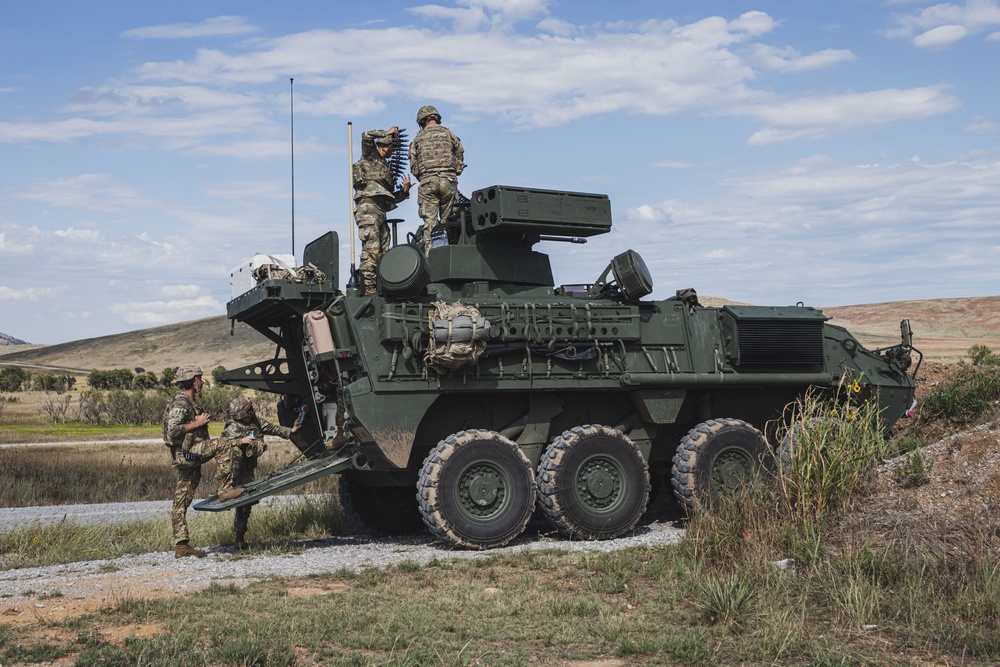
Photo: Sgt Christian Carrillo, U.S. Army / 75th Field Artillery Brigade. DVIDS 9337300. Public domain.
1. SGT STOUT: the integrated Stryker
SGT STOUT is the redesignated name for M-SHORAD Increment 1 (Maneuver Short-Range Air Defense), the US Army’s answer to the question of how to push organic short-range air defence into the close fight alongside armoured manoeuvre. The system was renamed in June 2024 after Sergeant Mitchell William Stout, a Vietnam War Medal of Honor recipient and air-defender. The platform is a Stryker A1 Double-V Hull (DVH) infantry carrier variant adapted as a remote-weapons fighting vehicle, fielded since 2022 with the 5th Battalion, 4th Air Defense Artillery Regiment (5-4 ADA) at Wiesbaden, Germany, and now extended to 4-60 ADA at Fort Sill, 6-56 ADA at Fort Hood, and 2-55 ADA at Fort Bragg (completing FY26).
The current dual-SVUL configuration carries eight ready FIM-92 Stinger missiles in two four-round Stinger Vehicle Universal Launchers, one on each side of the turret. Earlier Increment 1 production blocks carried a single SVUL plus an M299 launcher for four AGM-114 Hellfire missiles; that mix was retired in favour of dual SVUL during FY25–FY26 retrofits, partly for standardisation across the fleet and partly because the Hellfire integration carried weight and stowed-energetic penalties the Stinger pod did not. The kinetic primary is the XM914 30 mm chain gun, a Northrop Grumman M230LF derivative mounted on a Moog Reconfigurable Integrated Weapons Platform (RIwP) integrated by Leonardo DRS. The Army variant carries an electric primer (inherited from the Apache M230) and a dual-feed magazine selector; in production from 2025–2026, the dual-feed allows the gunner to switch between two ammunition natures (typically a proximity-airburst nature and a kinetic / point-detonate nature) without a magazine swap. The cannon weighs under 73 kg without ammunition (roughly 77 kg ammunition-loaded), with recoil in the 7,400–8,700 N range and lethality range over 2,000 m. Cyclic rate is approximately 625 rounds per minute on the M230 family, sustained rate around 300 rpm (thermally limited). On the SGT STOUT mount the practical engagement-burst rate sits closer to 200 rpm with single-shot, controlled-burst and full-automatic modes. Magazine depth on SGT STOUT is approximately 250–400 rounds, sustaining roughly 80–200 single-target intercepts per vehicle per reload at the manufacturer-claimed 2–3 rounds-per-kill figure against Class 1 and Class 2 UAS (Valpolini 2022, EDR Magazine, quoting Hafften, Northrop Grumman).
A 360° Multi-Mission Hemispheric Radar (MHR; Leonardo DRS, part of the same RPS-62 four-panel family the Marines use on the MADIS Mk2 sensor vehicle) sits atop the vehicle, integrated with an electro-optical / infrared (EO/IR) suite. A 7.62 mm M240 machine gun provides secondary defence against ground threats inside the cannon’s effective minimum range. Crew is three: commander, gunner, driver. All three sit under armour, share a single decision loop, and ride behind 14.5 mm-class front protection and the DVH’s under-belly mine resistance.
The programme of record per the FY26 Army Procurement of Missiles Justification Book is 230 systems: 144 Directed Requirement, 20 Public Interest Determination, 66 Acquisition Decision Memorandum. FY26 funds 48 systems at $729 m total, equating to a unit cost of $12.89 m per system in dual-SVUL configuration. The fleet is fielded across four active-duty battalions today, with Florida and Ohio Army National Guard fieldings programmed for FY28–FY29 within the 230-system envelope.
The architectural logic is integration. One vehicle carries the sensor (radar, EO/IR), the brain (fire control, classification, decision), and both effectors (missile and gun). One crew, one decision loop, one logistics tail per platform. Everything the system needs to find, fix, and finish a threat is inside the same protected hull.
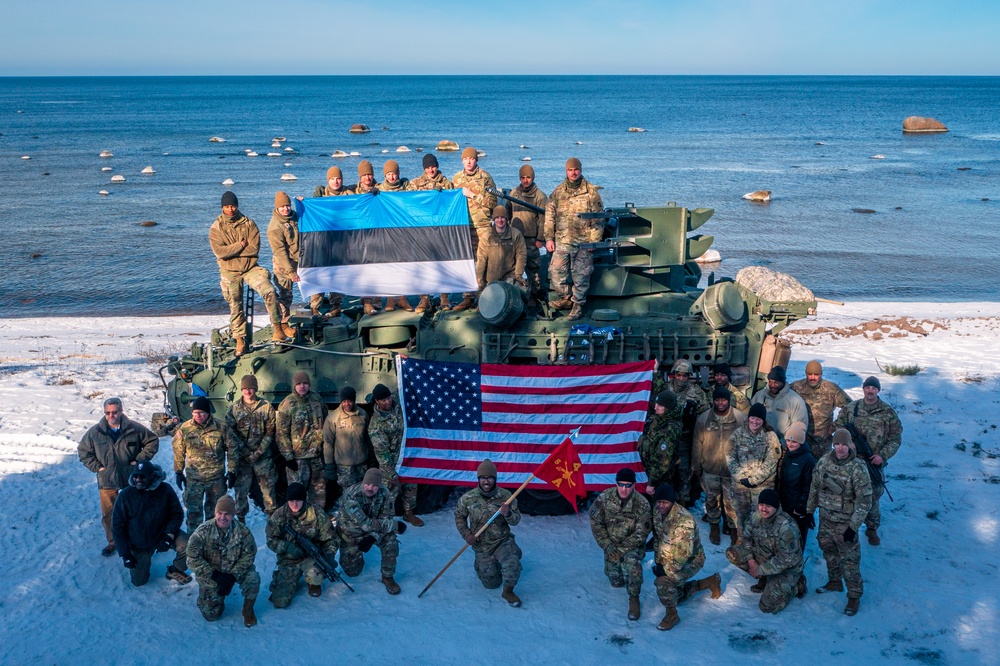
Photo: U.S. Army / 10th Army Air & Missile Defense Command. DVIDS public domain.
2. MADIS Mk1 + Mk2: the distributed JLTV pair
MADIS, the Marine Air Defense Integrated System, is built around sensor-shooter separation: the Mk1 is the kinetic / shooter vehicle, the Mk2 is the sensor and electronic-warfare vehicle, each on its own JLTV chassis. The doctrinal philosophy is different from SGT STOUT and the equipment fits the philosophy.
The Mk1 is the kinetic vehicle. It carries the XM914E1 30 mm chain gun, a Marine-specific variant of the M230LF distinguished from the Army’s XM914 by a percussion primer (rather than the Army’s electric primer) and a single-feed magazine (rather than the Army’s dual-feed). The cannon is mounted on a Kongsberg Protector RS6 Remote Weapon Station together with an M240C 7.62 mm coaxial machine gun and an integrated EO/IR sensor. The Mk1 also mounts a two-round FIM-92 Stinger Air-To-Air Launcher (ATAL) (with dismounted reload Stingers carried in the cargo bed), and the Sierra Nevada Corporation Modi II electronic-warfare suite. Range against UAS is the same 0.5–5 km envelope as SGT STOUT, but with a single-feed magazine the burst-to-burst flexibility is lower. The Stinger pod folded forward at the front of the vehicle and the Protector RS6 sitting amidships are the Mk1’s two visible identifiers.
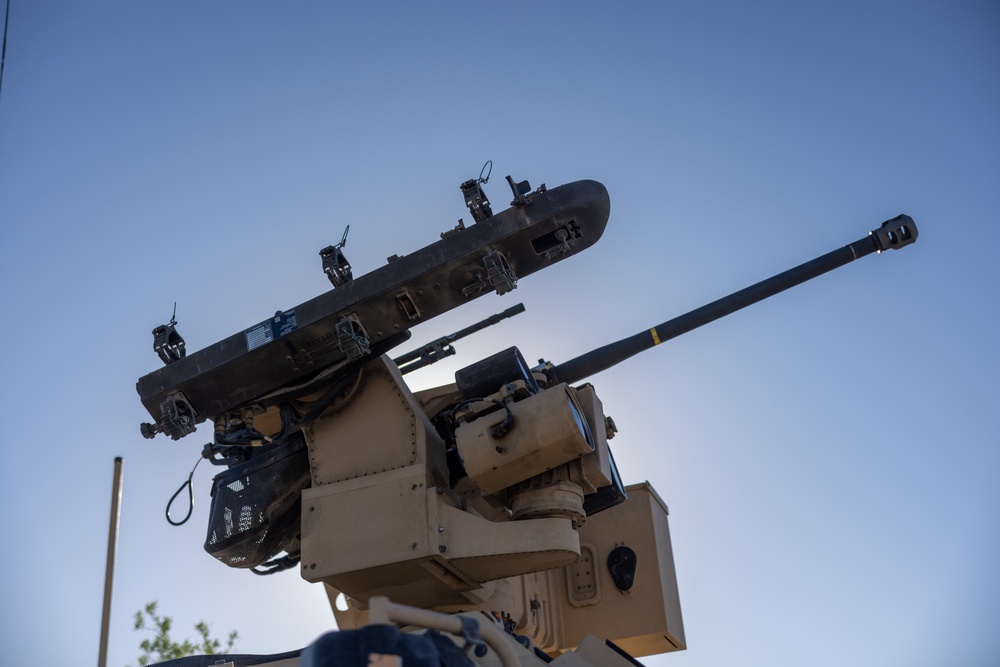
Photo: LCpl Samantha Devine, U.S. Marine Corps / MAWTS-1. DVIDS 9358075. Public domain.
The Mk2 is the sensor and electronic-warfare vehicle. It carries no 30 mm cannon. The primary payload is the RPS-62 S-band Multi-Hemispheric Radar (DRS RADA Technologies), a four-panel pulse-Doppler array providing 360° low-altitude air-surveillance coverage out to roughly 30 km at altitudes from near-ground level to 30,000 feet. The radar is paired with the Sierra Nevada Modi II electronic-warfare suite for jamming, GPS spoofing, and breakage of drone command-and-control links, and with an EO/IR sensor for visual classification. For self-defence against ground or close-in aerial threats, the Mk2 mounts an M240C coaxial in 7.62 mm rather than a 30 mm chain gun. The command-and-control suite supports Beyond Line-of-Sight networking and integrates with the Common Aviation Command and Control System (CAC2S), the Marine Air Command and Control System (MACCS), and the Joint All-Domain Command and Control (JADC2) framework. The Mk2 is the sensor and brain of the MADIS pair; the kinetic engagement sits on the Mk1.
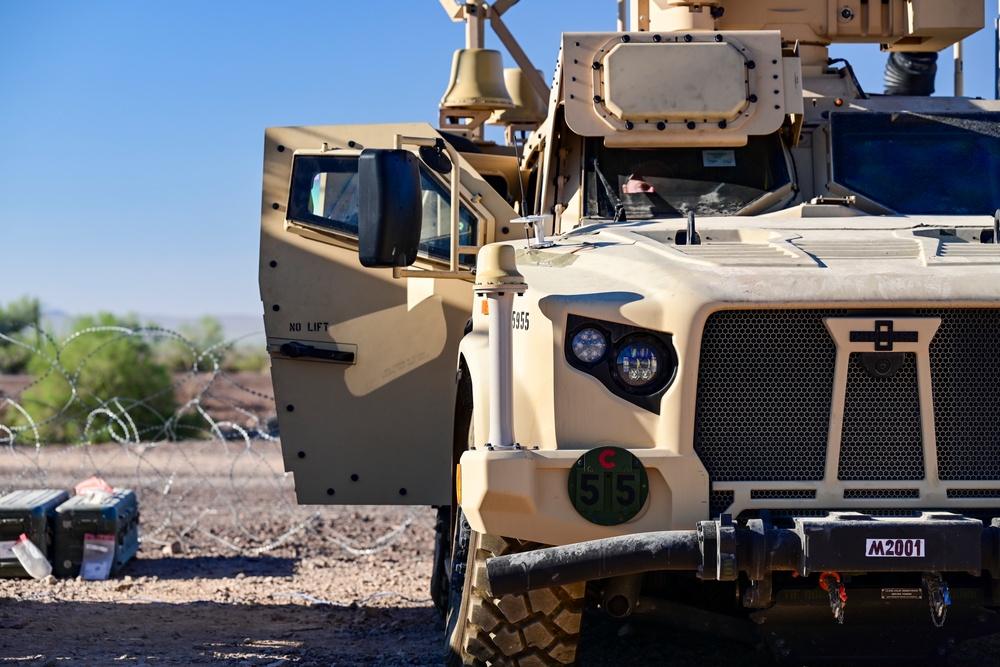
Photo: Neil Mabini, Naval Surface Warfare Center, Corona Division. DVIDS 8090724. Public domain.
Each Mk2 pairs with one Mk1. The Approved Acquisition Objective is approximately 190 pairs (380 vehicles) with Full Operational Capability targeted around FY2031 across twelve Low Altitude Air Defense (LAAD) battalion batteries. LRIP fielding began with 3rd LAAB / 3rd Marine Littoral Regiment in late 2023; full-rate production was reached in September 2025; operational deployments include Balikatan 2025 and Balikatan 2026 in the Philippines.
A lighter variant, L-MADIS, scales the same architecture onto Polaris MRZR-class all-terrain vehicles for niche dispersed roles where the JLTV pair is too heavy or visible. L-MADIS allows Marine Littoral Regiment small units to take organic counter-UAS coverage into the hardest expeditionary terrain. Whether L-MADIS retains the XM914E1 + XM1211 footprint or substitutes a smaller-calibre effector is not yet publicly disclosed.
2.5 At a glance: side-by-side reference
The architectural divergence resolves to the following side-by-side, accurate as of FY26:
| Parameter | SGT STOUT (Stryker A1) | MADIS Mk1 + Mk2 (JLTV pair) |
|---|---|---|
| Carrier vehicle | Stryker A1 Double-V Hull (~17 tonnes) | JLTV × 2 (~6–7 tonnes each) |
| Crew | 3, single decision loop | 6 (3 + 3), specialised by role |
| Remote Weapon Station / mount | Moog Reconfigurable Integrated Weapons Platform (RIwP), integrated by Leonardo DRS | Kongsberg Protector RS6 on Mk1 only (with the 30 mm cannon). Mk2 mounts the radar plus an M240C coaxial separately. |
| Primary cannon | XM914 30 mm chain gun (electric primer, dual-feed capable) | XM914E1 30 mm chain gun (percussion primer, single-feed) on Mk1 only; Mk2 has no 30 mm cannon |
| Cannon magazine | Dual-feed capable; cyclic ~625 rpm; sustained ~300 rpm (thermally limited) | Single-feed; cyclic ~625 rpm; sustained ~300 rpm (thermally limited) |
| Ammunition | 30 × 113 mm B, electrically-primed cartridges (XM1211, XM1223, XM1225, XM1198) | 30 × 113 mm B, percussion-primed cartridges; not interchangeable with the Army electric variant |
| Secondary MG | M240 7.62 mm | M240C 7.62 mm coaxial on Mk1 only; M240C coaxial 7.62 mm on Mk2 (self-defence) |
| Ready Stinger load | 8 missiles (2 × SVUL) | 4 missiles on the Mk1 pod + dismounted reloads in cargo bed; no Stinger on Mk2 |
| Primary radar | 360° Multi-Mission Hemispheric Radar (Leonardo DRS / RPS-62 family) on the Stryker | RPS-62 S-band Enhanced Compact Hemispheric Radar (eCHR family — production-standard fit on the FRP MADIS Mk2; the legacy RPS-62 was the pre-FRP/LRIP designation in the older MHR family) (DRS RADA Technologies) on Mk2 only |
| EO/IR | Lockheed Martin EO/IR (single suite) | EO/IR sensor integrated in the Mk1’s Protector RS6 and a separate EO/IR sensor on the Mk2 |
| EW suite | Sierra Nevada Modi II (single suite, kinetic-integrated) | Sierra Nevada Modi II on the Mk2 (sensor / EW vehicle); the EW-first doctrine sits with the Mk2 |
| Platform protection | DVH 14.5 mm-class front; NBC overpressure; under-belly mine resistance | JLTV B-kit; smaller individual signature |
| Lift compatibility | C-17 / C-5 (C-130 awkward); not CH-53K portable | CH-53K, LCAC, LSM. Full expeditionary lift |
| Engagement envelope | 0.5–5 km LSS; 2–5 km optimum vs Shahed-class | 0.5–5 km LSS via 30 mm on the Mk1 only; 2–5 km optimum vs Shahed-class. Stinger envelope (4 km+ class) also from the Mk1. The Mk2 provides detection and EW, not kinetic engagement. |
| Target set | Groups 1–3 UAS, helicopters, low-flying fixed-wing | Groups 1–5 UAS, helicopters, low-flying fixed-wing, low-altitude cruise missiles |
| Doctrine | BCT-integrated; kinetic-first | MLR-organic / EABO; EW-first then kinetic |
| Programme of record | 230 systems (FY26 P-form: 144 DR + 20 PID + 66 ADM) | ~190 pairs (~380 vehicles); FOC ~FY2031 across 12 LAAD batteries |
| Unit cost | ~$12.89 m per system (FY26 dual-SVUL configuration) | Not explicitly disclosed; combined Army+USMC procurement value FY25 ~$369.3 m (USMC GBAD only) |
| Fielding status (May 2026) | 144 fielded in 4 active battalions; FY28–29 ARNG fieldings programmed | Full-rate production Sept 2025; 3rd LAAB operational; Balikatan 2025/26 deployments |
| Lighter variant | None published | L-MADIS on Polaris MRZR-class ATV |
The pattern is consistent across the line items. Where SGT STOUT compresses the whole kill chain into one armoured Stryker hull, MADIS distributes the kill chain across two unarmoured JLTVs by role: shooter (Mk1) and sensor/EW (Mk2). The chain-gun family is shared (M230LF-derived 30 × 113 mm) but the variants are not: SGT STOUT runs the electrically-primed dual-feed XM914 on a Moog RIwP, while MADIS Mk1 runs the percussion-primed single-feed XM914E1 on a Kongsberg Protector RS6. The Stinger is common (although count differs: 8 ready on SGT STOUT, 4 ready on the Mk1). The Modi II EW suite is common (single-vehicle on SGT STOUT, on the Mk2 inside MADIS). And the 30 mm cartridge primer is different, so the Army and Marine ammunition pools are not interchangeable. Same family, different platforms, different doctrines, different theatres.

Image: US Marine Corps work, public domain. Via Wikimedia Commons, file Marine_Air_Defense_Integrated_System_(MADIS)_Mk1_and_Mk2.jpg.
_Mk1_and_Mk2.jpg)
3. Why the doctrinal split makes sense
The choice between one vehicle and two is not really an engineering question. It tracks the way each service thinks it will fight: who it will be with, what terrain it will be on, what it will be willing to lose.
3.1 The Army case: SGT STOUT inside the Brigade Combat Team
The Army’s primary warfighting scenarios are continental: the NATO eastern flank, US Central Command, the Korean peninsula. A Stryker Brigade Combat Team is a 4,000-soldier formation that moves as a mass – armoured carriers up front, infantry behind them, fires, sustainment and signals threaded through. Anything that goes into that formation has to keep up with it, eat the same logistics, talk on the same nets and survive what the rest of the column survives. SGT STOUT belongs inside that formation. It is a member of the team, not a stand-off asset waiting at distance.
From that, the platform choice almost picks itself. The vehicle has to be armoured to a Stryker standard. It has to keep pace on a road march with M2A4 Bradleys and M1A2 SEPv3 Abrams. Its fuel, ammunition and mechanic have to be the same fuel, ammunition and mechanic the rest of the BCT is using. It has to take fragmentation, small-arms fire and IED blast like everything else in the column. And it has to be controlled from the brigade fires cell as part of the BCT’s air-defence kill chain, not as a separate stovepipe. A single vehicle with a single crew and a single decision loop fits inside that picture. Two vehicles do not: they double the convoy footprint, double the maintenance bill, and add an inter-vehicle radio link that is one more thing to lose when the jamming starts.
SGT STOUT’s engagement envelope (0.5–5 km against low-slow-small aerial threats, 2–5 km optimum against Shahed-class targets) is consistent with this doctrine. The system is not meant to defend a 200 km swathe of airspace; it is meant to keep a 4,000-soldier formation alive long enough for Patriot, NASAMS, and Coyote to engage the larger threats further out. It is the last protective layer for the BCT, not the outer ring of the integrated air defence system.
3.2 The Marine case: MADIS organic to the Marine Littoral Regiment
The Marines are fighting a different war on different geography. Force Design 2030 and the Expeditionary Advanced Base Operations (EABO) concept have moved them away from continental mass warfare toward dispersed small-unit operations across the Pacific island chains. The Marine Littoral Regiment is a 1,800–2,000-Marine formation built to seize and hold expeditionary advanced bases – small, often unimproved, usually coastal – and project anti-ship and counter-UAS coverage from them into the South China Sea and the Philippine archipelago.
A 17-tonne Stryker does not fit that picture. The vehicles you actually want are the ones that can be carried under a CH-53K King Stallion, driven off the back of an LCAC, or rolled onto an LSM. A JLTV at 6 or 7 tonnes can do all of that. The Stryker A1 cannot. Lighter platforms come with a thinner armour penalty, which the Marines accept because the operating concept rests on dispersion: an Expeditionary Advanced Base is not designed to absorb a divisional strike, but to be small enough that the adversary never quite locates it before it relocates.
Distribute the same logic across two vehicles and the rationale for the Mk1+Mk2 split falls out. If you put everything onto one platform, a single kinetic hit takes the whole capability off the board. Split it by role, the Mk1 carries the XM914E1, Stinger pod, and EO/IR; the Mk2 carries the RPS-62 radar, Modi II EW, EO/IR, and an M240C coaxial machine gun, and a hit on either vehicle still leaves the other doing useful work. Lose the Mk2 and the Mk1 can still fight on its own EO/IR picture; lose the Mk1 and the Mk2 still detects, jams, and cues another shooter. Neither half is as capable on its own; the pair as a whole is harder to neutralise.
The same doctrine drives the EW-first posture. MADIS is built for an Indo-Pacific operating environment where the adversary has every reason to jam, spoof and disrupt the defender’s sensors and communications, so the doctrine pushes electronic countermeasures up the kill chain. The Mk2 tries to break the drone’s command link or spoof its GPS before either vehicle commits kinetic effects. That conserves the 30 mm round, which is the binding constraint on a force operating from austere bases with limited resupply, and it preserves a soft-kill option against hardened EW threats the gun cannot reach.
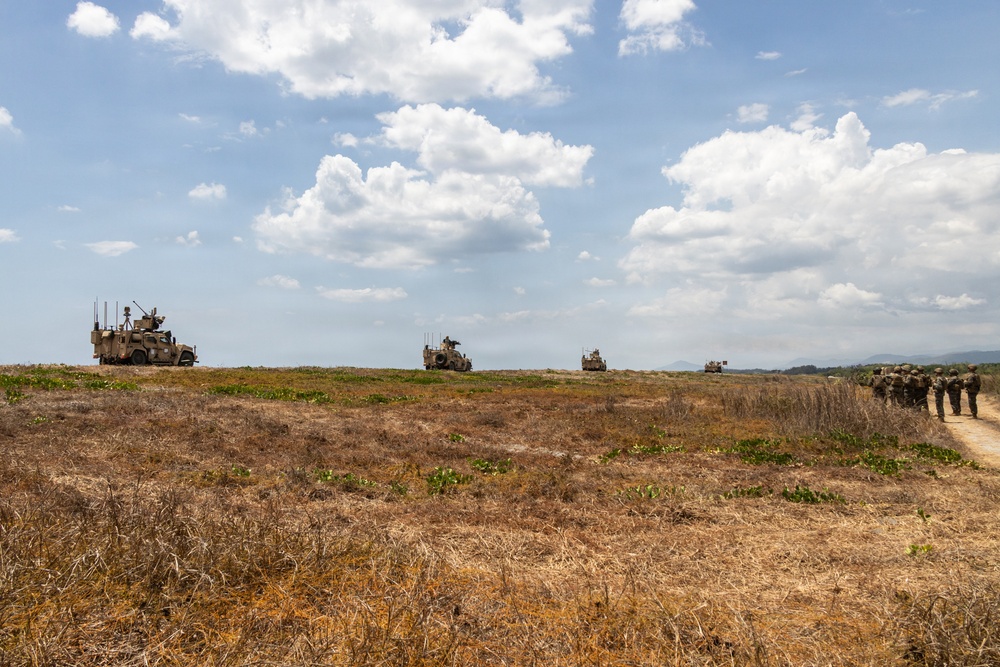
Photo: Sgt Atticus Martinez, U.S. Marine Corps. DVIDS 9647453. Public domain.
4. Operational advantages and disadvantages
The two doctrines produce trade-offs that look almost like mirror images. What helps the Army hurts the Marines, and the other way around.
4.1 What one vehicle gets the Army
Engagements happen quickly. With one crew running everything inside the same hull, the path from radar detection to launch never has to leave the vehicle. The radar slews the EO/IR. The EO/IR confirms the classification. The gunner pulls. There is no second crew to coordinate with, no radio link between vehicles to drop at the wrong moment, and no doctrinal question over who actually has the engagement.
The platform itself is also survivable in a way two JLTVs are not. A Stryker A1 with its Double-V Hull carries 14.5 mm-class front protection, NBC overpressure, and under-belly mine resistance, all of which match what the rest of the BCT is sitting behind. Two JLTVs at their nominal B-kit level do not. In a column taking artillery and ATGM, the difference in protection is the difference between a platform that fights through and a platform that does not.
Mobility is the same story. The Stryker keeps pace with the Bradley M2A4 and the M1A2 SEPv3 it is fighting alongside, on roads and off them. Two JLTVs do not. Putting MADIS into a heavy column would slow the column.
SGT STOUT also carries more ready missiles. Eight Stingers across two SVULs is double the four-round Mk1 pod. Magazine depth matters when the BCT is facing rotary, fixed-wing and cruise-missile threats inside the same engagement window: an Apache reinforcing a ground fight is a different problem from a Group 1 quadrotor swarm, and the SGT STOUT magazine has to cover both.
The logistics footprint is also smaller in the obvious way. One fuel queue, one ammunition resupply, one driver-mechanic, one spares bin. Inside a 4,000-soldier brigade, an extra vehicle of any kind is not free; an extra two vehicles per unit of capability is meaningfully more expensive to support.
4.2 What one vehicle costs the Army
Concentration is a liability as well as an asset. Lose the platform – a kinetic hit, a mobility kill, an unscheduled maintenance casualty – and the BCT loses its entire organic short-range air-defence capability at that point in the formation. The Army accepts that risk because 144 SGT STOUT are fielded today and 230 are programmed, so the loss of one is recovered through fleet redundancy rather than platform redundancy. It is still a real risk.
A 17-tonne Stryker also presents a larger thermal, radar and visual footprint than a JLTV. To an adversary running counter-fire radar against the air-defence platform itself, or sending a loitering munition after it, a bigger signature is a bigger target.
The heavier platform also gives up lift. A Stryker A1 is not air-portable inside a CH-53K and fits awkwardly inside a C-130. For NATO eastern flank and CENTCOM operations this is not the binding constraint. For Indo-Pacific deployment it is. The Army is not optimising SGT STOUT for the Indo-Pacific.
And there is a question hidden inside the crew of three. The same Soldiers run the radar, the EO/IR, the missile, the gun, the comms and the vehicle – simultaneously, under fire, on the move. The Marines split that workload across two crews of three (one per Mk1 and one per Mk2). The Army compresses it into one crew of three. Whether the Army crew can sustain that workload across a multi-day high-intensity fight is a doctrinal bet rather than a settled question.
4.3 What two vehicles get the Marines
Distributing the capability gives the pair a kind of graceful degradation a single platform does not have. A hit on the Mk2 silences the radar and the C2 but the Mk1 still has its missiles and gun, with its own EO/IR to see by. A hit on the Mk1 takes the kinetic stack off the board but the Mk2 still has the radar, the jammer and the picture. The pair is more resilient than either platform is on its own, not because the JLTVs are tougher than a Stryker (they are not) but because no single hit removes the whole capability at once.
The platforms are also harder to find. A JLTV has a smaller thermal, radar and visual signature than a Stryker. Two of them, dispersed over a tactical bound, are a much harder target set for a single loitering munition than one larger vehicle in one place.
Lift is where the architecture really pays. A JLTV fits inside a CH-53K, drives off the back of an LCAC, and rolls on and off an LSM. EABO requires exactly that: a force able to reposition by sea and air between the Philippine, Ryukyu and Mariana island chains as the picture demands. A Stryker cannot operate inside those lift constraints.
And the EW-first doctrine has a logistics dividend the Army architecture does not get. Jam first, shoot second, and the 30 mm round is reserved for the engagements that actually need it. For a force operating from austere expeditionary bases with thin resupply lines, every round burned by the Modi II rather than the gun is a round still available when the EW does not resolve the engagement.
Splitting the workload also lets each crew specialise. A Mk2 crew can be trained and certified as sensor and EW operators. A Mk1 crew can be trained as gunners and Stinger operators. With a limited Marine training budget, deeper specialisation per crew may extract more useful performance than asking one SGT STOUT crew to do everything competently and nothing exceptionally.
4.4 What two vehicles cost the Marines
The most obvious cost is in people and platforms. Six Marines per pair instead of three Soldiers per Stryker. Two vehicles to fuel, repair and recover. Two weapons fits to maintain, two sets of comms to keep up. Roughly twice the logistics for the same unit of capability. The Marine Corps accepts the bill because dispersion is worth more to its doctrine than logistics economy is, but the bill is not zero.
The architecture also relies on a working radio. The Mk2 detects the threat on the RPS-62 and cues the Mk1; the Mk1 then prosecutes with Stinger or with the XM914E1. If the inter-vehicle link drops (jamming, terrain masking, equipment failure), the Mk1 is reduced to fighting on its own EO/IR picture and the Mk2 has no kinetic option to call on. The link that makes the pair work is a single point of failure SGT STOUT does not have.
The decision loop is also longer. A detection on the Mk2 has to be communicated to the Mk1 before any kinetic engagement starts, and even at radio speeds that adds latency. For a Group 1 quadrotor at 1 km closing at 25 m/s, that latency starts to matter. For a Shahed-class target at 5 km closing at 50 m/s the time budget is more forgiving but still tighter than it is for a SGT STOUT crew engaging in-house.
And the kinetic inventory per pair is smaller. Four Stingers on the Mk1 against eight on SGT STOUT halves the ready-launch missile count. Reload Stingers in the cargo bed close some of the gap once the gunner can dismount, but inside the engagement window the pair has half the ready depth a single Stryker brings to the same fight.
Finally, the doctrine assumes the pair stays together. Detach the Mk1 to a tactical bound the Mk2 cannot reach, or vice versa, and the architecture loses most of its value. Keeping the pair within radio range and within mutual support is a doctrinal discipline that has to be enforced under fire.
5. The industrial-base implication
Both configurations consume the same round and pull on the same production base. The combined demand has been understated in the open-source record because the Army inventory-gap arithmetic does not include USMC MADIS demand.
The Army-only requirement against the eight-battalion SGT STOUT fielding plan is approximately 440,000–745,000 rounds — the combined XM1211 plus XM1223 shortfall against fleet requirement (200,000–250,000 procured-plus-on-contract vs 500,000–700,000+ required for XM1211; 4,000–8,000 procured vs 150,000–250,000+ required for XM1223). Closing the gap at programme-of-record unit cost (XM1211 at $1,894–$2,598; XM1223 at $2,369 FY27) is approximately a $1.0–$1.9 billion ammunition-only programme cost for the Army alone.
MADIS draws on the same XM1211 / XM1198 / XM1223 / XM1225 production pool. The USMC Approved Acquisition Objective is approximately 190 systems (Mk1/Mk2 pairs) with Full Operational Capability targeted around FY2031 across twelve LAAD-battalion batteries. Each pair has one XM914 (on the Mk1), so the kinetic-vehicle count is 190 on top of the Army’s 230 SGT STOUT systems. The combined Army+USMC kinetic-platform count is approximately 420 vehicles drawing from the same round. A precise USMC ammunition demand figure is not in the open-source record, but on a like-for-like consumption assumption it adds 30–50% on top of the Army figure, expanding both the requirement and the gap, and lengthening the timeline to operational maturity unless production scales accordingly.
The pool is wider than the ground fleet alone. The same XM1211 / XM1223 / XM1225 family now also arms the AH-64 Apache via the M230 chain gun, validated by the December 2025 XM1225 APEX air-to-air UAS engagement at Yuma Proving Ground. That extends the 30 × 113 mm ecosystem across ground and aviation counter-UAS missions, with the same Northrop Grumman cartridge line, the same L3Harris fuze line and (in the longer term) the same XM1223 multi-mode evolution serving every host platform. Industrial-base use cuts both ways: production scaling benefits all three services, and a fuze-line disruption affects all three at once.
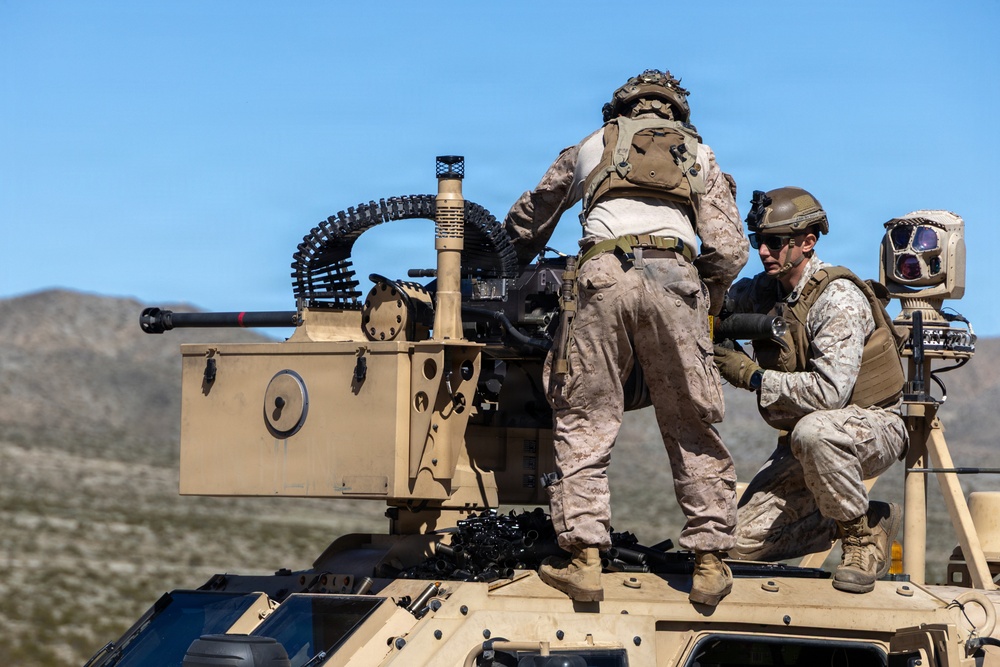
Photo: LCpl Nicholas Figueroa, U.S. Marine Corps / 3d Marine Division. DVIDS 9576291. Public domain.
6. When each architecture works best
Neither configuration is universally better. Each was optimised for a specific doctrinal frame, and works well inside that frame; outside it, both look less convincing.
| Operational context | SGT STOUT (one vehicle) | MADIS (two vehicles) |
|---|---|---|
| Armoured manoeuvre warfare alongside heavy armour | Strong fit. Stryker A1 keeps pace, shares logistics, survives BCT-level threats. | Weak fit. JLTV pair cannot keep pace; convoy footprint doubles inside the BCT. |
| Continental land theatre with mature logistics | Strong fit. One vehicle per system; one logistics tail; one decision loop. | Acceptable. Two vehicles add overhead but the doctrine still functions. |
| Indo-Pacific island-chain dispersion (EABO) | Weak fit. Stryker cannot be CH-53K-lifted; logistics footprint exceeds dispersed-base capacity. | Strong fit. JLTV pair is sea- and air-liftable; smaller individual signature; dispersion built into the doctrine. |
| Forward Operating Base perimeter defence (semi-static) | Acceptable. Functions but oversized for static defence. | Strong fit. EW-first posture conserves rounds; pair architecture provides graceful degradation under attack. |
| EW-rich operating environment (jamming, spoofing common) | Acceptable. Modi II EW is the same on both platforms. | Strong fit. EW-first doctrine is built around the assumption. |
| Saturation swarm engagement (≥100 airframes) | Weak fit. Magazine depth and decision-loop saturate. | Weak fit. Same magazine constraint per Mk1; F-213 swarm-test gap applies to both. |
| Multi-day sustained high-intensity engagement | Acceptable. Single crew workload is the constraint. | Strong fit. Two crews split workload; one can rest while the other operates. |
| Brigade-level integrated air-defence kill chain | Strong fit. Designed to receive cueing from Sentinel A4 at brigade level; sits in the Army’s fires architecture. | Acceptable. Mk2 integrates with CAC2S/MACCS/JADC2; cross-service integration possible but not natively Army. |
The pattern is straightforward. SGT STOUT does best in continental theatre, alongside large armoured formations, against concentrated threats. MADIS does best in maritime or insular theatre, alongside dispersed light formations, against distributed threats. Neither has been characterised against true saturation swarms because the open-source record does not yet contain that data – the F-213 swarm-test gap applies equally to both.
7. Implications for NATO allies and industrial planners
The architectural choice in front of Allied buyers is the same one the US Army and US Marine Corps have already made: integrate onto one platform, or distribute across two. The answer depends on the doctrine the buyer wants to support.
Australia is the closest test case. The Australian Army’s LAND 156 short-range ground-based air defence programme has been examining 30 mm proximity-fuzed options on an EOS Slinger remote weapons station (M230LF derivative), with December 2025 demonstrations. Australian operational geography is closer to the Marine case (long littoral coastline, dispersed Northern Territory bases, lift-constrained logistics) than to the Army case. The MADIS pair architecture maps more naturally onto Australian doctrine than the SGT STOUT integrated architecture; the question is whether the cost and crew penalty of two vehicles is acceptable inside the Australian force structure.
The United Kingdom faces a related but distinct choice. The Sky Sabre / CAMM-based medium-range layer is already covered; the question is what sits below it for very-short-range counter-UAS. The British Army’s armoured-manoeuvre case (e.g. Ajax Brigade Combat Team in the Suffield NTC context) leans toward the SGT STOUT model. The Royal Marines’ commando force, operating from littoral bases with limited heavy lift, leans toward the MADIS model. The UK may need both, in different proportions.
For Continental European NATO allies the operating geography favours the SGT STOUT model: armoured manoeuvre, continental theatre, mature logistics. Germany’s Rheinmetall Skyranger 30 (30 × 173 mm AHEAD) is an architecturally similar single-platform answer on a different cartridge case. The architectural choice is consistent across allies; the cartridge-case standardisation is not.
The round itself is what really wins out of either configuration. It works with both. Industrial planners can therefore treat the round as the convergent investment and treat the platform choice as a doctrinal variable. Convergence on the round (XM1211 / XM1223 / XM1225 family at 30 × 113 mm in the US case) lets production scaling be the binding constraint rather than cartridge incompatibility. The 30 × 113 mm vs 30 × 173 mm Atlantic split remains, but is independent of the one-vehicle-vs-two question.
8. Open questions and data gaps
Several questions remain unresolved in the open-source record and would materially refine the comparative analysis.
- True saturation-swarm performance for either architecture. F-213 swarm-test gap applies equally to both. The open-source record establishes single-target and small-group performance; no characterised live-fire data exists for engagements above small-group level (~100+ airframes).
- Probability-of-kill curves comparing single-platform SGT STOUT engagement with paired Mk1+Mk2 engagement. Whether the Marine doctrine’s EW-first sequencing actually delivers a higher net Pk than the Army doctrine’s direct-engagement model is not publicly disclosed.
- Combined Army+USMC ammunition demand figure. The 440,000–745,000 round figure is Army-only. A precise USMC LAAD-battalion consumption rate is not in the open-source record.
- L-MADIS effector choice. Whether L-MADIS retains the XM914E1 + XM1211 footprint or substitutes a smaller-calibre effector is not yet publicly disclosed.
- Operational data from Ukraine and CENTCOM. Both theatres are running the threat MADIS and SGT STOUT are designed to engage. Lessons-learned that might refine doctrine on either side are not yet publicly released.
9. ISC commentary
The divergence between SGT STOUT and MADIS is, on balance, a healthy one. Two services solving for two different doctrines on two different theatres have converged on the same effector stack at the round level, and split at the platform level. From a joint-service procurement perspective that is roughly what you would want to see: shared investment where the technology is shared, distinct investment where the operating concepts differ.
The harder question is whether either doctrinal frame will actually hold. If the Army ends up fighting in the Pacific island chains, the integration of everything onto an unliftable Stryker becomes a liability rather than a strength. If the Marines end up defending continental armoured manoeuvre at scale, the two-vehicle dependency adds logistics overhead nobody budgeted for. Both configurations are bets on the geography each service expects. If the geography turns out otherwise, what looked like an architectural advantage starts to look like a constraint.
For NATO allies and industrial planners watching the two architectures, the useful conclusion is fairly simple: invest in the round, then choose the platform by doctrine. The XM914 plus the XM1211 / XM1223 / XM1225 family is the convergent industrial bet, and it works inside either configuration. Industrial-base risk concentrates on the proximity-fuze module and on the Holston-class energetic-precursor pipeline, not on platform-specific tooling. A country that buys the round and the gun keeps the option to deploy either way as its doctrine matures.
On the inventory side, the open-source figure understates the requirement. The 440,000–745,000 round shortfall is calibrated to the Army fleet alone and does not include USMC demand on the same Northrop Grumman cartridge line and the same L3Harris fuze line. The Northrop Grumman five-fold output ramp and the L3Harris seven-fold fuze ramp will probably close the Army-only gap by 2028–30. The combined Army-and-Marine gap is harder to close inside that window unless production capacity scales faster than is currently planned. The procurement-policy reading is that combined-services demand modelling should be the budgetary baseline, not Army-only.
Each service has built the right architecture for the war it expects to fight. The unresolved question is whether the war that arrives looks like either expectation. If it looks like both at once – armoured manoeuvre in Europe and dispersed expeditionary in the Pacific, on overlapping timelines – then the combined industrial bill is materially larger than either Service has reported publicly, and the architectural debate stops being primarily about platforms and starts being about production capacity.
10. References & further reading
10.1 Manufacturer technical data sheets (primary, Tier A-2)
- Leonardo DRS, “SGT STOUT (M-SHORAD) data sheet”, December 2025. Mission equipment package, hemispheric radar, EO/IR and integration detail for the SGT STOUT configuration. cdn.leonardodrs.com
- Leonardo DRS / RADA Electronic Systems, RPS-62 / SHORAD-C-UAS product page. Four-panel S-band AESA pulse-Doppler radar; 30–30,000 ft altitude band; ~30 km range; hemispheric coverage via four 90° faces. drsrada.com
- Northrop Grumman, “XM914 30 mm Bushmaster Chain Gun” technical brochure. Weight, recoil, cyclic rate, mode selection and ammunition compatibility for the XM914 / M230LF family. northropgrumman.com
- Sierra Nevada Corporation, “SNC Awarded $73.2M Contract for USMC Dismounted ECM (Modi II)”. EW suite scope; UAS, communications and RCIED disruption capability. sncorp.com
10.2 Official US Government / DoD primary sources (Tier A-1)
- Congressional Research Service IF12397, “M-SHORAD / SGT STOUT” In Focus, updated April 2026. Programme background, SVUL configuration, retrofit history. congress.gov
- Congressional Research Service R48477, “DoD Counter Unmanned Aircraft Systems: Background and Issues for Congress”. USMC GBAD FY2025 budget, MADIS architecture, Force Design 2030 priority. congress.gov
- FY26 Army Procurement of Missiles Justification Book. The 230-system SGT STOUT programme of record, FY26 quantity (48 systems at $729 m), unit cost ($12.89 m / system, dual-SVUL configuration). asafm.army.mil
- PEO Land Systems (USMC), “Rapid Innovation, Real-World Impact: Marines Unveil First Full-Rate Production of MADIS”, 10 July 2023. PM GBAD ownership, FRP confirmation. peols.marines.mil
- marines.mil, “New air defense system advances Corps’ air dominance”. Paired Mk1/Mk2 doctrine; Mk1 = kinetic, Mk2 = sensor, EW and C2. marines.mil
- JPEO Armaments and Ammunition, “NEED FOR SPEED”, Army AL&T magazine, 26 July 2024. Hand-assembly bottleneck and parts-process commonality across the medium-calibre proximity portfolio.
10.3 Trade press & analytical sources (Tier B-2)
- Paolo Valpolini, “Northrop Grumman: new life to the M230LF”, EDR Magazine, 26 August 2022. Hafften and McCollum interview on XM1211 architecture, 2–3-rounds-per-kill claim, swarm-test gap, Sky Viper follow-on. edrmagazine.eu
- USNI Proceedings, April 2020, “Air Defense for the Marines”. Origins of the MADIS pair construct: four-face surveillance radar, SNC Modi RF jammer, EO/IR, Stinger, JLTV / MRZR mount. usni.org
- Breaking Defense, “Marines eye 2025 fielding of 3 new, mobile air defense systems”, May 2024. Increment 1 software baseline; sensor-shooter pairing; 3rd LAAB fielding timeline. breakingdefense.com
- Breaking Defense, “M-SHORAD renamed SGT STOUT in honour of Vietnam War Medal of Honor recipient”, June 2024. Renaming announcement and retrofit context (dual-SVUL replacing Stinger + Hellfire mix). Indicative URL: breakingdefense.com
- Army Recognition, “US Marine Corps selects Kongsberg XM914 turret for MADIS”. Kongsberg RT-20 RWS; XM914 30 × 113 mm chain gun on Mk1; coax 7.62 mm option; Stinger integration kit. armyrecognition.com
- Missile Defense Advocacy Alliance, MADIS profile. Programme overview, Mk1 / Mk2 component listing, doctrinal context. missiledefenseadvocacy.org
- Leonardo DRS (DRS RADA Technologies), RPS-62 / A°CHR product page. Manufacturer description of the four-panel S-band Multi-Hemispheric Radar (and its Advanced/Enhanced Compact Hemispheric Radar derivative) used on MADIS Mk2 for low-altitude air surveillance and C-UAS / C-CM cueing. leonardodrs.com
- DVIDS image gallery 8090714, “System Integration Test of the Marine Air Defense Integrated System”, Yuma Proving Grounds, Arizona, 27 September 2023. 48-image gallery showing the MADIS Mk1 (with Protector RS6 RWS carrying the XM914E1 + M240C coaxial, and the Stinger pod) and the MADIS Mk2 (with RPS-62 radar mast and M240C coaxial). dvidshub.net
- Kongsberg Defence, “Protector RS6 Remote Weapon System” product information. Medium-calibre RWS hosting the XM914E1 30 mm chain gun on the MADIS Mk1, with an M240C 7.62 mm coaxial. kongsberg.com
- National Defense Magazine (NDIA), “Marine Corps Ramps Up Production of Remote Weapon Stations”, July 2023. Kongsberg RWS production; PM GBAD ownership. nationaldefensemagazine.org
10.4 ISC Defence Intelligence cross-references
- ISC Defence Intelligence, SGT STOUT, MADIS & the 30 mm Counter-Drone Round: XM1211, XM1223, the Inventory Gap and the Critical-Materials Bottleneck, 5 May 2026 (V3, amended 7 May 2026). Companion industrial brief on the round itself, the production base, and the critical-materials chokepoints under Chinese export control. integratedsynergyconsulting.com
- Article Facts Report (held by ISC; available on request): AFR-2026-05-05-30mm-proximity-fuze.html. 165 facts, 70 references, 28 data gaps, NATO STANAG 2022 source ratings throughout. F-107 (magazine depth), F-209 (Hafften kill rate), F-307 (MADIS Mk1 loadout), F-1010 to F-1018 (USMC MADIS architecture handover, 6 May 2026), F-1020 (MADIS AAO ~190), F-1021 (USMC MADIS FOC FY2031), F-214 (XM914 cyclic rate), F-215 (XM914 weapon parameters), F-1114 (W519TC24F0158 contract value precision).
Open source / unclassified. AI-assisted analysis. Compiled by Steven Sawyers MIExpE VR, Founder & Defence Consultant, Integrated Synergy Consulting. Contact: [email protected]. All imagery DVIDS public domain (U.S. DoD). NATO STANAG 2022 source ratings applied throughout the underlying Article Facts Report.