From Apache to Stryker: The 30×113mm Chain Gun Family on SGT STOUT and MADIS
The same Hughes-designed 30mm chain gun that armed the AH-64 in 1986 now sits central to two of America's mobile short-range air defence systems. A walk through the M230 / M230LF / XM914 / XM914E1 lineage, the naming, and the dual-feed inflection that arrived in October 2024.
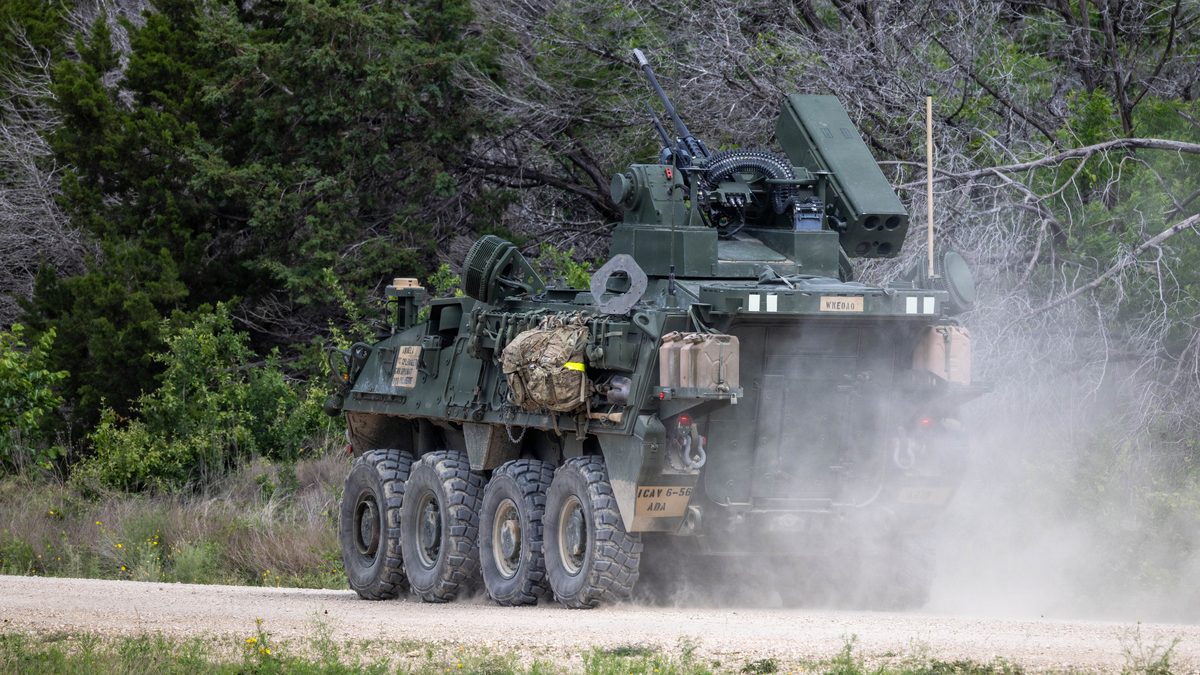
Hero: U.S. Army SGT STOUT (6-56 ADAR) on the firing line at Fort Hood, Texas, 5 May 2026. The XM914 30mm chain gun sits in the centre of the Moog RIwP turret, flanked by the four-round Stinger pod and the multi-mission hemispheric radar. Photo: Spc. Patrick Connery, III Armored Corps. DVIDS 9665694 · U.S. Government — Public Domain.
When the U.S. Army renamed its Maneuver Short-Range Air Defense system (M-SHORAD) SGT STOUT on 15 June 2024, in honour of Sergeant Mitchell W. Stout, the only U.S. Air Defense Artillery soldier to have received the Medal of Honor [1], it tidied up one piece of nomenclature while leaving a more confusing one alone. The gun bolted on top of the Stryker A1 hull, the system's kinetic backbone, has been called at least four different things in the past two years depending on which press release you were reading: M230, M230LF, XM914, XM914E1. Add the U.S. Marine Corps' Marine Air Defense Integrated System (MADIS) into the picture, which uses the same gun under a different designation on a different vehicle in a different mount, and the lineage gets harder to follow than it should.
It is, in fact, all the same chain gun. The naming reflects the platform, the contracting authority, and the engineering changes between variants, not a separate weapon at each step. This article is a guided tour through that lineage: from the AH-64 Apache helicopter for which the original M230 was designed, to the ground-vehicle M230LF, to the dual-feed XM914 now entering U.S. Army production, and to the percussion-primed XM914E1 chosen by the Marine Corps for JLTV integration. It also covers the ammunition family, the remote weapon stations that host the gun, and the present fielding picture across both services.
1. Apache origins: the original M230, 1972–1986
The M230 was a Hughes Helicopters self-funded design that began in 1972 to meet the U.S. Army's Advanced Attack Helicopter (AAH) requirement, the programme that became the AH-64 Apache. Hughes proposed a 30mm chain gun, a weapon driven by an external electric motor cycling the bolt via a captive chain loop, rather than gas, recoil or blowback. The chain-drive principle decoupled the rate of fire from chamber pressure and made the gun substantially more tolerant of dud rounds and propellant variations than a comparable revolver or rotary cannon. The Army selected the C-model M230, a linkless-fed variant, for the YAH-64 prototype in January 1975. The Apache entered Army service in 1986 with the M230 mounted under the fuselage, fed from a 1,200-round magazine, firing the 30×113mm cartridge originally developed for the ADEN/DEFA aircraft cannons but reworked into a high-explosive dual-purpose (HEDP) family for ground attack [2, 3].
The figure most often quoted for rate of fire is 625 rounds per minute, that is the cyclic rate on the Apache installation. The ground-vehicle M230LF / XM914 is deliberately detuned to approximately 200 rounds per minute for thermal management, recoil control on lighter platforms, and barrel life [22]. Operational bursts on either installation are typically shorter than either figure. The gun fires from an open bolt and uses electric ignition on the helicopter installation.
2. M230LF: the gun goes to ground, mid-2010s
Northrop Grumman, which absorbed Hughes' Bushmaster line via the Alliant Techsystems (ATK) and Orbital ATK acquisitions, redesigned the M230 for ground-vehicle use in the mid-2010s, in response to combat-veteran feedback that the round had no readily-available ground equivalent. The result was the M230LF (Lightweight Feed): a link-fed version of the same gun, optimised for vehicle mounts, with a redesigned ammunition feed system that accepts disintegrating belted rounds rather than the helicopter's linkless feed. The barrel and chamber are identical, the chain mechanism is unchanged, but the recoil mount, the feed chute, and the supporting hardware are all platform-tailored [4].
The M230LF was always a technology-demonstrator name. Once the U.S. military took it into a service programme, the technical family name persisted in manufacturer literature while the service applied its own programmatic designation on top. For the U.S. Army that became XM914. For the U.S. Marine Corps it became XM914E1. Both are M230LF derivatives.
3. Two doors, same gun: XM914 versus XM914E1
The U.S. Marine Corps selected the XM914E1 in September 2020 as part of the MADIS Increment 1 Mk1 vehicle build, with Kongsberg's Protector RS6 remote weapon station as the integrating mount [5]. The Army began fielding the XM914 on the Initial Maneuver Short-Range Air Defense system (IM-SHORAD, later renamed SGT STOUT) in April 2021, with the first live-fire conducted by 5th Battalion, 4th Air Defense Artillery Regiment (5-4 ADA) in Germany on 7 October 2021 [6, 7].
The two designations carry one substantive engineering difference. The XM914E1 is percussion-primed: the cartridge is initiated by a firing pin striking a primer, not by an electrical impulse [8]. The XM914 used by the Army on Stryker carries the standard electrically-primed configuration inherited from the Apache. The Marine Corps requirement for percussion priming has not, to ISC's knowledge, been spelled out in a publicly-releasable engineering rationale; the JLTV electromagnetic environment is the most-commonly stated context, but it should be treated as a reasonable inference rather than a confirmed root cause until a primary source emerges. The substantive operational consequence is that the two services field non-interchangeable ammunition primers on otherwise identical chambers.
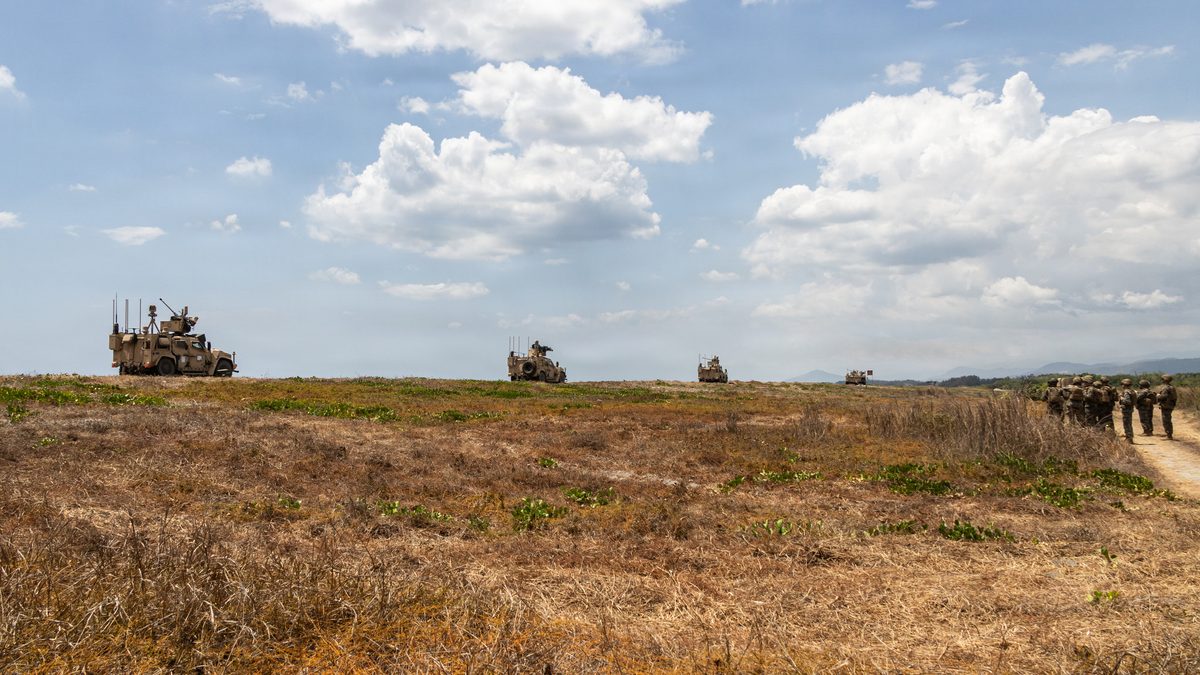
The two services field different primers in otherwise identical 30×113mm cartridges. Electrically-primed ammunition will not function in a percussion-primed gun, and percussion-primed ammunition will not function in an electrically-primed gun. The mismatch is fail-to-fire, not delayed fire, the firing system has no mechanism to initiate a cartridge of the wrong primer chemistry.
The supply-chain consequence: belt fills, magazine reloads and pallet picks for SGT STOUT and MADIS must be packaged, labelled and routed as separate stock-keeping units. Cross-loading a U.S. Army ammunition truck onto a Marine Corps MADIS, or vice versa, produces a system that cycles and ejects rounds without firing them. Allied operators acquiring either platform inherit the same constraint: the primer chemistry chosen at procurement is the primer chemistry that must follow the gun for the life of the system.
For ammunition technicians and ATs: verify primer-type marking on every belt before issue. The cartridge case is externally identical between the two natures; the difference is internal. NATO-pattern STANAG marking conventions for 30×113mm primer type should be confirmed against the relevant U.S. service publication before resupply across service boundaries.
4. The dual-feed inflection, October 2024
Northrop Grumman unveiled the M230LF Dual Feed at AUSA in mid-October 2024 [9, 10]. The dual-feed design adds a second magazine and a feed selector that can switch between two ammunition natures in a single round, without breaking the belt, without reloading, and without dismounting the crew. For a counter-uncrewed-aerial-system (C-UAS) role, this is more than a convenience. It means the same gun can engage a Group 2 quadcopter with proximity-fuzed airburst (XM1211 or the multi-mode XM1223) and then transition to high-explosive dual-purpose (M789, XM1198) against a ground target on the next trigger pull. Before dual-feed, the gunner had to commit to one ammunition nature per belt and reload to switch.
The Army has integrated the dual-feed XM914 into production SGT STOUT vehicles through 2025–2026. The Marine Corps' MADIS Mk1, as currently fielded, uses a single-feed XM914E1; whether MADIS will adopt dual-feed in a future increment has not been publicly confirmed.
5. The 30×113mm ammunition family
The cartridge is the same 30×113mm B (Belgian) used historically by ADEN, DEFA and the M230. What has changed is the warhead family. The legacy HEDP round on Apache was the M789, recognisable by its yellow stripe and black band, which combined a shaped-charge precursor with a fragmentation jacket. The modern ground-vehicle and helicopter family looks like this:
| Designation | Type | Role | Status |
|---|---|---|---|
| M789 | HEDP | Legacy Apache ground-attack round; shaped-charge plus fragmentation | In service |
| XM1198 | HEDP–SD (self-destruct) | Modern anti-materiel round; HEDP with self-destruct fuze | Production |
| XM1211 | High-Explosive Proximity (HEP) | Proximity-fuzed airburst; primary counter-UAS round; UMR fielding FY21–22 | Limited fielding |
| XM1223 | Multi-Mode Proximity Airburst (MMPA) | Programmable multi-mode round combining anti-armour (XM1198) and proximity airburst (XM1211) in a single cartridge; FY24 new-start, TRL 6 | Development |
The proximity-fuzed XM1211 is the round that turns a 30mm chain gun into a credible drone-killer. It detonates a short distance from the target, producing a fragmentation pattern that compensates for the difficulty of scoring a direct hit on a small, manoeuvring uncrewed aerial vehicle. The XM1223 MMPA, currently in development under the U.S. Army Acquisition Support Center, takes the next step: a programmable round that can be set in flight to airburst against an aerial target or function as HEDP against a ground target, without the gunner needing to switch belts [11, 12].
6. Where the gun is mounted: Moog RIwP versus Kongsberg RS6
Neither service mounts the gun directly. Both use a remote weapon station (RWS) that integrates the chain gun with the missile pod, the coaxial machine gun, the electro-optical/infrared (EO/IR) sights, and the fire-control computer.
The U.S. Army uses the Moog Reconfigurable Integrated Weapons Platform (RIwP), integrated into the SGT STOUT mission equipment package by Leonardo DRS as a subcontractor to General Dynamics Land Systems (GDLS) [13]. RIwP carries the dual-feed XM914, four FIM-92 Stinger surface-to-air missiles, an M240 coaxial 7.62mm machine gun, and the multi-mission hemispheric radar. RIwP is designed for reconfigurability across the U.S. Army's family of light and medium combat vehicles, and the Stryker A1 application is the most weapon-dense configuration in the catalogue.
The U.S. Marine Corps uses the Kongsberg Protector RS6 for the MADIS Mk1 kinetic vehicle [14]. RS6 mounts the single-feed XM914E1, a 7.62mm coaxial M240-class machine gun, an EO/IR sensor, and a four-round Stinger Air-To-Air Launcher (ATAL) pod. The MADIS Mk2 sensor vehicle, paired with each Mk1, mounts the RPS-42 S-band Multi-Hemispheric Radar from DRS RADA Technologies (a Leonardo DRS subsidiary), an M134 Minigun in 7.62mm, a Modi II electronic-warfare system from Sierra Nevada Corporation, and the command-and-control suite that pulls the team together.
Operationally, the two architectures answer different problems. SGT STOUT is a single-vehicle solution sized for armoured manoeuvre formations: one Stryker carries radar, missiles, gun and crew. MADIS is a two-vehicle pair sized for expeditionary littoral operations: one JLTV is the shooter, the other is the sensor and electronic-warfare node. Neither approach is universally better. The Army's choice prioritises self-contained kinetic effect inside a brigade combat team; the Marine Corps' choice prioritises layered sensor-shooter separation suited to dispersed littoral basing.
7. Fielding status, May 2026
The Army has fielded SGT STOUT to four Air Defense Artillery battalions. 5-4 ADA in Germany was the lead unit, receiving 36 systems from April 2021 [6]. 4th Battalion, 60th ADA (4-60 ADA) was reactivated at Fort Sill, Oklahoma on 4 March 2022 as the second unit [15]. 6th Battalion, 56th ADA Regiment at Fort Cavazos, Texas began fielding in late 2023 to early 2024 [16]. 2-55 ADA at Fort Liberty, North Carolina is in mid-fielding, with completion expected by the end of fiscal year 2026.
The June 2025 contract activity is the most significant procurement signal of the past 18 months. The U.S. Army awarded General Dynamics Land Systems a $621 million order, modification P00056 to base contract W31P4Q-20-D-0039, for additional SGT STOUT vehicles, with work running through 29 September 2028 [17]. The original $1.21 billion base contract was awarded in September 2020 [18]. Leonardo DRS sits beneath the GDLS prime as the Mission Equipment Package supplier, with a separate Mission Equipment Package contract awarded in October 2024 [19]. Moog supplies the RIwP turret through Leonardo DRS [20]. The Northrop Grumman M230LF gun is procured as government-furnished equipment.
The Marine Corps' MADIS programme reached an inflection in December 2025. The first full-rate production MADIS systems were accepted on 15 December 2025 and delivered to 1st Low Altitude Air Defense Battalion (1st LAAD) [21]. The preceding low-rate initial production batch had been fielded to 3rd Littoral Anti-Air Battalion (3d LAAB) through 2024–2025. Total fielded numbers are tightly held in public sources because the programme is still ramping up; ISC has avoided quoting a specific battalion endstate for either service in the absence of a primary procurement document.
ISC Commentary
Three observations from this lineage. The first is that the United States now relies on a single 30mm chain gun family across both the Army's and the Marine Corps' mobile short-range air defence answers. That is a logistic outcome that ought not to be taken for granted, given the divergent procurement cultures of the two services. It is also a brittle outcome: a single supplier (Northrop Grumman, via the former ATK/Orbital ATK lineage), a single barrel forging chain, and a single ammunition family. A disruption upstream in any one of those would touch both services.
The second is that the dual-feed XM914 is the more important capability development of the past two years, and it has received considerably less public discussion than the SGT STOUT renaming or the MADIS Marine Corps fielding milestones. Dual-feed turns a single-purpose air-defence gun into a true dual-role weapon, ground or air, in the time it takes the fire-control computer to switch feeds. The operational consequence is that one belt of XM1211 proximity airburst can sit alongside one belt of XM1198 HEDP and the same crew can engage both threat categories without re-equipping. Whether the Marine Corps will follow with a dual-feed XM914E1 in a future MADIS increment is, for now, an open procurement question.
The third is the asymmetry in primer chemistry. The U.S. Army fields electrically-primed 30×113mm; the U.S. Marine Corps fields percussion-primed 30×113mm. This is not a barrier to interoperability in the strict NATO sense, but it does create two parallel ammunition sub-stocks across services that use the same gun family. Allied nations adopting either platform, and there has been credible export interest in both since AUSA 2024, will need to choose which primer chemistry to qualify in their national ammunition supply chain. The decision propagates downstream into magazine fills, transport-classification paperwork, and stockpile-management software in ways that are easy to underestimate at the moment a procurement contract is signed.