The cheapest drone fielded against US forces in the past three years cost less than the AA batteries that power its receiver. The cheapest interceptor used to shoot one down cost more than a small flat in central London. The American answer, after several false starts with directed-energy systems and high-power microwave demonstrators, has settled on something far less futuristic: a 30 mm cannon round that explodes near its target rather than having to hit it directly. Three closely related natures, the XM1211 high-explosive proximity (HEP), the XM1223 multi-mode proximity airburst (MMPA), and the XM1225 Aviation Proximity Explosive (APEX), carry that capability onto US Army and Marine Corps platforms that already exist.
Two platforms define the operational frame. The US Army’s SGT STOUT — the redesignated M-SHORAD Increment 1 maneuver short-range air-defence system, built on a Stryker A1 Double-V Hull with a crew of three, the XM914 30 mm chain gun, eight ready FIM-92 Stinger missiles in two four-round Stinger Vehicle Universal Launchers (SVULs), an M240 7.62 mm secondary, a 360° multi-mission radar and an EO/IR suite. And the US Marine Corps’ MADIS, the Marine Air Defense Integrated System, a sensor-shooter pair of JLTV-mounted Mk1 (kinetic) and Mk2 (sensor / EW) vehicles. The Mk1 mounts the XM914E1 cannon (the Marine percussion-primed single-feed variant of the M230LF), a two-round FIM-92 Stinger Air-To-Air Launcher (ATAL) integration kit on the Kongsberg Protector RS6 remote weapon station, and an M240C 7.62 mm coaxial machine gun; the Mk2 carries the DRS RADA RPS-62 S-band hemispheric radar, the Sierra Nevada Modi II EW suite, the same XM914E1 30 mm chain gun and M240C coaxial, and no Stinger launcher (per the Kongsberg production statement of 10 July 2023). The Stinger and the projectile family are common to both services; the Army and Marine cannon primers (electric vs percussion) make the ammunition non-interchangeable. Both are close-in protective effectors. Both have to win the engagement when Patriot, NASAMS, lasers and M-LIDS have not.
This is the comprehensive industrial brief on the round, the platform, and the gap between the two. The capability is mature. The cost arithmetic is decisively in the defender’s favour. The constraint is everything that sits behind the gun: the 440,000–745,000 round inventory shortfall against the eight-battalion fielding plan, the sole-source production base, the five critical-material chokepoints under Chinese export control, the hand-assembled fuze module that resists economies of scale, and the $1.0–1.9 billion ammunition-only programme cost required to close the gap.
1. The round: XM1211, XM1223, XM1225, and the lineage
Three related natures share one operating principle and one Northrop Grumman production ecosystem. The XM1211 HEP is the base 30 × 113 mm high-explosive proximity round optimised for the XM914, the lightweight Mk44 Bushmaster derivative carried on the Stryker-based SGT STOUT, on the JLTV-mounted MADIS, and on the M-LIDS M-ATV. Designated DODIC AC61, NSN 1305-01-696-9172. The XM1223 MMPA is the multi-mode evolution: selectable point-detonate, proximity airburst, proximity airburst delay, customisable self-destruct and gated modes via a contact fuze setter integrated into the XM914 chain gun. Currently at TRL 6 in advanced maturation, with FY26-funded acceleration toward fielding (full fielding expected late FY28). The XM1225 APEX is the same 30 × 113 mm calibre tuned for the M230 chain gun on the AH-64 Apache and validated in air-to-air UAS engagements at Yuma Proving Ground in December 2025; approximately 1,200 rounds were fired across short and long range during the evaluation.
The lineage runs deep. The M789 HEDP, an electrically primed 30 mm dual-purpose round with a shaped charge liner for light-armour penetration, has served on the AH-64 Apache for almost forty years. NSN 1305-01-268-9373 in the lightweight variant; 27 g of PBXN-5 high-explosive fill; M759 point-detonating fuze; penetration in excess of 50 mm RHA at 2,500 m and a fragmentation radius of approximately 4 m. The XM1198 HEDP-SD modified the M789 with a percussion primer and a self-destruct fuze feature to reduce collateral risk in ground-to-air engagements; it was fielded under Urgent Materiel Release authority in FY21 alongside the SGT STOUT mandate. The XM1211 retained that self-destruct architecture and added the radio-frequency proximity sensor on top. Microelectronics miniaturisation made the proximity capability, previously the preserve of large-calibre artillery, viable at 30 mm calibre for the first time.
The rounds rely on the same fundamental component: a miniaturised electronic proximity fuze that detects the approach of a target through a radio-frequency return, runs the return through onboard clutter-discrimination algorithms to reject ground signatures, decoy returns and multi-path artefacts, calculates the closest point of approach in real time, and initiates the warhead at the optimum miss distance of two to five metres. The fuze is fully self-contained: it requires no external programmer or fire-control time-to-target signal, which is the principal architectural difference between the US round and the European Rheinmetall AHEAD design that ejects 152 pre-formed tungsten sub-projectiles at a programmed time. The L3Harris FALCO-family proximity fuze technology is the closest publicly described US analogue.
The energetic fill is a low-vulnerability composition (LX-21 or PBXN-9 class) at approximately 30 g per round. Service life is qualified across −54 °C to +71 °C and across the vibration profiles encountered on hovering helicopter mounts, Stryker road march and naval remote weapon stations. Hazard Division 1.2, Compatibility Group E, consistent with the M789 HEDP family. The electronic fuze includes a small reserve energy store; an in-service safety-case revision is expected during mid-2026 to formalise its handling under AOP-7 and STANAG 4439, although the current transport classification remains valid.
The fielding advantage is ballistic similarity. The XM1211 and XM1223 are designed to be drop-in compatible with the existing M230 and XM914 fire-control solutions; they require no gun-system modification, no fire-control software change, and no additional crew training. They can be belted alongside legacy natures in mixed loads, with the gunner selecting the proximity round for aerial engagements and the HEDP for ground targets within the same engagement. JPEO Armaments & Ammunition refers to this as parts-and-process commonality across the medium-calibre proximity portfolio, the practical consequence is that ramp-up of any one round directly benefits the others.
2. Performance from SGT STOUT and the XM914 dual-feed
The XM914 cannon on SGT STOUT is the M230LF derivative: less than 73 kg without ammunition, recoil under 7,400 N, lethality range over 2,000 metres, full-automatic cyclic rate approximately 200 rounds per minute, with single-shot and controlled-burst modes. Magazine depth on SGT STOUT is approximately 250–400 rounds. At the manufacturer’s claimed 2–3 round-per-kill figure against Class 1 and Class 2 UAS (Valpolini 2022, EDR Magazine, quoting Hafften, Northrop Grumman), the ready magazine sustains approximately 80–200 single-target intercepts per vehicle. At a more conservative 3–5 round burst against harder Group 1–2 targets the platform delivers approximately 50–130 bursts before reload, for example, a 400-round load at 5-round bursts = 80 bursts. Performance against large saturation swarms is operationally untested above small-group level (F-213 swarm-test gap); rounds-per-swarm is therefore not derivable from the open-source record.
The crucial near-term capability addition is the XM914 dual-feed. The conventional single-feed configuration forces a binary choice on the belt: either XM1211 (proximity airburst, anti-UAS) or XM1198 (HEDP-SD, ground), with belt swap-out the only way to change. Dual-feed delivers two belts to the breech, gunner-selectable, allowing instant transition between aerial and ground engagements without dismount. Northrop Grumman flagged the dual-feed prototype availability for Q1 2024; SGT STOUT is the natural integration host. For a Brigade Combat Team-protected vehicle that must answer both Shahed-class loitering munitions and ground threats simultaneously, dual-feed converts the platform from a specialist into a general-purpose effector, and dilutes the magazine-depth penalty that always accompanies single-nature loadout.
The XM1223 MMPA is the destination state. Its programmable fuze offers five selectable modes from a single round: point-detonate for lightly armoured ground targets; proximity airburst for small UAS or personnel in the open; proximity airburst delay for troops in protected positions; customisable self-destruct range; and gated mode. Programming is via the contact fuze setter integrated into the XM914 chain, a programming message is sent when the round is cycled into the weapon. One round, five effects. XM1223 makes single-feed loading viable without forcing a tactical choice; once fielded at scale, it removes the rationale for dual-feed entirely. But XM1223 will not be at full-rate production until late FY28. Until then, dual-feed XM1211 + XM1198 is the bridge solution that the SGT STOUT fleet will fight with.
Performance against the actual battlefield threat is the operational test. The optimum engagement range against a Shahed-136 (Geran-2) is 2–5 km. Within that envelope, SGT STOUT’s detection rates excellent against low-slow-small targets via the multi-mission radar; identification rates very good through the EO/IR pod; and kill probability is rated very high with proximity or airburst ammunition. The 2–5 m fragmentation envelope of the XM1211 round, sized to defeat soft and lightly built UAS structures, converts a hit-required engagement against a sub-1 m² target into a near-miss-acceptable engagement at altitude.
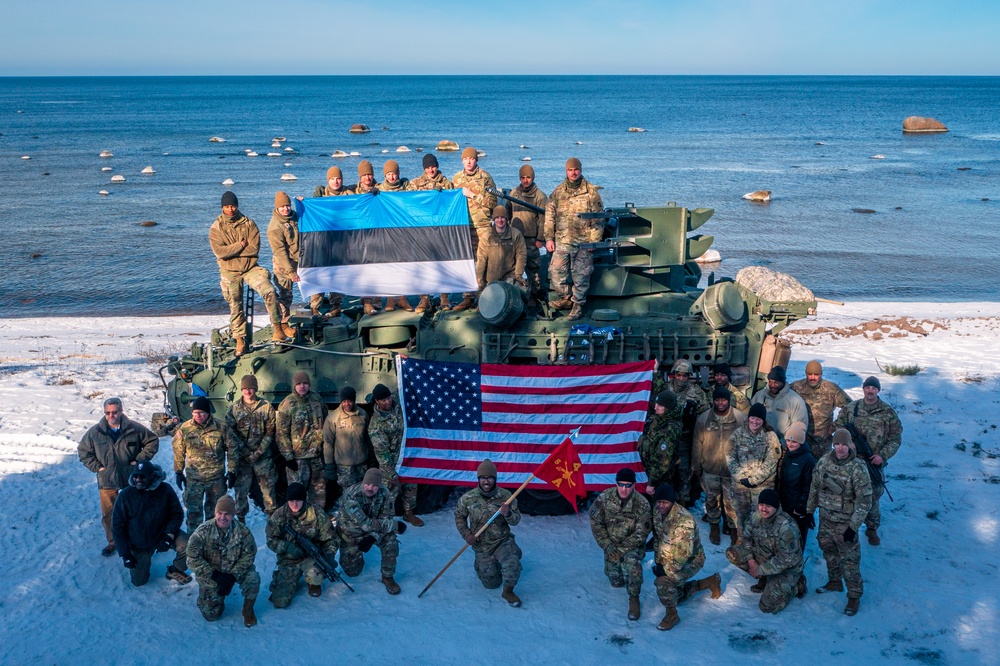
Photo: U.S. Army / 10th Army Air & Missile Defense Command. DVIDS public domain.
Engagement geometry against the weaponised Group 1 threat
A bare DJI Mavic-class platform presents an extremely small radar cross-section, low mass and high agility, the most awkward target the proximity fuze faces. A weaponised Group 1 quadrotor or hexacopter looks fundamentally different. A Mavic-3 carrying a modified RKG-3 or RGD-5 grenade (~1 kg), an Aerorozvidka- or Magyar’s-Birds-pattern hexacopter (the “Vampire” or “Baba Yaga” classes) carrying a 60 mm mortar bomb (~3.5 kg), or a heavier custom build releasing a 120 mm projectile, presents higher mass and reduced wing-loading margin (the carrier flies more slowly, climbs more conservatively, manoeuvres less aggressively); a larger and denser radar cross-section (the metallic mortar body or grenade case sits at the geometric centre of the radar return); a recognisable flight signature (terminal dive on an armoured target, level flight to a release point, hover-and-drop); and the prospect of secondary effects on the payload (fragmentation envelope sized for 2–5 m miss distance against the carrier delivers fragments to the explosive payload in most engagement geometries, with sympathetic detonation or in-flight deflagration as the typical outcome).
The implication is that the 30 mm proximity round is markedly more effective against the Ukrainian-pattern weaponised Group 1 platform than against a bare reconnaissance quadrotor, and it is the weaponised platform, not the bare scout, that drives the strategic threat picture. The bare reconnaissance quad remains the residual problem, addressed better by lasers, electronic-attack and net solutions.
3. MADIS: the Marine sister system
The Marine Corps’ counterpart to SGT STOUT is the Marine Air Defense Integrated System, MADIS. Where the Army integrates radar, EO/IR, gun and missiles on a single Stryker A1 hull, the Marines distribute the effects across a two-vehicle sensor-shooter team mounted on Joint Light Tactical Vehicles. The doctrinal philosophy is different. The round it consumes is the same.
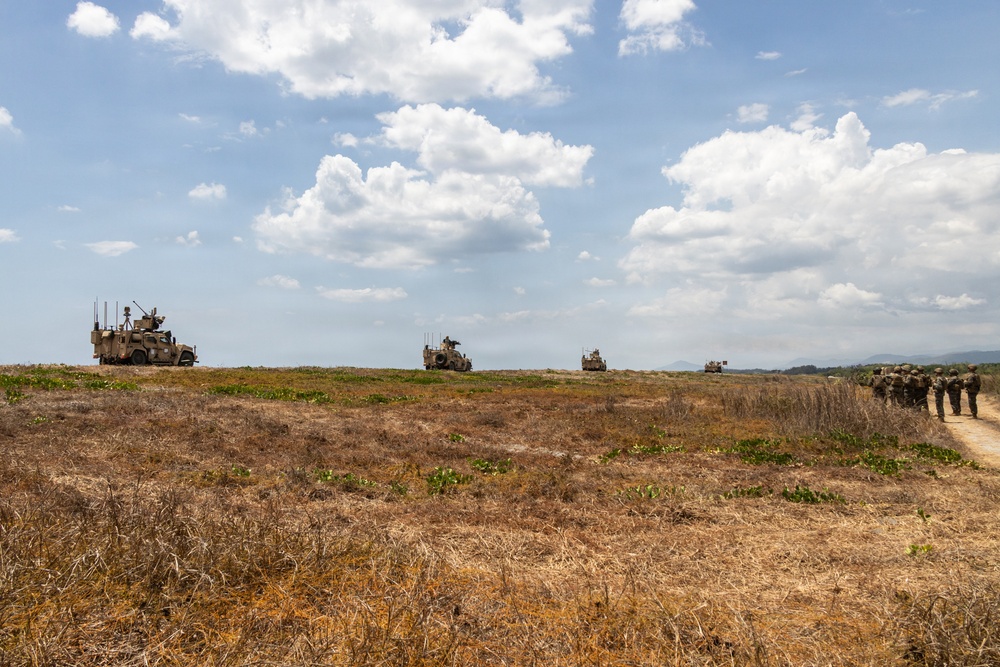
Photo: Sgt Atticus Martinez, U.S. Marine Corps. DVIDS public domain.
The Marine Corps developed MADIS to close the mobile air-defence gap left by the retirement of the Avenger system in the mid-2000s, and to meet the rapid drone proliferation seen in conflicts from ISIS through to near-peer adversaries. The programme advanced under Program Manager Ground-Based Air Defense (PM GBAD) at Program Executive Office Land Systems from 2018, using commercial-off-the-shelf and government-off-the-shelf technologies to compress the timeline. Low-rate initial production live-fire testing took place at Yuma Proving Ground in December 2023, with multiple drones defeated by both Stinger and 30 mm cannon. First full-rate production systems were unveiled in September 2025, with initial fielding to the 3rd Littoral Anti-Air Battalion (3d LAAB) of the 3rd Marine Littoral Regiment and operational use in Balikatan 2025 in the Philippines and at Pohakuloa Training Area in Hawaii. The Approved Acquisition Objective is approximately 190 systems (vehicle pairs) with Full Operational Capability targeted around FY2031 across twelve LAAD-battalion batteries.
MADIS supports the Marine Corps’ Force Design 2030 and Expeditionary Advanced Base Operations (EABO) concepts. It gives forward-deployed Marine Littoral Regiments and Low Altitude Air Defense (LAAD) battalions organic, self-contained air-defence coverage in dispersed Indo-Pacific posture, without heavy reliance on joint-force assets. That doctrinal context shapes the platform: MADIS is built to operate in pairs at the small-unit level and to be lifted by the same logistics chain as the rest of the MLR.
Mk1 and Mk2: the sensor-shooter pair
MADIS Mk1 (kinetic / engagement vehicle). The shooter. Carries the two-round FIM-92 Stinger Air-To-Air Launcher (ATAL), a Raytheon/RTX product line integrated as a kit on the Kongsberg Protector RS6 remote weapon station, with dismount reload Stingers in the cargo bed; the XM914E1 30 mm chain gun (a Marine-specific variant of the M230LF: percussion primer, single-feed, distinct from the Army’s electric-primed dual-feed XM914 on SGT STOUT) on a remote weapons station; Lockheed Martin EO/IR sensors; and a multi-functional electronic-warfare suite, the Sierra Nevada Corporation Modi II, for jamming, spoofing and disruption of drone command-and-control links.
MADIS Mk2 (sensor / command-and-control vehicle). The eyes and brain. Carries the DRS RADA RPS-62 360° hemispheric radar (the production-standard fit on the FRP MADIS Mk2; the legacy RPS-42 designation belongs to the older Multi-Mission Hemispheric Radar family and appears in pre-2025 trade press describing the developmental / LRIP configuration), a small-RCS specialist that detects drones from near-ground level out to approximately 30 km range and across altitudes from 30 to 30,000 feet. Its command-and-control suite supports Beyond Line-of-Sight networking and integrates with the Common Aviation Command and Control System (CAC2S), the Marine Air Command and Control System (MACCS), and the Joint All-Domain Command and Control (JADC2) framework. The full-rate production Mk2 accepted by the US Marine Corps on 15 December 2025 carries the M240C 7.62 mm coaxial on the same Protector RS6 mount as the Mk1, the same XM914E1 30 mm chain gun, the same EO/IR sensor, and the same Modi II EW suite as the Mk1.
The doctrinal innovation in MADIS is the layered-effects sequencing. EW, jamming the drone’s command link, spoofing its GPS, disrupting its video downlink, is the first line of defence. Kinetic options (Stinger or 30 mm gun) are the second. That sequence consumes fewer rounds per intercept than a kinetic-first posture; in many engagements the Modi II resolves the drone before the gun is needed. Compared with SGT STOUT’s primarily kinetic-first close-in role, MADIS conserves ammunition by burning electrons first.
The target set is broader: Groups 1–5 unmanned aerial systems, helicopters, low-flying fixed-wing aircraft, and emerging low-altitude cruise-missile threats. SGT STOUT’s nominal envelope is Groups 1–3; MADIS is engineered to handle Groups 4 and 5 (the larger reconnaissance and combat UAS, and the cruise-missile-class threat) when the EW suite cannot resolve the engagement. The 30 mm round itself is not the dominant effector against Group 5 targets, that is what the Stinger is for, but the platform retains the option.
L-MADIS and the demand-pool implication
A lighter variant, L-MADIS, scales the same architecture onto Polaris MRZR-class all-terrain vehicles for niche dispersed roles where the JLTV pair is too heavy or visible. L-MADIS allows MLR small units to take organic C-UAS coverage into the hardest expeditionary terrain. Whether L-MADIS retains the XM914E1 + XM1211 footprint or substitutes a smaller-calibre effector is not yet publicly disclosed; this is a flag for follow-up.
The strategic implication for the 30 mm round programme is the most important point in this section. SGT STOUT and MADIS draw on the same XM1211, XM1198, XM1223 and XM1225 production pool. They use the same Northrop Grumman cartridge ecosystem, the same L3Harris fuze cluster, the same Holston AAP energetic precursor. The Northrop Grumman master IDIQ contract W519TC24F0158 ($273 m ceiling) is a US Army contract, but Marine Corps demand is an additional pull on the same production base. The 144-system / four-battalion SGT STOUT figure does not include MADIS; nor does the 200,000–250,000 round XM1211 procured-plus-on-contract figure capture USMC LAAD-battalion demand. The total combined Army+USMC requirement is materially higher than the Army-only inventory-gap arithmetic indicates, expanding both the requirement and the gap, and lengthening the timeline to operational maturity unless production scales accordingly. A precise USMC fleet figure is not yet publicly disclosed at battalion-by-battalion granularity; that is a flagged data gap.
4. Per-round and per-kill economics
The cost story for advanced 30 mm cartridges has to be told in two layers. The first is unit cost, the price of a single round leaving the production line. The second, more useful, is engagement cost, the dollars expended to actually kill a target, factoring in the burst length needed for a high-confidence intercept.
| System | Approx. unit cost (USD) | Source basis |
|---|---|---|
| FIM-92 Stinger Block I | ~$430,000 | FY24 US Army contract reporting |
| AIM-9X Sidewinder | ~$485,000 | FY25 DoD budget submission |
| Coyote Block 2 interceptor | ~$100,000–125,000 | RTX (Raytheon) contract awards 2023–2025 |
| XM1211 HEP (programme-of-record) | $1,894–$2,598 | Programme-of-record band; varies by quantity and fiscal year |
| XM1223 MMPA (FY27) | $2,369.02 | FY27 budget figure |
| M789 HEDP (legacy) | $1,000–$1,600 | Legacy ground-target round |
| Rheinmetall 30 mm DM21 KETF | ~$1,000–1,200 | Bundeswehr Puma framework derivation |
| Rheinmetall 35 mm AHEAD (premium) | ~$1,000–1,500 | Forbes 2025; analyst $600–1,200 |
| Shahed-class one-way attack UAS | ~$20,000–50,000 | Open-source Iranian production cost |
| Group 1 weaponised quadrotor + payload | ~$1,500–5,000 | Ukraine theatre reporting |
At programme-of-record pricing the XM1211 sits firmly above the European programmable peer band, not below it. American manufacturing scale has not yet delivered the price advantage that the underlying industrial base ought to make achievable, because the XM1211 is still in the transition between Urgent Materiel Release low-rate production and full-rate. The forward-looking analytical floor, approximately $900 per round, would put US production decisively below the European peer if the L3Harris sevenfold ramp lands and if the hand-assembled proximity module is automated. That figure is at present aspirational, not operational.
Per-kill engagement cost at programme-of-record pricing is therefore:
- XM1211 at $2,250 mid-range × 2–3 rounds per kill (manufacturer figure, Hafften): $4,500–$6,750 per kill.
- XM1211 at $2,250 × 3–5 rounds per kill (conservative): $6,750–$11,250 per kill.
- XM1223 at $2,369 × 2–4 rounds per kill (programmable airburst typically more efficient): $4,738–$9,476 per kill.
Against a $30,000 Shahed-class drone, even the worst-case $11,250 burst delivers a 2.7:1 cost win for the defender. Against a $430,000 Stinger engagement, the alternative until very recently, the cost ratio against the same Shahed inverts from 14:1 in the attacker’s favour to better than 38:1 in the defender’s favour. That is the financial rationale for the entire programme. It is not free; it is the right answer at a real but manageable cost.
Against a $1,500–5,000 weaponised Group 1 quadrotor at current pricing the dollar arithmetic sits at parity or slightly in the attacker’s favour. The defender’s winning calculus is then expressed in payload-effects-denied: a single intercepted strike on an armoured fighting vehicle, a fuel point or an aircraft on the ground saves an asset worth several orders of magnitude more than the burst that killed the carrier.
5. SGT STOUT and MADIS fleet inventory and the gap
The SGT STOUT fleet today is four active-duty battalions, totalling approximately 144 systems: 5-4 ADA in Germany (fully fielded), 4-60 ADA at Fort Sill (fully fielded), 6-56 ADA at Fort Hood (fielded), and 2-55 ADA at Fort Bragg (completing FY26 fielding). The FY26 Army Procurement of Missiles Justification Book identifies 230 total approved systems as the programme of record: the 144 Directed Requirement plus 20 systems under Public Interest Determination plus 66 systems approved through Acquisition Decision Memorandum under Middle Tier Acquisition Rapid Fielding. Florida and Ohio Army National Guard fieldings are programmed for FY28–FY29 within that 230-system envelope. Any expansion beyond 230 is currently aspirational rather than budgeted.
For the XM914-equipped Army fleet (electric-primer ammunition), the operational ammunition-load arithmetic is:
| Loadout state | 30 mm rounds required (whole fleet) |
|---|---|
| Full load (one complete distribution) | ~184,000 rounds |
| Full load + three reloads (sustained-rate operational requirement) | ~735,000 rounds |
Against this requirement the inventory position breaks out as follows:
| Round | Procured + on contract | Estimated requirement | Shortfall |
|---|---|---|---|
| XM1211 HEP | ~200,000–250,000 | 500,000–700,000+ | ~300,000–500,000 |
| XM1223 MMPA | ~4,000–8,000 | 150,000–250,000+ | ~140,000–245,000 |
| Combined | ~204,000–258,000 | 650,000–950,000+ | ~440,000–745,000 |
The XM1223 gap is proportionally far worse than the XM1211 gap and reflects the round’s low-rate-production status. The combined shortfall of 440,000–745,000 rounds is the binding operational constraint on SGT STOUT’s sustained-campaign capability. Until it closes, the fleet will fight with mixed loadouts of XM1211, XM1198 HEDP-SD and legacy M789, a doctrine the Army has accepted as the bridge solution while the supply chain matures.
Closing the inventory gap at the programme-of-record unit-cost band (XM1211 at $1,894–$2,598; XM1223 at $2,369) is approximately a $1.0–$1.9 billion ammunition-only programme cost, before any expansion of the eight-battalion fielding plan. Per battalion, one full load plus three reloads at mid-range pricing represents approximately $215 million in ammunition outfit alone. Full operational maturity for the SGT STOUT 30 mm advanced-cartridge ecosystem is realistically not until 2028–2030.
The figures above cover the Army fleet only. The USMC MADIS programme has an Approved Acquisition Objective of approximately 190 systems (vehicle pairs) with Full Operational Capability targeted around FY2031 across twelve LAAD-battalion batteries. MADIS Mk1 fires the same XM1211 / XM1198 / XM1223 / XM1225 projectile family but on percussion-primed cartridges, distinct from the Army’s electric-primed stock. The projectile-manufacturing line is shared between services, but the cartridge primer cannot cross-feed between Army and Marine inventories. The published Army inventory-gap arithmetic does not capture USMC demand; combined Army-and-USMC demand expands both the requirement and the gap, and the inventory pool effectively splits into two non-interchangeable cartridge streams.
Production is now scaling. L3Harris delivered approximately 500,000 proximity fuzes in 2025 (+80% year-on-year) under an $871 million US Army Indefinite-Delivery / Indefinite-Quantity contract, with an explicit sevenfold ramp programme that supports VAMPIRE, the 30 mm proximity-round family, and other counter-UAS munitions. Northrop Grumman’s current XM1211 output is approximately 1,000+ rounds per month, with a planned five-fold further increase under the December 2025 contract. Earlier total US XM1211 stock was reportedly only "a few hundred rounds" before the December 2025 contract; the 200,000–250,000 rounds procured-plus-on-contract figure represents the breakout from that low baseline. Steady-state annual demand once all platforms are fielded sits in the 20,000–100,000+ rounds-per-year band; phased FY budget lines (~40,000 in a recent year, ~6,500 in FY27) understate the ultimate steady-state because they reflect production-line phasing rather than operational requirement.
The honest read on production timeline: with high confidence the US can meet 30 mm advanced-cartridge demand by 2027+, with moderate confidence in the near term. The L3Harris ramp is delivering. The Northrop Grumman line is scaling. Second-source qualification is in progress. The constraint is no longer the round, it is the proximity fuze module specifically, and the L3Harris seven-fold throughput programme has to land on schedule.
6. The Stinger missile question
The 30 mm round is one of two missile-class effectors on SGT STOUT and MADIS. The other is the FIM-92 Stinger. Stinger’s industrial story runs in parallel to the 30 mm round’s: production rate constrained by component obsolescence, an inventory drawdown still being recovered, a successor programme on a 2028 horizon, and a combined Army-and-Marine-Corps demand pool that the existing production base cannot fill within the bridging period.

Photo: SPC Patrick Connery, U.S. Army. DVIDS public domain.
Per-platform Stinger complement
| Platform | Stinger ready load |
|---|---|
| SGT STOUT (US Army M-SHORAD Inc 1) | 8 ready missiles in 2× 4-round Stinger Vehicle Universal Launchers (SVULs); previous 4 Stinger + 2 Hellfire Longbow being phased to dual SVUL |
| MADIS Mk1 (USMC) | 4 ready in turret pod + dismounted handheld Stinger launchers (typically 2–4 additional) carried in the vehicle |
| Avenger M1097 (legacy, retired) | 8 ready in 2× 4-round Standard Vehicle Missile Launchers (SVMLs) |
| AH-64 Apache (air-to-air) | Up to 4 AIM-92 ATAS in twin-tube wingtip pods (2 per pod) |
| MANPADS (dismounted) | 1 ready in gripstock launcher; reload missiles carried by the gunner / loader |
| VAMPIRE (L3Harris) | Does not use Stinger. Uses APKWS-guided 70 mm rockets in a 4-round palletised launcher |
| M-LIDS | Does not use Stinger. Effectors are Coyote interceptors and 30 mm cannon |
Production restart, contracts and the manufacturing constraint
Raytheon stopped producing new Stingers in 2002 after the US Army concluded its planned orders. The line was dormant for twenty years. Russia’s February 2022 invasion of Ukraine triggered the emergency restart. RTX (Raytheon Technologies) chief executive Greg Hayes told investors at the time that the company would not be able to ramp production until 2023, partly because the Stinger had been scheduled for replacement and contained obsolete components requiring redesign for modern procurement.
| Date | Contract | Value | Quantity / scope |
|---|---|---|---|
| 27 May 2022 | Ukraine Supplemental emergency replenishment | $624 million | 1,300 missiles: first major restart contract |
| 2023 | Replenishment contract | $687 million | 1,468 missiles: further Ukraine drawdown replenishment |
| September 2024 | Stinger missiles and support | $126 million | Includes $20.1 m Block I modification, work in Tucson, AZ |
| July 2025 | Stinger Air-to-Air Launchers (USMC) | $51.9 m modification ($96.25 m cumulative) | Full-rate production launchers; Tucson AZ + Diné NM; completion September 2026 |
| August 2025 | RTX–Diehl Defence MOU | Undisclosed | European co-production of key Stinger elements: capacity extension |
| September 2025 | Army Stinger production contract | $578–579 million | Largest single Stinger procurement of FY25 |
Cumulative Stinger-family awards across the four-year restart period total approximately $2.07 billion, an order of magnitude above the pre-2022 sustainment posture. The US Army expects monthly production to reach 60 missiles per month by 2025 (~720 per year), up 50 per cent from the prior rate, with full high-rate production slated for 2026.
The binding manufacturing constraint is the seeker’s Dual Detector Assembly (DDA), a sensor combining infrared and ultraviolet detectors. The original DDA part is no longer in production; Raytheon is redesigning the DDA to enable sustained manufacturing. First deliveries of Stinger missiles equipped with the new DDA are expected in 2026. Until that redesign lands, the 60-per-month figure is a target rather than a reality. The RTX-Diehl Defence Memorandum of Understanding signed in August 2025 opens a co-production source in Europe that is independent of US capacity and provides surge depth that would otherwise be unavailable.
Inventory drawdown and stockpile position
By 7 March 2022, the United States and NATO allies had together sent more than 2,000 Stinger missiles to Ukraine. Subsequent transfers brought the US contribution alone above 1,400 missiles. Combined with German (500) and Dutch (200) contributions, Ukraine received more than 2,100 Stingers from these donors. By May 2022 the United States had sent at least 25 per cent of its aging Stinger missile stockpile to Ukraine, the figure that triggered the House Armed Services Committee call for a next-generation replacement. The pre-war absolute stockpile is not publicly disclosed; the 25 per cent drawdown arithmetic implies a minimum pre-war US inventory of approximately 5,600 missiles, but the actual figure may be higher.
SGT STOUT and MADIS Stinger demand: the arithmetic
The ready-load demand on the Stinger pool is straightforward. The Marine Corps’ MADIS Approved Acquisition Objective is approximately 190 systems (vehicle pairs) with Full Operational Capability targeted around FY2031 across twelve LAAD-battalion batteries. At 4 ready Stingers per Mk1 plus dismounted spares carried in the vehicle, the basic MADIS loadout across the AAO is approximately 760 missiles, and the total MADIS requirement with training stock, war reserves and replenishment lands at 1,500–3,000 missiles.
The Army adds 230 SGT STOUT systems × 8 missiles per system = 1,840 ready Stingers at full dual-SVUL retrofit, plus reload-on-vehicle and battalion-level reserve. Stinger doctrine typically operates at a tighter reload posture than 30 mm cannon: the missile is shorter range, the engagement timeline more compressed, and combat experience suggests a one-ready-load-plus-one-reload posture is operationally credible. At that posture SGT STOUT requires approximately 3,680 Stingers; together with MADIS, the residual Avenger fleet, Apache ATAS reserves and MANPADS holdings, the combined US requirement sits in the band of approximately 6,000–8,000 missiles for fleet operational sufficiency through 2031.
That figure is achievable within the funded production window. The Raytheon production rate of approximately 60 missiles per month (~720 per year) once the DDA redesign lands, combined with the 1,900+ Stinger missiles already refurbished back into operational inventory and the September 2025 contract that funds production through September 2031, brings the supply line into rough equilibrium with the demand curve. The RTX-Diehl Defence European co-production memorandum signed in August 2025 adds further surge depth on top.
NGSRI: the successor
The Next-Generation Short-Range Interceptor (NGSRI) is the programme of record to replace Stinger. In September 2023 the US Army DEVCOM Aviation & Missile Center awarded competing prototype contracts to RTX Raytheon Land & Air Defense Systems and Lockheed Martin Missiles and Fire Control. Lockheed’s design is designated QuadStar. RTX tested its NGSRI in February 2025 (advanced seeker, flight rocket motor, man-portable command launch assembly, warhead). Lockheed Martin conducted its first NGSRI test fire on 13 January 2026. A formal shoot-off between prototypes is scheduled for FY2026 at White Sands Missile Range or Yuma Proving Ground under realistic operational conditions including drone swarms, terrain masking, cruise missiles and electronic-warfare environments. The Army intends to select a single vendor in FY2028, with initial production in 2028.
Performance over Stinger is meaningful. NGSRI is expected to accelerate beyond Mach 3 (against Stinger’s Mach 2.17) and intercept targets at approximately 9 km (against Stinger’s 4–8 km). It is designed against helicopters, fixed-wing aircraft, cruise missiles and hypersonic weapons, a target set Stinger does not credibly cover. The Congressional Research Service confirms that NGSRI will replace the Stinger missiles on SGT STOUT with new missiles "intended to be mounted and soldier-portable as well as new 30-millimeter ammunition." NGSRI is therefore the destination state for both the Stinger and the 30 mm advanced cartridge family.
7. Critical materials, China’s use, and US national capability
The XM1211 fuze module contains microelectronics, tediously assembled by hand onto circuit boards that compete across industries, resulting in long lead times, higher unit cost, and inconsistent quality from undefined process control. That JPEO A&A admission, in the US Army AL&T magazine in July 2024, is the most important industrial-base statement on the round in the public record. It explains why “limited production” persisted from FY22 fielding to mid-2024, and why the December 2025 Northrop Grumman contract is the breakout from low-rate production rather than a routine production order.
The materials picture matters because it determines whether that breakout can hold. The article elsewhere uses “rare-earth dependency” loosely. The strict scientific definition of rare-earth elements covers fifteen lanthanides plus scandium and yttrium. The materials of greatest concern for the XM1211 fuze module are mostly NOT rare earths in this strict sense: they are critical materials under Chinese export control. Five chokepoints carry direct relevance to 30 mm advanced-cartridge production:
| Material | Use in the round | China export control | US domestic capability |
|---|---|---|---|
| Gallium | GaAs / GaN semiconductors in the proximity-fuze RF oscillator and receiver | Licensing imposed July 2023 | Zero primary production since 1987. Imported low-purity gallium refined in New York. 2024 imports valued at ~$4 m metal + ~$140 m GaAs wafers (USGS 2025 MCS). At least one US firm exploring restart. |
| Germanium | Legacy RF circuits, IR optics | Licensing imposed July 2023 | Small primary production from a zinc concentrate mine in Alaska, refined in Canada. A Tennessee mine remains suspended. UT firm produces germanium wafers from imports and recycled material. |
| Antimony | Priming compositions, fragmentation hardening, IR sensors, night vision | Licensing imposed 15 August 2024 (effective 15 September 2024). Shipments from China subsequently dropped 97% with prices rising 200%. | Zero primary US mine since the 1980s. Perpetua Resources’ Stibnite Gold Project in Idaho began initial construction October 2025; commercial production targeted late 2028. Reserves of 148 million pounds of antimony to supply ~35% of US annual demand over a 15-year mine life. US Army has invested in establishing Stibnite’s antimony sulfide capability. |
| Graphite | Anode material in lithium reserve batteries (the dominant fuze power supply) | Licensing imposed October 2023 | Very limited natural-graphite production. Synthetic-graphite production in development. Australia and Mozambique are the principal alternative sources. |
| Tungsten | Pre-formed fragmentation in some airburst designs (the European AHEAD round uses 152 tungsten sub-projectiles; the US single-burst design uses materially less) | Licensing imposed February 2025 | No primary US tungsten mine since 2015. Sandfire Resources and other juniors progressing, but no near-term production. |
A bilateral suspension presently applies to the US for several of these controls following 2025 negotiations. The status is fluid; the controls could be reimposed at short notice. The strategic posture for the SGT STOUT 30 mm advanced-cartridge programme is therefore exposed at five separate material chokepoints, with US national supply capability ranging from “limited but recoverable” (germanium, graphite) to “effectively zero in the short term” (gallium, primary tungsten, primary antimony until Stibnite reaches production).
Rare-earth elements proper are now directly attested. The XM1211 fuze module’s sensors and actuators use neodymium-iron-boron (NdFeB) permanent magnets. China dominates approximately 60 per cent of rare-earth mining and 80–90 per cent of processing globally. US national mitigation is in motion: MP Materials’ Mountain Pass facility in California is ramping production and processing; allied supply through Australia (Lynas Rare Earths and other producers) is increasing; and the US Department of Defense has made Defense Production Act investments in Mountain Pass and adjacent facilities to expand domestic processing capacity. The honest assessment is that NdFeB is not a hard blocker on the XM1211 production path but is a material requiring ongoing monitoring through the production ramp.
The honest reading of the XM1211 critical-materials position is therefore measured rather than alarmist. Five Chinese-controlled chokepoints (gallium, germanium, antimony, graphite, tungsten) plus the NdFeB rare-earth dependency present real exposures, but each one has a US or allied mitigation path of varying maturity: Mountain Pass for rare earths, Stibnite for antimony, gallium-restart projects, allied supply contracts for graphite and tungsten, and the bilateral suspension on Chinese controls holding the short-term line. Strategic material reserves carry the gap. The article’s industrial-base argument depends on these projects landing on schedule alongside the L3Harris fuze ramp; the directional momentum is favourable.
8. Single-source manufacturing risk
Northrop Grumman is the only qualified producer of the XM1211 round. Dave Fine, Vice President of Armament Systems at Northrop Grumman, said so explicitly when the December 2025 contract was announced: “As the only qualified producer of the XM1211 proximity round, Northrop Grumman is uniquely positioned to deliver this urgent need.” The 3 December 2025 contract worth more than $200 million on a master IDIQ ceiling of approximately $273.53 million confirms the sole-source position. Production runs across four facilities:
- Plymouth, Minnesota — cartridge case manufacture
- Elk River, Minnesota — cartridge case manufacture (second site)
- Allegany Ballistics Laboratory, Mineral County, West Virginia — energetic loading
- Radford Army Ammunition Plant, Pulaski County, Virginia — additional energetic capacity
The Holston Army Ammunition Plant in Kingsport, Tennessee is the sole US source of the RDX and HMX explosive precursor for the LX-21 / PBXN-9 fill. L3Harris (whose FALCO-family proximity-fuze technology is the closest publicly described analogue to the XM1211 fuze) is the dominant proximity-fuze prime; DRS Technologies and a small set of subcontractors hold the remaining active production lines.
The mitigations are visible but incomplete. A second-source qualifier for XM1211 production is in qualification at the time of writing; identity not yet publicly confirmed. JPEO Armaments & Ammunition has invested in increasing the manufacturing throughput of the liquid reserve battery (a critical fuze sub-component common across multiple proximity C-UAS munitions). L3Harris has publicly announced a sevenfold proximity-fuze capacity-expansion programme with first incremental tranches scheduled to come online from late 2026. None of these are complete.
The single-source structural risk is the dominant industrial vulnerability of the XM1211 / XM1223 / XM1225 programme. The L3Harris ramp and the second-source qualification are the two visible mitigations; both are still in execution, and either could slip.
9. Financial obligations and the programme cost
| Obligation | Value | Status |
|---|---|---|
| Northrop Grumman master IDIQ contract W519TC24F0158 | $273.53 m ceiling | Active; covers XM1211 production |
| L3Harris US Army IDIQ for proximity fuze production | ~$871 m | Active; sevenfold capacity ramp; 500,000 fuzes delivered 2025 (+80% YoY) |
| Raytheon Stinger production through September 2031 | $579 m (Sep 2025 award) | Funded production line; 1,900+ refurbished missiles in parallel |
| Northrop Grumman task order, December 2025 | >$200 m | Production commitment under W519TC24F0158 |
| L3Harris proximity-fuze ramp programme | Undisclosed | Sevenfold capacity expansion; first tranche late 2026 |
| JPEO A&A liquid-reserve-battery throughput investment | Undisclosed | Common component across the proximity portfolio |
| Second-source XM1211 qualification | Undisclosed | In qualification |
| Stibnite Gold Project (US Army antimony investment) | ~$1.3 bn project; US Army stake | Construction; commercial production late 2028 |
| SGT STOUT inventory gap closure (XM1211 + XM1223) | ~$1.0–1.9 bn | Programme cost to reach full load + three reloads |
The headline number in this table is the inventory gap closure. To reach the operationally meaningful state, one full load plus three reloads across the eight-battalion plan, requires approximately one billion to nearly two billion dollars of ammunition procurement above the 2026 baseline. Whether that money is appropriated, and whether the production base can absorb it within the FY26–FY30 window, is the single biggest variable in the SGT STOUT capability story. The L3Harris fuze ramp and second-source qualification are the limiting inputs; the appropriations cycle is the limiting authority.
Per-engagement cost stays favourable across the entire pricing range. At full programme-of-record pricing the defender wins on dollar arithmetic against any threat costing more than approximately $5,000 to field. Against a $1,500–5,000 weaponised quadrotor the dollar logic is parity or slight loss; the win is in payload-effects-denied. Against a Stinger-class alternative the defender always wins by an order of magnitude.
10. The European peer benchmark
The European programmable airburst round is the relevant peer benchmark for the US programme: not because Rheinmetall and Saab compete for US procurement, but because their decade-plus production record is the open-source proof that an advanced 30 mm cartridge category can be matured, fielded and sustained.
Rheinmetall 30 × 173 mm DM21 KETF. Tungsten sub-projectile design ejected at programmed time-to-target via inductive muzzle programmer. Fits the MK30-2/ABM cannon on the Puma IFV and the Skyranger 30 turret being procured by Germany, Austria, Hungary and Denmark. Bundeswehr framework worth €576 million for over 600,000 mixed-nature rounds (2022, expanded toward €1 billion total in 2026). KETF-variant unit cost approximately $1,000–$1,200.
Rheinmetall 35 mm AHEAD. Flagship of the Skyranger family, in service since 2010 on Skynex and Gepard upgrades. Ejects 152 pre-formed tungsten sub-projectiles at programmed time, generating an estimated ~10–15 m² intercept zone at the optimum miss distance, a useful comparator metric for hybrid-warhead arguments. The density beats the US single-burst envelope at the cost of a programmer dependency and tungsten supply exposure. Forbes’ 2025 industry analysis assesses the premium AHEAD anti-drone round at “likely over $1,000 per shot”; analyst sites place the band at $600–1,200. The 2023 German contract for Ukraine’s Gepards (€168 million for 300,000 modified rounds) priced at approximately €560 per round, but those were modified existing high-explosive incendiary and APDS-T natures, not the premium programmable AHEAD.
The European data establishes that an advanced programmable 30 mm airburst round can be made at $1,000–$1,500 per shot using boutique European manufacturing. The US round at programme-of-record pricing (currently $1,894–$2,598) sits above the European peer band. American manufacturing scale ought to deliver a lower unit cost once the L3Harris ramp lands, that is the structural advantage the US can unlock. Until then, the European peer is the cheaper substitute. The supply chains do not, however, drop into US platforms: AHEAD, KETF, 3P and CT40 each use a different fuze interface, a different cartridge case dimension and fire-control software integrated to specific national turrets. None of them feed the M230 or XM914 chamber. The US capability remains, for the foreseeable future, a US-fed capability.
11. Technical evolution and gap-closing levers
The XM1211 family is mature. The next generation will not be a clean-sheet replacement; it will be incremental evolution along five visible levers, and each one widens the cost-asymmetry advantage that the round already delivers.
Edge AI / ML fuze discrimination. Current XM1211 fuzes use onboard clutter-discrimination algorithms to reject ground returns, decoys and multi-path artefacts, calculating closest point of approach in real time. The next step is signature-based classification at the fuze: lightweight edge machine-learning models that distinguish a small UAS from a bird from a piece of foliage by RCS signature, propeller modulation and Doppler shape. Adaptive thresholding lets the fuze stay armed in cluttered electromagnetic environments without falsely triggering. “Smart burst” logic, the fuze signalling back to the gun the optimum salvo length or self-destruct gating, is the natural extension. DEVCOM Armaments Center cognitive-sensing investments are visible in the open-source record; integration into the XM1223 successor or a Block II XM1211 is the realistic path.
Warhead evolution, hybrid directed fragmentation. The XM1211’s natural-plus-controlled fragmentation envelope works well at 2–5 m miss distance against soft, lightly built UAS structures. For longer-range or higher-aspect engagements against fast, manoeuvring Group 1–2 targets, hybrid directed-fragmentation, pre-formed tungsten pellets in selected sectors of the warhead, or selectable EFP-style liner geometries, would lift Pk per round. The European comparator is instructive: Rheinmetall’s 35 mm AHEAD ejects 152 pre-formed tungsten sub-projectiles in a forward cone, generating an estimated ~10–15 m² intercept zone at the optimum miss distance. That density beats a single-burst envelope at the cost of a programmer dependency and tungsten supply exposure. A US hybrid, selectable payload variants in XM1223 or an XM1227-class follow-on, would deliver the directed effect without the timed-airburst architecture.
Platform integration and dual-feed standardisation. The XM914 dual-feed is a near-term win that should be standardised across every M230LF / XM914 host: SGT STOUT, MADIS, M-LIDS and the Apache. In-belt or pre-belt programmable fuze setting (the XM1223 architecture extended) lets the gunner switch modes without breaking belt. Tighter fusion of the multi-mission radar, the EO/IR pod and the gun lay, predictive lead generation, burst-length optimisation against the actual target signature, automated salvo discipline, converts the platform’s existing magazine depth into the right number of engagements. At 250–400 rounds per vehicle and the manufacturer’s 2–3 round burst figure, that is approximately 50 to 130 intercepts per vehicle reload cycle. Modelling that against sustained swarm scenarios is the work that decides whether the inventory gap, when closed, is sufficient.
Production scalability, automation and parallel paths. The hand-assembly bottleneck on the proximity module is the single largest cost-reduction lever. Automated robotic-assembly lines, qualified for the same fuze module, would target a 30–50% unit-cost reduction at scale: bringing the round from $1,894–$2,598 today toward the $900–$1,300 band that the L3Harris ramp and a second qualified producer could deliver. Parallel paths matter: commercial microelectronics foundries adapted for military-spec vibration and EMI requirements, second-source qualification beyond Northrop Grumman, and the JPEO A&A liquid-reserve-battery throughput investment all need to land. The combined effect is the structural cost-down that converts the article’s “right round at programme-of-record price” into “right round at decisively cheap price.”
Hybrid platform effects, co-mounted laser. SGT STOUT-class platforms are natural candidates for hybrid kinetic-and-directed-energy fitouts. A co-mounted high-energy laser (50 kW class) handles the bare reconnaissance quad, the XM1211’s residual problem, at near-zero cost-per-shot for as long as the magazine is hot. The 30 mm round handles the weaponised Group 1–2 platforms and the Shahed-class targets the laser cannot kill in a usable timeframe. Together they cover the threat spectrum with the cheapest-effective answer at each point. The US Army has been testing 50 kW laser-equipped Stryker prototypes at Yuma Proving Ground; the convergence with SGT STOUT is a fielding decision rather than a development one.
Metrics transparency. The article uses 2–3 (manufacturer) and 3–5 (conservative) round-per-kill bands and engagement geometries derived from open-source data. Pk curves against specific drone classes, environmental envelopes covering rain, wind, smoke and multi-path, and end-to-end engagement-cycle modelling (detection through reload) are all available inside the programme but not yet publicly disclosed. A reasonable public modelling target would be a 25–50% Pk improvement over the point-detonating M789 HEDP at 1–2 km engagement range, derived from the December 2025 Yuma data. Releasing characterised Pk-by-range curves at unclassified resolution would substantiate the round’s "3-to-5 times more effective than M789" claim with measurable confidence interval rather than manufacturer assertion. That transparency is the lowest-cost analytical lever in the entire stack.
Hybrid sensor backup against electronic warfare. The current XM1211 fuze is RF-only. As adversary electronic-warfare tooling against C-UAS effectors matures, an RF-only proximity fuze becomes vulnerable to deliberate jamming or spoofing in the terminal phase. A hybrid design adding a low-cost infrared or laser proximity sensor as backup, a fail-over channel rather than a primary, would harden the fuze against jamming while preserving the existing self-contained architecture. The sensor-fusion complexity is modest because the fuze module already accepts multiple inputs.
NATO interoperability and the cartridge-case gap. US 30 × 113 mm is a different cartridge case from the European 30 × 173 mm of Rheinmetall’s MK30-2/ABM (Puma IFV, Skyranger 30) and the heavier Bushmaster II naval mount. Coalition operations cannot rely on round-level cross-service substitution. Allied surge support has to come at the fuze-module or component-supply level, the RTX–Diehl pattern for Stinger is the template, not at the cartridge level. Any cross-Atlantic interoperability planning for 30 mm advanced cartridges has to start with that calibre-architecture reality.
APKWS / VAMPIRE proximity-fuze synergy. The APKWS-guided 70 mm rocket family used in the L3Harris VAMPIRE counter-UAS system is itself receiving proximity-fuze variants for engagement against small UAS. L3Harris is the producer of both the FALCO-family proximity fuzes and the APKWS C-UAS variants; commonality of fuze technology across the 30 mm and 70 mm calibre families would deliver economies of scale on the proximity-fuze line that benefit the XM1211 directly. The two programmes are technically distinct but feed from the same industrial base, and that overlap is a structural advantage if the industrial-base policy treats it as one ecosystem rather than two procurements.
12. Ammunition technician observations
For the AT in the magazine, in the issue point and on the gun line, the XM1211 introduces several practical considerations.
Storage and handling. HD 1.2, Compatibility Group E, consistent with the existing M789 HEDP family. Existing 30 mm ammunition holding magazines and licensed transport infrastructure accommodate the round without modification. The electronic fuze adds a small reserve-energy component that is expected to receive in-service safety-case revision under AOP-7 and STANAG 4439 in mid-2026; current transport classification stands pending that revision.
Compatibility. XM1211, XM1198 HEDP-SD and legacy M789 HEDP are all 30 × 113 mm and ballistically matched for mixed-belt loading. The XM914 fire-control solution is round-agnostic across the family. Recommended bridging mix for SGT STOUT is XM1211 (proximity, anti-air) + XM1198 (HEDP-SD, ground / anti-light-armour) until XM1223 fielding is complete and dual-feed becomes redundant.
Self-destruct and arming. The XM1211 retains the self-destruct architecture from XM1198, ensuring rounds that do not detonate via proximity or impact within range will self-destruct in flight. This minimises collateral risk in ground-to-air engagements over populated areas. Standard fuze-arming distance applies. Specific arming geometry is treated at unit level.
Reserve battery shelf life. The liquid reserve battery is the dominant shelf-life-limiting component in the fuze module. JPEO A&A’s investment in throughput should also drive battery shelf-life data into the record; current shelf life and storage-condition tolerances should be confirmed against the round’s Technical Manual on issue.
Climate qualification. Fuze and round are qualified across −54 °C to +71 °C. The reserve battery and electronic fuze components are sensitive to thermal transients; rapid thermal cycling should be avoided where the operational environment permits.
Identification and stock control. Unique-identifier marking and serialisation should follow JPEO A&A guidance. The DODIC AC61 and NSN 1305-01-696-9172 are the primary tracking handles.
Disposal. End-of-life disposal must consider both the energetic content and the electronic fuze. Recommended procedure is post-detonation incineration in approved facilities or controlled detonation per unit Standard Operating Procedure. The fuze contains rare-earth and critical-material components that may have material-recovery value; coordination with theatre disposal cells is recommended.
Training and live-fire familiarisation. The 30 mm M788 Target Practice round and the M977 TP-T provide ballistic-equivalent practice for crew familiarisation; live-fire training with XM1211 is constrained by the round’s cost and inventory position. Synthetic-environment training is the appropriate substitute for sustained gunner familiarisation.
13. NSN and MIL-SPEC reference
| Round | DODIC | NSN | FSC |
|---|---|---|---|
| XM1211 HEP | AC61 | 1305-01-696-9172 | 1305 (Ammunition, through 30 mm) |
| XM1198 HEDP-SD | To be confirmed | To be confirmed | 1305 |
| XM1223 MMPA | Pending full-rate fielding | Pending | 1305 |
| XM1225 APEX | Pending full-rate fielding | Pending | 1305 |
| M789 HEDP (lightweight) | To be confirmed (commonly cited) | 1305-01-268-9373 | 1305 |
| M788 TP (training) | To be confirmed | To be confirmed | 1305 |
The applicable military standards and NATO publications for the XM1211 family include:
- MIL-STD-1316 — Fuze Design, Safety Criteria for
- MIL-STD-810 — Environmental Engineering Considerations and Laboratory Tests
- MIL-STD-331 — Fuze and Fuze Components, Environmental and Performance Tests
- MIL-STD-882 — System Safety
- STANAG 4170 — Principles and Methodology for the Qualification of Explosive Materials for Military Use
- STANAG 4439 — Policy for Introduction and Assessment of Insensitive Munitions
- STANAG 4123 — Methods for the Determination of Hazard Classification
- AOP-7 — Manual of Data Requirements and Tests for the Qualification of Explosive Materials for Military Use
- AOP-15 — Guidance on the Assessment of the Safety and Suitability for Service of Munitions
- AOP-39 — Guidance on the Development, Assessment and Testing of Insensitive Munitions
14. ISC commentary
The American 30 mm advanced cartridge, XM1211 HEP in production at $1,894–$2,598 per round, XM1225 APEX validated against UAS at Yuma in December 2025, XM1223 MMPA approaching full-rate production through FY28, is a credible answer to one of the most awkward problems of the drone age. It moves the unit kill cost from the millions-of-dollars territory of an air-defence missile to a $4,500–$11,250 burst at current pricing. It does so on platforms that already exist, with no fire-control software change, no additional crew training and no new turret. It is the right round.
The qualifying observations come in three layers. First, the SGT STOUT inventory gap is real and binding: 440,000–745,000 rounds short of the operational requirement, $1.0–$1.9 billion of ammunition procurement to close. Second, the production base is sole-source at every node, with the proximity-fuze module hand-assembled and the cartridge case, energetic fill and proximity electronics each running through a single qualified producer. Third, the materials base is exposed at five separate Chinese-controlled chokepoints, with US national supply capability ranging from limited to zero on a three-to-five-year horizon.
The mitigations are visible. The L3Harris sevenfold fuze ramp is in motion. Second-source qualification for XM1211 is in progress. The JPEO A&A liquid-reserve-battery throughput investment is funded. The Stibnite Gold Project is in construction, with antimony production targeted for late 2028. MP Materials and the gallium-restart firms are running. Each of these is the right answer to the right problem. None is yet complete.
The strategic prize is the convergence: a US 30 mm round at full-rate production cost, on a SGT STOUT fleet of eight battalions with sustained-rate ammunition stocks, fed by a dual-source production base on a domestic critical-materials supply chain. That state is realistically not before 2028–2030. Until then, MADIS, M-LIDS and SGT STOUT will be capable American platforms that are intermittently rationed on ammunition, and the most consequential industrial story in counter-UAS is not the cannon, the radar or the turret. It is the fuze, the round, the cartridge case, the energetic, the gallium and the antimony, and they are being built in the United States.
References & further reading
- Primary — US Army. “Built to Hunt: Apache attack helicopter’s new 30 mm proximity ammunition”, US Army public release, 12 February 2026 — XM1225 APEX live-fire details and Yuma Proving Ground December 2025 results.
- Primary — JPEO A&A. Lt. Col. Paul Santamaria & Maj. Jake LaGue, “NEED FOR SPEED”, US Army AL&T magazine, 26 July 2024 — primary doctrinal source for the XM1211 lineage, the hand-assembly bottleneck, the programmable-mode list, and the family-tree extensions. https://www.army.mil/article/278344/need_for_speed
- Primary — Northrop Grumman. “Northrop Grumman to Produce High Explosive Proximity for the U.S. Army”, press release, 3 December 2025 (XM1211 HEP, >$200 m). https://news.northropgrumman.com/armaments/northrop-grumman-to-produce-high-explosive-proximity-for-the-u-s-army
- Rojoef Manuel, “US Army Orders $200M in Anti-Drone Shells From Northrop Grumman”, The Defense Post, 5 December 2025. https://thedefensepost.com/2025/12/05/us-anti-drone-shells/
- Miles Jamison, “Northrop Grumman Secures $200M Army Contract for XM1211 High Explosive Proximity Rounds”, Govconwire, 4 December 2025. https://www.govconwire.com/articles/northrop-grumman-army-xm1211-hep-round
- Jared Keller, “The Army is fielding a new ‘proximity’ round to take out incoming drones”, Task & Purpose, 21 October 2022. First confirmation of XM1211 fielding to Stryker. https://taskandpurpose.com/tech-tactics/army-xm1211-high-explosive-proximity-round-fielding/
- Tyler Rogoway, “AH-64 Apache Is Getting Proximity Fuzed 30 mm Cannon Ammo For Swatting Down Drones”, The War Zone, 16 February 2026. https://www.twz.com/air/...
- Paolo Valpolini, “Northrop Grumman: new life to the M230LF”, EDR Magazine, August 2022 — Hafften & McCollum on XM1211 architecture, kill rate, swarm-test gap and Sky Viper follow-on. https://www.edrmagazine.eu/northrop-grumman-new-life-to-the-m230lf
- Kaitlyn Tani & Anthony Amoroso, “INCREMENTAL ADVANCES”, USAASC (Army AL&T), 2021 — primary on M789 / XM1198 / XM1211 / MMPA development pipeline. https://asc.army.mil/web/news-incremental-advances/
- Army Recognition, “Northrop Grumman demonstrates EMAV-LW30 UGV armed with 30mm cannon”, 2 February 2022. https://www.armyrecognition.com/...
- USA Spending federal contract record W519TC24F0158 (master IDIQ ceiling ~$273 m). https://www.usaspending.gov/award/CONT_AWD_W519TC24F0158_9700_W519TC24D0007_9700
- USGS, Mineral Commodity Summaries 2025 — gallium, germanium, antimony, graphite, tungsten chapters. https://pubs.usgs.gov/periodicals/mcs2025/mcs2025.pdf
- Cory Combs et al., “China Imposes Its Most Stringent Critical Minerals Export Restrictions Yet”, CSIS, 2025. https://www.csis.org/...
- Global Trade Alert, “A Widening Net: A Short History of Chinese Export Controls on Critical Raw Materials”, 2025. https://globaltradealert.org/blog/...
- ORF America, “China’s Critical Mineral Export Controls: Background & Chokepoints”, 2025. https://orfamerica.org/newresearch/...
- Perpetua Resources, Stibnite Gold Project — Idaho antimony & gold development. https://perpetuaresources.com/project/
- Mining.com, “Perpetua Resources starts building $1.3B Stibnite gold-antimony mine”. https://www.mining.com/...
- US Army, “U.S. Army opens future domestic source of antimony sulfide”, 2024. https://www.army.mil/article/288633/...
- NATO STANAG 4439 (Insensitive Munitions); AOP-7 (Qualification of Explosive Materials); STANAG 4123 (Hazard Classification); MIL-STD-1316 (Fuze Safety Criteria); MIL-STD-810 (Environmental); MIL-STD-331 (Fuze Tests); MIL-STD-882 (System Safety). All current editions.
- General Dynamics Ordnance & Tactical Systems, 30 × 113 mm Ammunition Suite (M789 HEDP, M788 TP, M977 TP-T) product literature. https://www.gdots.com/munitions/medium-caliber-ammunition/30x113mm/
- RAND Corporation, “David vs Goliath: Cost Asymmetry in Warfare”, 2025 — broader cost-asymmetry framing for the C-UAS engagement.
- Congressional Research Service reports on M-SHORAD / SGT STOUT — 144 systems planned for four battalions, Increment 3 MMPA plans.
- Unmanned Airspace, “US Army tests Stryker-Based SHORAD laser counter-drone prototypes at Yuma Proving Ground”. https://www.unmannedairspace.info/counter-uas-systems-and-policies/us-army-tests-stryker-based-shorad-laser-counter-drone-prototypes-at-yuma-proving-ground/
- EOS Defence Systems Slinger remote weapon station (M230LF, 30 × 113 mm) — allied / parallel system reference for the dual-feed and proximity-airburst architecture.
- USMC Program Executive Office Land Systems / Program Manager Ground-Based Air Defense (PM GBAD), Marine Air Defense Integrated System (MADIS) programme documentation.
- Sierra Nevada Corporation, Modi II multi-functional electronic warfare suite (MADIS Mk2 EW component).
- DRS RADA Technologies (Leonardo DRS), RPS-62 S-band Enhanced Compact Hemispheric Radar (eCHR family — MADIS Mk2 primary sensor on the FRP configuration accepted 15 December 2025; the legacy RPS-42 is in the older MHR family and reflects the pre-FRP / LRIP configuration).
- USMC press releases on Balikatan 2025 and Pohakuloa Training Area MADIS deployments (3rd Marine Littoral Regiment / 3d Littoral Anti-Air Battalion).
- USMC Force Design 2030 and Expeditionary Advanced Base Operations (EABO) doctrinal documents.
- Stinger and NGSRI — primary. Congressional Research Service IF12397, “U.S. Army’s Maneuver Short-Range Air Defense (M-SHORAD) System — SGT Stout”. Updated August 2024 / July 2025. Primary source for the 8-Stinger dual-SVUL configuration on SGT STOUT and the NGSRI replacement intent.
- Stinger — primary. FY26 Army Procurement of Missiles Justification Book. Primary source for the 230-system SGT STOUT programme of record and FY26 procurement quantities. https://www.asafm.army.mil/Portals/72/Documents/BudgetMaterial/2026/...
- Stinger — contracts. Raytheon Missiles & Defense, “$624 million for Stinger missile production”, 27 May 2022. RTX, “Raytheon signs MOU with Diehl Defence for Stinger missile co-production”, 19 August 2025. Defense Post, “Raytheon Lands $51.9M Deal for Stinger Air-to-Air Launchers”, 24 July 2025. Defense Post, “Raytheon Secures $579M US Army Contract for Stinger Anti-Aircraft Missiles”, 29 September 2025.
- Stinger — production rate. Janes, “Stinger missile production to rise 50% by 2025, US Army says”, 2024. FlightGlobal, “Raytheon progressing with development of Stinger replacement”, February 2025 (DDA redesign, 2026 first deliveries).
- Stinger — inventory drawdown. Stimson Center, “Ukraine Aid Strains U.S. Defense Stockpiles”, 2022 (transfer figures). Breaking Defense, “HASC leaders want next-gen Stinger replacement, as stockpile dwindles due to Ukraine”, March 2022 (≥25% drawdown figure).
- NGSRI replacement. Defense Post, “US Army Stinger Missile Replacement Program Makes Progress”, 21 February 2025. European Security & Defence, “NGSRI: Progressing towards Stinger’s replacement”, October 2025 (FY26 shoot-off, FY28 downselect, >Mach 3 / 9 km performance). The War Zone, “Everything We Learned About Lockheed’s QuadStar Missile”, 2026.
This analysis is open source / unclassified. AI-assisted research; all factual claims drawn from publicly available material. Quantitative figures qualified with their basis where given. Programme-of-record figures derived from published trade-press and JPEO A&A material; primary FY26 P-form retrieval is pending follow-up.