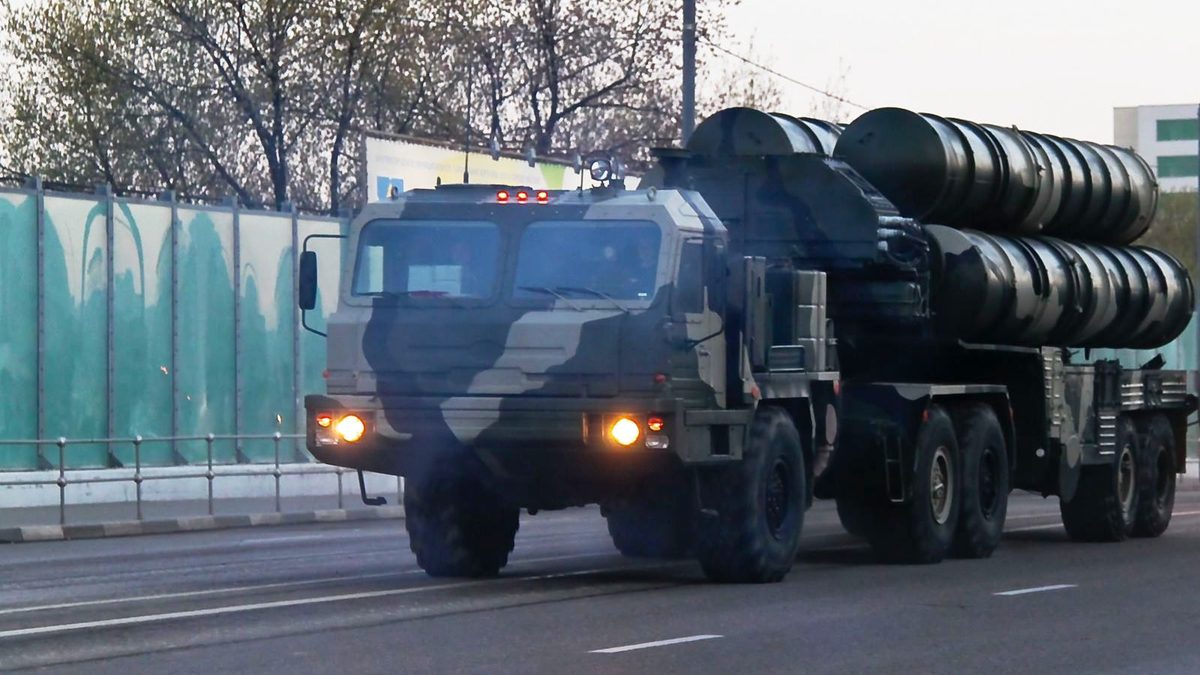
S-400 Triumf launcher (file photo, illustrative). Photo: Vitaliy Ragulin, CC BY-SA 3.0, via Wikimedia Commons, cropped to 16:9 for ISC. Not an image of any transfer; this edition concerns an unconfirmed report.
Turkey's Reported S-400 Resale to a Gulf State: Confirmed Facts, Open Questions, and the Steel Dome Enabler
Technical Summary
On 10 July 2026 the pro-government Hurriyet columnist Abdulkadir Selvi reported that Turkey has sold its two Russian-made S-400 Triumf long-range surface-to-air missile (SAM) systems, NATO reporting name SA-21 Growler, to a third country described as a state in the Gulf, with an official announcement expected the same day. His words were careful: "According to information I obtained, the S-400s have been sold to a third country. The sale will be announced today. The S-400s are going to a country in the Gulf." That sourcing is a single columnist, phrased as "edindigim bilgilere gore" (according to information I obtained). No government has confirmed a completed transaction.
The only official corroboration is partial and it comes from two directions. The Kremlin has acknowledged that Russia and Turkey remain in contact over the systems' possible onward sale, while stressing that the matter is sensitive and that Moscow's consent is required. United States President Donald Trump, meeting President Recep Tayyip Erdogan in Ankara on 7 July 2026, said Washington would lift the sanctions that Turkey's S-400 purchase triggered and would consider selling F-35 fighters to Turkey. For a weapons, ordnance, munitions and explosives (WOME) readership the interest is not the diplomacy alone. It is the physical transfer and end-user control of two complete SAM battalions, the re-export consent Moscow holds, and the indigenous interceptor that now lets Ankara contemplate parting with the Russian layer at all.
This is an extremely sensitive issue. We are in contact with the Turkish side on this matter and our contacts will continue. Dmitry Peskov, Kremlin Press Secretary, 10 July 2026
What Is Actually Confirmed
Three things are on the record. First, the Kremlin position. Press Secretary Dmitry Peskov confirmed on 10 July that Russia and Turkey are in continuing contact over the systems and called the topic extremely sensitive. Reporting of the Kremlin line notes the legal reality behind it: Turkey holds no re-export licence for the S-400, so any onward transfer needs Russian authorisation under the original end-user agreement.
Second, the United States signal. At the Ankara meeting on 7 July 2026 Trump stated plainly, "We are going to be taking the sanctions off," referring to the Countering America's Adversaries Through Sanctions Act (CAATSA) measures imposed on Turkey in December 2020. He described the F-35 as "the best plane by far" and said he would consider a sale. He set no explicit precondition in those remarks, yet existing United States law bars F-35 participation while Turkey retains the S-400, so removal of the Russian system is the mechanism that squares the two.
Third, the baseline history, which is well established. Turkey contracted two S-400 systems from Russia in 2017 for a figure widely reported near 2.5 billion United States dollars, with deliveries beginning in July 2019. The purchase drew CAATSA sanctions and Turkey's removal from the F-35 programme. That is the stranded asset now in question.
What Remains Unconfirmed
Almost every load-bearing detail of the reported sale is unverified. There has been no confirmation or denial from the Turkish Ministry of National Defence, the Ministry of Foreign Affairs, the Presidency of Defence Industries (SSB), or the Presidency itself. President Erdogan's only public gesture on the subject has been the allusive line "Bizi izlemeye devam edin," meaning "Stay tuned," which international and Turkish outlets have read as a hint rather than a confirmation.
The buyer is speculation. Reporting most often names the United Arab Emirates or Qatar, but neither government, defence ministry nor embassy has commented. Washington has issued no statement from the White House, State Department, Pentagon or Congress on the specific deal. Price, whether one system or both change hands, whether the missile rounds transfer with the launchers, and the timeline are all absent. The finalised-sale claim rests on one columnist. Treat it accordingly.
Turkey plans to resell its Russian S-400 air defense systems to Qatar or the UAE, paving the way for the U.S. to lift CAATSA sanctions and proceed with the sale of F-35 fighter jets.
— Daily Turkic (@DailyTurkic) July 10, 2026
The S-400 as a Weapon System
What is being moved, if anything is being moved, is not a pair of launchers. Each Turkish S-400 system is a battalion-sized complex. In open-source terms it pairs a 91N6E acquisition and battle-management radar with a 92N6E multifunction engagement radar, a command post, and several 5P85 transporter-erector-launchers (TELs) carrying a mixed missile load. Published figures credit the long-reach 40N6 round with an engagement range approaching 400 km and the 48N6 series with roughly 250 km, with shorter 9M96-family rounds for terminal defence. Those ranges are manufacturer and open-source figures and are not independently verified here.
A transfer therefore moves two full systems, which open sources commonly break out as four batteries and roughly 36 transporter-erector-launchers with 192 or more missile rounds, together with their spares and the fire-control software and cryptographic material that make them work. The rounds themselves are live: solid-propellant rocket motors carrying fragmentation warheads, with the 48N6 warhead estimated in open sources at between 143 and 180 kg (open-source estimates only; the net explosive quantity is not published). Moving that inventory across a border engages transport-of-dangerous-goods regimes, storage and quantity-distance rules at the receiving site, and an end-user certification chain that is exactly where the political sensitivity lives.
WOME scope note
This assessment treats the S-400 as a complete weapon system and reads the transfer, re-export control and interceptor-substitution dimensions. It does not detail missile internals, guidance defeat, or any handling procedure beyond what is already public. All system parameters are open-source and flagged where unverified.
The Steel Dome Enabler: SIPER Replaces the Russian Layer
The piece the headlines skip is why 2026 is different from 2020. In 2020 the S-400 was Turkey's only high-end long-range interceptor and giving it up meant a capability hole. That hole is now being filled by an indigenous system. SIPER, Turkey's long-range SAM, is developed under the Presidency of Defence Industries (SSB) by Aselsan, Roketsan and the TUBITAK SAGE research institute. Its first production block, SIPER Block-I, has entered service and been folded into Turkey's Celik Kubbe (Steel Dome) layered air-defence network, with serial production under way and the first battery delivered to the Turkish Armed Forces.
The quantified picture matters. Open reporting puts SIPER Block-I intercept range approaching 100 km with high-altitude coverage, using a two-stage solid-propellant interceptor with active radar homing on a mobile wheeled launcher. It is netted through the ADVENT command-and-control system alongside the shorter-range HISAR-A+ and HISAR-O+ tiers, and the Steel Dome architecture was fielded together for the first time at the EFES 2026 exercise. Turkey has also spent heavily on the energetics and missile-production base that underpins all of this, a theme ISC has tracked in Roketsan's Kırıkkale expansion. At approaching 100 km, SIPER Block-I is a substantial indigenous step rather than a full peer replacement: it does not reproduce the 250 to 400 km reach of a fully loaded S-400, a gap the planned Block-II and Block-III interceptors are intended to close. Even so, once a national long-range interceptor is in the field, the two S-400 batteries read less as an irreplaceable capability and more as a strategic liability under CAATSA. That is the substitution that makes a sale politically conceivable.
Re-Export Control: Why Moscow's Consent Is the Gate
The commercial contract that delivered the S-400 carries an end-user agreement, and Turkey does not hold a re-export licence. Any onward transfer therefore needs Russian consent, which is precisely why Peskov framed the matter as sensitive and ongoing rather than settled. Moscow gains bargaining power from that veto and a say in who ends up operating one of its most capable export systems next to Western fighters. On the United States side, sanctions relief and any F-35 return would run through a Congressional notification process, and ISC has already set out the specific legal bar in detail. See Türkiye Already Owns Six F-35s It Cannot Take Home, which examines the NDAA Section 1245 restriction that keeps Turkey's existing airframes out of Turkish hands. The parallel diplomacy over Turkey's Western fighter options is covered in From F-35 to Eurofighter, and the NATO air-defence backdrop in NATO Deploys Third Patriot Battery to Türkiye.
Analysis of Effects
If the reporting proves correct, the payoffs line up neatly for three capitals. Turkey escapes CAATSA, reopens the F-35 door, and recovers value from a roughly 2.5 billion dollar asset it can no longer use politically. A Gulf buyer gains a high-end long-range SAM at a moment of acute regional air and missile threat. Russia earns a consent fee, keeps a foot in Gulf air defence, and preserves influence with both Ankara and the recipient. Trump's framing of a "3-0" style outcome, echoed in some reporting, captures why the deal is attractive to all sides on paper.
If it does not prove correct, the most likely reading is a negotiating signal timed to the Ankara thaw: a way to make the S-400 removal that Washington demands look like a Turkish win rather than a concession. Either way the second-order effects are real. A completed transfer would set a precedent for re-exporting Russian strategic SAMs to United States security partners, raise interoperability and security-of-supply questions for any Gulf operator running Russian kit alongside Western aircraft, and reopen the NATO standardisation debate about Russian systems inside allied and partner inventories.
Personnel and Safety Considerations
A physical transfer is a WOME logistics problem before it is a diplomatic one. Live SAM rounds require dangerous-goods classification, compatible storage and quantity-distance compliance at the receiving facility, and trained handling from crane-out to magazine. The rounds are Class 1 explosives under the United Nations transport regime, so net explosive quantity, not total round mass, drives the magazine separation and earth-cover requirements at the receiving site under AASTP-1 or the national equivalent. Fire-control software and cryptographic fills would need sanitisation before hand-over, or the seller exposes system logic to a new operator. If the buyer lacks S-400 trained crews, a training and technical-support tail follows, most plausibly Russian, which carries its own sanctions exposure and operational-security questions for a state that also flies or seeks Western aircraft. None of this is insurmountable, and none of it is quick, which is one more reason to treat a same-day announcement claim with caution.
Data Gaps
The confidence-limiting gaps are substantial and should travel with any use of this material. Buyer identity and whether any sale is actually finalised remain unconfirmed. Price, quantity (one system or both), and timeline are unstated. The status of formal Russian consent is open. It is unknown whether the 48N6, 40N6 and 9M96 missile rounds transfer with the launchers or are retained. The United States Congressional notification status and any conditions attached to CAATSA relief are not public. Precise SIPER Block-I and future Block-II range and altitude figures are open-source estimates. Every claim of a completed transaction here is attributed to reporting, not to a primary official confirmation, because no such confirmation exists at the time of writing.
Key Questions
Has Turkey actually sold its S-400 systems to a Gulf country?
No government has confirmed a completed sale as of 10 July 2026. The finalised-sale claim comes from a single Hurriyet columnist. The only official corroboration is the Kremlin acknowledging continuing contacts with Ankara about a possible onward sale, which would require Russian consent under the original contract.
Why would selling the S-400 help Turkey get the F-35?
United States law bars F-35 participation while Turkey holds the Russian S-400. Removing the system to a third country could satisfy that bar, aligning with President Trump's 7 July 2026 signal that Washington would lift CAATSA sanctions and consider F-35 sales to Turkey.
What lets Turkey give up the S-400 now?
Turkey's indigenous SIPER long-range interceptor, developed by Aselsan, Roketsan and TUBITAK SAGE and integrated into the Celik Kubbe or Steel Dome network, has entered service with an intercept range approaching 100 km. That indigenous layer reduces reliance on the Russian system.
References
Source-evaluated under NATO STANAG 2022 (Reliability A–F / Accuracy 1–6). Tier 1 = government primary source; Tier 2 = quality news / specialist defence media; Tier 3 = authoritative aggregator / encyclopaedia. No Tier 1 confirmation of a completed transaction exists as of publication.
- T2Defense News – US will lift sanctions on Turkey, possibly sell F-35 fighter jets, Trump says, 7 July 2026. Carries the President's on-record remarks (Reliability A / Accuracy 2).
- T2Al Jazeera – Trump says will lift sanctions on Türkiye, consider selling F-35s, 7 July 2026. (Reliability B / Accuracy 2).
- T2Arab News – Kremlin discusses letting Türkiye sell off Russian-made missile systems, 10 July 2026. Relays Peskov and the re-export-licence point (Reliability A / Accuracy 2).
- T2APA – Peskov: Türkiye's sale of Russian S-400 systems is a highly sensitive issue, 10 July 2026. (Reliability B / Accuracy 2).
- T2Diken – Abdulkadir Selvi: S-400'ler ucuncu ulkeye satildi, 10 July 2026. Report of the Hurriyet columnist claim, single-source (Reliability C / Accuracy 3).
- T3Army Recognition – Türkiye integrates SIPER-1 long-range air defense system into Steel Dome network, 5 January 2026. (Reliability B / Accuracy 2).
- T5Daily Turkic (@DailyTurkic) on X – Turkey plans to resell its Russian S-400 air defense systems to Qatar or the UAE, 10 July 2026. Social-media aggregator, single unverified claim (Reliability E / Accuracy 5).
Corrections & updates welcome. If you hold open-source data that refines or corrects any parameter in this article, please contact [email protected] citing the specific claim and your source. Verified corrections will be incorporated and credited in the revision history. AI-assisted technical assessment based on open-source material. Not a formal intelligence product.