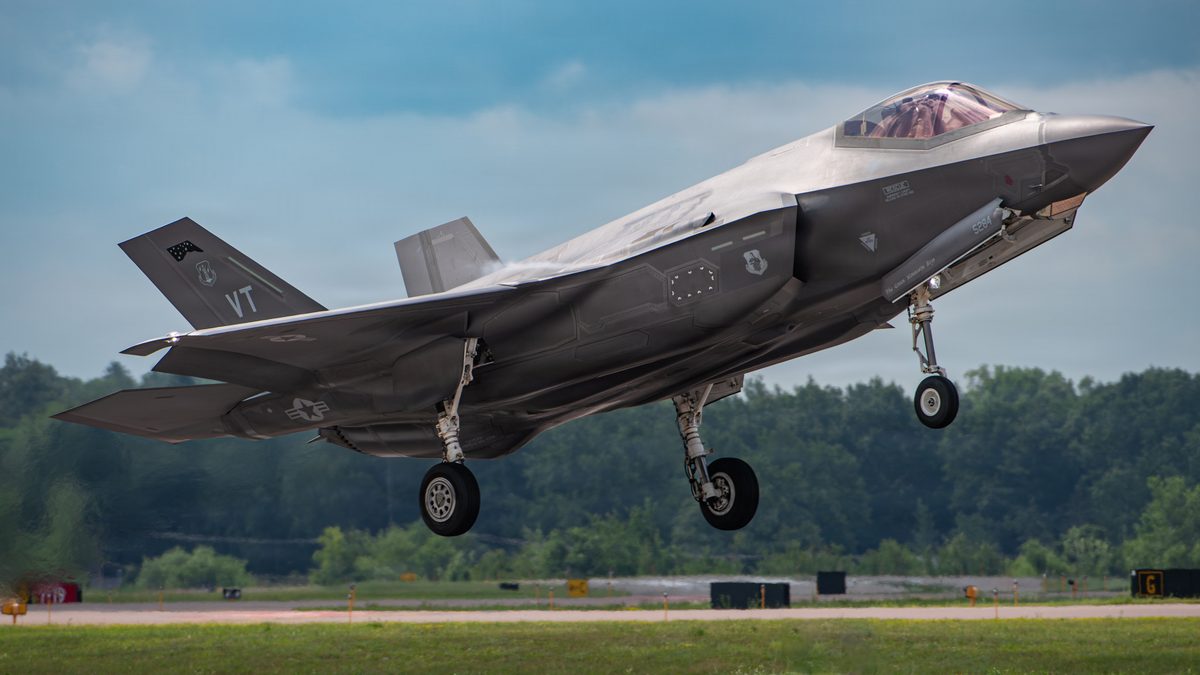
Illustrative: a U.S. Air Force F-35A Lightning II, 4 July 2026. U.S. Air National Guard photo by Airman 1st Class Raymond LaChance, 158th Fighter Wing, via DVIDS (public domain).
Türkiye Already Owns Six F-35s It Cannot Take Home
Türkiye already owns six F-35A jets it built and paid about 1.7 billion dollars for, yet they sit in United States storage and Türkiye has never taken delivery. On 7 July 2026 President Trump said Washington would lift CAATSA sanctions and consider a sale. One barrier is easy to lift. Section 1245 of the FY2020 NDAA still blocks transfer while Türkiye holds the Russian S-400.
Technical Summary
Türkiye is not waiting to buy the F-35. It already owns six of them, and Turkish pilots have already flown them. Six F-35A Lightning II aircraft, built and paid for by Türkiye at a cost of about 1.7 billion dollars, sit today in United States long-term storage. Türkiye itself has never taken delivery of a single one. On 7 July 2026, on the sidelines of the NATO summit in Ankara, President Trump said the United States would lift its sanctions on Türkiye and would consider selling it the F-35. He called the aircraft the best plane by far. President Erdogan spoke of five jets rather than the six generally reported, and said he expected the commitment to be honoured. The signal was loud. The law underneath it did not move.
Two separate United States legal instruments sit between that announcement and any delivery. The first is the Countering America's Adversaries Through Sanctions Act, known as CAATSA. Section 231 sanctions were imposed in December 2020 on the Presidency of Defence Industries, Türkiye's main procurement body, over its purchase of the Russian S-400 air defence system. Those sanctions can be lifted by executive action. The second instrument is harder. Section 1245 of the National Defense Authorization Act for Fiscal Year 2020, Public Law 116-92, bars the transfer of F-35 aircraft or related technology to Türkiye for as long as Türkiye holds the S-400 or related equipment. Lifting CAATSA does not touch it.
Six Türkiye-owned F-35As, worth about 1.7 billion dollars, sit in United States long-term storage. Not one can be handed over while Section 1245 stands and no certification has been signed by the Secretaries of State and Defense. ISC open-source assessment, 8 July 2026
How Türkiye Ended Up With the S-400
Türkiye's route to the S-400 began with a gap it could not otherwise fill. Ankara needed a long-range system able to intercept ballistic missiles, and its preferred choice was the United States MIM-104 Patriot. Washington would not sell the Patriot on the terms Türkiye wanted, above all the technology transfer and co-production Ankara pressed for. No comparable Western system was offered to it. Türkiye then bought the Russian S-400. From Ankara's standpoint this was not a turn towards Moscow but the only ballistic-missile interceptor actually available to it. That framing sits at the centre of the dispute. Washington treats the S-400 as an unacceptable intrusion into the F-35's stealth envelope, while Türkiye treats it as a capability it was left with no Western means of acquiring.
Analysis of Effects
Section 1245 does not simply express disapproval. It sets a test. Before any F-35 can move, the Secretary of State and the Secretary of Defense must certify in writing, at least 90 days in advance, that Türkiye no longer possesses the S-400 and has given credible assurances that it will not accept future Russian air defence systems. No such certification has been issued. The technical objection behind the statute is specific. The S-400 pairs a 91N6E acquisition and battle-management radar in the L-band with a 92N6E engagement radar in the X-band. The L-band set supports wide-volume search and can erode the advantage a low-observable aircraft relies on, while the X-band set handles precision tracking and engagement. Operating those sensors alongside the F-35 would let an operator characterise the aircraft's radar cross-section and its electronic-warfare emissions. That risk, identified by United States defence assessments since 2019, is the reason the programme was unwound in the first place.
Even a signed certification would not put the six jets straight into service. The aircraft are Lot 10 and Lot 11 airframes, preserved in United States storage since 2019. Before any could fly operationally they would need configuration updates, pilot and cadre re-training, and reconnection to the F-35 logistics backbone, first the Autonomic Logistics Information System and now its replacement, the Operational Data Integrated Network. Türkiye's former industrial role adds a second layer. Turkish Aerospace Industries built centre-fuselage sections and supplied engine components before 2019. That work was redistributed across other suppliers after the removal. Bringing Türkiye back into production would require full re-qualification, supply-chain re-certification, and the re-establishment of secure data links. None of that is quick.
Regional and Political Reaction
The regional reaction was immediate. Israel opposes the sale. Prime Minister Netanyahu said publicly that he was against transferring F-35s to Türkiye, and United States Defense Secretary Pete Hegseth cancelled a planned meeting with him on 8 July as tension over the question rose. Greece already holds an approved F-35 path of its own, so any Türkiye acquisition would feed straight into the Aegean and Eastern Mediterranean balance. Inside Washington the resistance is bipartisan. Members of Congress who wrote the Section 1245 language have shown no sign of repealing it, and several have restated its intent through 2025 and into 2026.
The Pilots Who Have Already Flown Them
The ownership point has a human dimension. Turkish pilots have already flown these aircraft. In 2018, before the programme was halted, a small cadre of Turkish Air Force aviators began F-35 conversion in the United States. Major Halit Oktay flew the first Turkish F-35 sortie, on 28 August 2018 at Luke Air Force Base in Arizona. Major Mustafa Onur Kara flew second and went on to serve as an F-35 instructor pilot. Oktay and Kara were the pioneering Turkish F-35 aircrew, and the aircraft they flew are the same airframes now in storage. Both came from an F-16 background, the same fast-jet lineage that produced the squadrons listed below.
The training ran under the United States Air Force 63rd Fighter Squadron at Luke Air Force Base, part of the 56th Fighter Wing, which reactivated the unit specifically for Turkish F-35 conversion. Turkish instructors served inside that squadron for a period. Reporting from 2018 and 2019 put the Turkish contingent at more than forty pilots and maintainers across Luke and Eglin Air Force Bases before the effort was wound down. No full public list of names exists, and United States officials cited privacy and operational security. The jets they flew, tail-coded in the AT-01 series and wearing Turkish markings, are the same batch now held in long-term storage. Türkiye did not just pay for these aircraft. Its aircrew were already qualifying on them.
Turkish F-16 Squadrons That Could Lead an F-35 Transition
If the six jets are ever released, Türkiye will not convert from a standing start. It fields an experienced F-16 force, and the units most likely to lead a fifth-generation transition are its strongest fighter-bomber, SEAD (Suppression of Enemy Air Defences) and NATO-facing squadrons. There is no reliable official public ranking of Turkish Air Force squadrons, so the assessment below is by mission reputation and operational significance, drawn from open-source unit listings such as F-16.net, NATO Tiger Association records and Defence Turkey, which describes 161 Filo as one of the air force’s premier fighter-bomber units.
| Rank | Squadron (Filo) | Base | Why it stands out |
|---|---|---|---|
| 1 | 161 Filo “Kartal / Yarasa” (Eagle / Bat) | Bandırma, 6th Main Jet Base | Widely regarded as the premier Turkish F-16 strike squadron. It pioneered LANTIRN night and precision strike in the Turkish Air Force, flew the first Turkish F-16 night precision bombing milestone, trained other units in LANTIRN and night-vision operations, deployed for NATO Balkan operations, and holds a specialist maritime strike (TASMO, Tactical Air Support of Maritime Operations) role. |
| 2 | 151 Filo “Kurt” (Wolf) | Merzifon, 5th Main Jet Base | Türkiye’s key F-16 SEAD (Suppression of Enemy Air Defences) unit. Listed with F-16C/D Block 40/50 in a multirole and SEAD role. |
| 3 | 152 Filo “Akıncı” (Raider) | Incirlik, 10th Tanker Base Command | Active F-16C/D Block 40 multirole and SEAD squadron. Its Incirlik basing makes it strategically important for Syria, Iraq, the Eastern Mediterranean and NATO-facing tasks. |
| 4 | 181 Filo “Pars” (Leopard) | Diyarbakır, 8th Main Jet Base | One of the most operationally exposed units, given Diyarbakır’s proximity to Syria, Iraq and southeast Türkiye. Active F-16C/D Block 40 in a multirole and attack role, linked in open reporting to northern Iraq strike activity. |
| 5 | 192 Filo “Kaplan” (Tiger) | Balıkesir, 9th Main Jet Base | Strong NATO profile as a NATO Tiger Association member, with F-16s from 1993 and Bosnia deployments in 1994 and 1997. Active F-16C/D Block 40/50 in multirole, air-defence and strike roles. |
| 6 | 191 Filo “Kobra” (Cobra) | Balıkesir, 9th Main Jet Base | A high-end multirole strike and SEAD squadron. Active F-16C/D Block 50 in multirole, SEAD and strike roles. |
| 7 | 132 Filo “Hançer” (Dagger) | Konya, 3rd Main Jet Base | The weapons and tactics training centre of gravity. Active F-16C/D Block 30/50 in a multirole and training role. |
By capability, the standout roles break down as follows:
- Strike and fighter-bomber: 161 Filo.
- SEAD: 151 Filo, with 191 Filo and 152 Filo also central.
- Frontline combat-exposed: 181 Filo.
- NATO prestige and Tiger Meet profile: 192 Filo.
- Tactics and training influence: 132 Filo.
- Most strategically placed: 152 Filo at Incirlik.
The point for NATO is that these are the crews and the institutional knowledge a fifth-generation force would inherit. A transition would concentrate first on the fighter-bomber and SEAD squadrons, where F-35 sensor fusion and low-observable access add the most, before spreading across the wider force.
Data Gaps
Several load-bearing facts remain open. There is no published waiver, executive order, or draft amendment giving effect to the sanctions decision. No Section 1245 certification has been signed or laid before Congress. The numbers do not fully reconcile either. Reporting records six airframes built and paid for, yet President Erdogan referred publicly to five, and open sources do not explain the difference. The disposition is unsettled as well, because reporting in 2020 indicated the United States Air Force would absorb the Turkish-built jets, so whether all six remain earmarked for Türkiye is an open question. The disposition of the six stored airframes is unchanged, and the 1.7 billion dollar figure traces to Congressional Research Service material cited in current reporting rather than a fresh audited number. Whether Türkiye would physically divest, relocate, or merely deactivate the S-400 has not been stated. Each of these gaps sits between the announcement and an actual aircraft on a Türkiye flight line.
Key Questions
Does Türkiye already own F-35 aircraft?
Yes. Türkiye built and paid for six F-35A Lightning II aircraft, worth about 1.7 billion dollars, before it was removed from the programme in 2019. The jets have never been delivered. They sit in United States long-term storage, and no certification allowing their release has been signed.
What is Section 1245 and why does the S-400 matter?
Section 1245 of the FY2020 National Defense Authorization Act blocks F-35 transfers to Türkiye until the Secretaries of State and Defense certify, 90 days ahead, that Türkiye no longer holds the S-400. The concern is that S-400 radars could characterise the F-35's stealth signature and electronic-warfare emissions.
Can Trump's sanctions signal release the six jets on its own?
No. Lifting CAATSA sanctions is an executive act. Section 1245 is separate law, and it requires a written certification that Türkiye no longer possesses the S-400. Until that certification exists, the six airframes stay in storage regardless of any political announcement in Ankara.
References
Source-evaluated under NATO STANAG 2022 (Reliability A–F / Accuracy 1–6). Tier 1 = government primary source; Tier 2 = quality news / specialist defence media; Tier 3 = authoritative aggregator / encyclopaedia.
- T1GovInfo (U.S. Government Publishing Office) – Public Law 116-92, National Defense Authorization Act for Fiscal Year 2020 (Section 1245), 19 December 2019. (Reliability A / Accuracy 1)
- T2Defense News – US will lift sanctions on Turkey, possibly sell F-35 fighter jets, Trump says, 7 July 2026. (Reliability B / Accuracy 2)
- T2PBS NewsHour – Trump says in Erdogan meeting that U.S. will lift Turkey sanctions, consider selling F-35s, 7 July 2026. (Reliability B / Accuracy 2)
- T2Bloomberg – Turkey in Line to Receive Six F-35 Jets If Trump Unblocks Sale, 8 July 2026. (Reliability B / Accuracy 2)
- T2CNN Politics – Netanyahu tells CNN he opposes US sale of F-35 jets to Turkey, 7 July 2026. (Reliability B / Accuracy 2)
- T2The Hill – Trump's potential F-35 sale to Turkey faces backlash ahead of NATO summit, 8 July 2026. (Reliability B / Accuracy 2)
- T2Daily Sabah – Turkish fighter pilot carries out first flight in US with F-35 jet, 28 August 2018. (Reliability B / Accuracy 2)
- T2Air Force Times – Turkish pilots will keep training on F-35s in Arizona, despite possibly being cut from the program, 2 April 2019. (Reliability B / Accuracy 2)
- T2The Times of Israel – Erdogan: Trump promised us five F-35 jets and he always keeps his promises, 7 July 2026. (Reliability B / Accuracy 2)
- T2Defense News – It's official: US Air Force to buy Turkish F-35s, 20 July 2020. (Reliability B / Accuracy 2)
Corrections & updates welcome. If you hold open-source data that refines or corrects any parameter in this article, please contact [email protected] citing the specific claim and your source. Verified corrections will be incorporated and credited in the revision history. AI-assisted technical assessment based on open-source material. Not a formal intelligence product. This article is also available in Turkish: Türkçe.