Roketsan’s $3bn Expansion: Türkiye Closes Its Energetics Gap and Delivers Eleven Missile Families in One Day
The conventional view treats Türkiye’s missile industry as an assembly base still dependent on foreign propellants and warhead fills. This week’s opening of a $3 billion Roketsan complex (warhead, integration and a new propellant facility at Kırıkkale) suggests a different reality: vertical integration across the energetics chain, paired with the simultaneous delivery of eleven indigenous missile families to the Turkish Armed Forces.
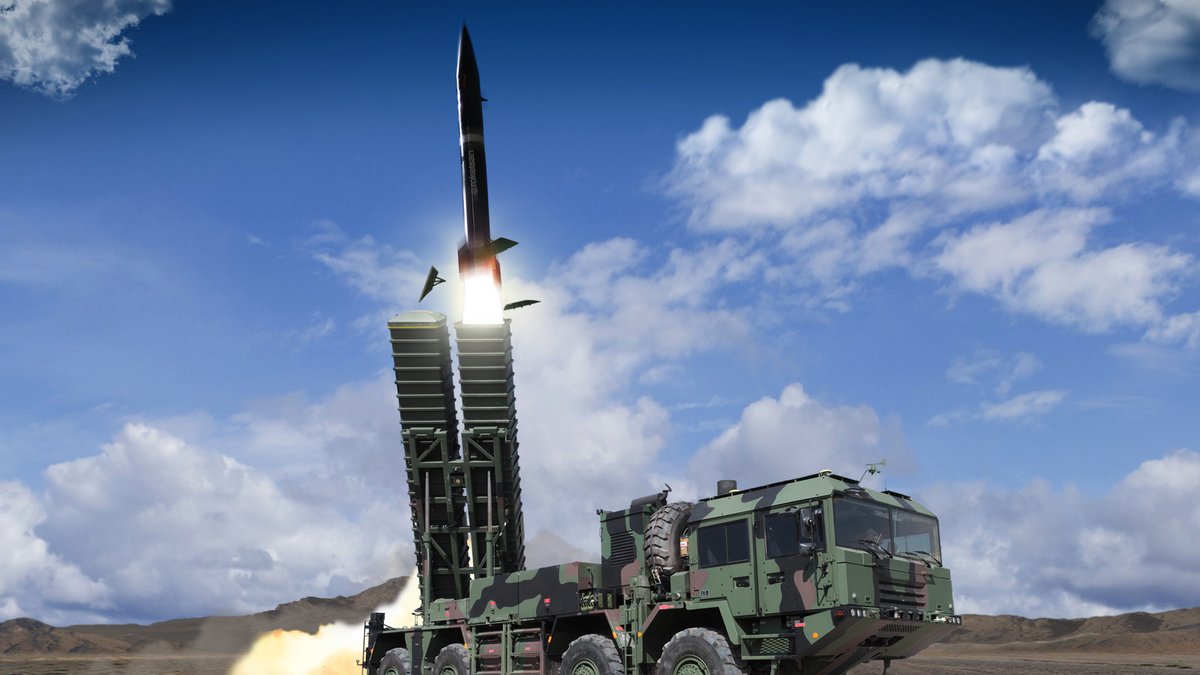
Roketsan BORA short-range ballistic missile — predecessor and family progenitor of the Tayfun. The $3 billion Ankara and Kırıkkale expansion is intended to scale production across this class of system and close Türkiye’s domestic propellant supply chain. Image © Roketsan A.Ş. — sourced from the official Roketsan media pack (roketsan.com.tr/en/media/photos) and reproduced for editorial use with attribution. All rights reserved by Roketsan.
The $3 Billion Commitment and What It Buys
Turkish President Recep Tayyip Erdoğan opened the first tranche of a $1 billion Roketsan investment on Tuesday 8 April 2026, part of a declared $3 billion total programme described by Roketsan chief executive Murat İkinci as “the largest defense industry investments in the history of the Republic.” The expansion spans three discrete industrial assets: a warhead facility, missile integration facilities in the Ankara area, and, critically for ISC’s purposes, a dedicated fuel (propellant) production plant at Kırıkkale in central Anatolia.
That sequencing matters. Warhead manufacture and missile integration are visible to satellite imagery and routine open-source observation. Propellant production is the less glamorous, and frequently overlooked, constraint on any indigenous missile programme. Solid rocket motors require specific classes of composite propellant, typically hydroxyl-terminated polybutadiene (HTPB) binders loaded with ammonium perchlorate (AP) oxidiser and aluminium fuel, sometimes with high-energy additives such as RDX (cyclonite) or HMX (octogen). Liquid-fuelled boost stages and turbojet-propelled cruise missiles impose their own feedstock demands. Each of these supply chains has historically been a choke point where export controls, denial of service, or single-source fragility can stall programmes for years.
Erdoğan framed the investment in explicit capability terms: “With these investments, we will strengthen our multipronged air defense, boost our strategic power, consolidate our cruise and ballistic missile capabilities, and will make remarkable contributions to our smart ammunition family, mass production speed and R&D capacity.” Translated into industrial terms, the language signals an attempt to resolve three parallel bottlenecks at once: throughput (mass production speed), sovereignty (smart ammunition family), and qualification capacity (R&D).
The investment scale is consistent with contemporaneous European peer activity. Rheinmetall’s announced capacity expansions exceed €2 billion; KNDS and MBDA have made comparable commitments across France and Germany; Chemring Nobel in Norway received €66.7 million from the European Union’s Act in Support of Ammunition Production (ASAP) programme to double explosives output. What distinguishes the Roketsan expansion is its vertical reach: a single national prime covering warheads, integration, and propellant in one programme, rather than a consortium spread across multiple countries and regulatory regimes.
The Eleven Missile Families: A Sovereign Strike Stack
At the same ceremony, Erdoğan announced the delivery of eleven indigenous missile families to the Turkish Armed Forces. Each occupies a distinct role in what is now a coherent national strike and air-defence stack, rather than a portfolio of technology demonstrators.
Tayfun is Türkiye’s longest-range indigenous short-range ballistic missile (SRBM), with open-source range estimates of approximately 560 km for baseline variants and claims of extended range and “hypersonic” performance for the Tayfun Block-4 derivative displayed at IDEF 2025. The hypersonic designation requires careful handling. Conventional SRBMs routinely reach Mach 5+ during terminal reentry without meeting the analytical definition of a hypersonic weapon, which normally implies sustained, manoeuvring flight in the Mach 5–10 regime via either boost-glide or scramjet propulsion. Open-source data does not yet independently verify that Tayfun Block-4 demonstrates either characteristic. Flag as PLAUSIBILITY CONCERN pending test-range telemetry or official test data.
Siper is the long-range surface-to-air missile (SAM) system intended to replicate, at the national level, capabilities previously sought through the suspended S-400 acquisition and the now-defunct Patriot dialogue. Open-source assessments place Siper Block-I engagement envelopes in the 100–150 km class. Hisar-A and Hisar-O occupy the short-range (approximately 15 km) and medium-range (approximately 25–40 km) air-defence tiers respectively. Sungur is a shoulder-launched man-portable air-defence system (MANPADS) with an infrared seeker and an approximate 8 km engagement envelope. Together these four systems constitute a layered indigenous air-defence architecture that no longer depends on foreign prime contractors.
Atmaca is a subsonic anti-ship cruise missile with turbojet propulsion and an approximate 220 km range, now replacing the Harpoon in Turkish Navy service. Çakır is a turbojet-powered, multi-purpose cruise missile in the approximate 150 km class, configurable for air, land and surface launch. SOM (Stand-Off Missile) is an air-launched cruise missile in the approximate 250 km class, integrated on F-16 and F-4 platforms. MAM-T and MAM-L are semi-active laser-guided smart micro-munitions designed for unmanned combat aerial vehicle (UCAV) employment, notably the Bayraktar TB2 and Akıncı, and carry documented combat histories across Libya, Syria and the 2020 Nagorno-Karabakh conflict. The eleventh system listed in Erdoğan’s announcement, “SIHA,” is the Turkish acronym for UCAV (Silahlı İnsansız Hava Aracı) and in this context likely refers to a specific UCAV-launched munition rather than a weapon family in its own right. Clarification is a data gap.

Why the Kırıkkale Propellant Facility Matters
Kırıkkale is not an arbitrary site selection. The region has hosted Mechanical and Chemical Industry Corporation (MKE) energetics manufacture for decades, providing an established workforce, environmental licensing baseline, and quantity-distance (QD) regulatory framework. Locating the new Roketsan propellant plant in the same industrial cluster allows inspected and qualified explosive storage licensing regimes to be extended, rather than constructed from scratch. It also concentrates Türkiye’s national energetics expertise in a single defended industrial geography — a hardening measure as much as an efficiency one.
The sovereignty implication is where the WOME significance lies. Most missile-producing states outside the P5 continue to import at least one class of energetic material. Propellant precursors, oxidisers, high-energy fillers, and insensitive munitions (IM) grade binders each carry their own export control regimes. For Türkiye, which operates outside the United States’ core trusted-partner envelope but inside NATO, the risk of denial during a crisis has been a live planning assumption. A domestic propellant facility, integrated with domestic warhead manufacture, insulates Roketsan’s production baseline from that denial risk.

ISC assesses that three specific data gaps remain significant:
Propellant formulation. Open-source reporting does not identify whether Kırıkkale will produce HTPB/AP composite propellant exclusively, double-base propellants for smaller applications, or high-energy cast-cured formulations incorporating RDX or HMX. Each has different precursor chains and export-control sensitivities.
Insensitive munitions compliance. NATO STANAG 4439 (policy for introduction and assessment of IM) and the supporting test standards (STANAG 4240 through 4496) define the IM hazard envelope for allied munitions. Turkish designation of warhead and propellant IM status has not been published for the delivered systems. Without it, interoperability claims for NATO storage and transport under AASTP-1 (Edition 2) cannot be independently verified.
Hazard classification and compatibility group. None of the open-source reporting identifies declared Hazard Division (HD) and Compatibility Group (CG) designations for the warheads, motors, or complete rounds. For NATO-interoperable storage, these must be declared under UN Recommendations on the Transport of Dangerous Goods and aligned with national regulation, in Türkiye’s case, broadly aligned with ADR/RID and AASTP-1 principles.
Export Strategy: Saudi Arabia, Indonesia and the MTCR Question
Roketsan’s export pipeline is already active. The company has signed a joint production agreement with Saudi Arabian Military Industries (SAMI) for co-production of cruise and anti-tank guided missiles, and a technology transfer agreement with Indonesia to localise production of the Çakır cruise missile. Both deals raise regulatory compliance questions that sit outside the Roketsan expansion itself but are structurally linked to it: sovereign production enables sovereign export, and Türkiye is positioning as a tier-two arms supplier to non-NATO partners.
The Missile Technology Control Regime (MTCR) divides missile technology transfers into Category I (range ≥300 km and payload ≥500 kg, subject to strong presumption of denial) and Category II (other missile technology, subject to case-by-case review). Çakır, at approximately 150 km range, sits in Category II. Türkiye has been an MTCR partner state since 1997 and is expected to apply equivalent controls. However, the 560 km baseline range of Tayfun places it in Category I, and any future export of Tayfun-class technology would be a substantive MTCR test case.
The Saudi agreement is particularly sensitive. Saudi Arabia is not an MTCR partner. Technology transfer to SAMI for cruise-missile co-production creates a regulatory surface area for both Türkiye’s export-control regime and for NATO partners observing the transfer. For ISC readers in defence industrial policy roles, the question is less whether the transfer is compliant (it may well be, depending on technical specifications and end-use controls) than whether the precedent compresses the effective boundary between MTCR members and non-members.
Strategic Outlook
The Roketsan expansion is not a discrete news event. It is a milestone in a fifteen-year national industrial project that has moved Türkiye from missile importer to missile exporter, and from assembler to vertically integrated prime. Barin Kayaoğlu, quoted in the Breaking Defense source reporting, argues that Ankara is already looking beyond munitions applications to dual-use space technology,“there is more money to be made from space than by shooting munitions at neighbouring countries.” That assessment is consistent with the shared propellant, guidance, and structural technologies that underpin both military missiles and civil launch.
For NATO allies, two consequences merit attention. First, interoperability: Türkiye’s indigenous systems will be procured and employed without the qualification data flows that accompany AQAP-compliant multinational procurement. Allied observers have limited visibility into IM compliance, qualification test data, and service-life assessments. Second, competition: Roketsan products will increasingly compete with European and American alternatives in third-country markets, particularly across the Middle East, North Africa and Southeast Asia.
The immediate WOME implication for ammunition technicians, explosive ordnance disposal (EOD) specialists, and storage authorities operating in partner nations is that Turkish-origin munitions will be encountered with increasing frequency. Reference material on warhead fills, propellant formulations, fuze states, and render-safe procedures should be anticipated as a growing demand on technical intelligence production.
References and Sources
- Breaking Defense — Turkey’s Roketsan opens new production facilities, delivers missiles to armed forces, 8 April 2026 (Agnes Helou). https://breakingdefense.com/ DEFENCE MEDIA
- Roketsan A.Ş. — Corporate communications and product pages (Tayfun, Siper, Atmaca, Çakır, SOM, MAM-T/L, Hisar, Sungur). https://www.roketsan.com.tr/en MANUFACTURER
- Republic of Türkiye Presidency — Presidential address at Roketsan facility opening, Ankara, 8 April 2026. https://www.tccb.gov.tr/en/ GOVERNMENT
- NATO Standardization Office — STANAG 4439: Policy for Introduction and Assessment of Insensitive Munitions. https://nso.nato.int/nso/ NATO OFFICIAL
- Missile Technology Control Regime — Guidelines and Equipment, Software and Technology Annex. https://mtcr.info/guidelines-for-sensitive-missile-relevant-transfers/ REGIME OFFICIAL
- SIPRI — Turkish arms exports and the rise of Roketsan (ongoing tracking). https://www.sipri.org/databases/armstransfers THINK TANK
ISC Commentary
The Roketsan expansion is best read not as a single industrial announcement but as the closing move in a fifteen-year programme to build a sovereign missile industrial base. The warhead and integration facilities provide visible capacity; the Kırıkkale propellant plant resolves the most export-control-sensitive bottleneck; and the eleven-missile delivery demonstrates that the production base is already throughput-capable across ballistic, air-defence, anti-ship, cruise and UCAV-launched classes. The outstanding technical questions concern IM compliance, hazard classification, and qualification data — none of which have been published. For NATO allies, the industrial and regulatory implications are likely to outlast the ceremonial coverage: Türkiye is now a vertically integrated tier-two arms exporter operating inside the alliance but increasingly on its own terms.