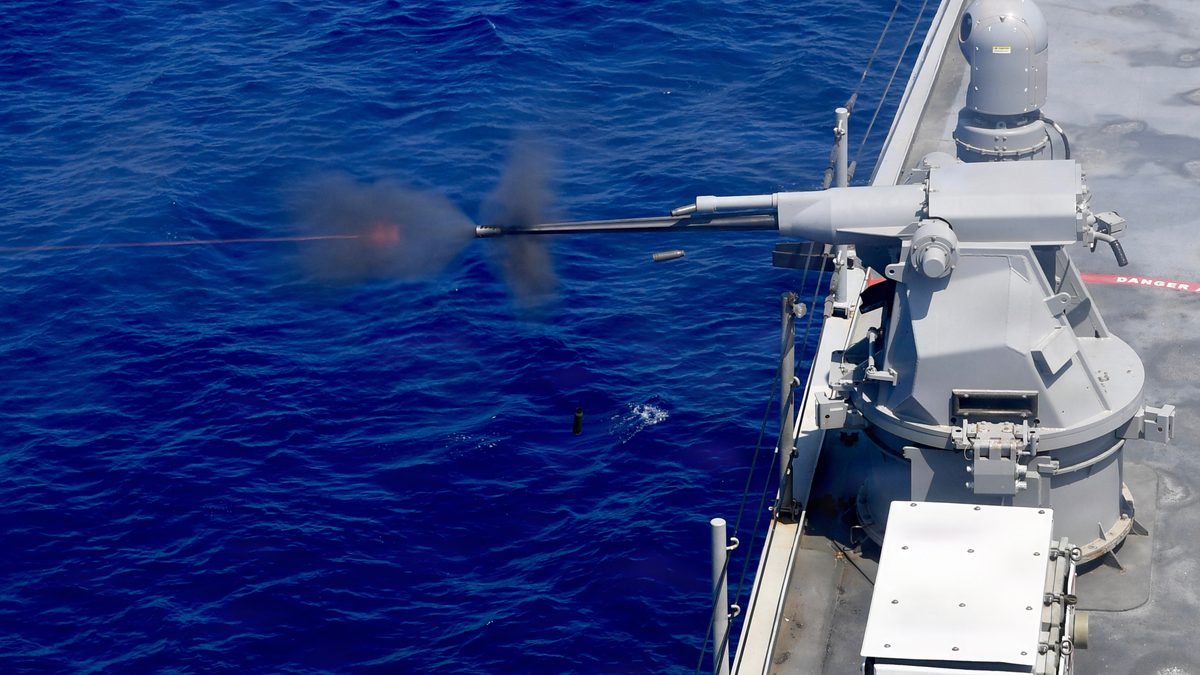
Illustrative: a MK 38 25 mm gun weapon system fires from the main deck of USS Mount Whitney (LCC 20) in the Mediterranean Sea, 4 August 2026. The electro-optical director sitting above the mount is the point of the photograph: on systems of this class the sensor and the effector are one procurement item. The MSI-DS contract described here covers 30 mm systems, not this 25 mm variant. US Navy photo by Petty Officer 1st Class Isaac Esposito via DVIDS. Public domain.
Three Guns, Three Loops: What a NATO Navy Bought for EUR 19.4 Million
MS International plc announced on 24 August 2026 that MSI Defence Systems has won a EUR 19.4 million contract from an unnamed NATO nation for three MSI-DS 30 mm naval gun systems, each supplied with radar and optical detection and the MSI-DS Fire Control System, against surface, semi-submersible and aerial threats. Deliveries are expected from late 2027. The customer is buying three sensor-to-effector loops, not three cannon mounts.
Technical Summary
The announcement is unusually specific on scope and unusually quiet on everything else. It names four elements inside each system: the 30 mm gun, radar detection, optical detection, and the MSI-DS Fire Control System. It names three threat classes, in that order: surface, semi-submersible and aerial, and it says the counter-drone protection sits alongside the established naval capability rather than replacing it. It gives a value, EUR 19.4 million for three systems, and a delivery start, towards the end of 2027, timed in the issuer’s words to the overall programme requirements. It does not name the customer, the vessel class, the specific MSI-DS variant, the radar, or the ammunition. It was released as inside information under Article 7 of the retained Market Abuse Regulation, which sets the standard of accuracy the wording had to meet and is part of why it repays close reading. MSI Defence Systems Limited is based at Norwich. According to Navy Lookout the site employs about 200 people. That source describes the company as the only United Kingdom based medium calibre system manufacturer, and records Seahawk 30 mm exports to more than 40 countries, alongside subsidiary operations in the United States and Poland and a factory at Rock Hill, South Carolina.
For readers who work with the hardware, the technical envelope of this class of system is reasonably well established even though this particular variant is not identified. Mountings in the Seahawk family carry a 30x173 mm weapon of the Mk 44 Bushmaster II type on a stabilised, remotely operated mount, controlled from a console below decks with an off-mount, dual-axis electro-optical director carrying a television camera, a thermal imager and a laser rangefinder, with auto-track. According to published ballistic data for this calibre, muzzle velocity for a high explosive incendiary tracer nature is roughly 1,080 metres per second. The lineage is long: Navy Lookout dates Royal Navy service with MSI mountings to the DS30M Mk I in 1984, and the DS30M Mk 2, the Automated Small Calibre Gun, to 2005. The United States Navy’s MK 38 MOD 4 programme uses the MSI-DS Seahawk mount as its basis, and according to Navy Lookout the move there from the 25 mm M242 to the 30 mm Mk 44S raised effective range from roughly 2,000 metres to roughly 4,000 metres, with the Mod 4 adding the Mk 48 Mod 2 electro-optical sight and integration with the ship’s combat system. The German Navy has also selected the 30 mm Seahawk, per the same source, starting with the Brandenburg class. Throughout that family the Bushmaster feeds through a dual-feed mechanism, so the operator can select between two natures already loaded in the feed path. That selector is the single most important line in this contract, and it is the one nobody is talking about.
The procurement unit is no longer the gun. It is the whole detection-to-engagement loop, and that loop is only as good as the round at the end of it. ISC assessment
Analysis of Effects
Medium calibre naval guns have been able to point at aircraft for decades, and a stabilised 30 mm mount with airburst selection has been able to engage a small aircraft for a good deal longer than the drone problem has been fashionable. So the news here is not that somebody has discovered a naval gun can shoot at a drone. The news is architectural: counter-UAS is being written into the procurement package that surrounds the gun, as a specified chain of radar detection, optical confirmation and tracking, fire control solution, then 30 mm engagement. That chain gives a ship a close-range kinetic layer it can spend repeatedly against small, cheap, numerous aerial threats without pushing every engagement up into the surface-to-air missile layer, while the same mount stays useful against fast attack craft and, per the announcement, semi-submersible targets. ISC has argued the cost asymmetry case for 30 mm proximity fuzing before, and the same arithmetic drives this contract.
The part of the loop that decides whether any of it works is the ammunition, and the announcement is silent on it. A radar-cued, optically confirmed, fire-controlled 30 mm burst against a small uncrewed aircraft is a different proposition depending on what leaves the barrel. Against a target of that size and signature, a point detonating or impact-fuzed nature requires a direct hit on a small, manoeuvring, low-mass object. A programmable airburst or proximity-fuzed nature converts a near miss into a fragmentation event and lifts probability of kill by a wide margin, which is why dual-feed proximity natures and programmable airburst have become the standard answer in the 30 mm counter-drone role. The reference nature for this weapon family is the Northrop Grumman Mk 310 programmable airburst munition with tracer, whose fuze counts projectile revolutions and time of flight to place the burst, and which can be set to airburst, point detonate, or point detonate with delay. Programmable natures of that kind import a fuze setter into the feed path and a data link from the fire control solution to the round, carrying a burst point corrected for measured muzzle velocity, meteorological data and target kinematics. That is an integration and a qualification task, not a stores decision. ISC assesses with moderate confidence that a programmable or proximity-fuzed nature is within scope, on the basis that the announcement names a counter-UAS role and that MSI markets airburst selection as the discriminator on this mount family. That is an inference from the role described, not a disclosed fact.
Personnel and Safety Considerations
Three points travel with a system of this configuration for the ammunition technicians and weapon engineers who will own it. First, a dual-feed mount means two natures live in the ready-use feed path at once, so magazine planning, ready-use stowage at the mount, segregation by hazard division and compatibility group, net explosive quantity limits at the mount position, cook-off and hangfire isolation, and the replenishment route from the magazine to the feeder all have to be settled at design stage rather than in service. The hazard division, compatibility group and net explosive quantity for the specific natures selected are not in the public record for this contract. Second, a remotely operated mount has nobody standing at the gun, which changes misfire and hangfire drill: the waiting period before a human approaches a stoppage on a hot barrel is a written procedure with a clock on it, and it becomes the pacing item in any re-engagement during a sustained attack. Third, programmable natures introduce a failure mode that impact fuzing does not have, because a round can leave the barrel with a bad or absent time-of-flight setting. That produces an unexploded projectile downrange with an armed or partly armed fuze train, which is a range safety and clearance question wherever these systems are proved and worked up. The design requirements that govern how such a fuze train is held safe until arming sit in NATO Standardization Agreement (STANAG) 4187 and its associated Allied Ordnance Publication AOP-4187, which set the safety design requirements for fuzing systems, and the evidence against them belongs in the weapon system safety case rather than in the ammunition datasheet.
Data Gaps
Six items are unresolved on open sources at the time of writing, and the sensible course is to resist filling them in. First, the customer nation is undisclosed, as is the vessel class and whether these are new-build or retrofit fits. Second, the specific MSI-DS mount variant and its designation are not stated. Third, the radar is not identified, and it matters whether it is a dedicated mount-level sensor or a feed from the ship’s existing surveillance picture. Fourth, no ammunition natures are named, so no hazard division, compatibility group or net explosive quantity can be stated for the ready-use stowage. Fifth, the split of the EUR 19.4 million between mounts, sensors, fire control, spares and support is not given, so the frequently quoted figure of roughly EUR 6.5 million per system is a division, not a unit price. Sixth, it is not stated whether a fuze setter is fitted. Readers holding open-source data on any of these points are invited to send it.
Key Questions
What exactly is in the MSI Defence Systems EUR 19.4 million contract?
Three MSI-DS 30 mm naval gun systems for an unnamed NATO nation. Each system is stated to include radar and optical detection capability together with the MSI-DS Fire Control System, and the integrated configuration is intended to protect the customer's vessels against surface, semi-submersible and aerial threats. Deliveries are expected to begin towards the end of 2027, in line with the overall programme requirements.
Why does it matter that radar and fire control are inside the contract rather than bought separately?
Because it changes what is being procured. A stabilised gun mount is an effector that has to be cued by something else. A package containing detection, tracking, fire control and the gun is a complete local engagement chain that can find, confirm and engage a target without depending on the wider combat system. For counter-drone work, where engagement timelines are short and targets are small, owning that whole chain at the mount is the capability.
Is this contract related to the Terrahawk Paladin systems used in Ukraine?
No causal link has been shown and none should be assumed. What can be observed is architectural convergence. Terrahawk Paladin pairs a 30 mm Mk 44 Bushmaster II with active electronically scanned array radar panels, an electro-optical director and fire control, and was shown in Ukrainian service by the 156th Anti-Aircraft Missile Regiment on 18 November 2025, according to Army Recognition. The same design logic, sensors and effector sold as one item, now appears at sea.
References
Source-evaluated per NATO source-evaluation doctrine, STANAG 2022 lineage (source reliability A–F / information credibility 1–6). Tier 1 = primary source, whether a government publication or a company disclosure made under a statutory regime; Tier 2 = quality news / specialist defence media; Tier 3 = authoritative aggregator / encyclopaedia.
- T1MS International plc, regulatory news service announcement via Investegate (primary source) – Contract to Supply Counter Uncrewed Aerial System to NATO Nation, 24 August 2026. (Reliability A / Credibility 2)
- T2Navy Lookout – In focus: MSI-DS sovereign UK medium calibre gun mount development, 2 April 2026. (Reliability B / Credibility 2)
- T2Naval News – US Navy completes first MK 38 MOD 4 gun weapon system install, April 2024. (Reliability B / Credibility 2)
- T2Army Recognition – Ukraine deploys first British MSI-DS Terrahawk Paladin air defence system against Russian drones, 21 November 2025. (Reliability B / Credibility 2)
- T2Northrop Grumman (company primary source) – Advanced Ammunition: Defeating Impossible Enemy Threats, accessed 25 August 2026. (Reliability B / Credibility 2)
- T3NavWeaps – USA 30 mm (1.2 inch) Bushmaster II Mark 46 Mod 1 and 40 mm (1.57 inch) Bushmaster II, accessed 25 August 2026. (Reliability C / Credibility 3)
Corrections & updates welcome. If you hold open-source data that refines or corrects any parameter in this article, please contact [email protected] citing the specific claim and your source. Verified corrections will be incorporated and credited in the revision history. AI-assisted technical assessment based on open-source material. Not a formal intelligence product.