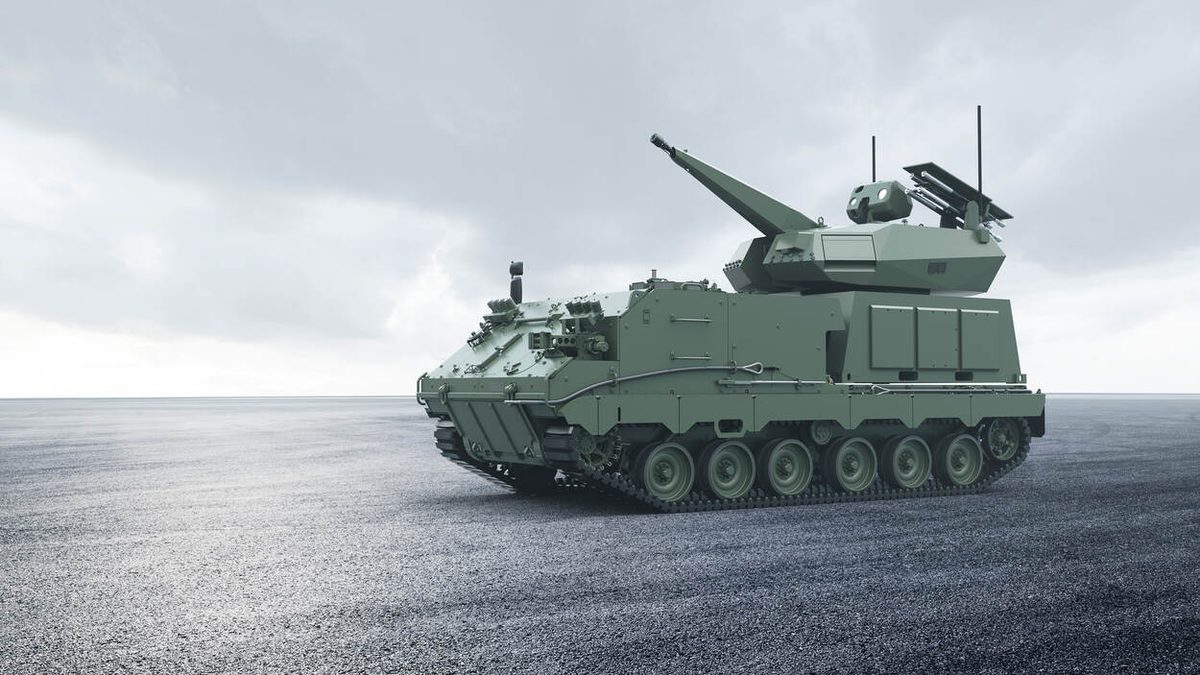
A Netherlands Ministry of Defence Skyranger 30 on the ACSV carrier, the Rheinmetall system Belgium is procuring through the Dutch framework. Image: Netherlands Ministry of Defence (Defensie) via Wikimedia Commons, CC BY-SA 4.0.
Belgium's EUR 3.1 Billion Air-Defence Plan Puts 30 mm AHEAD Airburst Ammunition at the Centre of Its Counter-Drone Gun Layer
Technical Summary
Belgium intends to acquire 20 Rheinmetall Skyranger short-range air-defence (SHORAD) systems alongside 10 Kongsberg National Advanced Surface-to-Air Missile System (NASAMS) launchers under a framework valued at about 3.1 billion euros, according to reporting on 2 July 2026, with a formal decision expected around the NATO summit in Ankara on 7 to 8 July 2026. Belgium plans to buy through existing Netherlands framework contracts, which point strongly to the Skyranger 30 variant rather than the larger-calibre Skyranger 35. The stated driver is a low-altitude capability gap exposed by repeated drone incursions over national infrastructure.
For weapons and ammunition technicians the significant content sits in the gun and its natures, not the vehicle. The Skyranger 30 mounts the 30 x 173 mm Oerlikon KCE revolver cannon firing at a nominal rate of order 1,200 rounds per minute out to an effective anti-air range of about 3 kilometres, with 252 to 300 ready rounds in the turret. Its counter-drone effect rests on programmable air-bursting ammunition of the Advanced Hit Efficiency And Destruction (AHEAD) family, a Kinetic Energy Time Fuze (KETF) nature that ejects a cloud of pre-formed tungsten sub-projectiles ahead of the target rather than relying on a direct hit.
The counter-drone effect is in the round, not the vehicle. Each AHEAD burst throws 162 tungsten sub-projectiles across the target's flight path, and the developmental PMC455 nature raises that to about 500 fragments at similar projectile mass. ISC open-source technical assessment
Skyranger 30 gun and counter-UAS ammunition (open sources)
| Cannon | 30 × 173 mm Oerlikon KCE revolver cannon |
| Rate of fire | Nominal order of 1,200 rounds per minute |
| Effective anti-air range | Approximately 3 km |
| Ready rounds in turret | 252 to 300 |
| Counter-UAS nature | AHEAD / KETF programmable airburst |
| PMC308 payload | 162 tungsten sub-projectiles |
| PMC455 (developmental) | Approximately 500 tungsten elements |

Analysis of Effects
The AHEAD principle is a muzzle-programmed time fuze. As each projectile leaves the barrel its muzzle velocity is measured and a burst time is set inductively on the fuze, so the round ejects its tungsten load at a computed point just ahead of the target. Terminal lethality is therefore fragmentation by pre-formed tungsten sub-projectiles rather than blast, because the standard AHEAD projectile carries no high-explosive burster. Against micro and small unmanned aerial systems (UAS), loitering munitions and light aircraft a dense fragment cone raises single-burst hit probability and reduces the round count for a kill, with open sources citing a three-round burst to neutralise a quadcopter out to nearly 3 kilometres. The developmental PMC455 nature, cited at roughly 500 tungsten elements against the PMC308's 162, is a direct response to ever-smaller drone targets that demand higher fragment density.
The procurement logic is a cost-exchange argument. Using a medium-range interceptor missile against a cheap quadcopter is economically unsustainable and rapidly depletes missile stocks, so a 30 mm gun layer gives a low-cost, deep-magazine terminal defence for repeated engagements inside the defended zone, the role Belgium's retired Gepard self-propelled anti-aircraft guns once filled. Choosing the Skyranger 30 over the 35 also preserves 30 x 173 mm ammunition commonality with the Netherlands and other NATO operators of the calibre, keeping a single AHEAD supply chain, common fire-control software and shared training rather than opening a separate 35 mm cannon and ammunition line.

Personnel and Safety Considerations
Hazard classification for the specific natures has not been published. Cased 30 x 173 mm cannon ammunition is normally assigned within Hazard Division 1.2 or 1.4 for storage and transport depending on the exact configuration and packaging, with the compatibility group (CG) fixed by the national qualification authority. The AHEAD projectile itself is kinetic and its tungsten sub-projectiles are inert, so the round's energetic content is the propelling charge and the small pyrotechnic time fuze rather than a bursting charge, which shapes both the net explosive quantity (NEQ) accounting and the fragmentation-hazard footprint on a range. Programmable airburst natures also carry a defined arming sequence and function height that range-safety and air-defence staff must model when firing over or near friendly airspace and ground troops.
Data Gaps
Open sources do not yet confirm the final Belgian Skyranger variant and carrier decision, although reporting from the BEDEX 2026 defence exhibition indicates a static Skyranger 30 configuration sited to protect the NASAMS batteries rather than a mobile mount; the exact AHEAD natures and quantities Belgium will buy; the per-round and programme ammunition cost; the missile fit chosen for the turret, whether Stinger, Mistral 3, DefendAir or SkyKnight; the hazard division, compatibility group and NEQ per packaged configuration; and the delivery schedule. The 3.1 billion euro figure and the counts of 20 systems and 10 launchers are drawn from reporting of an as-yet-unannounced decision and are not a signed contract.
Key Questions
What ammunition makes the Skyranger 30 effective against drones?
The Skyranger 30 fires 30 x 173 mm AHEAD programmable airburst ammunition from an Oerlikon KCE revolver cannon. Each round ejects a cloud of tungsten sub-projectiles ahead of the target, 162 in the PMC308 nature and about 500 in the developmental PMC455, forming a dense fragment cone that defeats small drones without a direct hit.
Why is Belgium buying a gun system as well as NASAMS missiles?
Using medium-range NASAMS interceptors against cheap drones is economically unsustainable and depletes missile stocks. A 30 mm gun layer provides a low-cost, deep-magazine terminal defence for repeated engagements, protecting the NASAMS batteries and national infrastructure from low-altitude threats that are too small or too numerous to justify a missile shot.
Why does choosing Skyranger 30 over Skyranger 35 matter?
The Skyranger 30 uses the 30 x 173 mm cannon and AHEAD ammunition already fielded by the Netherlands, so Belgium keeps a common ammunition chain, fire-control software and training. The Skyranger 35 would introduce a different cannon, a separate ammunition supply and its own integration and sustainment burden.
References
Source-evaluated under NATO STANAG 2022 (Reliability A–F / Accuracy 1–6). Tier 1 = government primary source; Tier 2 = quality news / specialist defence media; Tier 3 = authoritative aggregator / encyclopaedia.
- T1Reuters – Belgium plans to spend 3.1 billion euros on NASAMS, Skyranger systems, 2 July 2026. (Reliability A / Accuracy 1)
- T2Rheinmetall – Skyranger mobile air defence (KCE cannon and AHEAD ammunition), accessed 4 July 2026. (Reliability B / Accuracy 2)
- T2Army Recognition – Belgium to purchase 20 Skyranger 30 air defense systems to protect key infrastructures, 3 July 2026. (Reliability B / Accuracy 2)
- T2Army Recognition – Netherlands orders Skyranger 30 air defense systems from Rheinmetall, December 2025. (Reliability B / Accuracy 2)
- T2Janes – BEDEX 2026: Belgium plans to protect NASAMS with static Skyranger 30, accessed 4 July 2026. (Reliability B / Accuracy 2)
- T3Wikipedia – Skyranger 30 (system and 30 x 173 mm AHEAD ammunition overview), accessed 4 July 2026. (Reliability C / Accuracy 3)
- T3Wikipedia – National Advanced Surface-to-Air Missile System (NASAMS) overview, accessed 4 July 2026. (Reliability C / Accuracy 3)
Corrections & updates welcome. If you hold open-source data that refines or corrects any parameter in this article, please contact [email protected] citing the specific claim and your source. Verified corrections will be incorporated and credited in the revision history. AI-assisted technical assessment based on open-source material. Not a formal intelligence product.