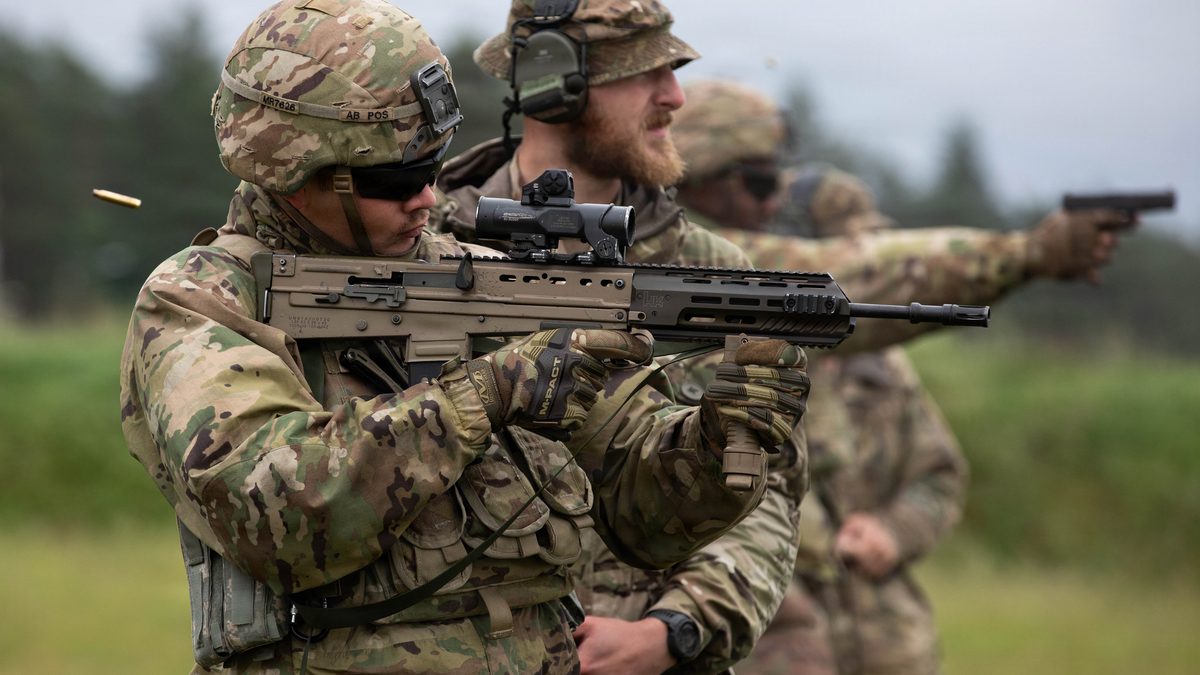
A U.S. Army soldier fires a British Army SA80 (L85A3) 5.56mm rifle alongside a Light Dragoons range safety, Bemowo Piskie Training Area, Poland, 11 June 2026. U.S. Army photo by Staff Sgt. Emilie Lenglain (DVIDS, public domain). Appearance of U.S. Department of Defense visual information does not imply or constitute DoD endorsement.
Project GRAYBURN Leaves Calibre Open and Puts STANAG 4172 on Review Watch
Project GRAYBURN, the UK Ministry of Defence concept-stage notice published on 13 January 2026 to replace the SA80 rifle family, sets no calibre but requires lethality that defeats current and emerging body armour. ISC assesses the unresolved choice between 5.56x45mm NATO, 6.8mm and 6.5mm options as a leading indicator that STANAG 4172 may come under review. No edition change is confirmed.
Technical Summary
The Find a Tender pipeline notice, reference 2026/S 000-002873, was published by Defence Equipment & Support (DE&S) on 13 January 2026 under the Procurement Act 2023. It describes a family of five weapons built on a common lower receiver: a Dismounted Close Combat rifle and a short variant replacing the SA80A3, a Personal Defence Weapon replacing the L22 carbine, a Generalist rifle replacing the SA80A2, and a cadet rifle replacing the L98. The indicative contract period runs from 1 April 2028 to 31 March 2045 under Common Procurement Vocabulary (CPV) code 35300000. The Authority intends UK manufacture, framed around sovereign supply chains, employment and export potential, with day optics as standard, rapid in-line night vision integration, and signature reduction technology on some variants. Reported fleet size is 150,000 to 180,000 weapons against an L85A3 out-of-service date of around 2030 (ISC profiled the contenders in June).
One parameter is absent. The notice specifies no calibre. What it does specify is the performance driver that makes calibre the live question: the requirement to defeat protected targets. The current round, the 4.0 g SS109 pattern ball standardised under STANAG 4172 on 28 October 1980, leaves a 508 mm barrel at roughly 922 m/s with approximately 1,709 J of muzzle energy. Ceramic and composite plates now issued at scale were not its design case. Defence Procurement Minister Maria Eagle told Parliament in August 2025 that "various rifles are being considered" and that "performance, interoperability and complexity are some of the factors under consideration". Interoperability, in this context, is the polite word for the standardisation question this article examines.
Pj GRAYBURN will look to provide sufficient lethality to defeat current and emerging body armour. UK MOD DE&S, Find a Tender pipeline notice 2026/S 000-002873, 13 January 2026
Where the Five Largest NATO Armies Stand
The United Kingdom is the only one of NATO's five largest military powers without a committed next-generation service rifle. Each of the other four has decided, and three of the four decisions kept 5.56x45mm NATO.
| Nation | Transition | Calibre | Status |
|---|---|---|---|
| United States | M4A1 to M7 (SIG MCX Spear) | 6.8x51mm Common Cartridge | FIELDING Type-classified 20 May 2025; acquisition objective 111,428 rifles |
| France | FAMAS to HK416F | 5.56x45mm NATO | FIELDED In service since 2017 |
| Germany | G36 to G95A1 (HK416A8) | 5.56x45mm NATO | FIELDING First series issues December 2025 |
| Italy | ARX 160 to Beretta NARP | 5.56x45mm NATO | FIELDING Production for the Italian Army from 2025 |
| United Kingdom | L85A3 to Project GRAYBURN winner | Open: 5.56mm, 6.8mm and 6.5mm all in play | CONCEPT Pipeline notice only; no investment decision |
That table is the strategic context for GRAYBURN's silence on calibre. The United States has already left the STANAG 4172 consensus for its close combat force. France, Germany and Italy have each re-armed inside it. Britain gets the deciding vote. A UK selection of 6.8x51mm, or of an intermediate 6.5mm solution such as the 6.5x43mm LICC concept ISC assessed in June, would make divergence a pattern rather than an exception. The 6.5mm option is not hypothetical in British service: the Royal Marines adopted the L129A2 sharpshooter rifle in 6.5mm Creedmoor in 2023. A UK decision to stay with 5.56mm would instead isolate the American move and leave the standard intact for the rest of the alliance. Neither outcome is decided. That is precisely why the decision carries indicator value.
The Standardisation Mechanics
STANAG 4172 is the NATO standardisation agreement that governs 5.56x45mm ammunition interchangeability, with its technical performance specification carried in AOP-4172. It made 5.56x45mm the alliance's second standard rifle cartridge, joining 7.62x51mm, the first NATO standard from 1954. The point of the agreement is practical: any nation's qualified 5.56mm ammunition should function safely and predictably in any other nation's qualified 5.56mm weapons. It standardises the cartridge, not the weapon that fires it: NATO has never standardised a rifle. The photograph above shows the benefit in its simplest form, a U.S. soldier firing a British L85A3 on a Polish range during Forward Land Forces battle group training in June 2026, with no ammunition question worth asking.
The US 6.8x51mm move did not amend that agreement. There is no STANAG for the 6.8x51mm Common Cartridge, a high-pressure design with a published Sporting Arms and Ammunition Manufacturers' Institute (SAAMI) maximum average pressure of 80,000 psi, roughly 551 MPa, against the NATO Electronic Pressure, Velocity and Time (EPVAT) test maximum of 430 MPa, about 62,000 psi, for 5.56x45mm. The M7 and M250 therefore sit outside the NATO small-arms interchangeability framework their predecessors defined. NATO has absorbed that as a single national exception. A second exception, from the alliance's other major expeditionary army, would be harder to absorb, and history says small-arms standardisation strains easily: the draft STANAG 4179, which would have standardised the M16 magazine pattern across NATO, was never ratified. The pressure is not only procedural. A Royal United Services Institute paper of 30 April 2026, by Major Laurence Thomson and Dr Jack Watling, recommended that the UK select rifle calibre and design "based on its own tactical needs, rather than aligning with diverging NATO standards", an argument that treats the divergence as already real. ISC examined the wider fitness of the 5.56mm round in a separate assessment this month. The conclusion holds here: the standard is not obsolete, but the population of forces it describes is shrinking at the top end.
Analysis of Effects
The terminal-effects argument for leaving 5.56mm is the same one that drove the US Next Generation Squad Weapon programme: modern hard plates defeat SS109-class ball at practical engagement ranges, and manufacturer-published figures put full-power 6.8x51mm loads at roughly double the muzzle energy of SS109 (an ISC estimate derived from published 8.7 g projectile and circa 900 m/s velocity figures, not independently verified). The cost side is equally measurable. A 6.8mm-class round is heavier per cartridge, cuts the rounds a soldier carries at fixed load weight, increases recoil impulse, and demands new production tooling. The UK's most recent new-rifle decision, Project HUNTER's selection of the 5.56mm KS-1 (L403A1) for the Royal Marines and Ranger Regiment in September 2023, stayed inside the standard. GRAYBURN is two orders of magnitude larger in fleet terms, which is why its calibre choice, not HUNTER's, is the one with alliance-level consequences.
Read as a portfolio, the UK signals point both ways at once. The four parallel UK small-arms projects ISC mapped on 7 July all sustain or procure 5.56mm and 7.62mm weapons, while UK-linked experimentation with the 6.5x43mm LICC intermediate cartridge continues and the GRAYBURN notice writes armour defeat into the requirement. Divergence from the standard is not divergence from every ally, either: a 6.8mm selection would align UK close-combat ammunition with the US Army while splitting from France, Germany and Italy. If the assessment phase resolves that tension in favour of a new calibre, the second divergence materialises. If it resolves toward advanced 5.56mm ammunition natures, the standard survives with its second-largest user recommitted. Ammunition-natures development, not rifle selection, is where that fork will first become visible in open sources.
Personnel and Safety Considerations
A calibre change is a two-decade logistics event, not a catalogue swap. UK 5.56mm ball production is an established sovereign line, and the notice's UK-manufacture intent would extend to any new cartridge, meaning new tooling, new proof and qualification programmes, and parallel stockpiles across a transition window that the indicative 2028 to 2045 contract period already anticipates. Hazard classification is the one variable that barely moves: small-arms cartridges remain UN 0012, typically Hazard Division 1.4S, so storage and transport regimes carry over while everything around them changes. The personnel burden lands on armourers, range staff and training establishments managing two calibres in parallel, on range safety templates resized for a more energetic round, and on multinational battle groups that lose the casual ammunition commonality the Bemowo Piskie photograph illustrates. In-service surveillance for a higher-pressure cartridge family would also need to mature quickly from a standing start.
Data Gaps
The following are not established in open sources at the time of writing: the calibre requirement itself (the notice is silent); assessment phase start and decision dates; the procurement route beyond concept stage; any MOD position linking GRAYBURN to NATO standardisation policy; and any NATO Standardization Office tasking, study or edition activity on STANAG 4172 (the NSO does not publish review schedules, so absence of evidence here is weak evidence of absence). The 150,000 to 180,000 fleet figure is reported, not contracted. No investment decision has been taken. Confidence in the core facts of the notice is high because the source is the primary document; confidence in any review of STANAG 4172 is deliberately not asserted, because this article's claim is about indicator value, not outcome.
Key Questions
What is Project GRAYBURN?
Project GRAYBURN is the UK Ministry of Defence concept-stage programme to replace the SA80 rifle family. A pipeline notice, reference 2026/S 000-002873, was published on Find a Tender on 13 January 2026. It covers five UK-manufactured variants on a common lower receiver, with an indicative contract period of April 2028 to March 2045.
Why does the GRAYBURN calibre decision matter to NATO?
STANAG 4172 has defined 5.56x45mm as a NATO standard rifle cartridge since 28 October 1980. The US Army is already fielding a 6.8x51mm rifle outside that standard. If the UK also selects a non-5.56mm calibre, two of NATO's largest armies would sit outside the consensus, strengthening the case for a standards review.
Has NATO confirmed a review of STANAG 4172?
No. No edition change, revision tasking or formal review of STANAG 4172 has been confirmed in open sources at the time of writing. ISC assesses the GRAYBURN calibre decision as a leading indicator only: a procurement signal that review pressure may build in the medium term, not evidence that a review has begun.
References
Source-evaluated under NATO STANAG 2022 (Reliability A–F / Accuracy 1–6). Tier 1 = government primary source; Tier 2 = quality news / specialist defence media; Tier 3 = authoritative aggregator / encyclopaedia.
- T1UK MOD Defence Equipment & Support, Find a Tender Service – Project GRAYBURN: Defence replacement of SA80 family of rifles – Concept Stage (pipeline notice 2026/S 000-002873), 13 January 2026. (Reliability A / Accuracy 1)
- T2Forces News (BFBS) – Project Grayburn: The hunt is on for the British Army’s next assault rifle, 6 August 2025. (Reliability B / Accuracy 2)
- T2UK Defence Journal – UK sets out Project Grayburn rifle replacement to industry, January 2026. (Reliability B / Accuracy 2)
- T2The War Zone – Sig Sauer’s M7 Rifle Gets Army’s Seal Of Approval Despite Controversy, 21 May 2025. (Reliability B / Accuracy 2)
- T2Guns.com – German Army Issues First Heckler & Koch G95 Rifles, 11 December 2025. (Reliability B / Accuracy 2)
- T3Royal United Services Institute (Thomson & Watling) – Grayburn: The UK’s Future Small Arms Requirements, 30 April 2026. (Reliability B / Accuracy 2)
- T3Wikipedia – 5.56x45mm NATO, accessed 17 July 2026. (Reliability C / Accuracy 2)
- T3Wikipedia – Beretta NARP, accessed 17 July 2026. (Reliability C / Accuracy 3)
Corrections & updates welcome. If you hold open-source data that refines or corrects any parameter in this article, please contact [email protected] citing the specific claim and your source. Verified corrections will be incorporated and credited in the revision history. AI-assisted technical assessment based on open-source material. Not a formal intelligence product.