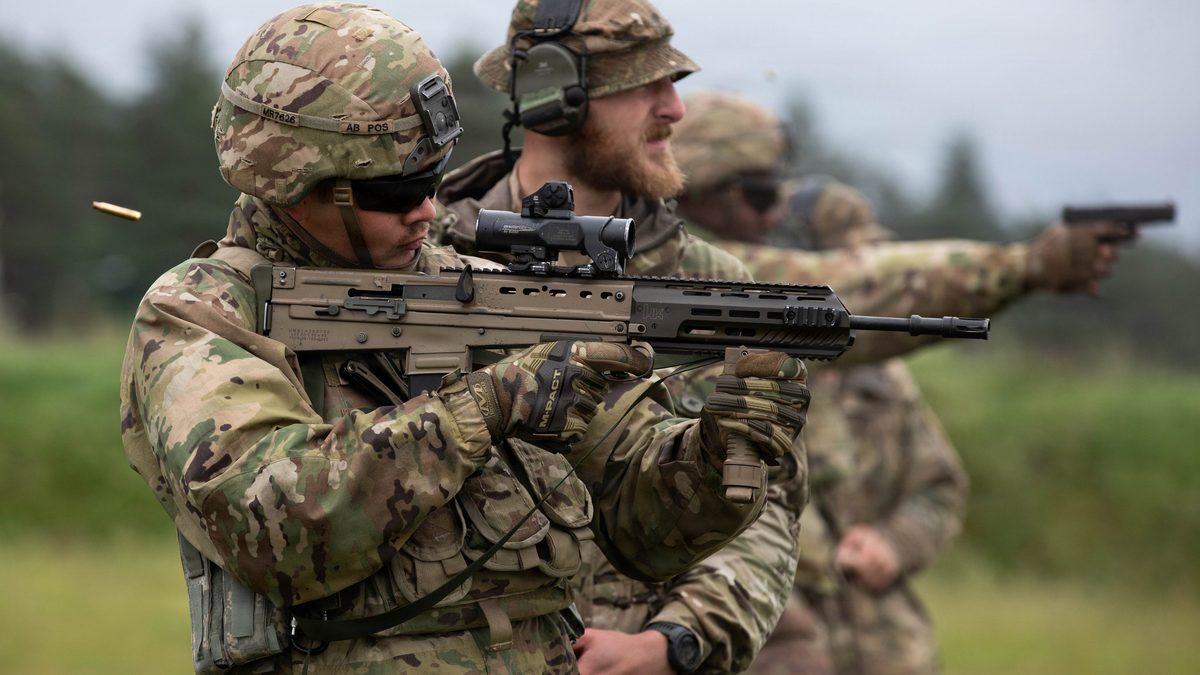
Soldiers fire the British Army's SA80 (L85) rifle during close-quarters training with Forward Land Forces Battle Group–Poland, 12 June 2026. The SA80 is the bullpup family Project GRAYBURN will replace. Photo: Staff Sgt. Emilie Lenglain, U.S. Army, via DVIDS (public domain). Appearance of U.S. Department of Defense visual information does not imply or constitute endorsement.
Project GRAYBURN takes shape: Beretta NARP and Sako line up to replace the British Army's SA80
Technical Summary
Project GRAYBURN is the United Kingdom Ministry of Defence (MoD) programme to replace the SA80 (L85) family of service rifles, the bullpup weapon in British service since 1985. As the Eurosatory 2026 exhibition in Paris closed on 19 June, Jane's placed the contest firmly around two rifles from Beretta Defence Technologies (BDT): the Beretta New Assault Rifle Platform (NARP) and a Sako rifle, the M23 family already in Finnish and Swedish service, which Jane's records for GRAYBURN under the Arctic Rifle Generation (ARG) designation. Both use the conventional AR-pattern layout, not the SA80 bullpup. Jane's places the BDT pairing at the front of the field, but it is not the only runner: Heckler & Koch (the HK416 and HK433), SIG Sauer (its MCX family) and Knight's Armament have also been reported as Project GRAYBURN contenders.
The programme remains at the concept stage with no tender award. Open reporting puts the intended buy at up to around 170,000 weapon systems (sources range from 150,000 to 180,000) across five variants, with an assessment phase expected in 2026 and a contract decision reported for late 2026 or 2027. The MoD wants greater lethality than the SA80 and its 5.56×45 mm NATO round, including the ability to defeat current and emerging body armour. That requirement, more than the choice of manufacturer, makes GRAYBURN a Weapons, Ordnance, Munitions and Explosives (WOME) story.
Up to around 170,000 weapon systems across five variants, replacing a bullpup family in service since 1985. The calibre decision inside Project GRAYBURN will set British small-arms ammunition logistics, and its NATO interchangeability, for the 2030s. ISC Defence Intelligence assessment, 19 June 2026
The five-variant fleet. Open reporting records the requirement as five distinct variants, each replacing a current SA80-family weapon:
| Variant role | Replaces | Maturity |
|---|---|---|
| Dismounted Close Combat (DCC) | SA80A3 | Concept |
| DCC (short barrel) | Short close-quarters role | Concept |
| Personal Defence Weapon | L22 carbine | Concept |
| Generalist rifle | SA80A2 | Concept |
| Cadet rifle | L98 Cadet GP rifle | Concept |
The calibre question. The body-armour-defeat requirement puts the cartridge nature, not the rifle, at the centre of the decision. The principal options and their approximate maximum chamber pressures:
| Cartridge | Approx. max chamber pressure | NATO small-arms standard | GRAYBURN relevance |
|---|---|---|---|
| 5.56×45 mm | ~430 MPa (about 62,000 psi) | Yes (STANAG 4172) | Retains full NATO interchangeability; the lethality ceiling is the concern |
| 7.62×51 mm | ~415 MPa (about 60,000 psi) | Yes (STANAG 2310) | More penetration and reach at a heavier weight and recoil cost |
| 6.8×51 mm (.277 Fury) | commercially rated ~550 MPa (about 80,000 psi) | No | US NGSW nature; high pressure for armour defeat, breaks NATO interchangeability |
| 6.5 mm Grendel | ~360 MPa (about 52,000 psi) | No | Cited by Sako as an adaptation option; intermediate reach, non-standard |
Analysis of Effects
The lethality requirement points in one direction: more energy on target and deeper penetration of modern hard body armour. The United States answered the same problem through its Next Generation Squad Weapon (NGSW) programme, adopting the 6.8×51 mm round (the commercial .277 SIG Fury) at chamber pressures well above the NATO 5.56 mm and 7.62 mm service ceilings. The United Kingdom faces the same physics. It can keep 5.56×45 mm and pursue improved-penetration projectiles and higher-pressure loadings, an avenue the US Special Operations Command Hypervelocity Improved Capability Assault Rifle (HICAR) effort is exploring, or it can adopt a heavier intermediate calibre and accept the weight, recoil and resupply burden that follow.
For the ammunition technician and the logistician, the calibre choice is the whole story. Retaining 5.56×45 mm preserves interchangeability under the NATO Standardization Agreement (STANAG) 4172, keeps the UK inside the NATO small-arms ammunition pool, and leaves the existing proof, packaging and storage base intact. A move to a non-standard nature such as 6.8×51 mm or a 6.5 mm round would add armour-defeat performance but create a national ammunition line outside STANAG 4172, with its own proof, war stock and resupply chain that NATO partners could not readily backfill. With five variants to equip, that decision propagates across the entire British small-arms estate and its training base.
The shift away from the bullpup layout carries a separate cost. A conventional AR-pattern rifle sits longer than a bullpup for the same barrel length, which matters for vehicle crews and close-quarters work, and it resets the manual of arms that British soldiers have trained on since 1985. Those are introduction-to-service and training burdens rather than ammunition burdens, but with five variants to field they shape how quickly the force and its training estate can convert.
Personnel and Safety Considerations
For armourers and ammunition technicians the impact lands at the introduction-to-service stage. Any new cartridge nature must pass NATO proof and qualification, including Electronic Pressure, Velocity and Action Time (EPVAT) measurement and the multi-calibre proof and inspection regime under Allied Engineering Publication 97 (AEP-97, STANAG 4823), before it enters service. Small-arms ball ammunition is benign in storage terms, typically Hazard Division 1.4, Compatibility Group S or G, so net explosive quantity (NEQ) per cartridge is low. The real burden is volume and accountability: a fleet-wide calibre change means re-baselining war reserves, range natures, packaging and the training-estate inventory, not simply issuing a new rifle.
Data Gaps
Several points stay open. The exact publication date of the Jane's Eurosatory update was not independently confirmed against a primary Defence Equipment and Support (DE&S) or Find a Tender notice. The SA80 out-of-service date is reported as 2030 in 2025 coverage and as slipping toward 2035 in the latest update, unconfirmed against a primary source. The Sako offering is named both as the M23 and, by Jane's, as the Arctic Rifle Generation, not yet reconciled against a primary Sako or BDT statement. The final calibre, the down-select, the assessment timeline and the contract value are all undecided.
References
Source-evaluated under NATO STANAG 2022 (Reliability A–F / Accuracy 1–6). Tier 1 = government primary source; Tier 2 = quality news / specialist defence media; Tier 3 = authoritative aggregator / encyclopaedia.
- T1British Army (UK MoD) – SA80 individual weapon, accessed 19 June 2026. (Reliability A / Accuracy 1)
- T2Jane's – Update: Candidates line up to replace UK's SA80 assault rifle, June 2026 (Eurosatory 2026 update). (Reliability B / Accuracy 2)
- T2BFBS Forces News – Exclusive: BFBS granted first look at contenders to replace the British Army's SA80, 6 August 2025. (Reliability B / Accuracy 2)
- T2Task & Purpose – Britain's next rifle: Inside the race to replace the SA80, 23 August 2025. (Reliability B / Accuracy 2)
- T3Wikipedia – Project Grayburn, accessed 19 June 2026. (Reliability C / Accuracy 3)
- T2UK Defence Journal – UK sets out Project Grayburn rifle replacement to industry, accessed 19 June 2026. (Reliability B / Accuracy 2)
Corrections & updates welcome. If you hold open-source data that refines or corrects any parameter in this article, please contact [email protected] citing the specific claim and your source. Verified corrections will be incorporated and credited in the revision history. AI-assisted technical assessment based on open-source material. Not a formal intelligence product.