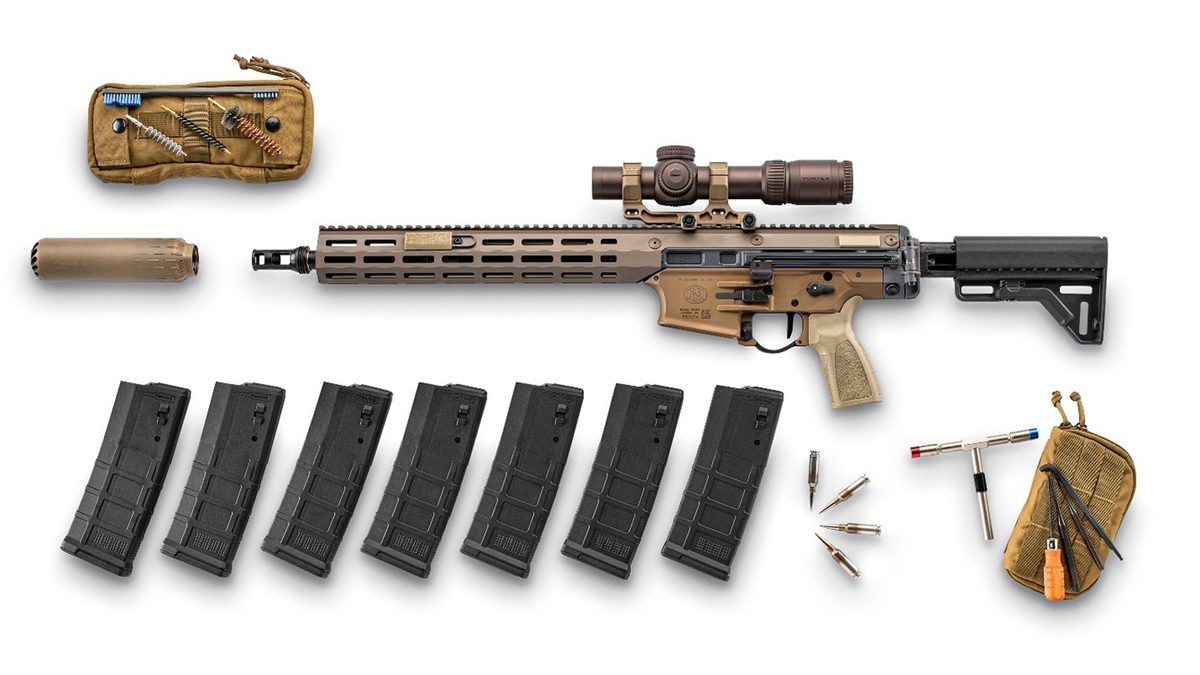
The FN LICC-IWS (Improved Performance Carbine) weapon system in 6.5 × 43 mm, with suppressor, magazines and cartridges. Image © FN America, LLC (LICC weapon systems press materials, October 2025), reproduced with attribution.
Ballistic Goldilocks: the 6.5 × 43 mm LICC and the weapons built around it
A reader who helped test it
Our 16 June piece on whether 6.8 mm can match 5.56 mm in the close fight drew a detailed reply from Davor C., an experienced security professional who was part of a team that field-tested a different answer to the same problem: the 6.5 × 43 mm round. His team built purpose-made platforms for it, from a close-quarters carbine to a bolt-action precision rifle, and fired it from point-blank range out to 1,200 m against a range of targets. His verdict was blunt, and favourable.
That comment is worth taking seriously, and it points at a round most of the calibre debate has overlooked. While the United States Army committed to the 6.8 × 51 mm Common Cartridge for its Next Generation Squad Weapon (NGSW) family, a second intermediate round has been moving quietly through allied hands: the 6.5 × 43 mm Lightweight Intermediate Caliber Cartridge (LICC). It is now the subject of a NATO standardisation effort, and one of its original proponents says it was conceived not to supplement the two NATO rounds but to replace both. This piece sets out what the round is, who has tested it, and every weapon configuration built around it.
Consistency, reliability, accuracy and terminal effect of 6.5 × 43 mm was literally astonishing. It outperformed 5.56 mm in absolutely every aspect, and past 300 m the 7.62 mm NATO was dragging behind it in every ballistic chart that we drew. Davor C., experienced security professional, in reply to the ISC XM8 assessment, June 2026
What the 6.5 × 43 mm actually is
The round began life as the .264 USA, developed in-house by the United States Army Marksmanship Unit (AMU) and first shown publicly in 2014. It was a direct answer to a Global War on Terror complaint: in Afghanistan, troops carrying 5.56 mm carbines were routinely outranged by enemy 7.62 × 54 mmR machine guns firing from distance. The AMU built the .264 USA on a lengthened 7.62 × 39 mm case with very little taper, giving an overall length of about 66 mm (2.6 in), closer in size to 7.62 mm than to 5.56 mm, and roughly 2,700 joules of muzzle energy.
The result is what people across the programme keep calling a "ballistic Goldilocks" between 5.56 × 45 mm and 7.62 × 51 mm NATO. The 6.5 mm projectile has a high ballistic coefficient, so it holds velocity, resists wind and shoots flat. It gives more range, retained energy and penetration than 5.56 mm, while staying far lighter and softer in recoil than 7.62 mm. The military designation that grew out of it, the LICC, pairs that bullet with a two-piece steel case (a stainless head joined to the case body) that FN America says trims about 20 per cent off the weight of an equivalent brass round. The production cartridge carries a 43 mm case, the figure that gives the round its name, and feeds from a dedicated magazine rather than a standard 5.56 mm one.
Several loads have been built. The 2018 requirement asked for a 108-grain open tip match (OTM) projectile at a threshold velocity of 2,650 feet per second, rising to an objective 2,750 fps from an 11.5-inch barrel, and earlier programme phases also specified barrier-defeating and enhanced-penetration loads. FN America's current family spans roughly 103 to 125 grains: a 103-grain Reduced Ricochet Limited Penetration (RRLP) round with a non-toxic primer, 109-grain and 120-grain copper monolithic OTM, a 120-grain ballistic-match multipurpose load, and a 125-grain controlled-expansion round for law-enforcement use. FN says a patented projectile coating cuts fouling and barrel wear while holding accuracy across temperature, and that the round has shown growth capacity at chamber pressures above the civilian 6.5 mm Creedmoor standard. The headline performance requirement: defeat current and emerging individual body armour out to 800 m.
Baseline specification (open sources)
| Calibre | 6.5 mm (.264 in) projectile |
| Case length | 43 mm (gives the round its name); parent .264 USA loaded length about 66 mm (2.6 in) |
| Parent / origin | .264 USA, US Army Marksmanship Unit (lengthened 7.62 × 39 mm case) |
| Case material | Two-piece steel (stainless head), about 20% lighter than brass |
| Projectile mass | 103 to 125 gr (FN loads: 103 gr RRLP, 109/120 gr copper OTM, 120 gr ballistic match, 125 gr controlled-expansion) |
| Muzzle velocity | About 2,650 to 2,750 fps (108 gr, 11.5 in barrel; parent .264 USA data) |
| Muzzle energy | About 2,700 J / 1,990 ft·lbf (parent .264 USA figure) |
| Pressure headroom | Demonstrated above the civilian 6.5 mm Creedmoor standard |
| Armour requirement | Defeat individual protective equipment to 800 m |
Open-source approximations for orientation only. FN America has not released official LICC velocity or energy figures; the velocity and energy values above are drawn from the .264 USA parent round and from the published programme requirement.
The testing record, military and manufacturer
The 6.5 × 43 mm has a longer test history than its low profile suggests. The AMU developed and refined the .264 USA across the mid-2010s. The US Army weighed intermediate candidates like it during those years without adopting one, and later chose the heavier 6.8 mm path for NGSW. The intermediate round did not disappear. It moved into the special-operations and irregular-warfare community instead.
The current programme runs through the Irregular Warfare Technical Support Directorate (IWTSD), formerly the Combating Terrorism Technical Support Office (CTTSO), renamed in 2021, which sits under the US Assistant Secretary of Defense for Special Operations and Low-Intensity Conflict. IWTSD issued a Broad Agency Announcement for a LICC weapon in 2018. FN America won the development contract in 2019 as lead integrator, working with four ammunition makers, a magazine maker (believed to be Magpul) and a flow-through suppressor developer (Huxwrx). Initial user acceptance testing and performance evaluation ran in the summer of 2022, and the rifle first broke cover at SHOT Show in January 2023.
FN's own test results are striking. The company reports that the LICC Individual Weapon System (IWS) groups roughly twice as tightly as the M4A1, about one to two minutes of angle (MOA), while handling like an M4A1 and staying soft-shooting. For the belt-fed weapon, FN says its LICC Assault Machine Gun (AMG) out-shot the 7.62 mm Mk 48 in full-automatic fire and bettered the M249, Mk 46 and Mk 48 on lethality, accuracy, durability, balance and handling. In October 2025, FN delivered LICC-IWS and LICC-AMG prototypes to IWTSD for test and evaluation by multiple users, with the stated plan of taking that feedback into low-rate initial production.
The allied dimension is the part to watch. Canadian Special Operations Forces Command (CANSOFCOM) co-sponsors the programme, to the point that the round has also carried the nickname ".264 International." In June 2025, reporting indicated CANSOFCOM is pursuing a NATO Standardization Agreement, STANAG 4884, covering the interchangeability of 6.5 × 43 mm ammunition, in partnership with at least one further NATO member. That partner has not been named, and it is not the United States, which remains committed to 6.8 × 51 mm. IWTSD itself maintains bilateral agreements with five partners: Australia, Canada, Israel, Singapore and the United Kingdom. The round reportedly drew strong interest in the UK in mid-2025, and NATO Stock Numbers have since been issued for the weapons.
| Stage | When | Lead / sponsor |
|---|---|---|
| .264 USA developed | ~2014 | US Army Marksmanship Unit |
| Army configuration study reviews it | mid-2010s | US Army (not adopted then) |
| LICC weapon requirement (BAA) | 2018 | CTTSO / IWTSD |
| FN America awarded development | 2019 | FN America (lead integrator) |
| Initial user acceptance / evaluation | Summer 2022 | IWTSD |
| Public debut (SHOT Show) | Jan 2023 | FN America |
| NATO STANAG 4884 pursued | 2025 | CANSOFCOM + 1 NATO partner |
| IWS + AMG prototypes delivered for T&E | Oct 2025 | FN America → IWTSD |
Against that documented record sits the account of one of this piece's contributors, worth setting out in his terms. By Davor C.'s account, the effort he worked on was a 2018 United States special-operations proposal, led by a retired US Army major general from that community, who chose him to run the technical testing and evaluation of the 6.5 × 43 mm and to arrange factory-level production of the ammunition for an intended US Department of Defense proving-ground phase. He says the proposal went through exhaustive field testing and a final presentation, with the documentation finalised in October 2018, then stopped one step short of the proving-ground evaluation. The objective he describes was not a modest one. It was a single 6.5 × 43 mm cartridge to replace both 5.56 mm and 7.62 mm NATO outright, a one-calibre force rather than a third round added alongside the other two.
On the testing itself, he describes firing the round across four purpose-built platforms, a close-quarters carbine, an assault rifle, a designated marksman rifle and a bolt-action precision rifle, from point-blank to 1,200 m, with various projectiles, propellants and cases, against targets that included AS500-grade hardened steel plate used to simulate armour. He reports barrel life comparable to a 1-in-7-inch (1:7) twist 5.56 mm NATO barrel firing M855 and M855A1, measured across slow semi-automatic, rapid semi-automatic, burst and full-automatic fire, with throat erosion, rifling and muzzle-crown wear no worse than a 5.56 mm barrel of the same use.
The role he did not test was the one he most wanted built. No 6.5 × 43 mm squad automatic weapon existed in 2018, but his final documentation singled out the SAW or light machine gun as the platform where the round would make the most immediate difference, ahead of any fielding of AR-pattern multi-calibre rifles. He drew that from carrying the M249 SAW through seven cumulative years in Iraq between 2003 and 2009, and argued that a 6.5 mm SAW would sharply raise squad and platoon effectiveness, with a separate paper covering its use by special-operations units. The later belt-fed FN LICC-AMG is, in effect, the platform he was describing.
He makes one further point that goes beyond ballistics, on commonality. His team built the round into an AR-pattern platform designed to share parts with 5.56 mm: by his account a 6.5 mm lower receiver accepted both 6.5 mm and standard 5.56 mm upper receivers and magazines, at the same weight, dimensions and ergonomics, which would cut the cost of spares, training and conversion for any force that adopted it. That commonality belongs to his team's prototype rather than the fielded FN weapon, which uses a purpose-built carbine and a dedicated 25-round magazine.
ISC cannot independently verify these recollections. The people, the sponsor and the internal decisions are not documented in open sources, so we present them as one participant's first-person account rather than an established programme history. With that stated plainly, the account tracks the open-source record closely. The 6.5 × 43 mm did come out of a cluster of US efforts in the 2016 to 2019 window before FN's IWTSD contract, the FN system is built in exactly the close-quarters, carbine and marksman configurations he describes, and the squad automatic weapon he argued for in 2018 is now real in the LICC-AMG. FN, for its part, describes the LICC as a paired system, the IWS rifle quickly followed by the AMG machine gun, developed with input from individual operators from the start of the programme. The public timeline places that machine gun well after 2018: the AMG is adapted from FN's EVOLYS, which appeared in 2021, and FN delivered it for evaluation in October 2025.
The compliant weapons: every role configuration
The round was designed from the start for both rifle and belt-fed use, and the FN weapon is modular: an operator changes role by swapping the upper receiver. Around it sit a 25-round purpose-built polymer magazine (a loaded 25-round magazine weighs about the same as a loaded 30-round 5.56 mm magazine) and a quick-detach signature suppressor (the FLOW 264), with the requirement setting a 140-decibel ceiling at the firer's ear. The requirement used Colt Canada's C8 Special Forces Weapon as its benchmark for length, recoil and reliability, and NATO Stock Numbers are now assigned to the carbine, CQB and RECCE variants. The configurations the round serves, with their maturity, are set out below.
| Role configuration | Platform in 6.5 × 43 mm | Maturity |
|---|---|---|
| Close-quarters battle (CQB) | FN LICC-IWS, CQB upper (12.5 in barrel) | Prototype, in T&E |
| Assault carbine | FN LICC-IWS, Carbine upper (14.5 in; 35.5 in extended, 32.5 in folded; 7.75 lb; long-stroke piston; cold-hammer-forged 5R chrome-lined barrel) | Prototype, in T&E |
| Designated marksman (RECCE) | FN LICC-IWS, RECCE / DMR upper (18.1 in barrel) | Prototype, in T&E |
| Light machine gun / SAW | FN EVOLYS LICC-AMG (belt-fed; 14.5 in; 13.8 lb; 36.5 to 39.8 in; short-stroke piston; about 750 rounds/min; side-feed, no feed cover) | Prototype, in T&E |
| Bolt-action precision rifle | No named production model in open source; demonstrated in the contributor's field testing | Role demonstrated |
| General purpose machine gun (sustained fire) | Prospective; the round is belt-fed capable and the EVOLYS architecture is scalable, but no 6.5 × 43 mm GPMG exists in open source | Concept only |
Maturity reflects open-source status as of June 2026. The FN LICC-IWS family (CQB, carbine, marksman) and the LICC-AMG machine gun are delivered prototypes under multi-user test and evaluation. The bolt-action precision role rests on the contributor's unverified field-test account. No general purpose machine gun has been built in this calibre; it is listed because the round and the EVOLYS belt-fed architecture would permit one, not because a product exists.
The supply-system footprint is already real. FN states that three LICC-IWS variants and two suppressors carry National Stock Numbers (NSNs) and are available for requisition by US Army, Navy, Marine Corps, Air Force and SOCOM elements.
| NSN | Item |
|---|---|
| 1005-01-729-0039 | FN Improved Performance Carbine, 12.5 in CQB (with Basic Issue Items) |
| 1005-01-729-0052 | FN Improved Performance Carbine, 14.5 in Carbine (with Basic Issue Items) |
| 1005-01-729-0046 | FN Improved Performance Carbine, 18.1 in RECCE / Designated Marksmanship Rifle (with Basic Issue Items) |
| 1005-01-728-9868 | Suppressor, FLOW 264, for the Improved Performance Carbine |
| 1005-01-728-9874 | Suppressor, FLOW 7.62, for the Improved Performance Carbine |
The 6.5 mm bullet class is, separately, already in Western special-operations service in a longer cartridge. US Special Operations Command adopted 6.5 mm Creedmoor in 2018, converting M110-pattern rifles to the M110K1 through Knight's Armament and fielding rifles such as the Lewis Machine & Tool Mid-Range Gas Gun alongside the FN SCAR-H, and it has evaluated 6.5 mm belt-fed guns. That is a different, heavier round, not interchangeable with the 6.5 × 43 mm, but it shows the appetite for 6.5 mm reach is real and growing. The LICC is the intermediate-length answer to the same demand.
What the round changes
The case for the 6.5 × 43 mm mirrors the XM8 logic but lands in a different place. Where 6.8 × 51 mm chases maximum armour defeat and reach, and pays for it in weight and recoil, the LICC aims for a smaller step up from 5.56 mm: more range, retained energy and penetration, in a package much closer to 5.56 mm in weight, recoil and round count than the 6.8 mm round is. That is why so many commentators have called it "what NGSW should have been" for general issue, even as they accept the 6.8 mm round for the heavier roles.
Barrel life is the quiet headline, and it is where the contributor's account matters most. As our XM8 piece noted, the 6.8 × 51 mm round runs at roughly 80,000 pounds per square inch, which wears the throat and bore faster and is managed with adjusted maintenance schedules and round-count tracking. The 6.5 × 43 mm runs at a far lower chamber pressure, and that is the structural reason a tester can report wear on a par with 5.56 mm rather than something markedly worse. A single field account is not proof, but it is consistent with the physics.
The round-count picture is the other half. A 25-round magazine and a cartridge that sits between 5.56 mm and 7.62 mm in weight keep the rifleman's load closer to today's than the 6.8 mm round does, and the same cartridge feeds the machine gun, which simplifies resupply for any force that commits to it. The squad automatic weapon is the likeliest place for its first clear advantage, which is where the round's early backers pointed and where the belt-fed LICC-AMG now sits. None of this makes the 6.5 × 43 mm a free lunch. It is still heavier than 5.56 mm, the magazine still holds fewer rounds than a 30-round 5.56 mm magazine, and a round without a ratified NATO standard is, for now, a supply liability rather than a supply asset.
The heavier road is not carrying all before it either. In early 2026 the US Marine Corps formally declined the Army's M7 and kept its 5.56 mm M27, judging the 6.8 mm rifle too heavy, too hard on barrels and short on magazine capacity for a fight still mostly inside 300 m. That is a vote for 5.56 mm, not for 6.5 mm. It still shows the appetite for a heavier general-issue round is far from universal, which leaves daylight for an intermediate that adds reach without the M7's weight and recoil.
What is still unknown
Several things remain open, and ISC flags them rather than filling them with estimates. FN America has not released official LICC velocity or energy figures, so the ballistic numbers here come from the .264 USA parent and the published requirement. The exact case construction and alloy are only partly disclosed. The second NATO STANAG 4884 partner nation has not been named. Whether US Special Operations Command or the US Marine Corps eventually take the round is unresolved, and the US Army remains committed to 6.8 × 51 mm. No production timeline or low-rate initial production date is public. The field-test account in this piece is a first-person report that cannot be independently verified. And the hazard classification of the fielded LICC load is not in open sources; small-arms ammunition is normally low-hazard, but the specific hazard division and compatibility group for this cartridge are not confirmed here.
References
Source-evaluated under NATO STANAG 2022 (Reliability A–F / Accuracy 1–6). Tier 1 = government / manufacturer primary source; Tier 2 = quality news / specialist defence media; Tier 3 = authoritative aggregator / encyclopaedia.
- T1FN America – FN LICC-IWS product page (specifications, ammunition family, NSNs; manufacturer primary source), 2025. (Reliability B / Accuracy 2)
- T1FN America – FN EVOLYS LICC-AMG product page and the 8 October 2025 delivery press release (manufacturer primary source), 2025. (Reliability B / Accuracy 2)
- T2The War Zone (J. Trevithick) – FN America Delivers Guns Chambered In 6.5mm LICC For U.S. Military Testing, 8 October 2025. (Reliability B / Accuracy 2)
- T2Soldier Systems Daily (E. Graves) – Canada Pursues NATO STANAG of 6.5 x 43mm, 2 June 2025. (Reliability B / Accuracy 2)
- T2Sandboxx News (T. Pike) – Army receives rifles with new LICC cartridge, but their purpose is unknown, 14 November 2025. (Reliability B / Accuracy 2)
- T2The Armourer's Bench (M. Moss) – FN's Individual Weapon System in .264 USA (BAA phases, loads, suppressor, variants), 12 March 2023. (Reliability B / Accuracy 2)
- T3The Firearm Blog (N. Collins) – Modern Intermediate Calibers 021: The US Army Marksmanship Unit's .264 USA (origin, case, ballistics), 31 August 2016. (Reliability C / Accuracy 3)
- T2Soldier Systems Daily – USSOCOM Adopts 6.5 CM (broader 6.5 mm military context), 23 March 2018. (Reliability B / Accuracy 2)
- T2Task & Purpose – No, the Marine Corps is not replacing the M27 with the Army's next generation squad weapon after all (USMC declines the M7), 2026. (Reliability B / Accuracy 2)
- T2ISC Defence Intelligence – Mass, Ammo Count and the XM8: Can 6.8 mm Deliver in the Close Fight? (the companion piece), 16 June 2026. (Reliability B / Accuracy 2)
- T3Davor C., security professional and former operator (Iraq, 2003 to 2009) – first-person account of 2018 6.5 × 43 mm testing, programme objective and SAW recommendation, provided to ISC, June 2026. (Reliability C / Accuracy 4: named participant account, not independently verified)
Corrections & updates welcome. If you hold open-source data that refines or corrects any parameter in this article, please contact [email protected] citing the specific claim and your source. Verified corrections will be incorporated and credited in the revision history. AI-assisted technical assessment based on open-source material. Not a formal intelligence product.