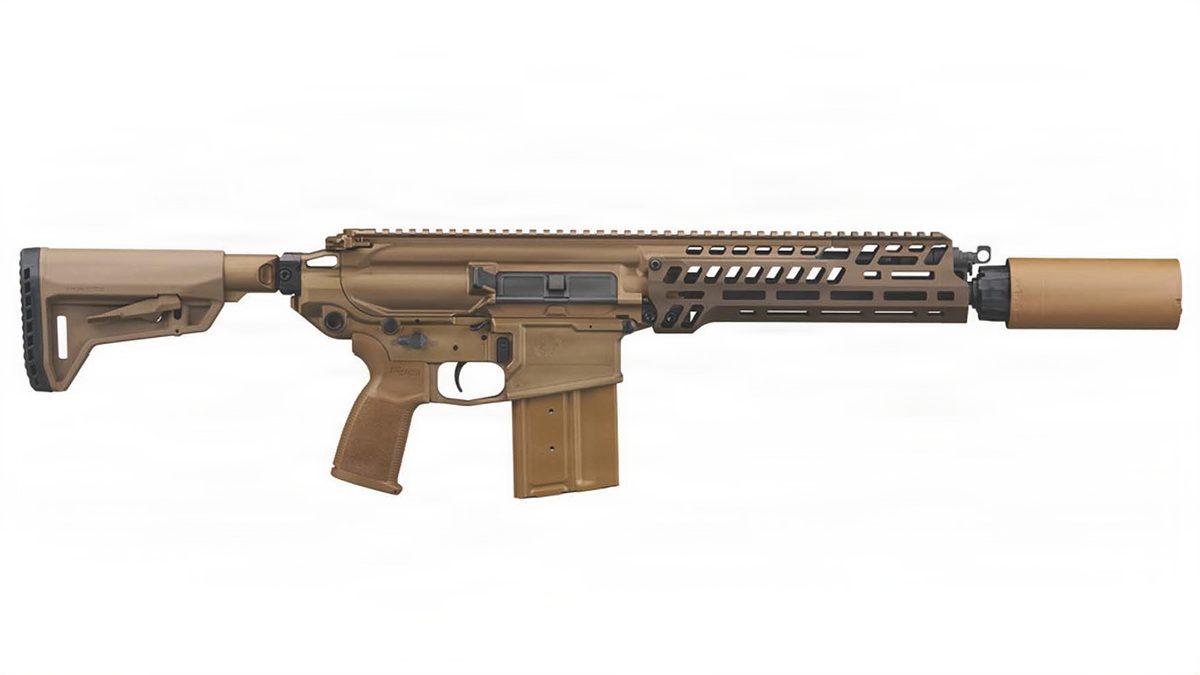
The SIG Sauer XM8 carbine, the US Army's compact 6.8 mm variant of the M7 rifle, shown with suppressor. U.S. Army photo by Aliyah Harrison (U.S. Army Acquisition Support Center) via DVIDS, public domain. Appearance of U.S. Department of Defense visual information does not imply or constitute endorsement.
Mass, Ammo Count and the XM8: Can 6.8 mm Deliver in the Close Fight?
A sharp challenge to the XM8 piece
Our 16 June assessment of the XM8 carbine drew a welcome challenge from Luka Bilić, a researcher who has spoken with Croatian war veterans and special forces operators from the conflicts of the 1990s and 2000s. Their verdict on close-quarters and urban fighting was close to unanimous: for that work they would pick 5.56 mm every time. The reason was mass and ammunition count. Anything past 200 to 400 metres was a job for grenades, a machine gun or a sniper pair, not the individual rifle.
That is a serious point from people who carried the weight, and it deserves a serious answer. Bilić asks whether the 6.8 mm round can live up to its billing in the field. The reply starts with a question of its own: who do you think the enemy is, and are they using 5.56 × 45 mm NATO?
For close quarters and urban warfare we'd always pick 5.56. It was always mass and ammo count. Luka Bilić, researcher, in response to the ISC XM8 assessment, June 2026
Who is the enemy, and are they using 5.56 mm?
The Next Generation Squad Weapon (NGSW) programme, which produced the M7 rifle, the M250 automatic rifle and now the XM8 carbine, was not built for the last war. It was built for a near-peer or peer adversary that fields, or is busy proliferating, body armour that 5.56 mm M855A1 cannot reliably defeat at combat ranges. That is the design brief. Take it away and the case for a heavier round falls apart. Keep it and the arithmetic changes.
The numbers are not subtle. A 5.56 mm M855A1 round leaves a carbine with roughly 1,200 to 1,300 foot-pounds of muzzle energy. The 6.8 × 51 mm Common Cartridge, driving a heavier projectile of about 135 to 140 grains from an 80,000 psi (pounds per square inch) chamber, delivers around 2,800 foot-pounds, close to double. It holds velocity further downrange and defeats barriers and plate that degrade 5.56 mm. Pair that round with the M157 Small Arms Fire Control optic, which ranges the target, computes the firing solution and places the aiming mark, and the whole system is built around first-round hits rather than volume.
| Parameter | 5.56 × 45 mm M855A1 (M4A1) | 6.8 × 51 mm (M7 rifle) | 6.8 × 51 mm (XM8 carbine) |
|---|---|---|---|
| Projectile mass | 62 gr (4.0 g) | ~135 to 140 gr (8.7 to 9.1 g) | Same cartridge |
| Chamber pressure | ~62,000 psi | ~80,000 psi | Same cartridge |
| Barrel length | 14.5 in | ~13 in (330 mm) | ~11 in |
| Approx. muzzle velocity | ~2,950 fps | ~3,000 fps | ~2,800 to 2,900 fps |
| Approx. muzzle energy | ~1,200 to 1,300 ft-lbf | ~2,800 ft-lbf | ~2,450 to 2,600 ft-lbf (est.) |
| Relative round weight | baseline | ~80% heavier | Same cartridge |
| Magazine capacity | 30 | 20 (25 available) | 25 standard |
| Seven-magazine load | 210 rounds | 140 (175 with 25-round) | ~175 rounds |
Open-source approximations for comparison only; figures vary by load and test conditions. The XM8 short-barrel velocity is as reported by SIG Sauer; the matching energy is an estimate calculated from that velocity and projectile mass. Even at the reduced velocity, the 6.8 mm round retains close to double the muzzle energy of 5.56 mm from a comparable barrel.
That reframes the mass-and-ammo-count logic. Volume of fire wins when the rounds work. Against an unarmoured insurgent at fifty metres, 5.56 mm works, and more of it is better. Against a peer soldier in modern plate, a burst of 5.56 mm that fails to penetrate is not mass. It is noise. One 6.8 mm round that defeats the plate is the better trade.
The veteran's point still stands
None of that makes the veterans wrong. Their experience was earned in exactly the fight 5.56 mm was good at: the close, urban, counter-insurgency (COIN) battles of the Global War on Terror (GWOT), against lightly armoured or unarmoured opponents, at ranges almost always inside 300 metres. There, 5.56 mm was the right answer. It was controllable, light and plentiful. A soldier carried about 210 rounds in seven 30-round magazines and could spend them freely. Longer shots went to the machine gun, the designated marksman or the mortar. That doctrine worked, and the men who lived it know why.
The hard part of the switch is precisely the part Bilić names. A 6.8 mm round weighs roughly 80 per cent more than a 5.56 mm round, and the M7-pattern magazine holds 20, not 30. A seven-magazine load drops from 210 rounds of 5.56 mm to about 140 rounds of 6.8 mm, and it weighs more while doing it. That gap, around 70 fewer rounds, has driven a live and public argument about volume of fire since the rifle entered service. It is a real cost, not a rounding error, and the individual rifleman feels it first. The XM8 itself ships with a 25-round magazine as standard, which lifts a seven-magazine load to about 175 rounds and narrows the gap, though it does not close it. The squad answer is the belt-fed M250 in the same calibre, which restores automatic volume at section level. The rifleman still carries fewer rounds than he used to.
What the XM8 actually changes
This is where the carbine earns its place. The full M7 is a fine rifle and a long one, and taking a full-power weapon into a stairwell or a vehicle is awkward. The XM8 shortens the barrel to around eleven inches and the whole weapon to about 32 inches. It trades muzzle velocity, and accepts more blast, flash and report, for handling in a confined space. On its own that velocity loss would chip away at the hit probability the programme exists to buy. The M157 optic is the offset. It corrects the firing solution for the shorter barrel, so compactness does not cost accuracy. A redesigned, shorter SLX suppressor with a thermal shield helps manage the signature problem a short, high-pressure barrel creates indoors. The product-improvement package that produced the carbine swaps the M7's side-folding stock for a fixed telescoping one and trims the suppressor to 1.31 pounds, about an inch shorter and 0.15 pounds lighter than the rifle's, for a weapon of roughly 7.3 pounds before optic and suppressor. SIG Sauer reports the short barrel cuts muzzle velocity to around 2,800 to 2,900 feet per second, against about 3,000 from the M7. Even at that figure the 6.8 mm round carries close to double the muzzle energy of 5.56 mm from a comparable barrel, so the compact form keeps the armour-defeat advantage that justifies the calibre.
So the XM8 is not a calibre swap dropped into the old M4 concept. It is a system: a compact rifle, a smart optic, a suppressor and a squad automatic weapon, engineered together to carry 6.8 mm lethality into the close fight without forcing every soldier to lug the full-length M7.
The polymer question
Bilić's strongest technical point is on the cartridge case, and he is right to press it. Weight is the binding constraint on this whole programme, and the case is where weight hides. True Velocity's composite-cased 6.8 mm, one of the original NGSW contenders, demonstrated more than 30 per cent weight reduction against brass while holding performance. Textron's cased-telescoped design chased similar savings by a different route.
The Army picked neither. It chose SIG Sauer's hybrid case, a stainless-steel base joined to a brass body, because it handles the extreme chamber pressure reliably and proved itself in testing. Even that hybrid already trims about 20 per cent of loaded-cartridge weight against an all-brass round. That was the right call for fielding, but it does not close the door on polymers. Lighter cases remain the most direct way to narrow the ammunition-count gap that worries the veterans, whether through a later loading, an alternate case or wider adoption once the technology matures. The per-round effectiveness gain cuts the same way: if one round does the work that once took several, the soldier may not need to carry as many to reach the same effect.
Can 6.8 mm deliver in the field?
For the fight it was designed for, yes. It gives meaningful overmatch against modern armour and at the ranges where 5.56 mm runs out of answers, and the XM8 brings that into close combat without the bulk of the rifle. It will not feel like an upgrade in every metric. In pure close-quarters battle (CQB) against unarmoured threats, the old virtues of 5.56 mm, its light recoil and deep magazines, still shine, and there will be a learning curve on recoil control, ammunition discipline and tactics. Barrel life is a real cost: the 80,000 psi round wears throat and bore faster than 5.56 mm, and is accepted with adjusted maintenance schedules and round-count tracking. The supply seam created by a round that carries no NATO Standardization Agreement is another, and both were flagged in our original assessment.
The mistake would be to settle the question on 1990s and 2000s experience alone. That risks preparing for the last war rather than the next one. The US Army has accepted the trade because it judges the future battlefield will reward armour defeat and reach more than it rewards magazine depth. Whether that judgement is right is an empirical question, and the first fielding data from 2026 will start to answer it. The engineering, the ballistics and the threat analysis all point the same way: handled with the right training and doctrine, 6.8 mm can do what is being asked of it.
Bilić's framing, who is the enemy, is exactly the right way to hold the debate. The XM8 is the Army's answer for the close spaces where that enemy will be hardest to beat. Time and operational feedback will judge it. The intent and the design are sound.
References
Source-evaluated under NATO STANAG 2022 (Reliability A–F / Accuracy 1–6). Tier 1 = government primary source; Tier 2 = quality news / specialist defence media; Tier 3 = authoritative aggregator / encyclopaedia.
- T1U.S. Army (army.mil) – Delivering tomorrow's small caliber ammunition lethality today, 21 April 2026. (Reliability A / Accuracy 1)
- T2ISC Defence Intelligence – US Army Introduces the XM8 Carbine for the Close Combat Force (the article under discussion), 16 June 2026. (Reliability B / Accuracy 2)
- T2National Defense Magazine (NDIA) – Army Introduces New XM8 Carbine For Close Combat Ops, 11 June 2026. (Reliability B / Accuracy 2)
- T2Task & Purpose – Why the Army's new XM7 rifle reignited a debate over volume of fire, 2025. (Reliability B / Accuracy 2)
- T319FortyFive – The Army Replaced the M4 With a More Powerful Rifle, Then Gave Soldiers 70 Fewer Rounds to Fight With, March 2026. (Reliability C / Accuracy 3)
- T3American Rifleman (NRA) – True Velocity Ships Composite-Cased Ammo to U.S. Army (composite case, >30% weight reduction), 2021. (Reliability C / Accuracy 3)
- T3American Rifleman (NRA) – Testing the Army's M855A1 Standard Ball Cartridge (5.56 mm velocity and energy), 2017. (Reliability C / Accuracy 3)
- T3Gun Digest – .277 Fury: The Army's Newest Cartridge's Background And Ballistics (6.8 × 51 mm velocity and energy), 2023. (Reliability C / Accuracy 3)
- T2Soldier Systems Daily – Army Approves XM8 Carbine & 25 Round Magazines for NGSW (25-round magazine, telescoping stock, suppressor and weight), 2 April 2026. (Reliability B / Accuracy 2)
- T3Army Recognition – US Army designates M7 carbine variant as XM8 for faster handling in close combat (short-barrel velocity), 2026. (Reliability C / Accuracy 3)
Corrections & updates welcome. If you hold open-source data that refines or corrects any parameter in this article, please contact [email protected] citing the specific claim and your source. Verified corrections will be incorporated and credited in the revision history. AI-assisted technical assessment based on open-source material. Not a formal intelligence product.