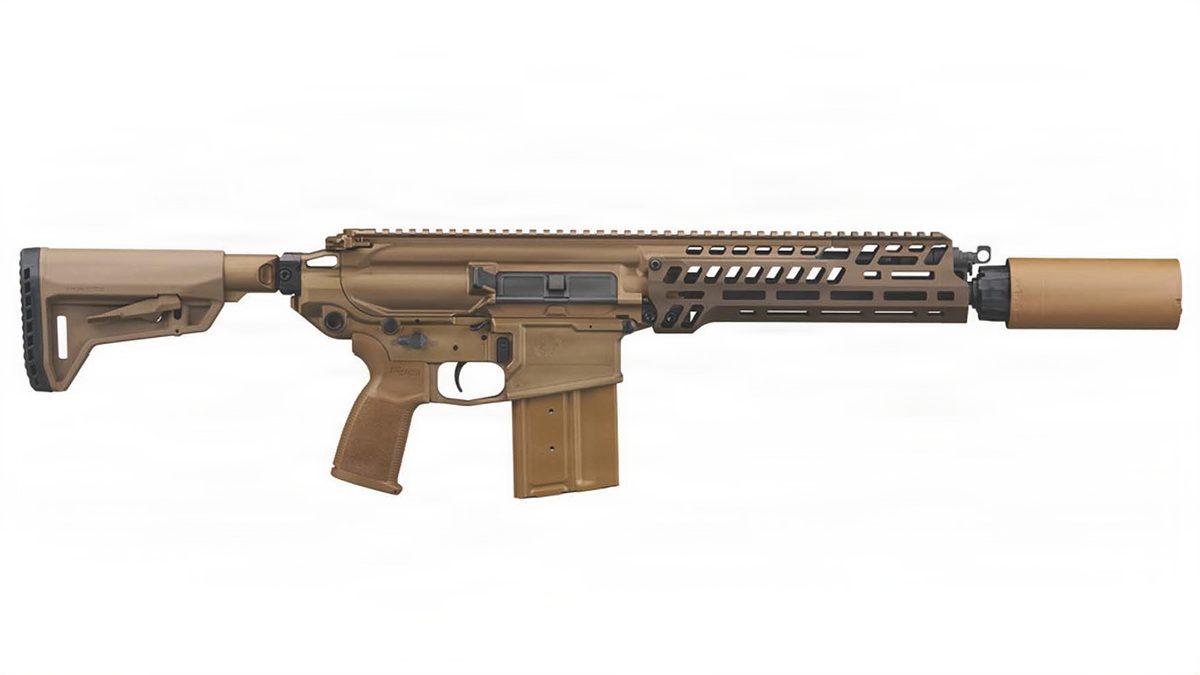
The SIG Sauer XM8 carbine, the US Army's compact 6.8 mm variant of the M7 rifle, shown with suppressor. U.S. Army photo by Aliyah Harrison (U.S. Army Acquisition Support Center) via DVIDS, public domain. Appearance of U.S. Department of Defense visual information does not imply or constitute endorsement.
US Army Introduces the XM8 Carbine: a Compact 6.8 mm Next Generation Squad Weapon for the Close Combat Force
Technical Summary
On 11 June 2026 the United States Army introduced the XM8 carbine, the compact variant of the M7 Next Generation Squad Weapon-Rifle (NGSW-R), and confirmed it will replace the 5.56 × 45 mm M4A1 carbine across the Close Combat Force. Manufactured by SIG Sauer, the XM8 received its formal designation and national stock number in March 2026, with first articles accepted on 3 April 2026; the June announcement marks the close-combat fielding decision. It retains the 6.8 × 51 mm Common Cartridge of the NGSW family in a shorter, lighter package built for confined spaces. The designation revives a label last carried by the cancelled Heckler & Koch modular rifle of the mid-2000s; the two weapons share nothing beyond the name.
The 6.8 × 51 mm Common Cartridge is the defining technical feature. It uses a hybrid case, a stainless-steel base joined to a brass body, to sustain chamber pressures in the order of 80,000 pounds per square inch (psi), well above the roughly 62,000 psi service envelope of 5.56 × 45 mm M855A1 and of conventional 7.62 × 51 mm ammunition. That pressure margin drives a heavier projectile, reported at about 135 grains (8.7 g), fast enough to defeat advanced body armour at range. Net explosive quantity (NEQ) is not a meaningful measure for inert ball or general-purpose small-arms ammunition; the governing parameters here are chamber pressure, case construction, barrel length and the resulting interior-ballistics trade.
The 6.8 × 51 mm round runs at chamber pressures near 80,000 psi, roughly a third above the 5.56 mm and 7.62 mm service envelope. Shortening the barrel to around eleven inches trades muzzle velocity for handling in the close fight. ISC technical assessment, 16 June 2026
Baseline specification (open sources)
| Designation | XM8 carbine (compact M7 NGSW-R variant) |
| Manufacturer | SIG Sauer |
| Calibre | 6.8 × 51 mm Common Cartridge (commercial .277 SIG Fury) |
| Chamber pressure | ~80,000 psi (hybrid stainless-and-brass case) |
| Barrel length | ~11 in (279 mm); reported as 10 in in some accounts |
| Overall length / mass | ~32 in (810 mm) / ~7.3 lb (3.3 kg) |
| Fire control | M157 Small Arms Fire Control (shared with M7, M250) |
| Role | Replace 5.56 × 45 mm M4A1 in the Close Combat Force |
| Transport class (packaged) | UN 0012, Hazard Division 1.4 Compatibility Group S |
Analysis of Effects
The XM8 carries NGSW lethality into the close fight without the bulk of the full-length M7. Shortening the barrel from the M7's 13 inches (330 mm) to about 11 inches (279 mm) reduces the volume available for propellant to burn, so a measurable fraction of muzzle velocity is given up relative to the rifle. With a high-pressure cartridge the shorter barrel also vents more unburnt propellant at the muzzle, increasing muzzle blast, flash and report. The M157 Small Arms Fire Control optic, which combines a laser rangefinder, a ballistic computer, environmental sensors and an aiming overlay, is intended to recover the first-round-hit probability that the velocity loss would otherwise erode. Fire-control sophistication, in effect, offsets the ballistic penalty of compactness.
At squad level the XM8 preserves ammunition commonality with the M7 rifle and the belt-fed M250 automatic rifle, all chambered in 6.8 × 51 mm and all integrated with the M157, and it shares the M7's 20- and 25-round SR-25-pattern magazines. That commonality is the logistic logic of NGSW, and it rests on a maturing industrial base: operating contractor Olin Winchester has produced 6.8 mm ammunition at the Lake City Army Ammunition Plant since March 2026, with projectiles also supplied to SIG Sauer. The strategic cost is standardisation. The 6.8 × 51 mm round is a United States sovereign nature with no NATO Standardization Agreement (STANAG), unlike the 5.56 × 45 mm (STANAG 4172) and 7.62 × 51 mm (STANAG 2310) cartridges it sits beside. A close-combat force re-equipping on a non-interchangeable round accepts a coalition-supply seam in exchange for terminal performance.
Personnel and Safety Considerations
For ammunition technicians and armourers the high-pressure 6.8 × 51 mm cartridge concentrates the maintenance burden on barrel and chamber wear. Sustained firing of an 80,000 psi round through a short barrel accelerates throat erosion and bore heating relative to 5.56 mm, shortening barrel service life and raising the importance of round-count tracking and timely barrel replacement. For the firer, the increased muzzle blast and flash from a barrel of around eleven inches are ergonomic and signature considerations, particularly when firing unsuppressed in enclosed spaces; a redesigned SLX suppressor, about an inch shorter and fitted with a thermal shield to manage barrel-heat signature, is reported for the carbine. Packaged ball and general-purpose 6.8 × 51 mm ammunition is handled as Hazard Division 1.4 Compatibility Group S (1.4S, UN 0012), the standard small-arms transport and storage classification; it presents no mass-explosion hazard, and NEQ is not the governing storage parameter.
Data Gaps
Several parameters remain unconfirmed in open source. Muzzle velocity and retained energy of 6.8 × 51 mm fired from the XM8's short barrel, as distinct from the M7's 13-inch barrel, are not published. Barrel length itself is reported variously as 10 or 11 inches across sources. The size and value of the Close Combat Force fielding tranche are not disclosed. The roughly 80,000 psi chamber pressure and the 135-grain projectile mass derive from manufacturer and trade reporting rather than a retrieved Army specification, and confirmed barrel-life round counts are not available. These figures are flagged for primary-source verification.
References
Source-evaluated under NATO STANAG 2022 (Reliability A–F / Accuracy 1–6). Tier 1 = government primary source; Tier 2 = quality news / specialist defence media; Tier 3 = authoritative aggregator / encyclopaedia.
- T1U.S. Army (army.mil) – Delivering tomorrow's small caliber ammunition lethality today, 21 April 2026. (Reliability A / Accuracy 1)
- T2National Defense Magazine (NDIA) – Army Introduces New XM8 Carbine For Close Combat Ops, 11 June 2026. (Reliability B / Accuracy 2)
- T2Military Times – Army receives first batch of XM8 carbines set to replace M4A1s, 7 April 2026. (Reliability B / Accuracy 2)
- T2Stars and Stripes – Army accepts first delivery of its new service rifle, the XM8 Carbine, 9 April 2026. (Reliability B / Accuracy 2)
- T3American Rifleman (NRA) – Army Testing New XM8 Carbine, 2026. (Reliability C / Accuracy 3)
Corrections & updates welcome. If you hold open-source data that refines or corrects any parameter in this article, please contact [email protected] citing the specific claim and your source. Verified corrections will be incorporated and credited in the revision history. AI-assisted technical assessment based on open-source material. Not a formal intelligence product.