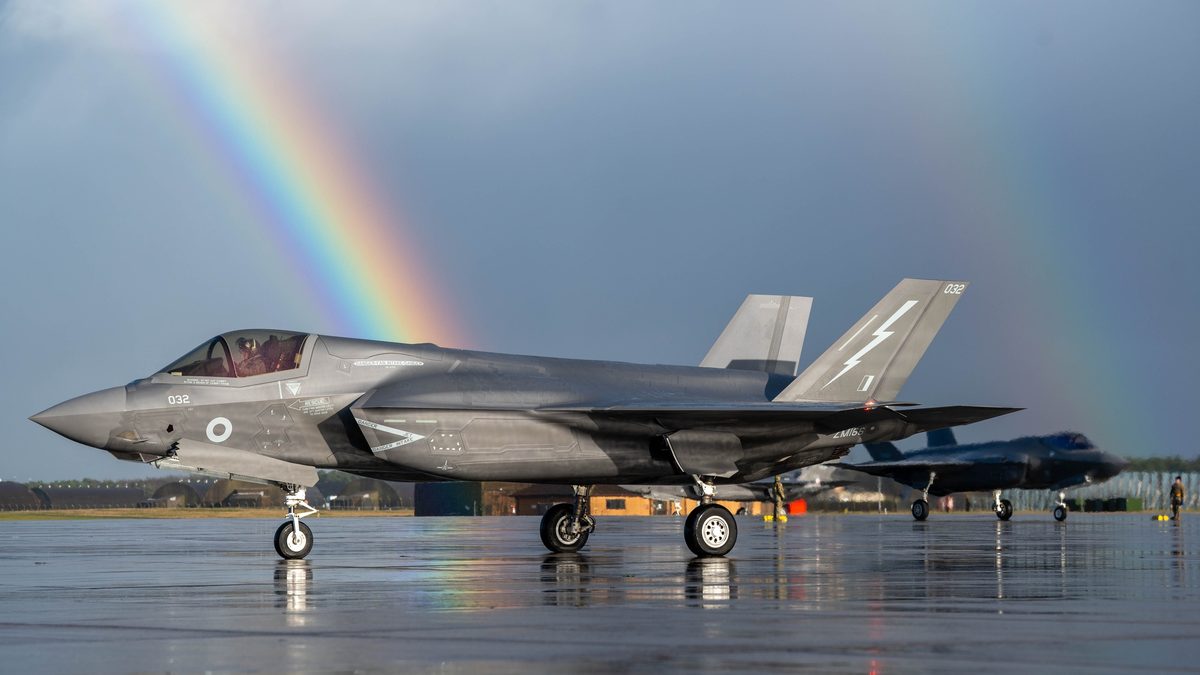
A Royal Air Force F-35B Lightning II assigned to RAF Marham taxis at RAF Lakenheath during Exercise Point Blank 25-1, 27 January 2025. U.S. Air Force photo by SrA Seleena Muhammad-Ali (DVIDS ID 8848932, public domain).
Stranded at Lajes: Two RAF F-35Bs and a Lightning Force Already Stretched Thin
A factory-fresh delivery flight from Lockheed Martin’s Fort Worth plant to Royal Air Force (RAF) Marham came down to five aircraft on 9 March 2026. Three reached Norfolk. Two, ZM177 and ZM179, diverted into Lajes Airport in the Portuguese Azores with technical faults and have not flown since. As of today the pair have been on the ground in the mid-Atlantic for roughly seventy-two days. The incident is awkward on its own. The wider story is what it reveals about UK F-35 mission availability, the spares chain, the Lockheed Martin production line and the architecture of carrier strike at a moment when the long-delayed Defence Investment Plan still has not committed to Tranche 2.[1][2]
What Happened: The Lajes Diversion
The two aircraft stuck at Lajes are part of Lot 17, the final batch of the United Kingdom’s initial Tranche 1 order of 48 F-35B Lightning II Short Take-Off Vertical Landing (STOVL) fighters. Five aircraft (ZM177, ZM178, ZM179, ZM180 and ZM181) left Naval Air Station Joint Reserve Base Fort Worth, Texas, on a routed transit via the Azores, the standard mid-Atlantic refuelling and staging stop for transatlantic ferry flights. Three completed the second leg into RAF Marham in Norfolk in late April. Two did not. ZM177 and ZM179 landed at Lajes International Airport on the island of Terceira on 9 March 2026 and have remained there since.[1][2]
The Ministry of Defence (MoD) has not described the nature of the faults. Open-source reporting tracking aviation movements over the Azores recorded a Royal Air Force Voyager (call-sign ASCOT 9303) returning to RAF Brize Norton from Lajes on or about 20 March with a recovery profile, but the two F-35Bs remained on the ramp. The aircraft are unlikely to fly home until Lockheed Martin engineers, working through the Joint Program Office sustainment chain, have repaired them; until handover acceptance at RAF Marham, they remain Lockheed Martin’s aircraft, not the RAF’s.[1] Each airframe is reported in the order of £125 million at unit-recurring flyaway cost, which is why the local Portuguese press has run the story as a quarter-of-a-billion pounds of stealth fighter on a holiday-island apron.[3]
Fleet Availability: The Sustainment Problem the NAO Already Documented
Two stranded jets matter less than what they signal. The UK Lightning Force now consists of 47 operational F-35Bs (the initial 48 minus ZM152, lost off HMS Queen Elizabeth in November 2021) with the final pair from Lot 17 still technically pending acceptance.[4] The National Audit Office (NAO) review published on 11 July 2025 (HC 989, Session 2024–25) found that in 2024 the UK fleet was achieving approximately half of the MoD’s target Mission Capable rate (the share of time an aircraft can fly at least one of the seven F-35 mission sets) and approximately one third of the Full Mission Capable target (the share of time an aircraft can fly all required missions).[5][6]
Over the three months from October 2024 to January 2025, the UK fleet’s Mission Capable rate ran at roughly three-fifths of the global F-35B fleet average, and its Full Mission Capable rate at roughly two-fifths.[5][6] The NAO attributed the gap principally to a shortfall in trained F-35 engineers within the UK Lightning Force and to a global shortage of spare parts that has affected every operator but bites the UK harder because of the smaller domestic stockholding and the contracted-out sustainment arrangement with Lockheed Martin and Pratt & Whitney through the Joint Program Office.[5]
Navy Lookout’s reading of the operational picture, drawn from open sources, is sharper: on a typical day perhaps ten or eleven of the 47 UK F-35Bs are flyable, with five or six fully combat capable.[2] The MoD disputes the underlying availability metric and prefers the more favourable Mission Capable figure, particularly on deployment.[6] The dispute is itself the issue: two years into intensive operations the UK and its principal scrutiny body still do not agree on how to count an available aircraft.
Carrier Strike Credibility: Kerala, Spare Parts and ZM152
The Azores incident sits in a sequence. On 14 June 2025, an RAF F-35B operating from HMS Prince of Wales (R09) on Operation Highmast diverted to Thiruvananthapuram International Airport in Kerala, India, after suffering a hydraulic system failure compounded by low fuel and monsoon weather over the Arabian Sea. The Royal Navy maintenance team could not address the fault. A fourteen-strong engineering party flew out from the United Kingdom aboard an RAF A400M on 7 July. The aircraft eventually departed on 22 July 2025, thirty-seven days on the ground.[7]
Operation Highmast also produced the Public Accounts Committee (PAC) finding that drew the loudest fire. Parliament’s scrutiny showed HMS Prince of Wales had deployed to the Middle East carrying twenty-four F-35Bs while the embarked spare-parts pack had been provisioned for twelve. Concurrent reporting confirmed that Royal Navy F-35Bs were also undergoing intensive corrosion inspections in Florida, a maintenance burden that has surprised no one familiar with operating a stealth airframe at sea in salt air but which has not been accompanied by any corresponding adjustment to the embarked sustainment package.[1][2]
The November 2021 loss of ZM152 from HMS Queen Elizabeth in the eastern Mediterranean remains the only F-35 the UK has written off in service. The cause was an engine intake blank left in place on launch; contributory factors included missed pre-flight briefs, distractions in the maintenance flow, and inadequate handover. The 148-page Service Inquiry report published in August 2023 read less as a freak-event narrative than as an organisational accident report, with the human-factors and procedural findings broadly applicable to the wider Lightning Force.[8]
Programme Accountability: The NAO and PAC Findings in Context
The NAO July 2025 review (HC 989) is the most authoritative independent assessment of where the UK F-35 programme sits. Its headline findings are not flattering: a fleet too small to deliver the planned force structure; mission availability significantly below MoD targets; a UK F-35 infrastructure footprint at RAF Marham and RAF Lakenheath still maturing; major personnel shortages in maintenance trades; and a national stockpile of weapons certified for F-35B carriage that the NAO assessed as inadequate to sustain a major operation.[5][9]
The MoD response, when pushed on availability figures, has been to challenge the metric rather than the result. That is a defensible position only up to a point. The Public Accounts Committee, whose role is to test that defence, has been more pointed, particularly on the gap between the carrier strike capability promised in the 2015 and 2021 Defence Reviews and the carrier strike capability that can be generated and sustained at sea today. A force that struggles to keep half of its frontline jets mission capable in peacetime, and that ferries new aircraft into service via the same Azores stop where two of them are now stuck, is not yet a force that can credibly underwrite the standing claim that UK carrier strike is a fifth-generation capability available at political readiness.[9]
The Industrial Angle: Lockheed Martin, TR-3 and Block 4
The Azores incident is, in part, a Lockheed Martin story. The aircraft ferrying out of Fort Worth in March were the last of Lot 17, a production lot whose deliveries have been entangled with the Technology Refresh 3 (TR-3) hardware-and-software upgrade that underpins the Block 4 capability roadmap. TR-3 was originally scheduled for delivery in April 2023. The US Government Accountability Office (GAO) confirmed in its September 2025 report (GAO-25-107632) that combat-capable TR-3 aircraft would not begin reaching units until 2026, a three-year slip, with full Block 4 not now expected before 2031 at the earliest, a five-year slip on the original timeline.[10]
The drivers documented by the GAO are the immature design of the Integrated Core Processor (ICP), late and quality-compromised ICP deliveries from the supplier, instability in the TR-3 software stack manifesting as ground and in-flight cockpit display and radar issues, and the delayed Next Generation Distributed Aperture System sensor suite. Deliveries to all customers were paused in 2024 while the software was stabilised; aircraft sat in storage at Fort Worth before resumed handovers in mid-2024.[10] Lockheed Martin nevertheless received on-time delivery bonuses for that production period, a point the Department of Defense Inspector General has criticised in subsequent oversight reporting.[10]
None of this means the two aircraft at Lajes were grounded by TR-3 software per se. The faults have not been publicly disclosed. It does mean that the production environment from which they emerged is one in which Lockheed Martin has been working through accumulated technical debt across hardware, software and supplier quality, with sustained pressure from operators including the UK, Norway, Finland, Italy, the Netherlands and a growing European Foreign Military Sales customer base.
References & Acknowledged External Resources (A&ER)
Sources are rated under NATO Standardisation Agreement (STANAG) 2022 for Reliability (A–F) and Credibility (1–6). Inline citation markers [1] through [10] link to the corresponding entry below; each entry links out to the primary source document.
ISC Commentary
The Azores incident is awkward optics. Treated only as awkward optics, it would be a footnote. Treated as a signal it is part of an unmistakable pattern. Within five years the UK Lightning Force has lost one airframe to an organisational accident off HMS Queen Elizabeth, stranded one in Kerala for thirty-seven days, deployed twenty-four aircraft on HMS Prince of Wales with spare-parts provisioning for twelve, received an NAO finding that mission capability is running at half the MoD’s own target, and now has two factory-fresh aircraft sitting unflyable on a North Atlantic island for two-and-a-half months before formal handover. Each incident has its own narrow technical cause. The pattern is the issue.
The pattern points at sustainment, not airframe design. The F-35B is a capable aircraft. Every advanced combat system has maintenance problems. What is exposed at Lajes is not the F-35B as a platform but the architecture wrapped around it: a contracted-out sustainment model in which Lockheed Martin retains effective control of repair authority until handover and during much of in-service life; a national spares holding too thin to absorb shocks; a maintenance trade pipeline that the NAO has flagged as undermanned; and a forward sustainment package on the carriers that has been sized for an aspirational fleet rather than the embarked one.
Two policy questions follow. First, what is the credible UK Mission Capable target for the next five years against the actual spares, engineering manpower and sovereign repair authority the Lightning Force will hold, not against the figures negotiated when the programme was sold? Second, on what basis will the Defence Investment Plan commit to the Tranche 2 mix of twelve F-35As and fifteen F-35Bs, nominally bringing the fleet to 74 against a programme of record of 138, without first closing the sustainment gap the NAO has already documented? An additional twenty-seven aircraft on an unaltered sustainment baseline will not produce additional flying hours at a rate that justifies the procurement, and the F-35A option that restores B61-12 nuclear gravity-bomb delivery under NATO arrangements brings its own basing, certification and aircrew-cycle implications. The Azores story will pass. The Mission Capable arithmetic will not.