On 17 December 2025 KNDS confirmed a dual listing in Paris and Frankfurt for the second half of 2026, with a target valuation of around €20 billion. In the eight weeks before and after that announcement, KNDS sold 80 RCH 155 to the Bundeswehr, signed a Letter of Intent with Leonardo for an Italian wheeled artillery programme worth around €1.81 billion, won the British Army's Mobile Fires Platform competition for 72 systems at roughly £1 billion, and booked a record run of CAESAR truck-mounted howitzer orders. The combined order book is the strongest in the company's history. Look closer and it is two order books.
One Company, Two Companies
KNDS was formed in 2015 by merging Germany's Krauss-Maffei Wegmann (KMW) and France's state-owned Nexter Systems. Ownership has remained 50/50 between the French government and the Wegmann family ever since. Headquartered in Amsterdam, the group sells a portfolio that includes the Leopard 2, the Leclerc, the PzH 2000, the Boxer (with Rheinmetall via ARTEC), the AGM-derived RCH 155, and the CAESAR. KNDS markets that catalogue as a single Franco-German offering. The order book tells a different story.
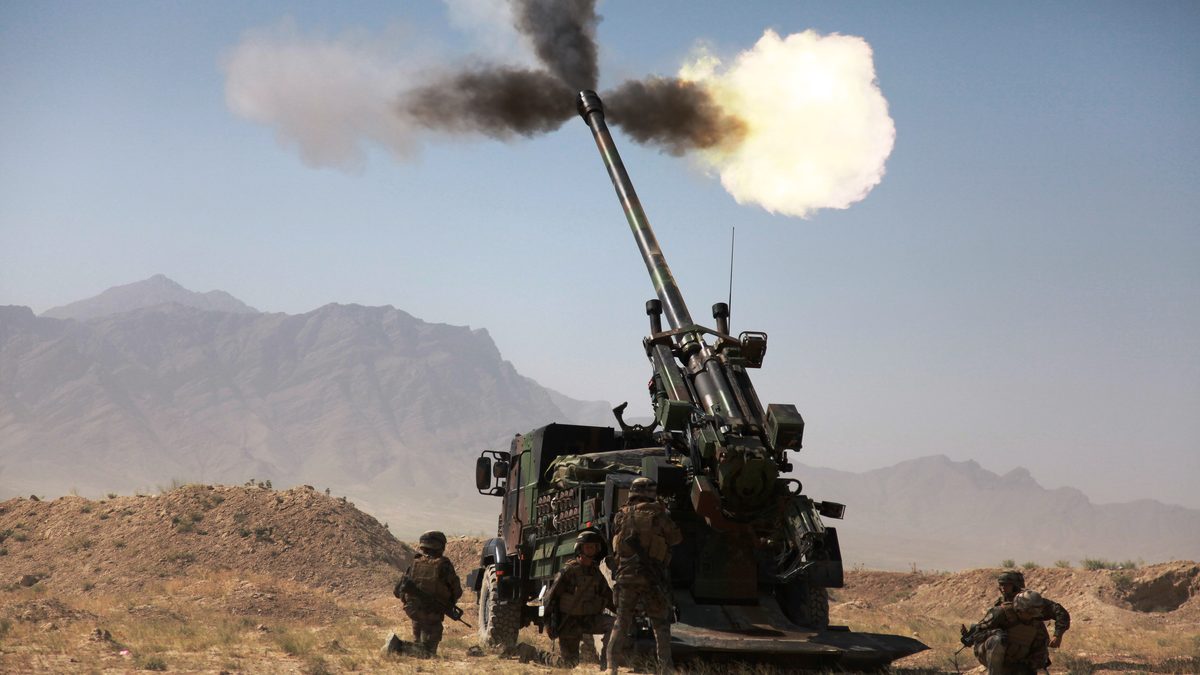
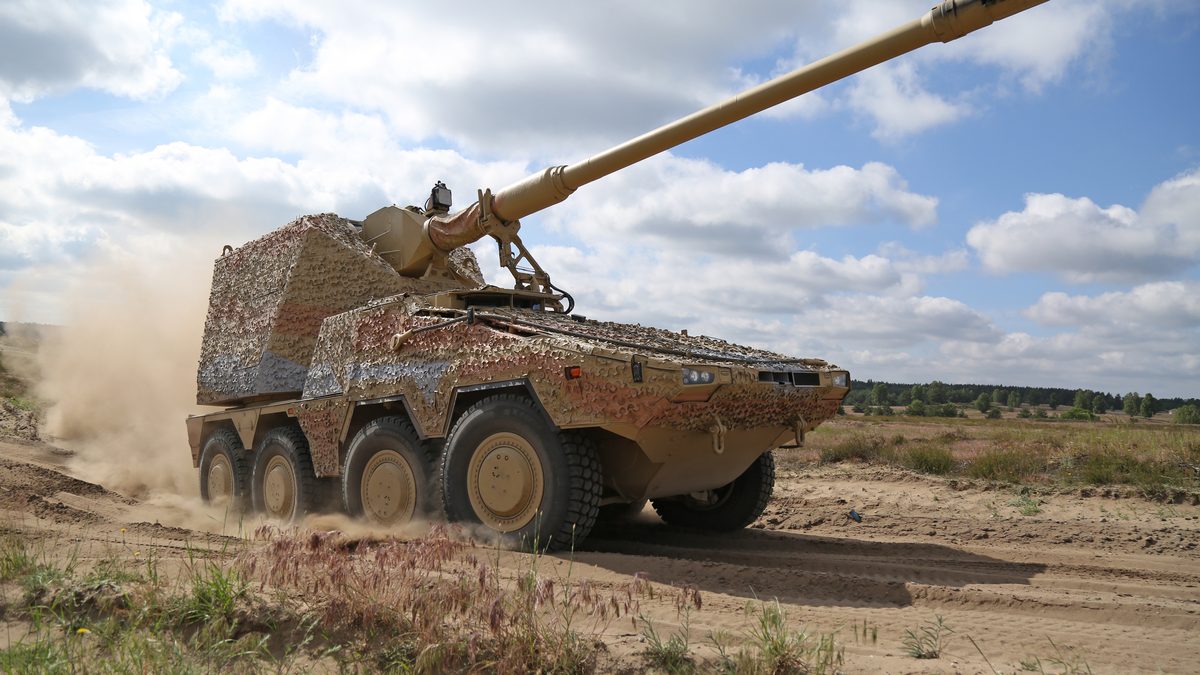
The cleanest way to see the bifurcation is the artillery line. CAESAR is a truck-mounted 155 mm L/52 howitzer, around 18 to 30 tonnes depending on chassis, two to five crew, light protection, designed to drive into a firing position, deliver six to eight rounds per minute and drive out before counter-battery radar can solve. RCH 155 is a wheeled self-propelled howitzer on the Boxer 8×8 chassis, around 39 tonnes, two crew, STANAG 4569 Level 6 frontal protection, capable of firing on the move, with an autoloader feeding the same L/52 barrel. Both can reach about 70 km with Leonardo's VULCANO GLR guided round. Both are, on paper, KNDS systems. In practice they are engineered, marketed and championed by different halves of the company, and their order books are diverging.
Where CAESAR Lost
CAESAR was a candidate in the UK's Mobile Fires Platform competition. It lost. KNDS UK's bid offered RCH 155 on a UK-manufactured Boxer drive module, and the British Army selected that offering in April 2024 over CAESAR, Archer (BAE Bofors), K9 (Hanwha) and a notional Mk41 truck-mounted Caesar variant. The production contract for 72 units worth approximately £1 billion was signed in May 2026 with first deliveries from 2028.
CAESAR was also displaced from the Italian wheeled artillery requirement. The Italian programme could plausibly have gone three ways. It could have selected CAESAR from KNDS France. It could have selected a Centauro-based national solution from Leonardo, building on the Italian wheeled-platform heritage. Or it could have selected the German AGM gun module on a Boxer-class chassis. KNDS Germany and Leonardo solved the politics by combining options two and three: in December 2025 the two companies signed a Letter of Intent under which KNDS Germany supplies the AGM and Leonardo provides a national protected wheeled vehicle. The programme envelope is around €1.81 billion, with an initial phase of €637 million funded from 2026. The Italian solution mounts the KNDS Germany AGM on a Leonardo chassis. The gun heart is identical to the UK system; the wheels and welds are Italian.
That is what the loss looks like. CAESAR has been absent from both of the largest higher-tier wheeled-howitzer competitions Europe has run in the last two years. France, the home market, ordered another 109 CAESAR in February 2024. But every time a non-French NATO buyer has had a free choice between CAESAR and a Boxer-class RCH 155 derivative since the start of 2025, CAESAR has lost.
Where CAESAR Still Wins
The bifurcation is not a CAESAR collapse. CAESAR is having its biggest order year. KNDS France is ramping production toward twelve units per month against an order book that now includes France (109 in 2024), Lithuania (48 across two orders), Belgium (28 across two), Estonia (24 across two), Slovenia (12), Indonesia (55), plus historic customers in Denmark, Czechia, Saudi Arabia, Thailand and Morocco. The platform is winning consistently in three categories: nations that need 155 mm fires quickly and cheaply, nations whose road network and bridging constraints argue against a 39-tonne wheeled SPH, and nations whose procurement budgets cannot absorb the per-unit cost of a fully-protected Boxer-class system.
For those buyers CAESAR is not the second-best option; it is the right option. The lesson is not that KNDS France is failing. It is that CAESAR and RCH 155 are serving different market segments, that those segments are growing in parallel, and that on the corporate balance sheet both halves of KNDS look healthy. The question is what happens when the IPO has to value them, and when the German family shareholders sell down their half of the company.
The Wegmann Sell-Down and the Stake Question
KNDS announced its IPO intent on 17 December 2025. The structure is a dual listing on Paris and Frankfurt during the second half of 2026, with an indicated valuation in the region of €20 billion. The intended sellers are the Wegmann family, the German half of the 50/50 ownership inherited from the 2015 merger. The French government has signalled it intends to retain its full stake. If the Wegmann family floats their entire holding into a free public market, the post-IPO ownership picture would have France as the largest single shareholder and a dispersed public-market float on the German side.
Berlin has noticed. Inside the German federal coalition the debate has been about whether to take a state pre-IPO stake to match the French position, and at what level. Defence and Finance reportedly favour around 40 per cent. Economy, and Chancellor Friedrich Merz, prefer around 30 per cent (sufficient to constitute a blocking minority under Dutch law, since KNDS is incorporated in Amsterdam). The timing window is closing because the IPO process is already in motion: Christian Schulz, formerly chief financial officer at RENK Group and the architect of RENK's IPO, joined the KNDS Board on 1 January 2026.
The reason it matters for product strategy is straightforward. A post-IPO KNDS where the French government remains the single largest shareholder and the German public float is dispersed will tilt, in governance terms, toward Nexter. A post-IPO KNDS where a German federal stake of 30 to 40 per cent matches France will sit more balanced. Either way the equity question lands, the artillery order book is currently lopsided in the German direction, and the IPO prospectus will have to either reconcile that or paper over it.
MGCS: The Workshare Lesson
The Main Ground Combat System (MGCS), the Franco-German tank replacement programme, used to be a cautionary tale and is now a slightly different kind of lesson. After more than five years of public Franco-German workshare dispute, agreement was reached in 2025 to add Rheinmetall as a third industrial partner. Each of Nexter, KMW and Rheinmetall holds a 25 per cent stake in the new MGCS Project Company GmbH, which was established in Cologne in April 2025 with German Federal Cartel Office approval. Each leads one third of eight technology pillars. Nexter retains 50 per cent of manufacturing; KMW and Rheinmetall split the other 50 per cent.
The workshare problem was solved by adding a fourth player and giving each of the three majority stakeholders an equal seat. Prototype delivery is now targeted for 2030 and initial operational capability is projected for the 2040 to 2045 window. That is roughly a decade later than the original concept, but a decade of slippage is the price paid for resolving the dispute rather than letting it kill the programme.
The implication for KNDS artillery is direct. Resolving the bifurcation, if Paris and Berlin ever want to, will require either an equally artificial structural compromise (a CAESAR-RCH 155 product fusion that nobody is currently asking the engineering teams for) or a comfortable acceptance that the two product lines stay separate and serve different markets. The MGCS precedent suggests neither side has the political appetite to force the first option, and on the order-book evidence neither side needs to.
VULCANO: The Integration That Actually Happened
Three-nation European industrial integration in 155 mm artillery is not happening at the platform level. It is happening at the ammunition level. The VULCANO family of 155 mm guided projectiles is developed and produced by Leonardo (Italy), in cooperation with Rheinmetall (Germany) for the unguided ballistic extended-range variant and with Diehl Defence and DDS for elements of the propulsion and fuzing chain. The fully-guided GLR variant is what gives RCH 155, CAESAR Mk2, PzH 2000, and the Italian KNDS-Leonardo wheeled SPH their 70 km reach.
Every higher-tier 155 mm system in NATO Europe is converging on VULCANO. The platforms are diverging while the ammunition supply chain is unifying. That happens at the layer of the system that matters most operationally (precision guided long-range munitions), gets the least visibility in press release headlines, and is hardest to substitute around if disrupted. For KNDS S.A. as an IPO story, the VULCANO supply position is arguably a stronger long-term moat than any platform-level workshare arrangement could deliver.
What to Watch Next
Three open questions will shape whether the bifurcation hardens or softens through the second half of 2026.
The Netherlands artillery decision. Up to 240 systems, possibly worth in the €2 to €3 billion range. RCH 155 is the assumed front-runner per the public Rheinmetall comments, but the Dutch have a documented preference for cost-effective wheeled artillery and a domestic political interest in supply-chain diversification.
The German federal stake decision. 30 per cent versus 40 per cent versus no state stake at all. The decision shapes which national government is the natural counterparty for KNDS S.A. once Wegmann is out.
Polish K9 follow-on or CAESAR import. Poland has been the largest single buyer of Korean K9 self-propelled howitzers and is approaching a follow-on decision. If Poland looks at a wheeled supplement (where CAESAR is the obvious candidate against ROK-developed alternatives), CAESAR could pick up a major new operator. That would partially counter the higher-tier German sweep.
None of these decisions makes KNDS less of an IPO story. They will determine whether the company that lists in Paris and Frankfurt in late 2026 trades as a single growth narrative, or as two adjacent product lines pulling in different directions.
About this research
This analysis was produced by the ISC Defence Intelligence research team, the open-source intelligence publication of Integrated Synergy Consulting Ltd. It is one of a two-part sequence on the May 2026 RCH 155 procurement decisions and the wider KNDS group trajectory.
ISC Defence Intelligence publishes on Weapons, Ordnance, Munitions and Explosives (WOME), NATO procurement, the defence industrial base, and explosive safety. Independent consulting, training and bespoke briefings are available on the same subject matter. For media enquiries, expert commentary requests, or a private briefing on the topics covered here, contact /contact.
Published by Integrated Synergy Consulting Ltd · trading as ISC Defence Intelligence · Registered in England and Wales · integratedsynergyconsulting.com
Acronyms Used
AGM Artillery Gun Module · CAESAR Camion Équipé d'un Système d'Artillerie · DGA Direction Générale de l'Armement (France) · GLR Guided Long Range · IOC Initial Operational Capability · IPO Initial Public Offering · K9 Hanwha self-propelled howitzer · KMW Krauss-Maffei Wegmann · KNDS Krauss-Maffei Wegmann + Nexter Defense Systems (holding company) · LoI Letter of Intent · MFP Mobile Fires Platform (UK) · MGCS Main Ground Combat System · OCCAR Organisation for Joint Armament Cooperation · RCH Remote Controlled Howitzer · SPH Self-Propelled Howitzer · STANAG Standardisation Agreement (NATO) · V-LAP Velocity-enhanced Long-range Artillery Projectile · VULCANO Leonardo 155 mm guided projectile family.
References
- KNDS Group, "KNDS intends to list in 2026 to support its long-term growth strategy," press release, 17 December 2025. knds.com (NATO STANAG 2022: B-2, primary corporate statement).
- Global Banking and Finance, "KNDS Proceeds with IPO as Germany Considers Pre-IPO Stake," 2026. globalbankingandfinance.com (B-3, reports German federal coalition stake discussions at 30 to 40 per cent).
- Nordic Defence Review, "KNDS: A Franco-German Land-Systems Champion on the Road to a Potential IPO," 2026. nordicdefencereview.com (B-2, structural analysis).
- Wikipedia, "Main Ground Combat System" and "RCH 155," compiled technical specification and programme status (used as cross-reference; underlying primary sources verified independently). Wikipedia MGCS, Wikipedia RCH 155 (C-3).
- Defense Security Monitor, "KNDS and Leonardo Set Aside Rivalry to Capture Italy's Heavy Firepower Market," 17 December 2025. dsm.forecastinternational.com (B-2).
- Army Recognition, "KNDS and Leonardo Team Up on Wheeled 155mm Artillery as Italy Modernizes Army Firepower," 2025. armyrecognition.com (B-3).
- Ministry of Defence (UK Government), "Next-generation remote controlled artillery systems to transform British Army," 13 May 2026. gov.uk (A-1).
- KNDS France, "A record year for CAESAR orders." knds.fr (B-2, primary).
- Army Recognition, "With Growing Demand French Caesar Self-Propelled Howitzer Expands its Presence Worldwide." armyrecognition.com (B-3).
- European Security & Defence, "MGCS status update," August 2025. euro-sd.com (B-2).
- Forces News, "Royal Artillery to get 72 RCH 155 howitzers," 2026. forcesnews.com (B-2).
- Breaking Defense, "All guns blazing: The UK sets up $1.35 billion RCH 155 artillery order," May 2026. breakingdefense.com (B-2).
- ISC Defence Intelligence, companion piece on the QinetiQ RCH 155 test contract, 19 May 2026. ISC.
- Hero image (left): CAESAR firing in Afghanistan, August 2009. Photo Sergeant Teddy Wade, US Army (VIRIN 090814-A-6365W-032). Public domain (work of US federal government). Sourced via Wikimedia Commons.
- Hero image (right): KMW-RCH155-01.jpg, KNDS press kit via Wikimedia Commons.
Note on investment-related claims. The €20 billion valuation figure is the indicated range from press reporting following the 17 December 2025 KNDS announcement and is not an ISC valuation opinion. Statements about post-IPO ownership composition are conditional on the Wegmann family selling their full stake; alternative scenarios (partial sale, anchor investor, deferred listing) would change the picture. This article is analysis, not investment advice.
This article is AI-assisted, drawn from open-source materials, and intended for analytical purposes only. It is not a substitute for legal, procurement, financial or operational advice. Source ratings follow NATO STANAG 2022 (Reliability A–F, Accuracy 1–6). Acronyms are expanded on first use.
ISC Assessment
An investment pitch could fairly say KNDS has two healthy artillery product lines firing into a structural rearmament cycle, and that the €20 billion valuation is defensible. That reading is correct as far as it goes. A structural read notices that those two product lines are engineered, marketed and sponsored by different halves of a company whose ownership is in transition.
The higher-tier protected-wheeled SPH segment is where pricing power, per-unit value, and the strategic capability narrative sit. The UK and Italian decisions in 2025 and 2026 took roughly €3 billion of reachable market out of CAESAR and put it into the AGM-derived line. The Netherlands is the next test. Rheinmetall's CEO publicly flagged Royal Netherlands Army interest in up to 240 RCH 155 in August 2024. A firm Dutch decision for RCH 155 would harden the split. A Dutch decision for CAESAR, K9 or a hybrid would moderate it.
Read the dual listing prospectus carefully when it is published. Look at how the artillery segment is reported. If the document presents RCH 155 and CAESAR as a single "wheeled 155 mm artillery" line, the split is being smoothed for investor consumption. If they are reported as separate product lines with separate order books, the disclosure is honest, and the question of which one carries the post-IPO group becomes a legitimate part of the equity story. Either way, the German side currently has the higher tier and the order book to match.