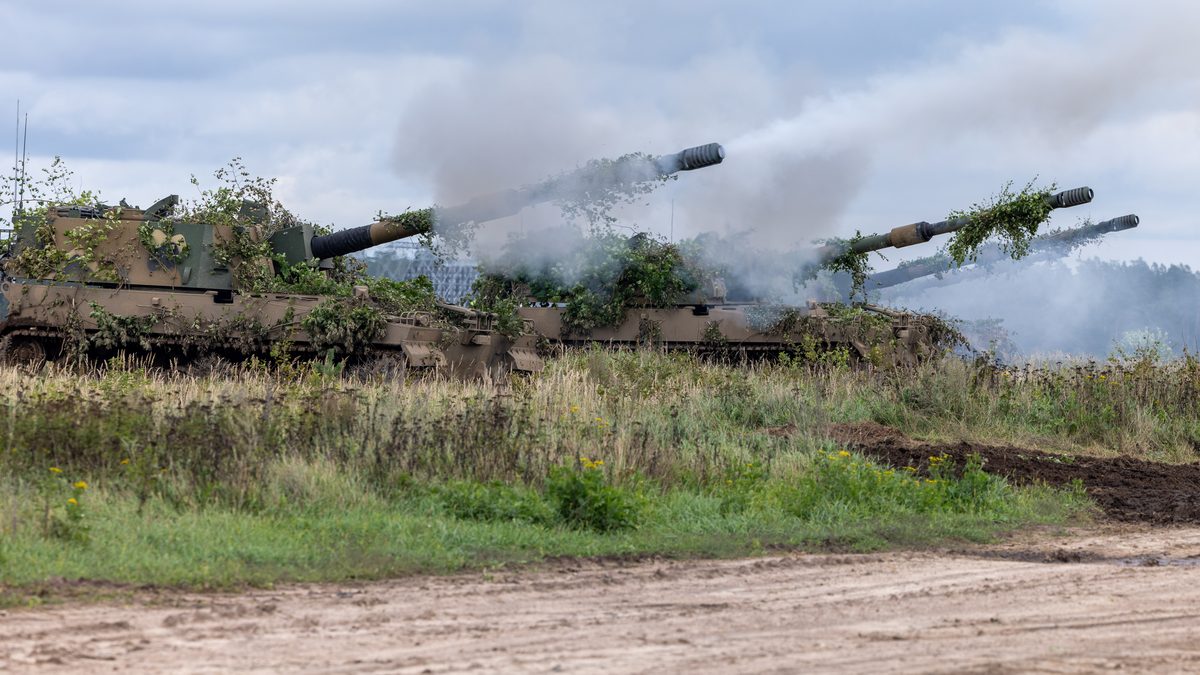
Illustrative image. Polish Land Forces AHS Krab self-propelled howitzers fire during Iron Defender-25 at Orzysz Training Area, Poland, 17 September 2025. The Krab is one of the two platforms the new projectile is designed for, but these are not the rounds or the firing described in this article. U.S. Army photo by Pfc. Andre Gremillion Jr, VIRIN 250917-Z-PV485-1069, released via the Defense Visual Information Distribution Service. U.S. Government work, public domain. Use does not imply endorsement by the U.S. Department of Defense.
Thirty Kilometres and No Gas Generator: Poland Fires Its First Nationally Designed 155 mm Projectile
On 2 September 2026 the Military Institute of Armament Technology (WITU), PGO S.A. and Niewiadów Polska Grupa Militarna fired the first integrated 155 mm projectile of wholly Polish design at the Central Air Force Training Ground at Ustka. The round is a hollow base nature with no gas generator fitted. The first shot exceeded 30 km and later series averaged safely above 30 km. The published design target is 30 km hollow base and more than 40 km with a gas generator.
Technical Summary
The firing took place on 2 September 2026 at the Central Air Force Training Ground at Ustka on the Baltic coast, with the Polish Navy securing the range and several dozen WITU personnel supporting the trial. A series was fired shortly after 11:00 local time from a 155 mm self-propelled howitzer released specifically for the test. The partners report that the first shot exceeded 30 km at high velocity with stable pressure parameters, and that subsequent series returned an average safely above 30 km. Range, dispersion and correct functioning were the three things under examination.
That is the whole of the news, and it needs separating from what sits behind it. The round is a Hollow Base nature, meaning a cavity formed in the projectile base rather than a gas generator, and the next milestone the partners name is an analysis of whether to fit a base bleed unit. The published design target is 30 km with the hollow base and more than 40 km with a gas generator, on a projectile carrying about 10 kg of explosive and compatible with the two 155 mm platforms Poland already fields, the AHS Krab and the Korean K9. Ustka has met the first half of that target. PGO puts the estimated capacity of its cast body route at about 100,000 bodies a year and says commercialisation is possible in 2027. The projectile goes on the company stand at the International Defence Industry Exhibition in Kielce this week, from 8 to 11 September.
Subsequent series confirmed an average range safely above 30 km, demonstrating the repeatability and stability of both the concept and the design. PGO S.A. and Niewiadów Polska Grupa Militarna, joint statement, 2 September 2026
The test sequence, as the partners describe it twice
The two company accounts of the run-up do not quite line up, and the difference is worth recording rather than smoothing over. PGO’s press release of 4 September counts four successful proving ground trials and several dozen shots across different locations: the first at the Military Institute of Armament Technology in April 2026, announced by the company on 13 May; a firing in early August on the AHS Krab ballistic gun at the institute’s test and development centre at Stalowa Wola; further firings at Niewiadów that checked the body’s design assumptions, including on an enhanced propelling charge; and Ustka. The partners’ joint statement of 2 September instead records a projectile body fragmentation test in March, two ballistic gun firings at Stalowa Wola, and a late August strength check at Niewiadów on an enhanced TCS propelling charge. Both accounts agree on the shape of the sequence and on the last step before Ustka. Neither identifies the howitzer used at Ustka, and the AHS Krab named at Stalowa Wola was a ballistic gun installation, which is not the same thing.
The first trial was not a firing at all. Colonel Piotr Ruliński, head of the institute’s Ballistics and Unmanned Systems Centre, described it as a static detonation of prepared bodies to confirm material characteristics and the main technological assumptions before moving to firing from a 155 mm howitzer. Those bodies were cast steel; forged bodies from PGO’s Kuźnia Glinik were at that point still to be tested. That distinction matters more than it looks, because the project is building the same projectile in more than one material route while holding what the partners call ballistic identity, meaning the variants are meant to share one set of firing tables. A body that shoots to the same table whether it was forged or cast is what lets a country spread production across plants that do not share a process, and it is the whole point of the exercise.
What “First” Means Here
Precision matters on the word first, because the partners are claiming something narrower than the headlines suggest and the narrower claim is the interesting one. Poland has been turning out 155 mm ammunition for years. MESKO has been making projectile bodies at Kraśnik under a Slovak licence since 2023, Dezamet assembles the complete round and produces the fuze under licence, and Nitro-Chem fills it. What did not exist until 2 September was an integrated 155 mm projectile of Polish design, fired as a projectile, with the design authority held in Poland and no licence sitting on top of it. Nor is this the only Polish attempt at that. WB Group is running an entirely separate indigenous family of high explosive hollow base and high explosive base bleed natures, with its own gas generator already reported through bench testing, and certification targeted for this month. There are three tracks here, not one, and reading Ustka as the whole national story flattens the picture.
| Track | Industrial participants | Design origin | Publicly documented status as at 8 September 2026 | Position | Basis |
|---|---|---|---|---|---|
| Track A: licensed PGZ set | MESKO S.A. (Kraśnik bodies, Pionki charges, Skarżysko-Kamienna igniters), Zakłady Metalowe DEZAMET (assembly, KZ984 fuze), Nitro-Chem (fill), ZPS Gamrat (base bleed) | Body licensed from ZVS Holding, now MSM Group within Czechoslovak Group | Delivering. This is the set behind the December 2023 and 30 May 2026 PGZ-Amunicja contracts. | In production | Refs 1, 4, 6 |
| Track B: PGO, WITU and Niewiadów national body | Design authority at WITU; bodies forged and cast by PGO S.A.; filling and completion at Niewiadów PGM | Polish design, free of licence restriction | Design target 30 km hollow base, more than 40 km with a gas generator, about 10 kg of explosive, compatible with Krab and K9. Hollow base fired above 30 km at Ustka on 2 September 2026. Base bleed named as the next milestone. Full body validation scheduled Q4 2026, pre-series early 2027. No qualification decision published. | In development | Refs 1, 2, 3, 8, 14 |
| Track C: WB Group | WB Group, through its ammunition arm | Independent Polish design, own body process and own gas generator | High explosive hollow base and high explosive base bleed natures. Gas generators developed in house, with 20 prototypes reported bench tested. Certification targeted for September 2026, with 5,000 to 10,000 rounds in 2026 and 50,000 to 100,000 a year from 2027. | In development | Refs 9, 10 |
What the Ammunition Set Actually Contains
A 155 mm round is not one item. The Military Institute of Armament Technology defines a set as the explosive filled projectile with its fuze and an optional base bleed unit, a set of modular propelling charges, and an igniter. The table below covers every element of that set for which a Polish producer is on the open record, with the status of each as at 8 September 2026.
| Element of the set | Function | Named Polish producer and site | Publicly documented status | Position | Basis |
|---|---|---|---|---|---|
| Projectile body, forged (licensed) | Steel body for the high explosive nature | MESKO S.A., Kraśnik plant | Serial production since 2023 under licence from ZVS Holding a.s., now MSM Group within Czechoslovak Group. Output recorded at 20,000 bodies a year with imports still required; the Kraśnik investment targets 150,000 rounds a year. | In production | Refs 1, 4 |
| Projectile body, forged and cast (alternative route) | Second source for the same part, by forging and by casting in steel and austempered ductile iron | PGO S.A.: Kuźnia Glinik at Gorlice, plus Śrem, Piotrków Trybunalski, Leszno and Zielona Góra | Development. WITU handed over projectile body technical documentation; 500 tonne and 1,500 tonne presses ordered. Four proving ground trials completed, the last at Ustka on 2 September 2026. Published schedule: full body validation in Q4 2026, pre-series production early 2027, serial production during 2027. Estimated cast body capacity stated as 50,000 a year in May 2026 and about 100,000 a year in September 2026. | In development | Refs 1, 2, 3, 8, 14 |
| Explosive filling | Filling the body with the bursting charge | Nitro-Chem S.A. | PLN 113 million allocated by the Polish Capital Investment Fund in July 2025 for technological lines to elaborate 155 mm ammunition. | Funded | Ref 4 |
| Filling and completion lines (second site) | Filling and final completion of 155 mm and 120 mm natures | Niewiadów Polska Grupa Militarna, ZSP Niewiadów | PLN 250 million secured. First lines from KONŠTRUKTA-Industry passed final technical acceptance; production readiness scheduled by end 2026; three lines planned for up to 180,000 rounds a year. | Funded | Ref 5 |
| Fuze | Initiation of the bursting charge | Zakłady Metalowe DEZAMET S.A. | KZ984 produced under licence for many years. Agreement of 24 July 2026 with CSG Polska, worth more than EUR 100 million, covers pyrotechnic components and subassemblies for 155 mm fuzes. | In production | Refs 1, 6 |
| Base bleed unit | Gas generator that raises base pressure to extend range | ZPS Gamrat Sp. z o.o., Jasło; separate WITU design at Zielonka | PLN 66 million allocated by the Polish Capital Investment Fund for construction, installation and production. WITU is developing its own unit with a burn time of around 30 seconds. | Funded | Refs 1, 4 |
| Modular propelling charge | The charge system that launches the projectile | MESKO S.A., Pionki branch | Under development with WITU. Dependent on a stable supply of modern multi-base propellants from abroad and, in time, domestic production. | In development | Ref 1 |
| Igniter | Initiation of the propelling charge | MESKO S.A., Skarżysko-Kamienna | Under development with WITU. Described by WITU as not critical at this stage because such pyrotechnic components can be imported. | In development | Ref 1 |
| Final assembly of the fully Polish round | Assembly of the complete ammunition set | Zakłady Metalowe DEZAMET S.A. | Planned role in the WITU project for a fully Polish 155 mm round compliant with NATO standards. | Planned | Ref 1 |
Why a shell body is the bottleneck
Bodies in calibres from 60 mm to 155 mm have been made in Poland for decades, but on plant that WITU describes as outdated and material, energy and labour intensive. The alternative routes PGO and a second domestic partner are pursuing, casting in steel and in austempered ductile iron rather than forging on high pressure presses, are attractive precisely because they skip the press and the post production heat treatment. WITU puts the potential cost reduction at 30 per cent or more in mass production, and notes that austempered ductile iron work hardens under stress, including the pressure a body sees in the barrel. The material was tested in the United States as a shell body alternative in the late 1980s and early 1990s. It is a manufacturing argument, not a ballistic one, and that is the point: the constraint Europe hit after 2022 was the making of the part, not the design of it.
What Is Still Missing
The same population, read the other way. These are the remaining elements and determinations where Polish capability or programme status is not publicly documented.
| Remaining element or determination | Current position | Publicly documented Polish capability or status | Basis |
|---|---|---|---|
| Modern multi-base propellant | Imported. WITU states the modular charge work depends on a stable foreign supply, and ultimately on domestic production based on Polish nitrocellulose. | Not publicly documented as established | Ref 1 |
| Combustible cartridge case | WITU names a domestic partner specialising in combustible cartridge cases, but the partner is not identified in the open record. | Not publicly documented by name | Ref 1 |
| Base bleed unit fitted to this projectile | Named as the next milestone. The partners describe an analysis of whether to use a gas generator; no fitting or firing has been reported. | Not publicly documented as tested | Refs 2, 3 |
| Hazard division and compatibility group for the new nature | No classification published. The Polish classification record is not an open register. | Not publicly documented | See data gaps |
| Insensitive munitions assessment (STANAG 4439, AOP-39) | No assessment published for the body, the base cavity or a future gas generator. | Not publicly documented | See data gaps |
| Ballistic interchangeability determination (STANAG 4425, AOP-29 Part 1) | No determination published against either target platform. | Not publicly documented | See data gaps |
| Qualification and Introduction to Service by the Polish Armed Forces | Commercialisation and an offer to the Polish Armed Forces are stated as objectives. No qualification decision, contract or schedule has been announced. | Not publicly documented | Refs 2, 3 |
On “not publicly documented”. The entry records the state of the open source record and nothing more. It does not mean a capability is absent, a test has failed or a decision has gone against the programme. Qualification files, hazard classification records and insensitive munitions assessments are held in registers that are not open to the public, and a company is under no obligation to announce a supplier. Absence of a public entry is a finding about the record, not about the capability.
Population, definition and as-at date
The population is the complete 155 mm ammunition set as the Military Institute of Armament Technology itself defines it: the explosive filled projectile with its fuze and optional base bleed unit, a set of modular propelling charges, and an igniter, together with the industrial functions that produce and assemble them. The first table lists every element of that set with a named Polish producer on the open record. The second lists every remaining element or determination in the same population where Polish capability or programme status is not publicly documented. A third table covers a different but related population: every publicly documented Polish 155 mm projectile track, licensed and indigenous. Status picture taken as at 8 September 2026.
Why the Money Is There
The driver is contractual rather than aspirational. In December 2023 the PGZ-Amunicja consortium and Poland’s Armament Agency signed an agreement worth close to PLN 11 billion for ammunition set deliveries to the Polish Armed Forces between 2024 and 2029. A second implementation agreement followed on 30 May 2026, worth more than PLN 13.5 billion for several hundred thousand artillery ammunition sets, financed under the European Union SAFE programme. In July 2025 the Polish Capital Investment Fund allocated more than PLN 2.4 billion to four companies in the Polish Armaments Group to expand 155 mm production, of which Zakłady Metalowe Dezamet received PLN 1.36 billion, MESKO PLN 887 million, Nitro-Chem PLN 113 million and ZPS Gamrat PLN 66 million.
The demand side is the reason those numbers keep rising. WITU’s own published assessment puts Polish contracts with domestic industry and with South Korean suppliers at more than 400,000 ammunition sets, against a force that is contracted for 364 K9A1 and K9PL howitzers and 186 Krab and Krab 2 units, with 26 Krabs delivered before the war. On WITU’s reading, supplying that force for training and an initial wartime reserve needs on the order of one million sets, and wartime consumption for a force of 800 to 1,000 systems would run into the millions a year. Those are the institute’s figures and its assumptions, and they are the reason a second source for something as unglamorous as a shell body is being treated as strategic. Read them as the institute’s figures at the date of its publication rather than as a standing Ministry of National Defence requirement, and expect the platform counts to be overtaken by later executive contracts. ISC covered the fuze component half of the same problem in our August analysis of the Dezamet fuze pyrotechnics agreement.
Two developments on the same industrial map are worth putting alongside the Ustka firing. On the very day the projectile was fired, Hanwha Aerospace Europe announced that a test group appointed by the head of the Armament Agency had completed verification of the K-MCS modular propelling charge in the Republic of Korea with a positive result, which means Korean-supplied ammunition for the K9 fleet will come with those charges. A body and a charge are two halves of the same set, and the charge half moved that day too. Separately, Northrop Grumman and Elaboracja Niewiadów have signed a memorandum of understanding to explore collaboration on 155 mm ammunition for Poland, including the potential delivery of austempered ductile iron shells, which puts a second industrial partner behind the cast body route.
Analysis of Effects
Read the milestone language rather than the headline number, because the sequence tells you where this design actually sits. A spin stabilised artillery projectile in supersonic flight loses energy to three things: wave drag at the nose, skin friction along the body, and base drag from the low pressure wake behind a blunt base. Artillery has three established answers to the third of those. A boat tail reshapes the base to narrow the wake. A base bleed unit burns a slow propellant grain and injects gas into the wake to raise base pressure, which is the standard route from a 30 km class round to a 40 km class round. A rocket assisted projectile adds thrust and pays for it in payload volume. A base cavity, which is what Hollow Base describes, is the passive option: it changes the base geometry and the mass distribution without carrying any energetic material aft of the bursting charge. What Poland has proved at Ustka is the passive case. The partners have said in the same breath that the gas generator is still under analysis, which is a precise way of saying the extended range variant does not yet exist. ISC reads the sequencing as deliberate rather than incremental. A base cavity is also a volume, and a volume in the base of a projectile is where a base bleed grain goes. Proving the passive body first, then fitting the generator, keeps the bursting charge cavity and the body geometry fixed across both variants. That is the reading the partners' own milestone language supports, and it is an inference from their sequencing rather than a design statement any of them has published.
A range figure without the gun that fired it is not a specification, and the gun has not been identified. Range on a conventional projectile is set by ordnance length, charge zone, projectile mass and the muzzle velocity those produce, and none of the four has been published for this trial. The reference frame for the comparison is the NATO 155 mm/52 convention, the 23 litre chamber arrangement that sits behind the interchangeability procedure in STANAG 4425 and Allied Ordnance Publication AOP-29 Part 1, and behind the Joint Ballistics Memorandum of Understanding signed by the United States, France, Germany, Italy and the United Kingdom. For an indicative scale on a different weapon with different ammunition, the published figures for the Patria 155 GH 52 APU towed howitzer are 31.7 km with a standard projectile and 41 km with a base bleed projectile. Treat that pair as a scale and nothing more, because published range figures for any gun move with the projectile fired. Set the Ustka result against it and the reading is straightforward: above 30 km with no gas generator puts the Polish round in the conventional class for an L52 ordnance, and the base bleed decision is the one that would move it into the other class. Both target platforms carry L52 ordnance, so the frame is the right one even though the trial gun is unstated. One caution on the word compatible. A NATO standard projectile can be fired from NATO standard guns, but each nation still has to qualify it on each weapon for performance and safety. Compatibility with the AHS Krab and the K9 is a design aim here, not a completed determination on either.
Personnel and Safety Considerations
A projectile body is not a munition. It becomes one when it is filled, fuzed and assembled to a charge, and each of those steps carries its own safety and classification consequence. The Ustka rounds were described as integrated, which means a fill and a fuze were present, but neither has been publicly identified for the rounds fired. The design target published for the projectile is about 10 kg of explosive, which is a design figure for the nature and not a net explosive quantity measured or declared for the rounds on the gun that day. A filled 155 mm high explosive projectile with a bursting charge is conventionally consigned as UN 0168, Hazard Division 1.1, Compatibility Group D, and the assignment is made by test under the procedures in STANAG 4123 and Allied Ammunition Storage and Transport Publication AASTP-3, using the United Nations Test Series 6. That assignment then drives everything downstream: quantity distance under AASTP-1 Edition D Version 1, dated November 2025, mixing and storage rules by compatibility group, and the net explosive quantity licensed at each site. No hazard classification has been published for this nature, and the Polish classification record is not an open register, so the absence of a public entry is a fact about the open source record rather than about the programme. Two further qualification questions are unanswered on the same basis. Qualification of the explosive fill runs through STANAG 4170 and AOP-15. Insensitive munitions assessment runs through STANAG 4439 and AOP-39, and it matters here because a new body geometry, a base cavity and a later gas generator each change the response of the assembled round to fast and slow heating, bullet attack and fragment impact. A base bleed unit in particular adds a second energetic composition inside the projectile, aft of the bursting charge, and that is a materially different insensitive munitions case from the one tested at Ustka. On the range itself, the sea danger area at Ustka and the Polish Navy's role in securing it are the visible part of a firing safety case for a projectile whose ballistic behaviour was, on the day, being measured rather than assumed. Downstream of the trial the storage arithmetic is already moving: Niewiadów currently holds seven specialist storage facilities of about 3,900 square metres in total, and the expansion under way is intended to take licensed capacity above 500 tonnes net explosive quantity. That is the number a quantity distance calculation is run against, and it grows with the production rate rather than with the range figure.
Data Gaps
The self-propelled howitzer used at Ustka is not identified, which leaves ordnance length and therefore the ballistic frame unstated. No charge system or zone is named for the range firing; the enhanced TCS charge appears only in the late August body strength check at Niewiadów, and the expansion of the TCS designation is not in the open record. Projectile mass, muzzle velocity, chamber pressure and drag coefficient are unpublished, as is the dispersion result, even though dispersion was one of the three parameters under test. The explosive fill type is unstated and the published figure of about 10 kg is a design target for the nature rather than a declared net explosive quantity for the rounds fired. The fuze fitted at Ustka is not identified; the WITU plan of record names the KZ984 fuze produced under licence by Zakłady Metalowe DEZAMET, but no source ties it to this trial. The two company accounts of the earlier test sequence differ, and neither identifies the Ustka howitzer. Hazard division and compatibility group are unpublished. No insensitive munitions assessment, ballistic interchangeability determination or Introduction to Service decision has been published. It is not stated whether a future base bleed unit would come from the WITU design under development at Zielonka or from the ZPS Gamrat line at Jasło. Finally, no contract, schedule or unit price for series production has been announced; commercialisation is stated as an objective, not as an award.
Key Questions
What did Poland test at Ustka on 2 September 2026?
The first integrated 155 mm artillery projectile of wholly Polish design, developed by the Military Institute of Armament Technology with PGO S.A. and Niewiadów Polska Grupa Militarna. A series was fired from a 155 mm self-propelled howitzer to measure range, dispersion and correct functioning. The partners report the first shot exceeded 30 km and later series averaged safely above 30 km.
What is a hollow base 155 mm projectile?
A projectile with a cavity formed in its base. The cavity changes base geometry and mass distribution to reduce the drag caused by the low pressure wake behind the shell. It is the passive alternative to a base bleed unit, which burns a propellant grain to raise base pressure, and it carries no energetic material aft of the bursting charge.
Can Poland build a complete 155 mm round on its own?
Not yet on the open record. Polish industry has publicly documented capability for projectile bodies, explosive filling, fuzes and base bleed units, and funded programmes for modular charges and igniters. The gap is propellant: the modular charge work depends on a supply of modern multi-base propellants from abroad until domestic production is established.
References
Source-evaluated per NATO source-evaluation doctrine, STANAG 2022 lineage (source reliability A–F / information credibility 1–6). Tier 1 = government primary source; Tier 2 = quality news / specialist defence media; Tier 3 = authoritative aggregator / encyclopaedia.
- T1PGO S.A. (article prepared from Military Institute of Armament Technology materials) – Increasing Large-Caliber Ammunition Production Capacity According to WITU, Accessed 8 September 2026. (Reliability B / Credibility 2)
- T2wnp.pl (Polskie Towarzystwo Wspierania Przedsiębiorczości) – Polska amunicja 155 mm przeszła ważny test. Spółki obwieszczają „wielki sukces”, 3 September 2026. (Reliability B / Credibility 2)
- T2Portal Obronny (Piotr Miedziński) – Polski pocisk 155 mm z historycznym wynikiem. Przełomowy test w Ustce otwiera drogę do masowej produkcji, 8 September 2026. (Reliability B / Credibility 2)
- T2Breaking Defense – Poland invests $662M to up production of 155mm ammunition (Polish Capital Investment Fund allocations to Dezamet, MESKO, Nitro-Chem and Gamrat), July 2025. (Reliability B / Credibility 2)
- T3Defence Industry Europe – PGM Niewiadów targets 180,000 155 mm rounds a year as PLN 250 million ammunition expansion moves towards production, 6 September 2026. (Reliability B / Credibility 2)
- T3Defence Industry Europe – CSG and Dezamet sign EUR 100 million-plus 155 mm ammunition components deal to support Poland’s expanding artillery production, 12 August 2026. (Reliability B / Credibility 2)
- T1PGO S.A. – Udany test poligonowy polskiego korpusu pocisku artyleryjskiego kalibru 155 mm (company announcement of the projectile body proving ground trial at WITU Zielonka), 13 May 2026. (Reliability B / Credibility 2)
- T1PGO S.A. – Pierwszy polski pocisk artyleryjski 155 mm niemal gotowy (company press release: four proving ground trials, about 100,000 cast bodies a year, commercialisation possible in 2027, MSPO Kielce 8 to 11 September 2026), 4 September 2026. (Reliability B / Credibility 2)
- T2Janes – WB Group to start 155 mm shell production in 2026 (independent Polish high explosive hollow base and base bleed natures, in-house gas generator), Accessed 8 September 2026. (Reliability B / Credibility 2)
- T2MILMAG – A New Player in the 155 mm Market: WB Group Announces Shell Production (20 gas generator prototypes bench tested; certification targeted September 2026; 5,000 to 10,000 rounds in 2026), Accessed 8 September 2026. (Reliability B / Credibility 2)
- T2Defence24 – Koreańska amunicja dla Polski coraz bliżej. Przeszła testy (Armament Agency test group completes K-MCS modular charge verification, announced 2 September 2026), 2 September 2026. (Reliability B / Credibility 2)
- T3Defence Industry Europe – Northrop Grumman partners with Polish firm Elaboracja Niewiadów on 155mm artillery production (memorandum of understanding covering potential delivery of austempered ductile iron shells), Accessed 8 September 2026. (Reliability B / Credibility 3)
- T1Defense Visual Information Distribution Service – Polish Land Forces AHS Krab howitzers fire during Iron Defender-25, Orzysz Training Area, Poland (VIRIN 250917-Z-PV485-1069), Published 18 September 2025. (Reliability A / Credibility 1)
- T2netTG.pl (reporting PGO S.A. and WITU statements) – Przełom w polskiej zbrojeniówce. Nowe pociski 155 mm do Krabów i K9 przeszły kluczowe testy (design targets of 30 km hollow base and more than 40 km with a gas generator, about 10 kg of explosive; static detonation of cast steel bodies at WITU Zielonka; validation schedule to Q4 2026 and pre-series in early 2027), 13 May 2026. (Reliability B / Credibility 2)
- T3Wikipedia – 155 GH 52 APU (published range figures for a 155 mm/52 towed howitzer, used here only as an indicative scale), Accessed 8 September 2026. (Reliability C / Credibility 3)
- T1United States Department of State, Treaties and Other International Acts Series 09-1218 – Joint Ballistics Memorandum of Understanding concerning 155 mm weapon and ammunition systems (United States, France, Germany, Italy, United Kingdom), Accessed 8 September 2026. (Reliability A / Credibility 1)
Editorial responsibility. This analysis is researched, written and published under the editorial responsibility of Steve Sawyers, MIExpE VR. Every technical claim is sourced to named open-source material and rated for reliability and accuracy under NATO STANAG 2022. ISC uses its own domain-trained research and drafting system under human direction; the analysis, the judgements and the accountability for them are ours. Corrections and updates welcome: if you hold open-source data that refines or corrects any parameter here, write to [email protected] citing the specific claim and your source. Verified corrections are incorporated and credited in the revision history. Full editorial and AI policy.