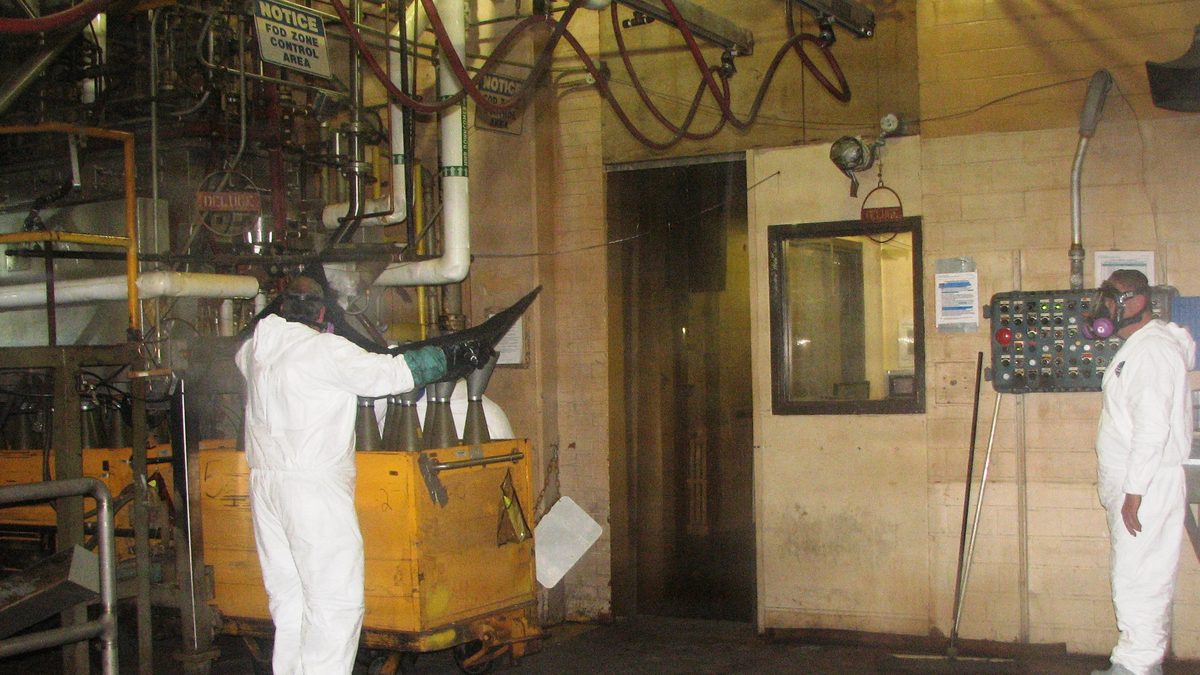
Illustrative: 155 mm M795 projectile cases in the load, assemble and pack process at Iowa Army Ammunition Plant. The components in the ZVS contract are pyrotechnic elements fitted at a later stage of assembly. US Army photo by Shawn Eldridge, US Army Sustainment Command, via DVIDS. Public domain.
The Grams That Gate the Round: Poland Buys Its 155 mm Explosive Train from Slovakia
Slovakia’s ZVS holding is the main supplier under an agreement worth more than EUR 100 million, signed on 24 July 2026 between CSG Polska and Poland’s Zakłady Metalowe Dezamet. ZVS will manufacture pyrotechnic components and fuze subassemblies at Dubnica nad Váhom. Those items weigh grams per round, but no 155 mm projectile functions without them.
Technical Summary
Czechoslovak Group (CSG) announced on 11 August 2026 that its Polish subsidiary CSG Polska and Zakłady Metalowe Dezamet S.A., part of Polska Grupa Zbrojeniowa (PGZ), had signed an agreement worth more than EUR 100 million covering, among other items, pyrotechnic components and subassemblies used in fuze production. The signature date was 24 July 2026. The manufacturing entity was not named in that release. It was named a fortnight later: ZVS holding, a.s., based at Dubnica nad Váhom with a second plant at Snina, and part of the Slovak MSM GROUP inside CSG. ZVS reports revenue of EUR 119.4 million for 2024 and more than 970 employees, so an order above EUR 100 million is close to a full year of company turnover, spread across the delivery period. Ownership shapes how that reads. Since 2015 ZVS has been held 50 per cent by MSM GROUP inside CSG and 50 per cent by the state-owned DMD Group, so the Slovak state sits on one side of a contract routinely described as a Slovak industrial contribution. The same year, 2015, is the one both parties cite as the start of the ZVS and Dezamet technology relationship.
The manufacturer publishes two product lines that map directly onto the contract description. The first is the KZ 984 impact fuze of ZVS design: a mechanical point-detonating fuze with a detonator reinforcing cap and mask safety, settable for immediate or delay function, listed by the manufacturer for 155 mm HEER HB, HEER BB, ERFB-BT and ERFB-BB projectiles, that is the high explosive extended range and extended range full bore families in their hollow base and base bleed forms. The second is pyrotechnic components: in-house initiators for ignition of the propelling charge, and primer screws for initiation in the 155 mm charge. ZVS states that both lines have been safety tested in accordance with STANAG 4157, the NATO agreement covering testing requirements for safety, arming and functioning systems, whose procedures are drawn from Allied Ordnance Publication AOP-20. The design requirements those tests demonstrate compliance against sit in STANAG 4187 and its allied publication AOP-4187, Fuzing Systems, Safety Design Requirements, which requires the explosive train interrupter to be locked in the safe condition by at least two independent safety features until the arming sequence begins.
A complete US M795 round weighs roughly 47 kg and carries about 10.8 kg of high explosive. The pyrotechnic elements that make a round of that class function are measured in grams, and Poland is buying them from Dubnica nad Váhom. ISC assessment, using published M795 figures for scale
Analysis of Effects
Poland has spent three years building artillery capacity, and the visible parts of that programme are shell bodies, explosive fill and propelling charge. The Armament Agency signed an implementation agreement with the PGZ-Amunicja consortium in December 2023 worth nearly PLN 11 billion, covering deliveries to the Polish Armed Forces between 2024 and 2029. A second implementation agreement followed on 30 May 2026, worth more than PLN 13.5 billion for several hundred thousand rounds, financed through the European Union’s Security Action for Europe (SAFE) instrument. The explosive train is the part of that output that does not appear in the headline numbers. The initiation sequence in a round of this class runs from initiator to relay to detonator to booster, and only then to the main fill, so every stage ahead of the booster is a small, sensitive, separately qualified item. Initiators, primers and fuze pyrotechnics are produced in small quantities per building, in facilities licensed for primary explosives, by operators qualified on those specific processes. Capacity there does not scale by adding a machining line, which is why it is the element most often bought in.
The consignment is also not a single commodity in handling terms. Under the United Nations hazard classification scheme carried into NATO storage practice through Allied Ammunition Storage and Transport Publication 1 (AASTP-1) and into European surface transport through the European Agreement concerning the International Carriage of Dangerous Goods by Road (ADR), a bare 155 mm high explosive projectile without its means of initiation sits in compatibility group D. An article containing a primary explosive substance, which is what a detonator, an initiator or a primer is, sits in compatibility group B. Propelling charge sits in group C. The mixing rules that follow from those group assignments govern which items may share a storehouse or a vehicle, and the hazard division and net explosive quantity then set the quantity distance. An explosive train sourced across a border is therefore a licensing, transport and storage question before it is a commercial one. ZVS has not published hazard division or compatibility group assignments for the specific items in this order, so the groups described here are the framework, not the consignment.
Personnel and Safety Considerations
For ammunition technicians and storage staff at the receiving end, the practical effect is that this contract adds an inbound compatibility group B flow to a site organised around groups C and D. Group B articles attract the tightest separation and mixing constraints relative to their net explosive quantity, because the governing hazard is initiation sensitivity rather than mass, so a delivery measured in kilograms of net explosive quantity can impose siting constraints out of proportion to its tonnage. Two further obligations travel with the goods. Receiving inspection and lot traceability have to reconcile Slovak lot identities against Polish assembly records, because a fuze train defect is traced through the lot, not the round. And the qualification evidence that underwrites the safety case for these items sits with the manufacturer at Dubnica nad Váhom, which means the Polish integrator carries a safety argument built on data it does not own and cannot regenerate. That is normal in an allied supply chain, and it is manageable, but it belongs in the risk register rather than in the assumptions.
Data Gaps
Five items are unresolved on open sources at the time of writing. First, hazard division and compatibility group assignments for the specific ZVS items in this order are not published. Second, it is not clear whether complete KZ 984 fuzes fall within scope, or only their pyrotechnic subassemblies: the CSG release refers to pyrotechnic components and subassemblies used in the production of fuzes, which reads as components rather than finished fuzes. Third, annual quantities, the delivery schedule and the split of the EUR 100 million figure between component types have not been disclosed. Fourth, the projectile and charge families the components feed are unstated, as is whether the fuze fitted to Polish 155 mm rounds is a ZVS design, a Dezamet design or a third-party design. Fifth, no net explosive quantity per component or per consignment has been published. Readers holding open-source data on any of these points are invited to send it.
Key Questions
Who is actually manufacturing the components in the CSG and Dezamet contract?
ZVS holding, based at Dubnica nad Vahom in Slovakia, is the main supplier. ZVS is part of MSM GROUP within CSG. CSG Polska is the contracting entity in Poland and represents ZVS there, while ZVS carries out the production and supply work at its Slovak plants.
Why do pyrotechnic fuze components matter more than their contract value suggests?
They are the explosive train. Without initiators, primers and fuze pyrotechnics, a projectile body, its explosive fill and its propelling charge do not function as a round. They are produced in licensed primary-explosive facilities in small batches, so that capacity is far harder to expand than shell machining capacity.
How does this contract fit Poland's wider 155 mm ammunition programme?
Poland's Armament Agency signed an implementation agreement with the PGZ-Amunicja consortium in December 2023 worth nearly PLN 11 billion, covering deliveries to 2029, and a second worth more than PLN 13.5 billion on 30 May 2026, financed through the EU SAFE instrument. The ZVS components feed that output.
References
Source-evaluated per NATO source-evaluation doctrine, STANAG 2022 lineage (source reliability A–F / information credibility 1–6). Tier 1 = government primary source; Tier 2 = quality news / specialist defence media; Tier 3 = authoritative aggregator / encyclopaedia.
- T1Czechoslovak Group A.S. (company release via GlobeNewswire) – CSG and Dezamet sign agreement worth over EUR 100 million for 155 mm ammunition components, 11 August 2026. (Reliability A / Credibility 1)
- T1MSM GROUP (company primary source) – ZVS holding: company profile, KZ 984 fuze and pyrotechnic components, accessed 25 August 2026. (Reliability A / Credibility 2)
- T1MSM GROUP (product leaflet) – Fuze KZ-984: point-detonating mechanical fuze for 155 mm HEER and ERFB projectiles, accessed 25 August 2026. (Reliability A / Credibility 2)
- T2Defence Industry Europe – Slovak firm ZVS to supply 155 mm ammunition parts under EUR 100 million-plus contract for Poland’s long-term artillery programme, 25 August 2026. (Reliability B / Credibility 2)
- T2Defence Industry Europe – CSG and Dezamet sign EUR 100 million-plus 155 mm ammunition components deal to support Poland’s expanding artillery production, 12 August 2026. (Reliability B / Credibility 2)
- T2MILMAG – CSG and Dezamet sign contract worth over 100 million Euro for 155 mm ammunition components, August 2026. (Reliability B / Credibility 2)
- T3Standards catalogue entry (NATO STANAG 4187 / AOP-4187) – Fuzing Systems, Safety Design Requirements, current edition. (Reliability C / Credibility 2)
- T3GlobalSecurity.org – M795 Projectile, 155 mm High Explosive: weight and explosive fill, accessed 25 August 2026. (Reliability C / Credibility 3)
Corrections & updates welcome. If you hold open-source data that refines or corrects any parameter in this article, please contact [email protected] citing the specific claim and your source. Verified corrections will be incorporated and credited in the revision history. AI-assisted technical assessment based on open-source material. Not a formal intelligence product.