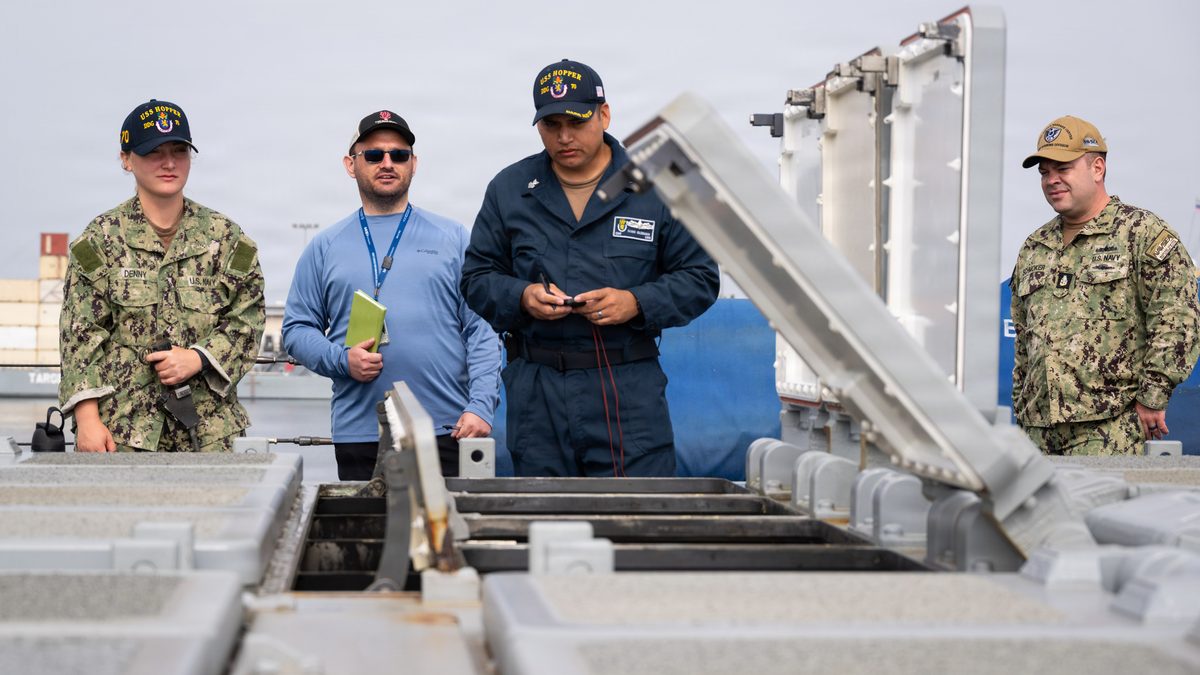
Illustrative. Sailors and a Vertical Launching System in-service engineering agent maintain the aft Mk 41 Vertical Launching System aboard the Arleigh Burke class destroyer USS Hopper (DDG 70) at Naval Surface Warfare Center Port Hueneme Division, July 2026. US Navy photograph by Jhon Parsons, released via DVIDS, public domain. The ship shown is a United States vessel and is not connected to the Royal Navy programme discussed here. Appearance of US Department of Defense visual information does not imply or constitute Department of Defense endorsement.
Thirty Days, No Engineer: The Magazine Inside Britain’s Hybrid Navy
On 29 June 2026 the Ministry of Defence cancelled the Type 83 destroyer and committed to at least six Common Combat Vessels working with uncrewed Type 91 missile platforms. Its own contract notice says current and planned missile silos are not optimised for uncrewed operation, and asks industry for one that sustains prepared for firing status for a minimum of 30 days without physical human interaction.
Technical Summary
The Defence Investment Plan announcement of 29 June 2026 ended the Type 83 destroyer. In its place the Royal Navy will field at least six Common Combat Vessels, described by the Ministry of Defence as a control hub for uncrewed systems, replacing the six Type 45 destroyers with delivery expected from the early 2030s. Four new uncrewed type numbers sit alongside them: Type 91 missile platforms, Type 92 underwater sensing platforms, Type 93 extra large uncrewed underwater vehicles and Type 94 sensor platforms.
Answering Baroness Goldie on 20 July 2026, Lord Coaker put figures on what had been stopped. Around £1 million was spent on platform specific design for the Type 83 across three financial years, inside a broader notional spend of about £6.9 million for Type 83 work within the Future Air Dominance System. He confirmed that maritime air defence will in future be delivered by a mix of crewed Common Combat Vessels and uncrewed missile (Type 91) and sensor (Type 94) ships, that the analysis behind the decision is classified, and that a decision on extending the Type 45 is not expected until 2027-28. That is the update. The rest of this piece is the reference picture underneath it, because the interesting part of this announcement is not the ship that was cancelled. It is the magazine that has to work without anybody aboard.
The alternative, an expensive, exquisite platform such as the Type 83, would have resulted in too few ships to cover all the Royal Navy’s tasks, increasing risk. Lord Coaker, Minister of State, Ministry of Defence, written answer HL1662, 20 July 2026
The future fleet, and how it stands
The table below covers every surface and subsurface fighting platform type named in the Ministry of Defence announcement of 29 June 2026, plus the two type numbers that announcement retired. Each row is separately traceable to the references. Weapon fits for the crewed platforms in the second table are the published open-source fits, cited at references 9 and 10; the Type 91 row derives from reference 8. Status is recorded as at 5 September 2026. Where a figure is absent from the open record the cell says so rather than carrying an estimate.
| Type | Role | Crewing | Number | Status at 5 Sep 2026 |
|---|---|---|---|---|
| Type 45 | Area air defence destroyer | Crewed | 6 in service | In service Extension decision not expected before 2027-28 |
| Type 26 | Anti-submarine frigate | Crewed | 8 | Building Named alongside the Common Combat Vessel in the announcement |
| Type 31 | General purpose frigate | Crewed | 5 | Building Named alongside the Common Combat Vessel in the announcement |
| Common Combat Vessel | Air defence and uncrewed control hub | Crewed | At least 6 | Design Delivery expected from the early 2030s |
| Type 91 | Uncrewed missile platform | Uncrewed | Not publicly documented | Concept Prototype aimed at 2030, no class service entry date set |
| Type 92 | Uncrewed underwater sensing platform | Uncrewed | Not publicly documented | Concept No service entry date on the open record |
| Type 93 | Extra large uncrewed underwater vehicle | Uncrewed | Not publicly documented | Concept Builds on the XV Excalibur trials, in the by-2030 first vessels aim |
| Type 94 | Uncrewed sensor platform | Uncrewed | Not publicly documented | Concept Named with the Type 91 in the future air defence mix |
| Type 83 | Air defence destroyer | Crewed | Never set | Cancelled 29 June 2026. About £1 million platform specific spend over three financial years |
| Type 32 | Frigate, role never settled | Crewed | Never set | Stalled in concept for years, then formally cancelled in the Defence Investment Plan alongside the Type 83. No successor type number named |
Two things fall out of that table. The crewed rows carry numbers and dates. Every uncrewed row carries a designation and a role and then stops. A prototype Type 91 is aimed at 2030, but the Ministry of Defence has stated to the UK Defence Journal that no service entry date has been set for the class, with a prototype in the water preceding any formal decision on fleet introduction. The Type 83 was never a class with numbers attached either, but it was not nothing: Lord Coaker described it as part of a wider Future Air Dominance System capability concept, which is where the £6.9 million went.
The money attached to the replacement is stated two ways, one ministerial and one from the House of Commons Library. Answering in writing on 10 July 2026, and quoted by the UK Defence Journal, Luke Pollard said Defence will invest at least £1.5 billion over the next four years to begin delivering the Hybrid Navy. The House of Commons Library briefing on the Defence Investment Plan records £1.3 billion earmarked for the hybrid navy transition. ISC states both rather than choosing. Neither figure has been broken down between the Type 91, the Type 92, the Type 93, the Type 94 and Common Combat Vessel design work, and Pollard said that split would be developed in consultation with industry.
The same fleet, read as ammunition
Read the same ships as a munitions problem rather than a shipbuilding one and a second table appears. The column that matters is not displacement. It is the route by which explosive stores get certified for that platform, and how long they are expected to sit armed with nobody to look at them. Every cell marked “not publicly documented” is a statement about the open record on 5 September 2026, not a claim that no internal work exists. The Ministry of Defence has said the supporting analysis is classified.
| Munition carrying platform | Launcher | Cells | Unattended readiness requirement | Published explosives safety case route |
|---|---|---|---|---|
| Type 45 | Sylver A50, six eight cell packs, hot launch. Separate cold launch CAMM silo being installed, HMS Defender first | 48 Sylver, plus 24 CAMM cells being added | None. Ship’s staff embarked | Not publicly documented |
| Type 26 | Mk 41 strike length, plus separate Sea Ceptor cells | 24 Mk 41, plus 48 Sea Ceptor | None. Ship’s staff embarked | Not publicly documented |
| Type 31 | Mk 41 strike length | Structural seats for four eight cell modules. 32 cells is the stated intent, not a locked fit | None. Ship’s staff embarked | Not publicly documented |
| Common Combat Vessel | Not publicly documented | Not publicly documented | None stated. Crewed platform | Not publicly documented |
| Type 91 | Sought from industry. Existing types assessed as not optimised for uncrewed use. Must launch the Common Anti-air Modular Missile (CAMM) and Aster families or similar | Not publicly documented | Prepared for firing for a minimum of 30 days without physical human interaction | Not publicly documented |
“Not publicly documented” is doing real work in that table and deserves a plain reading. It does not mean the Ministry of Defence has no answer. It means that on the open record, on the date above, no published document sets out the launcher type, the cell count, the net explosive quantity, the hazard division and compatibility group of the embarked natures, or the certification route by which any of it would be accepted into service on an uncrewed hull. For the crewed rows that absence is unremarkable, because the answers exist inside the platform safety case and the pattern is decades old. For the Type 91 row it is the whole question, because there is no precedent to fall back on.
Analysis of Effects
The requirement itself is the most informative thing published about the Type 91 so far, and it reads better in the Ministry of Defence’s own words than in summary. Contract notice 715865497, Future Integrated Air and Missile Defence Silos, was published on 1 June 2026 with a listing deadline of 29 June, and Naval Technology reported an update to it on the Defence Sourcing Portal on 30 June. The awarding authority recorded that current and planned maritime missile launcher and silo systems carry substantial platform design and integration work, require “high levels of maintenance and operator interaction”, and are “not optimised for remote operations in the Hybrid Navy onboard Uncrewed Surface Vessels”. It sought high performance launchers with low maintenance and low operator interaction able to work on crewed platforms and uncrewed surface vessels alike. Then the sentence that matters: the expectation is for silos “to sustain ‘prepared for firing’ status for a minimum of 30 days without physical human interaction”. Two further lines are easy to skim past and should not be. The silos of interest must launch current effectors, the notice naming the CAMM and Aster families or similar, and remain compatible with future ones. And as secondary learning the authority asked about containerisation and about solutions achieving 90 per cent component commonality across maritime and land domain variants. The notice adds that the exercise is not intended to prepare industry for any specific procurement.
Decompose that and it stops being a naval architecture requirement. Precision matters here, because the components carry different duties. The cell is the shipboard well; the canister is the sealed container the round travels and lives in; the module is the group of cells with its shared structure. Thirty days of assured prepared-for-firing status with nobody aboard asks four separate things at once. It asks the canister and the hatch and uptake seals to hold through a North Atlantic winter, which is where the hatch ageing and saltwater intrusion recorded in a 2021 United States Navy maintenance note on Mk 41 ships, reported by Naval Technology, turns from a scheduled maintenance driver into a design constraint. It asks the magazine environment, temperature and humidity and shock history, to be monitored and logged by instrumentation rather than by a person walking the compartment. It asks the round to tolerate that environment for the full period with no change in its assessed condition, which is a munitions surveillance question rather than an engineering one, and condition is judged at lot level and not by a sensor on one canister. And it asks the launcher to resolve a misfire or a hangfire with no human available to apply the drill.
Naming CAMM and Aster in the same notice sharpens all four, because those two families do not launch the same way. CAMM uses soft vertical launch: a gas generator ejects the round clear of the ship and the rocket motor lights in the air, so there is no hot efflux inside the hull and no shared exhaust path. Aster from a Sylver module, and anything strike length from Mk 41, is hot launch, with a common exhaust plenum and uptake per module, ablative lining whose life is set by firings, and a restrained-firing response built around deluge. Those are two different failure regimes with two different drills. An uncrewed magazine asked to host both is being asked to automate two sets of consequences, and the hot-launch set is the one where every current procedure ends with somebody making a judgement in the compartment. The 90 per cent land commonality line points the same way: if the answer is a canister family shared with ground based air defence, then the safety case being written is not a ship safety case at all.
There is a precedent for the mixed magazine, and it is being built this year. The Type 45 is receiving a separate 24 cell silo for CAMM forward of its 48 cell Sylver A50, raising missile capacity by half and freeing every Sylver cell for the longer ranged Aster 30. HMS Defender is first, with installation due to complete in late summer 2026 and the ship to finish her upgrade before the end of the year, and HMS Diamond and HMS Duncan follow at Birkenhead. That makes the Type 45 the first Royal Navy hull to carry cold launch CAMM and hot launch Aster together, which means the two physics problem the notice sets an uncrewed platform is already a live certification problem on a crewed one. The difference is the one that matters here. The Type 45 has a ship’s company to hold the second half of it.
There is a reasonable case on the other side and it deserves stating. Canisterised all-up rounds already sit for long periods without daily human attention in land based and containerised launchers, and the round in its canister is designed to be left alone. If the Type 91 answer turns out to be a containerised module drawn from a land variant, much of the 30-day requirement may already be met by hardware that exists. That is very likely why the notice asks about containerisation and 90 per cent commonality in the same breath. The counter-case is strongest for the cold launch half and weakest for the hot launch half, because a land launcher does not have to vent a hot motor through a shared plenum inside a hull, and it does not have to survive green water. It also does not answer the regulatory question, which is who holds the duty at sea.
Personnel and Safety Considerations
In the United Kingdom, explosive stores reach service through the Defence Ordnance, Munitions and Explosives framework owned by the Defence Safety Authority. The acquisition lane sits in DSA 03.OME Part 1, including Defence Code of Practice 118, Certification of Defence OME, issued at version 2.0 in February 2026; in service and operational safety management sits in DSA 03.OME Part 2, under the policy set in DSA 02.OME, whose current published issue is version 2.0, last updated on 16 September 2024. That framework is written around a duty holder chain with people in it. Somebody signs the safety case, somebody holds the licence for the storage arrangement, and somebody is physically present to act when a store behaves unexpectedly. An uncrewed missile platform removes the last of those three and leaves the first two intact, which is a genuinely new configuration rather than a variation on an existing one. The consequence runs straight into insensitive munitions policy. On a crewed ship, the response of a round to fire or fragment attack is one input to a damage control plan that assumes a trained party will fight the fire. Take the party away and the insensitive munitions case under STANAG 4439 and its supporting publication AOP-39 stops being one mitigation among several and becomes close to the only one. The United Kingdom keeps its own code of practice for this, DSA 03.OME Part 1 DCOP 112, OME Vulnerability (Insensitive Munitions), reissued at version 2.0 in February 2026 alongside the certification code. The fast heating case, a munition in a liquid fuel fire, is the one that decides it, along with sympathetic reaction between rounds in a dense magazine. A response type that is tolerable on a frigate with a crew, because the crew is the next line of defence, may not be tolerable on a hull where the reaction is the whole outcome. None of that is an argument against the Type 91. It is an argument that the qualification standard for a munition going aboard one is a different standard, and nothing on the open record yet says who sets it.
Who reloads it, and where
The notice asks for a silo that needs nobody for 30 days. It says nothing about day 31, and reloading is where an uncrewed missile platform stops being a naval architecture question and becomes a logistics one. There are three ways to get missiles back into a ship: replenishment at sea from a solid support ship, a passage to a jetty, or transfer from lighters at a buoy. All three are currently constrained, and the constraints are documented.
Take replenishment at sea first. RFA Fort Victoria is, in the words of the UK Defence Journal, the Royal Fleet Auxiliary’s only solid support ship, able to transfer ammunition, food and stores to warships at sea alongside fuel. She has been laid up at Birkenhead amid the RFA’s crewing shortages and did not accompany the 2025 carrier deployment to the Indo-Pacific, which relied on allied support vessels for solid stores. The UK Defence Journal does not say whether that included ammunition. Navy Lookout reported in May 2026 that she is due to begin a refit in September 2026 with a possible return to service in 2027 if crew can be found, and recorded the reason plainly: the primary driver is to generate suitably qualified and experienced people to crew the Fleet Solid Support ships when they enter service. ISC reads that as a statement about where the competence currently sits: reactivating a ship in order to grow the people who can work her is not a routine regeneration.
The replacements are real and moving. The keel of RFA Resurgent was laid on 3 September 2026, two days before this article, with sister ships RFA Reliant and RFA Resourceful announced at the same time. The Ministry of Defence says they will deliver munitions, spares, food and other supplies to Royal Navy vessels at sea, each with a core crew of 101 and berths for 80 more, and that Resurgent is due in service in the early 2030s. The Royal Navy states that the class will take over the role from RFA Fort Victoria. That is the same window as the Type 91 prototype. ISC’s reading is that the Fleet Solid Support ships and the Type 91 are aimed at the same years, and that the only solid support competence available before then sits in a single ship whose own return to sea is conditional on finding a crew for her.
Now the part that has not been said publicly. The mechanics below are not in dispute, but ISC could find them in none of the documents cited here, so they are given on the author’s own service knowledge. A replenishment at sea is a two ended seamanship evolution. It needs hands on deck at both ends to take a gunline, rig and tension a jackstay, control the load across the gap and clear a breakaway, and it needs them on a moving ship in a seaway. An uncrewed vessel has nobody at its end. ISC’s assessment is that the replenishment route therefore may not exist for a Type 91 at all, not merely that it is unavailable until the 2030s, unless a party is embarked to receive the load. Embarking a party reinstates precisely the crew the platform exists to delete, and it puts people on board a hull whose magazine has just spent 30 days unattended. Either the Type 91 is designed for an evolution nobody has described, or it reloads in harbour.
In harbour means one of a small number of places, and not all of them are alongside. The table below sets out the points at which conventional munitions are known on the open record to be got aboard a Royal Navy surface warship, with the status each carries as at 5 September 2026. It is not offered as an exhaustive list; it is what the open record shows. The handling arrangements in the third column are as described by Navy Lookout in 2018 and 2019 and ISC has found no later account of them.
| Point of embarkation | Served from | Arrangement | Status on the open record |
|---|---|---|---|
| Upper Harbour Ammunition Facility, Portsmouth | DM Gosport, via Bedenham | Lighters towed to a mid-harbour jetty, ships cold moved by tug, two 34 metre boom cranes | In use The Bedenham pier that supplies it is advertised for replacement by the Defence Infrastructure Organisation, notice dispatched May 2026, estimated at £120 million excluding VAT and £144 million including it, on estimated contract dates running 2027 to 2033 |
| Northern Ammunition Jetty, Glen Mallan, Loch Long | DM Glen Douglas | Deepwater jetty alongside, 135 metre structure, two pedestal cranes, operated by DE&S | In use Rebuilt under a £67 million contract, handed over January 2022. HMS Prince of Wales ammunitioned there in May 2026, reported by The Lochside Press |
| River Tamar buoys, Devonport | DM Plymouth, Ernesettle jetty | Lighters and crane barges mid river. No ammunition jetty. Weather dependent | Unconfirmed Documented in 2018. ISC found no confirmation on the open record since |
| DM Crombie, Firth of Forth | DM Crombie | Deepwater explosives handling jetty. Transits under the Forth bridges within tidal windows | Withheld The Ministry of Defence declined in January 2026 to say whether the jetty is fully operational |
| RNAD Coulport | Coulport | Explosives handling jetty | Strategic weapons and submarine armament. Not a surface warship ammunitioning facility |
Crombie deserves its own paragraph, because the way the question was answered says more than the answer. On 2 January 2026 the Labour member Graeme Downie tabled six written questions asking when the jetty would be fully operational, what assessment had been made of its condition, what plans existed to upgrade it, what its strategic importance was, whether refuelling should be added, and how many Royal Navy and Royal Fleet Auxiliary ships would use it over the next five years. On 12 January all six received the same answer. Crombie, it said, remains a key support enabler for Defence and continues to offer operational flexibility to the Royal Navy and Royal Fleet Auxiliary fleet along with allied partners in the North Sea, Euro-Atlantic and High North. It then declined, on operational security grounds, to release ship movements or to comment on the material condition of the infrastructure. That is a legitimate and entirely standard formulation. It is also not an answer to the question that was asked, which was when the jetty would be fully operational. ISC’s reading is that a member does not ask when a facility will be fully operational about one that already is, and that the decision to withhold the material condition is the most informative part of the reply. That is an inference and not a documented finding. Set that against the working record: the published movement history of RFA Fort Austin has her at Crombie repeatedly from 1991 to 2015, which is what a solid support ship’s ammunitioning port looks like when the system is running normally.
So the number of places a Royal Navy warship can take on ammunition depends on a definition nobody has settled. On the strict reading, a purpose built jetty a warship can lie alongside, it is two: Portsmouth and Glen Mallan, and only Glen Mallan carries a recent ammunitioning ISC can confirm on the open record. On the broadest reading, counting the Devonport mid river evolution and Crombie, it is four. The gap between those two numbers is the finding. The pier that supplies one of the two is meanwhile advertised for replacement on estimated dates running from 2027 to 2033, and the notice does not say what ammunitioning capacity is available while that work runs.
One further point belongs in the open, and it is the author’s own rather than a document’s. The Supply and Transport Officer (Naval) organisation, the STO(N) department, was the branch that did this work afloat: receiving, stowing and issuing armament stores and ammunition, and building the loads that moved them between ships. The author held that appointment. He was named and quoted as RFA Fort Victoria’s STO(N) in Gibraltar in November 2013, on her way home from three years of continuous deployment across the Gulf, Red Sea, Arabian Sea and Indian Ocean, a deployment whose stated purpose was keeping Royal Navy warships supplied with fuel, ammunition, food and general naval stores. He then returned to the Gulf as STO(N) of RFA Fort Austin, which deployed on Operation Kipion in October 2013 and came home in 2015. Fort Austin never deployed again. She was laid up at Birkenhead in 2020, ceased operational Royal Fleet Auxiliary service on 31 March 2021 and was sold to Egypt. Fort Victoria has not been operational since 2021.
ISC’s assessment, on that basis, is that the manning construct no longer exists in the Royal Fleet Auxiliary or Royal Navy order of battle in the form that carried the competence, and that the author held the last of those appointments. That is offered as professional testimony and not as a sourced claim, because ISC could find no published document recording the change. What the published record does show is that the two ships on which the role was last exercised are now respectively scrapped abroad and laid up. The absence is part of the picture when the Ministry of Defence is reactivating a ship in order to grow people who can do the job.
Data Gaps
The following are absent from the open record as at 5 September 2026 and are recorded as data gaps rather than estimated. Type 91 displacement, length, cell count and launcher type. The missile natures intended for the Type 91, and therefore the net explosive quantity per platform and the hazard division and compatibility group of the embarked load. Three questions about who holds the duty: who the accountable person for ordnance, munitions and explosives is on a hull nobody is aboard; how a store is rendered safe in an emergency when the available options are scuttle, jettison or destruction from a distance; and whether the platform is regulated as a magazine that happens to float, with storage, compatibility and quantity distance rules attached, or as a weapon system under tactical employment rules. Whether the Type 91 is designed to receive a replenishment at sea at all, and if so by what means with no crew at the receiving end; and if not, what jetty throughput a class of uncrewed missile platforms would require. How many United Kingdom jetties can currently ammunition a surface warship, and the material condition of the explosives handling jetty at DM Crombie, which the Ministry of Defence declined to disclose in January 2026. The Common Combat Vessel hull form, displacement, combat management system, radar and weapon fit, none of which has been announced. The Type 45 out of service profile beyond the statement that an extension decision is not expected before 2027-28. The split of the announced Hybrid Navy funding between the four uncrewed types and Common Combat Vessel design work.
Key Questions
Why did the UK cancel the Type 83 destroyer?
The Ministry of Defence announced on 29 June 2026 that the Type 83 would be replaced by at least six Common Combat Vessels. Lord Coaker said in a written answer of 20 July 2026 that an exquisite platform such as the Type 83 would have produced too few ships to cover Royal Navy tasks, and that around one million pounds had been spent on platform specific design.
What is the Royal Navy Common Combat Vessel?
The Common Combat Vessel is a crewed warship the Ministry of Defence describes as a control hub for uncrewed systems. At least six will replace the six Type 45 destroyers, with delivery expected from the early 2030s. Its hull form, radar, combat system and weapon fit have not been announced.
Who reloads an uncrewed missile ship once its magazine is empty?
No published document says. The Royal Fleet Auxiliary has one solid support ship, RFA Fort Victoria, currently laid up, and her replacements are due in service in the early 2030s. ISC assesses that replenishment at sea may not be available to an uncrewed hull at all, because the evolution needs hands on deck at both ends. That leaves harbour. How many United Kingdom jetties can ammunition a surface warship depends on the definition used: two on the strictest reading, Portsmouth and Glen Mallan, and four if the Devonport mid river evolution and DM Crombie are counted.
Can an uncrewed warship carry missiles safely for 30 days without a crew?
No published document answers that. Ministry of Defence contract notice 715865497 states that existing missile silos need high levels of maintenance and operator interaction and are not optimised for uncrewed use, and asks industry for one holding prepared for firing status for a minimum of 30 days without physical human interaction. The certification route for explosive stores on an uncrewed hull is not on the open record.
References
Source-evaluated per NATO source-evaluation doctrine, STANAG 2022 lineage (source reliability A–F / information credibility 1–6). Tier 1 = government primary source; Tier 2 = quality news / specialist defence media; Tier 3 = authoritative aggregator / encyclopaedia.
- T1UK Ministry of Defence, GOV.UK – At least six new air defence warships to defend UK waters and boost shipbuilding, 29 June 2026. (Reliability A / Credibility 1)
- T1UK Parliament, written question HL1662, answered by Lord Coaker – Type 83 Destroyers, 20 July 2026. (Reliability A / Credibility 1)
- T1Defence Safety Authority – DSA 02.OME, Defence Ordnance, Munitions and Explosives regulations, the policy wrap for the OME regulatory framework. (Reliability A / Credibility 1)
- T2Naval Technology, Richard Thomas – Exposing the flaw in the UK’s Type 91 drone ships, 6 July 2026. (Reliability B / Credibility 2)
- T2Navy Lookout – All in on the hybrid navy, the Royal Navy’s surface fleet gamble, 29 June 2026. (Reliability B / Credibility 2)
- T2UK Defence Journal, Lisa West – Uncrewed missile ship prototype to join British fleet by 2030, 11 July 2026. (Reliability B / Credibility 2)
- T1House of Commons Library – Defence Investment Plan: key decisions, briefing CBP-10935, 2026. (Reliability A / Credibility 1)
- T2Ministry of Defence contract notice, republished by Defence Online – RFI 715865497, Future Integrated Air and Missile Defence Silos, notice published 1 June 2026, listing deadline 29 June 2026. (Reliability B / Credibility 1, verbatim notice text)
- T2Navy Lookout – From Sea Dart to Sea Viper, area air defence for the Royal Navy (Type 45 Sylver A50 fit, six eight cell packs). (Reliability B / Credibility 2)
- T2Navy Lookout – Royal Navy’s Type 31 frigates to be fitted with Mk 41 vertical launch system (Type 26 and Type 31 launcher fits). (Reliability B / Credibility 2)
- T3GlobalSecurity – Sea Ceptor, Common Anti-air Modular Missile (CAMM) (soft vertical launch sequence, contrasted with hot launch). (Reliability C / Credibility 3)
- T1Defence Safety Authority – DSA 03.OME Part 1, DCOP 118, Certification of Defence OME, version 2.0, February 2026. (Reliability A / Credibility 1)
- T2UK Defence Journal, George Allison – Status of RFA Fort Victoria remains unclear, 3 July 2026. (Reliability B / Credibility 2)
- T2Navy Lookout – RFA head of service outlines workforce recovery and plan to return ships to sea, 21 May 2026. (Reliability B / Credibility 2)
- T1Ministry of Defence, GOV.UK – Key milestone reached for future Navy support ship as names of sister ships announced, 3 September 2026. (Reliability A / Credibility 1)
- T1Royal Navy – Fleet Solid Support Ships, unit page, accessed 5 September 2026. (Reliability A / Credibility 2)
- T1Ministry of Defence and Defence Infrastructure Organisation, GOV.UK – Vital upgrades to rearming jetty for Royal Navy completed, 12 January 2022. (Reliability A / Credibility 1)
- T2Defence Infrastructure Organisation contract notice, republished by Defence Online – DM Gosport Waterfront Munitions Handling Facility, Bedenham Pier, works contractor, notice dispatched 18 May 2026. (Reliability B / Credibility 1, verbatim notice text)
- T1UK Parliament, written questions 102282 to 102287, tabled by Graeme Downie and answered by Luke Pollard – DM Crombie, answered 12 January 2026. (Reliability A / Credibility 1)
- T2Navy Lookout – Arming the fleet, the network that supplies munitions to the Royal Navy, 30 July 2018 (handling arrangements at Portsmouth, Devonport, Crombie and Coulport; body text is of 2018 vintage). (Reliability B / Credibility 3, dated)
- T2Navy Lookout – Upgrades to the Scottish facility used to ammunition the Royal Navy’s aircraft carriers, 24 June 2019 (Upper Harbour Ammunition Facility constraint; Crombie tidal transit under the Forth bridges). (Reliability B / Credibility 3, dated)
- T3The Lochside Press – Assurances sought on MoD wanting permanent closure of public roads, 10 May 2026 (HMS Prince of Wales ammunitioning at Glen Mallan). (Reliability C / Credibility 2)
- T1Defence Safety Authority – DSA 03.OME Part 2, In-Service and Operational Safety Management of OME. (Reliability A / Credibility 1)
- T2Navy Lookout – HMS Defender fitted with Sea Ceptor missile silo (24 cell CAMM silo forward of the 48 cell Sylver A50; Defender first, Diamond and Duncan to follow). (Reliability B / Credibility 2)
- T1Defence Safety Authority – DSA 03.OME Part 1, DCOP 112, OME Vulnerability (Insensitive Munitions), version 2.0, February 2026. (Reliability A / Credibility 1)
- T3Naval Today – Type 32 frigate programme scrapped as UK embraces hybrid navy concept, 6 July 2026. (Reliability C / Credibility 2)
- T3Your Gibraltar TV – RFA Fort Victoria stops in Gibraltar after three year deployment, 28 November 2013 (contemporaneous record naming and quoting the author as the ship’s STO(N)). (Reliability C / Credibility 1, primary quotation)
- T3Historical RFA, supported by the RFA Association – RFA Fort Austin, ship information (movement record, Operation Kipion 2013 to 2015, lay-up 2020, ceased operational service 31 March 2021, sale to Egypt). (Reliability C / Credibility 2)
- T3NATO Allied Ordnance Publication – AOP-39, Guidance on the Assessment and Development of Insensitive Munitions, supporting STANAG 4439 (copy hosted by the Insensitive Munitions European Manufacturers Group). (Reliability C / Credibility 2)
Editorial responsibility. This analysis is researched, written and published under the editorial responsibility of Steve Sawyers, MIExpE VR. Every technical claim is sourced to named open-source material and rated for reliability and accuracy under NATO STANAG 2022. ISC uses its own domain-trained research and drafting system under human direction; the analysis, the judgements and the accountability for them are ours. Corrections and updates welcome: if you hold open-source data that refines or corrects any parameter here, write to [email protected] citing the specific claim and your source. Verified corrections are incorporated and credited in the revision history. Full editorial and AI policy.