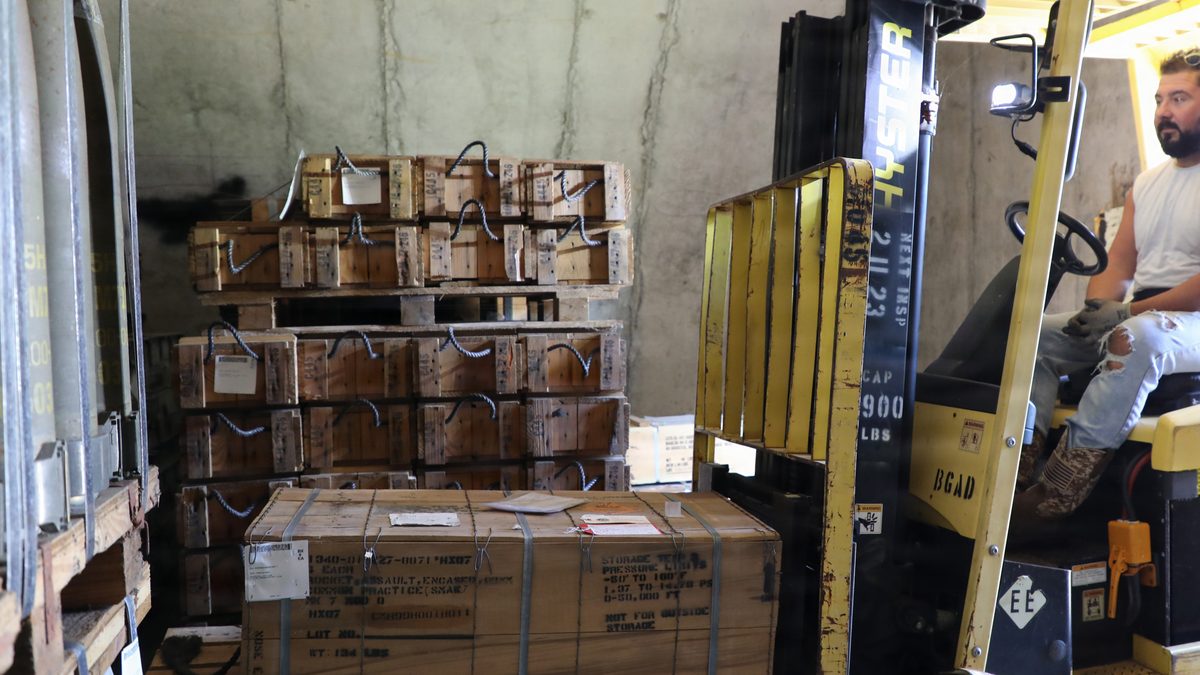
A Quality Assurance Specialist, Ammunition Surveillance inspects munitions in an earth-covered magazine at Blue Grass Army Depot, Kentucky. US Army photo by Dori Whipple, Joint Munitions Command, released via DVIDS. US Government work, public domain. The role shown is the United States national equivalent of the ammunition technical authority function discussed here.
Required, Recorded, Not Quorate: What UK Regulation Asks of Independent Ammunition Safety Advice
UK regulation requires independent technical evaluation of ammunition and says who may give it: demonstrably competent personnel outside the delivery chain and outside the team fielding the system. DSA 02.OME Regulation 102, at Version 4.0 dated July 2026, makes it mandatory. Defence Code of Practice 102 then states twice that the independent adviser is not a quorate member of the safety committee. The advice must be obtained, recorded and considered, and it can be overruled, provided the duty holder is told.
Technical Summary
UK regulation is unusually direct about who may judge whether a munition is safe. DSA 02.OME Regulation 102, at Version 4.0 dated July 2026, requires that the accountable person shall use independent technical evaluation from demonstrably competent personnel to confirm that ordnance, munitions and explosives conform to UK safety legislation, regulation and policy. The acceptable means of compliance with that regulation is Defence Code of Practice (DCOP) 102, reissued at Version 2.0 in February 2026, and it defines the test for independence structurally rather than professionally. Independent technical evaluators are demonstrably competent Suitably Qualified and Experienced Personnel, or organisations, that are not within the delivery chain of the weapon system and sit outside the project or delivery team fielding it. Not senior enough, not experienced enough, not well-intentioned enough. Outside.
The code explains why the test is drawn that way, and the explanation is a confession. Where the Ministry of Defence holds disapplications, exemptions or derogations from safety legislation, it becomes its own regulator, and DCOP 102 opens by naming the conflict that follows: between the pressure to deliver defence capability and the duty under the Health and Safety at Work Act 1974 and the Secretary of State's policy statement to reduce risk As Low As Reasonably Practicable and to a tolerable level. It then reaches for the case that proves it. The code cites the Haddon-Cave report into the loss of Nimrod XV230, which found that the project team bore substantial responsibility for the failure of the Nimrod safety case, having failed to appoint an independent safety advisor to audit it and having signed off the contractor's work when it was manifestly inappropriate to do so. That is the reasoning written into the ammunition rules. Independence is not a courtesy extended to technical staff. It is a control against a failure the Department has already suffered, and the regulation's own stated provenance is that ordinary legislation does not regulate high-risk military activity tightly enough.
The independent safety advisor and the independent auditor are not quorate members of the project or programme safety committee. Their comments should be recorded and considered. Mandatory to obtain, structurally impossible to impose. DSA 03.OME Part 1, DCOP 102 Version 2.0, paragraphs 10 and 21
Two Advisers and an Auditor
DCOP 102 does not describe a single independent figure. It describes two advisory roles and one audit role, engaged at different points and answering different questions. The safety advisor is appointed at the outset and stays with the argument. The scientific subject matter expert is brought in across the life cycle for specific technical questions. The auditor examines the management system rather than the munition.
| Role | When engaged | What it covers | What it is not |
|---|---|---|---|
| Independent OME Safety Advisor | Appointed at the outset | Advice and guidance across fifteen listed areas, from applying the regulations and codes of practice, through case development, hazard review panels and hazard logs, safety and suitability for service, in-service surveillance trials plans and design safety assessments, to live crew clearance, land range safety and air weapon safety. | Not a quorate member of the project committee. Comments recorded and considered. |
| OME Scientific Subject Matter Expert | Engaged throughout the life cycle | Technical assessment on specific topics: energetic material properties and qualification, munitions vulnerability and insensitive munitions, electromagnetic environmental effects and hazards of electromagnetic radiation to ordnance, electrostatic discharge and lightning, initiation systems, programmable elements, climatic and mechanical environmental characterisation, munition life assessment, blast and fragmentation modelling, risk quantification, personal ballistic protection. | Advisory. The accountable person seeks advice as they see fit. |
| Independent Safety and Environmental Auditor | Appointed to audit the management system | Audits safety against planned programme activity, recommends on the acceptability of a proposed safety argument to aid duty-holder acceptance, and advises on interpretation of policy and standards. | Not a quorate member of the project committee. Comments recorded and considered. |
The right-hand column is the part that repays attention, and the code states it twice, once for the advisor and once for the auditor. Neither is a quorate member of the project or programme committee that decides. Their comments should be recorded and considered. The regulation compels the accountable person to obtain independent evaluation; the code of practice then places the person who provides it outside the body that decides.
That structure also has a history. Regulation 102 was reworded in July 2024. It previously required the accountable person to engage the services of an independent OME safety advisor to provide independent technical evaluation support throughout the CADMID/T life cycle. The current wording requires independent technical evaluation from demonstrably competent personnel. The obligation moved from a named role to a function, which widens who can satisfy it and removes the explicit lifecycle span from the regulation itself, leaving the code of practice to carry the timing.
Three Lines of Audit
Independence is not treated as a single condition. For auditing the management system, the code grades it across three levels, and the gradient is precise.
| Audit level | Name | Definition | Distance from the activity |
|---|---|---|---|
| Level 1 | First-party audit | Self-audit by those managing the activity. | Inside the team |
| Level 2 | Second-party audit | Undertaken by specialists outside the immediate line management chain but still within the organisation. In the OME domain this is the OME Safety Review Panel. | Inside the organisation |
| Level 3 | Third-party audit | Fully independent of line management or its organisation. In the OME domain this is the regulator's certification process. | Outside the organisation |
In the ordnance, munitions and explosives domain the second line runs through the OME Safety Review Panel and the third through the regulator's certification process. Both were formerly described as second and third party assurance. The renaming matters less than the distinction the levels preserve: being outside your own line management is not the same as being outside your own organisation, and the code refuses to let the two be confused.
Analysis of Effects
The code sets out fifteen areas in which the independent safety advisor may be asked to advise. They run from applying the regulations and the codes of practice to a system, through compliance with national and international standards, safety and environmental case development, hazard review panels and hazard logs, safety and suitability for service, in-service surveillance trials plans, design safety assessments and the drafting of user and system requirement documents, to live firing assessments and live crew clearance, land range safety, air weapon safety, and the second and third lines of assurance. Procurement is not among them. That is not an omission to be indignant about, and precision matters about what it is. No UK regulation states in terms that ammunition technical authority and procurement authority are separate duties. The separation is an implication of two rules read together: the independence test, which puts the evaluator outside the delivery chain and outside the delivery team, and the quorum rule, which puts them outside the committee. The same boundary then reappears when the competence framework is examined.
DCOP 102 requires that the competence of independent evaluators be identifiable, demonstrable and measurable, and that the accountable person be able to assure the competence of the organisations providing the advice. That is a demand for an instrument rather than an assertion, and in UK Defence the instrument is the Defence WOME Functional Skills Framework, built on the Explosives Substances and Articles National Occupational Standards developed from late 2003 at the request of the Defence Ordnance Safety Group and operational from 2006. The framework is candid about its purpose: elsewhere in Defence, functional competences support workforce planning and appraisal, but within WOME they carry the additional job of assuring the Secretary of State, through the regulator, that the people working on or controlling this material are competent. Its Annex A lists thirteen numbered functional areas, two marked as not used. The eleven live areas carry 162 competences. Procurement carries three. Disposal carries 27, Safety Management 22 and Test and Evaluation 20. The proficiency scale runs across four levels, from a blank entry meaning the competence is required but absent, through Basic Application and Skilful Application, to Expert. An individual self-assesses, a line manager validates, and any gap against the level set for the post is recorded as a finding of non-competence that must be covered by specialist supervision until it is closed.
Where the Competence Weight Sits
| Functional area | Competences | Share of 162 |
|---|---|---|
| Disposal (11) | 27 | 16.7 per cent |
| Safety Management (2) | 22 | 13.6 per cent |
| Test and Evaluation (3) | 20 | 12.3 per cent |
| Storage (7) | 18 | 11.1 per cent |
| Maintenance (5) | 16 | 9.9 per cent |
| Research, Design and Development (1) | 14 | 8.6 per cent |
| Manufacture (4) | 14 | 8.6 per cent |
| Transport (8) | 14 | 8.6 per cent |
| General (13) | 9 | 5.6 per cent |
| Facilities Management (9) | 5 | 3.1 per cent |
| Procurement (6) | 3 | 1.9 per cent |
Areas 10 and 12 are marked as not used and carry no competences. The counts are taken from the framework's own Annex A listing; the total of 162 is arithmetic on those figures rather than a number the framework states.
Personnel and Safety Considerations
The accountability chain is legal rather than cultural, and the independent evaluator sits alongside it rather than inside it. Duty Holders are to be supplied with equipment whose risks have been assessed as tolerable and As Low As Reasonably Practicable, and with information sufficient to use, store, move, maintain and dispose of it safely. Operational Duty Holders are legally accountable for safe operation within their area of responsibility and answer upwards to the Secretary of State. DCOP 102 requires that all specialist advice be documented and formally reviewed by the appropriate committees, and that the accountable person ensure the duty holder is informed where independent advice is not followed. Consider what that sentence is doing. It concedes that independent advice can be rejected, and it makes rejecting it a recorded act, reported to the person carrying the legal risk. The stakes are about to be re-set. On 9 July 2025 the regulator issued Regulatory Notice DOSR/RN/2025-07 announcing Project COWLEY, confirming that UK Defence will adopt the new NATO AASTP-1 quantity distances from 1 January 2028. The new distances treat blast, debris and fragments, and thermal hazards as distinct effects, where the previous tables were built primarily around blast with conservative minimums standing in for debris and fragment throw. The transition is phased as each explosives licence reaches review and renewal, and full transition is expected to take around five years. Every one of those licence renewals is a safety argument being re-opened on stock bought under the old tables, by somebody who has to be competent enough to notice what changed. When that chain fails, whether through an unplanned initiation, a mismatched projectile and charge combination, a degraded fuze or a compatibility group applied to the wrong packaging configuration, people are injured or killed.
Data Gaps
Four items are recorded rather than resolved. First, the Defence WOME Functional Skills Framework Version 3.1 is not published at a public MOD address. ISC worked from a copy of Version 3.1 and cites it by name and version. The per-area competence counts are taken from its Annex A listing, and the total of 162 is ISC arithmetic on those counts rather than a figure the framework states. Second, that copy carries no publication date or document reference, its Annexes B, C and D were not available, and it anchors its competence obligation to JSP 482 Chapter 3, which has since been restructured into DSA 03.OME Part 2. Whether a later version repoints that reference could not be established, and nor could the division of labour between the WOME framework and the Pan Defence Skills Framework now being rolled out across Defence. Third, the amendment record for Defence Code of Practice 102 shows a Regulation removed from Section 1 at Version 2.0 in February 2026. This is consolidation rather than deregulation: DSA 02.OME Version 4.0 carries Regulation 102 in full and mandatory form, and names the code of practice as its acceptable means of compliance. ISC could not obtain the superseded Version 1.2 to compare the wording that was moved, so the reading rests on the current pair of documents rather than on a side-by-side. Fourth, this article describes UK practice. Other NATO nations discharge the same function through different national instruments, and no consolidated comparison is publicly available.
Key Questions
Is independent technical evaluation of ammunition mandatory in the UK?
Yes. DSA 02.OME Regulation 102, at Version 4.0 dated July 2026, states that the accountable person shall use independent technical evaluation from demonstrably competent personnel to confirm that the ordnance, munitions and explosives conform to UK safety legislation, regulation and policy. Defence Code of Practice 102 is the acceptable means of compliance with that regulation.
Does the independent ammunition safety advisor have a vote?
No. Defence Code of Practice 102 states in two places that the independent safety advisor and the independent auditor are not quorate members of the project or programme committee, and that their comments should be recorded and considered. The advice is mandatory to obtain and structurally impossible to impose.
What counts as independent under UK ammunition regulation?
A structural test rather than a professional one. Independent technical evaluators are demonstrably competent Suitably Qualified and Experienced Personnel, or organisations, that are not within the delivery chain of the weapon system and sit outside the project or delivery team fielding it. Audit independence is separately graded across three levels, from self-audit to fully independent of the organisation.
References
Source-evaluated per NATO source-evaluation doctrine, STANAG 2022 lineage (source reliability A–F / information credibility 1–6). Tier 1 = government primary source; Tier 2 = quality news / specialist defence media; Tier 3 = authoritative aggregator / encyclopaedia.
- T1UK Defence Safety Authority – DSA 02.OME, Defence Ordnance, Munitions and Explosives Regulations, Version 4.0, Part 1 Regulation 102, July 2026. (Reliability A / Credibility 1)
- T1UK Defence Safety Authority – DSA 03.OME Part 1, Defence Code of Practice 102: Use of Independent OME Competent Personnel for Independent Technical Evaluation, Version 2.0, February 2026. (Reliability A / Credibility 1)
- T1UK Defence Safety Authority – DSA 03.OME Part 1, Defence Code of Practice 103: OME Safety and Environmental Case(s) and Report(s), Version 2.0, February 2026. (Reliability A / Credibility 1)
- T1Defence Ordnance, Munitions and Explosives Safety Regulator – Regulatory Notice DOSR/RN/2025-07, Project COWLEY: Adoption of NATO AASTP-1 Quantity Distance Tables, 9 July 2025. (Reliability A / Credibility 1)
- T1UK Ministry of Defence, Acquisition Safety and Environmental Management System – The Acquisition Lifecycle: the six-phase CADMID/T model, ASEMS Document Version 3.1, effective 21 May 2024. (Reliability A / Credibility 2)
- T2Institution of Explosives Engineers, Standards Setting Body for Explosives, Munitions and Search Occupations – Work in Support of Explosives, Munition Clearance and Search Competence, the origin of the Explosives Substances and Articles National Occupational Standards, accessed 25 August 2026. (Reliability B / Credibility 2)
Corrections & updates welcome. If you hold open-source data that refines or corrects any parameter in this article, please contact [email protected] citing the specific claim and your source. Verified corrections will be incorporated and credited in the revision history. AI-assisted technical assessment based on open-source material. Not a formal intelligence product.