A defence contracting officer running a framework competition for explosive ordnance disposal (EOD) detection equipment is being asked to make a sensor-family choice with operator-safety implications, against a standards regime that defines parts of the answer well, parts of it partially, and parts of it not at all. This is not an indictment of the people doing that work. It is a description of the architecture they are working inside, and an argument that the architecture has visible gaps that the standards community and the major defence-procurement bodies are well placed to close.
The argument draws on the ISC Defence Intelligence three-part dossier on magnetic detection equipment for EOD tasking, published 28–29 April 2026 [1][2][3]. The dossier surveys manufacturers, NATO and CEN standards, and the open record of defence framework awards in the category. Read end to end, it sets out a competence-architecture concern with four specifiable components in the standards regime, against a fifth requirement (what the buyer is actually being asked to specify) that the four are meant to support.
What the contracting officer is actually being asked to specify
An EOD detection-equipment line in a framework competition is, in practice, a request for two distinct categories of equipment that are often tendered together. Active-emission tools (pulse-induction metal detectors such as the Schiebel AN-19/2, the US Army AN/PSS-12, and the CEIA family) transmit short, high-current electromagnetic pulses and read the eddy-current response in nearby conductive metal. Passive magnetometers (the Foerster FEREX 4.032/4.034, the VALLON VMH series, the Bartington Grad601) transmit nothing; they read perturbations in the Earth's magnetic field caused by ferromagnetic mass [1].
Physics of the safety envelope
Pulse-induction (PI) detectors emit short, high-current electromagnetic pulses, typically in the kilohertz range, that induce eddy currents in conductive targets. The same emitted fields, and the induced transients they create, can couple into magnetic-influence fuze circuitry. Passive magnetometers (fluxgate, Overhauser, proton-precession, optically-pumped) measure only static or quasi-static perturbations in the Earth's magnetic field caused by ferromagnetic mass. They emit nothing of their own. This is the physical reason the two families have opposite safety envelopes near magnetic-influence-fuzed ordnance and are complements, not substitutes [1][4].
Annex C of STANAG 2897 codifies the test regime as Magnetic Signature Design Criteria for EOD Equipment. The certification is binary: a tool either meets the magnetic-signature and electromagnetic-emission limits or it does not. Any active-emission device, including dual-sensor systems that carry a pulse-induction component, cannot be certified to it. Foerster (FEREX, MAGNETOSCOP) and Bartington document Annex C compliance for their relevant product lines; pulse-induction manufacturers do not, because the standard does not admit them.
The two families are complements, not substitutes. They have different target sets, different operational employment doctrines, and different safety envelopes. The MagDetect briefing is precise on the boundary: pulse-induction sets "actively transmit electromagnetic pulses; they should never be used in proximity to magnetic-influence-fuzed sea mines or pressure-sensitive UXO" where passive magnetometers are the correct tool [1]. NATO Standardization Agreement (STANAG) 2897 and its allied publication AEODP-7 (EOD Equipment Requirements and Equipment, whose Annex C is the canonical reference for non-magnetic and low-signature toolkit certification) specify the magnetic-signature and electromagnetic-emission properties of any tool intended to approach a magnetic-influence-fuzed sea mine or certain bottom mines. A pulse-induction set cannot be certified to that standard [2][4].
Where EOD operators legitimately work inside the safety envelope
- MCM dive or ROV intervention. Clearance diver (RN SDU, Bundeswehr SEK-M, USN EODMU, Marine Nationale GPD) or remote vehicle (SeaFox, K-STER, Archerfish) approaches a sonar-classified bottom mine to confirm identity and rig disposal. STANAG 2897 / Annex C non-magnetic toolkit only.
- Stranded or beach-cast sea mine. WWII LMB / GC / GD or modern bottom mine washed ashore; land EOD AT identifies and disposes in situ inside the lethal radius of a fuze that may still be armed.
- Buried magnetic-influence ordnance in littoral or surf zone. Deliberate search in known mined coastline (Thames Estuary, Solent, Wash, Baltic approaches); only passive magnetometry can do the looking; a PI sweep would initiate.
- Offshore wind-farm UXO clearance. Pre-construction survey by towed or AUV-mounted passive magnetometer; ROV-led render-safe on identified contacts under the same Annex C rule for any diver-handled subset.
- Post-event forensic exploitation. Recovery of partially-functioned items for technical exploitation; residual fuze state treated as live until the item is declared inert.
The doctrine across all five. When the operational task puts the operator inside the lethal radius of a magnetic-influence fuze, the only tool family permitted is the one certifiable to STANAG 2897 / AEODP-7 Annex C: passive, non-magnetic. Active-emission detectors are the right tool for most of the EOD workflow but not this part of it.
| Configuration | Fuze-coupling risk (qualitative) | STANAG 2897 Annex C |
|---|---|---|
| Pulse-induction handheld | High: active EM emission | Not certifiable |
| Dual-sensor (PI + magnetometer / GPR) | High: inherits PI emission | Not certifiable |
| Passive magnetometer (handheld / UAV / towed) | Low: no emission | Certifiable |
| Ground-penetrating radar (standalone) | Moderate: active RF emission, frequency-dependent | Case-by-case; consult Annex C |
The contracting officer's task is therefore not "buy a detector". It is: specify, evaluate, contract for and accept two different categories of equipment, against the standards that apply to each, for the operational tasks they are each intended to support. That is a multi-disciplinary specification problem and is most defence contracting officers' day job for a few weeks of any framework cycle.
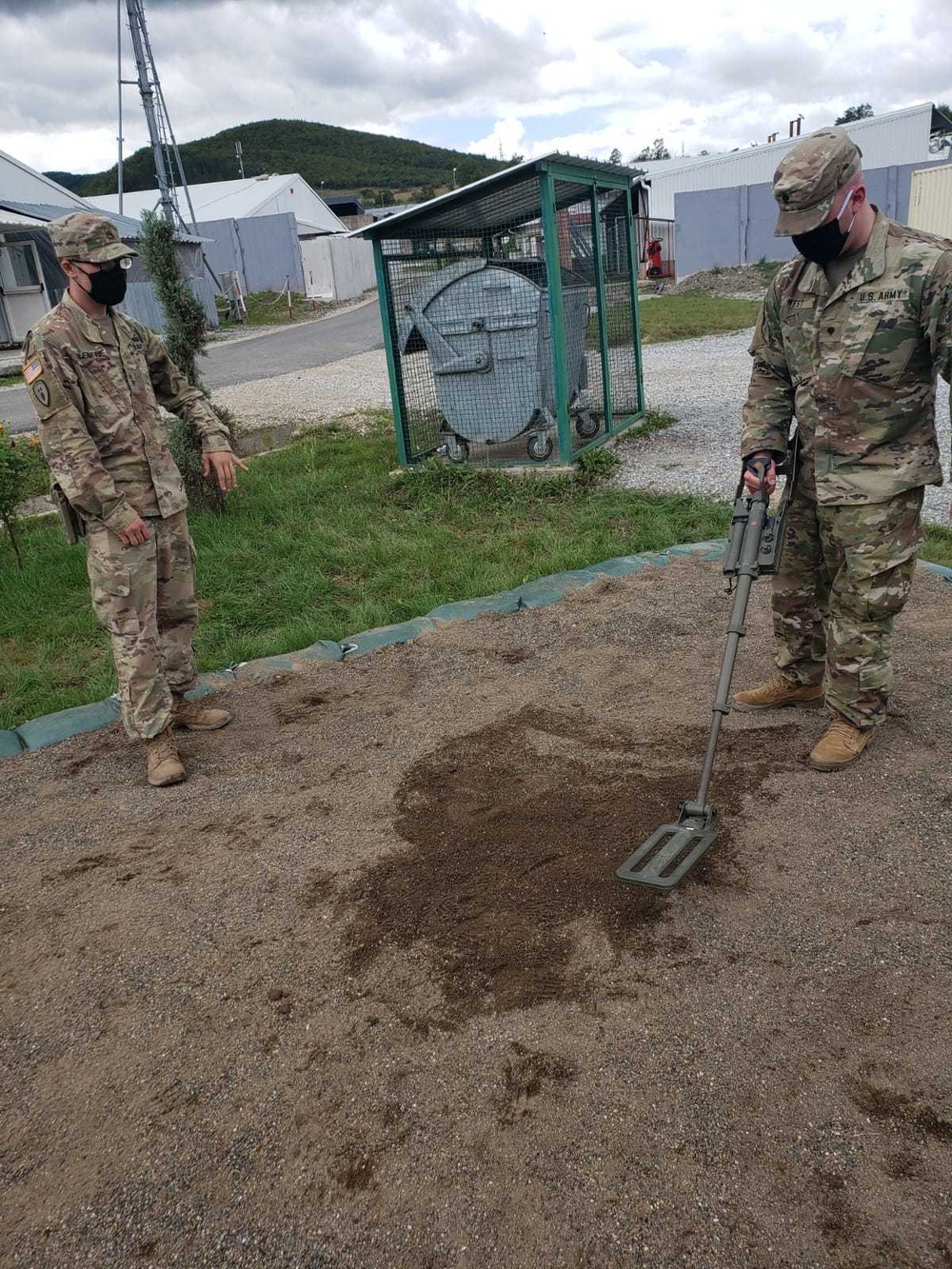
Hand-held dual-sensor mine detector in EOD training. Spc. Donovan Hinde of Oregon Army National Guard (KFOR Regional Command East) receives instruction on the VALLON VMR2 MineHound (metal detector + ground-penetrating radar, dual-sensor) from EOD Specialist Staff Sgt. Zachary Valentine, Camp Nothing Hill, Kosovo, 19 August 2020. US Army photo by Spc. Mitchell Arnone, 100th Mobile Public Affairs Detachment. Public domain via DVIDS (asset 6334190).
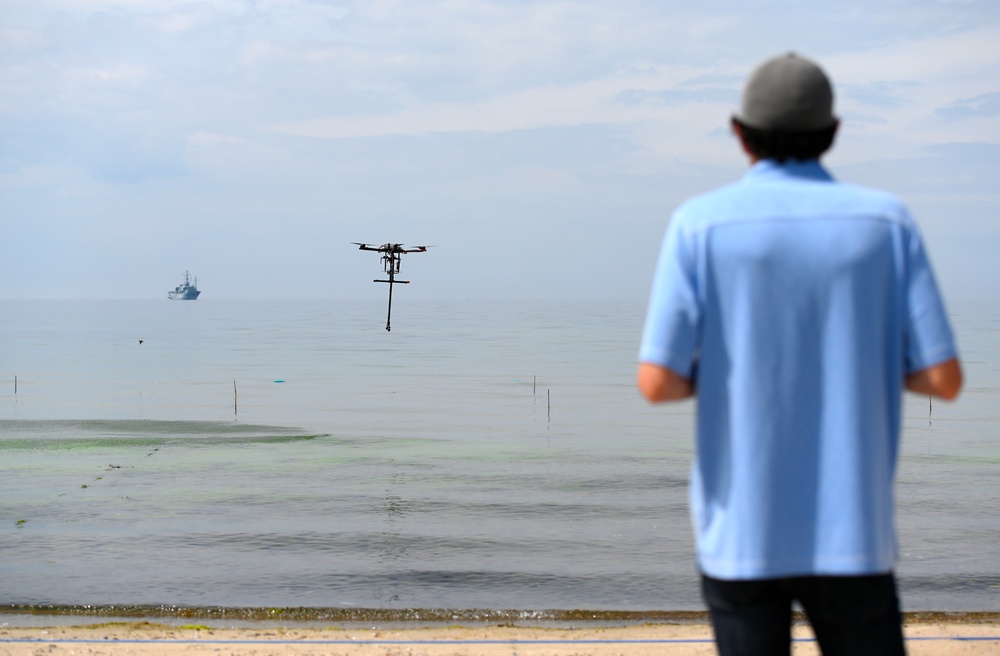
Hand-held passive magnetometer at a NATO mine-warfare exercise. Office of Naval Research personnel test the Magnetic Expeditionary Threat Locator, a hand-held passive magnetometer designed for shallow-water detection of magnetic-influence ordnance, during NATO exercise BALTOPS 50 at Putlos, Germany, 11 June 2021. US Navy photo by Mass Communication Specialist 1st Class Christopher Hurd. Public domain via DVIDS (asset 6690484).
Technical note: the VMR2 MineHound is a dual-sensor instrument
The instrument in the left panel of Figure 2 is the VALLON MINEHOUND VMR2 Dual-Sensor Mine Detector, introduced around 2005 under the UK Ministry of Defence / Cobham programme. It pairs a VALLON metal-detector / electromagnetic-induction (MD/EMI) stage based on VMH3 technology with a 1 GHz time-domain ground-penetrating radar (GPR) developed by ERA Technology / Cobham, and presents to the operator as a single hand-held instrument with selectable MD-only, GPR-only, or simultaneous MD + GPR modes.
| Architecture | Dual-sensor: MD/EMI (VALLON VMH3-derived) + 1 GHz GPR (ERA Technology / Cobham) |
| Mass (operational) | < 4 kg |
| Search head | 210 × 335 mm; telescopic bar 240–1,020 mm |
| Power | Rechargeable Li-Po; < 5 W |
| Operating range | GPR −30 °C to +60 °C; MD −32 °C to +65 °C |
| NSN | 6665-12-371-0357 (German / NATO, "Detecting Set, Mine, VMR2 MINEHOUND") |
| Status | Out of production; superseded by VMR3 / VMR3G MINEHOUND (current production, MIL-STD-810G qualified, IP68 to 1.5 m for 1 h, ~4.0 kg, ~8.5 h Li-Po endurance). VMR3G remains in service with multiple armies. |
| Users | UK MoD (extensive use in Afghanistan and Iraq under the original Cobham programme); German Bundeswehr / NATO (NSN-confirmed); humanitarian demining operators. Procurement via national channels and NSPA frameworks. Product page: vallon.de / VMR3 MineHound. |
Why this matters for the article. The VMR2 in the photograph is the canonical example of the dual-sensor bridge category discussed earlier. Because the MD/EMI stage is active-emission, the integrated instrument inherits the safety envelope of its most permissive component and cannot be certified to STANAG 2897 / AEODP-7 Annex C, regardless of how compliant the GPR sub-system might be in isolation. In a framework call-off the VMR2 / VMR3G arrives as a single line-item product number; the disambiguation between active-emission and passive-magnetometer use cases has to be done at the tender-specification stage, not at the point of issue to the operator.
Manufacturer landscape and NSN reference
The procurement-architecture argument is easier to read against the live product catalogue. The table below lists the principal passive magnetometer and gradiometer systems currently in NATO and European mine-action service, with manufacturer links, NATO Stock Numbers (NSNs) where publicly documented, and a user-nation summary. Active-emission and dual-sensor instruments are noted separately below for context. This is open-source data compiled from manufacturer technical sites, US NSN databases, NSPA and UNDP reporting, the September 2023 SPH / SENSYS / Geometrics comparative trials in Latvia, and the GICHD Equipment Catalogue; many European systems are procured nationally, via NSPA frameworks, or via UNDP and humanitarian donors, and do not always carry US NSNs.
| Product / System | Manufacturer (country) | NSN (US or noted) | Key user nations & organisations |
|---|---|---|---|
| FEREX 4.032 / 4.034 Fluxgate gradiometer; handheld, DLG, borehole, underwater variants |
Institut Dr. Foerster GmbH & Co. KG (Germany) · foerstergroup.com / FEREX | 6665-01-503-7886FEREX 4.032 Mk26 Mod1 US variant |
US Army EOD (standard Mark 26); NATO via NSPA framework, including Bundeswehr, French Sécurité Civile, Spanish, Italian, Polish, Czech forces; Ukrainian SESU and MoD; UK commercial UXO firms (1st Line Defence, Brimstone); humanitarian operators including MAG, NPA, HALO Trust. MIL-STD-qualified. |
| VX1 Surface / Borehole / SEPOS Modular fluxgate magnetometer with VSM4 probe |
VALLON GmbH (Germany) · vallon.de / magnetometer | No widely published NSN for pure magnetometer kit. Some VALLON dual-sensor kits carry German NSNs in the 6665-12-... range. |
US Marine Corps; Bundeswehr; UK MoD; Netherlands and Norway; Ukrainian SESU and humanitarian operators; MAG, NPA, Cambodian Mine Action Centre (CMAC). GICHD-listed. Dual-sensor variants common. |
| Grad-13 / Mag-13 series Three-axis fluxgate gradiometer; land and submersible |
Bartington Instruments Ltd (UK) · bartington.com / Grad-13; Mag-13 | None at sensor level. Component-grade sensors integrated by OEMs. | UK Royal Navy clearance divers (magnetic hygiene and signature verification); AUV / ROV system integrators; specialist EOD OEMs worldwide. Low-noise option; 200 m depth-rated variants. |
| MagDrone R4 Five tri-axial fluxgate UAV payload |
SENSYS Sensorik & Systemtechnologie GmbH (Germany) · sensysmagnetometer.com / MagDrone R4 | None. | Ukrainian SESU under the UNDP "Mines Eye" pilot (~360 ha scanned); MAG, NPA, HALO Trust drone teams; European commercial UXO contractors; SPH Engineering at the Latvia test range. ~2 kg payload, compatible with DJI M300 and M350 RTK platforms. |
| MAGNETO MX V3 Modular vehicle-towed array, up to 16 fluxgates |
SENSYS Sensorik & Systemtechnologie GmbH (Germany) · sensysmagnetometer.com / MXV3 | None. | Large-area surveys in Ukraine; commercial UXO firms in Germany, Netherlands, UK and Italy; North Sea wind-farm pre-construction clearance. RTK DGPS positioning at ±1 cm; throughput up to 25 ha per day. |
| G-882 Marine Magnetometer Caesium-vapour towed fish; TVG variant |
Geometrics, Inc. (USA) · geometrics.com / G-882 | 5845-01-563-8180 |
USACE and US Navy; North Sea offshore-wind UXO contractors (TenneT, Ørsted, RWE), including MMT, Bedrock, Geomines, N-Sea. Industry standard for 2–5 m line-spacing UXO clearance. |
| MagArrow II UAV-suspended caesium MFAM |
Geometrics, Inc. (USA) · geometrics.com / MagArrow | None specific. | Commercial UAV UXO surveys; participated in the Latvia 2023 comparative trials (detected 105 mm at altitude, with motion and heading trade-offs noted versus rigid fluxgate arrays). |
| K-Mag / DRONEmag GSMP-35U Optically-pumped potassium-vapour |
GEM Systems Inc. (Canada) · gemsys.ca | None. | USACE contractors; Canadian DND; mineral and UXO surveys in Australia, South-East Asia and Latin America; participated in the Latvia 2023 trials (high sensitivity but with altitude limits on small targets). Approximately 10× caesium sensitivity. |
Active-emission and adjacent systems — for context
- VALLON MINEHOUND VMR2 / VMR3 / VMR3G. Hand-held dual-sensor mine detector (MD/EMI + 1 GHz GPR). UK MoD / Cobham origin programme; VMR3G is the current production model and is MIL-STD-810G qualified, IP68-rated to 1.5 m for 1 hour, with an LED graphic display and optional vibration alarm. Operational mass approximately 4.0 kg with standard battery. NSN
6665-12-371-0357for the VMR2 (German / NATO). Manufacturer: vallon.de / VMR3 MineHound. Users: UK MoD (Afghanistan / Iraq), Bundeswehr, NATO, humanitarian operators. As a dual-sensor with an active-emission component, the family inherits the safety envelope of its most permissive stage and cannot be certified to STANAG 2897 / AEODP-7 Annex C. - Schiebel AN-19/2 (AN/PSS-12 in US service). Pulse-induction metal detector; not a magnetometer. Widely fielded NATO standard, with approximately 2,600 units supplied through the NSPA framework cycle of 2017–2020 (open-source trade-press figure, not independently verified against an issuing contract notice). NSN
6665-21-906-1023(NATO variants). Manufacturer: schiebel.net / AN-19/2. Users: most NATO armies, US Army (AN/PSS-12 designation), humanitarian deminers. The active-emission classification is the reason this family cannot be certified to STANAG 2897 / AEODP-7 Annex C. - AN/PSS-14 (HSTAMIDS). Electromagnetic induction plus ground-penetrating radar; not a magnetometer. US Army programme. Original developer CyTerra now part of L3Harris. No magnetometer NSN overlap.
- MAGNETOSCOP 1.070 / MAGNETOMAT (Institut Dr. Foerster, product page). Not a search instrument: the test equipment specified under STANAG 2897 / AEODP-7 Annex C for verifying the non-magnetic properties of EOD tools, divers' kit, and ROV manipulators. Direct US Navy procurement on contract N6833525C0181 in FY2025 records (~$881,440), reflecting the position of this product line as the de-facto NATO test instrument for Annex C compliance.
- Emerging quantum sensors. Optically-pumped magnetometers (OPMs) and nitrogen-vacancy diamond magnetometers. Vendors include QuSpin (quspin.com), Twinleaf (twinleaf.com), FieldLine, Cerca Magnetics, and prototype work at GEM and Geometrics. No established NSNs or mass fielding yet. DARPA AVIS, US Navy MAD-XR and SERDP-ESTCP programmes drive development at TRL 4–6. Disruption expected within five to seven years.
Procurement-data note. US NSNs dominate NATO and US Army references (Foerster FEREX, Geometrics G-882). European systems (VALLON, SENSYS, Foerster non-US variants, Bartington) are procured nationally, through NSPA frameworks, via UNDP and humanitarian donors, or on commercial contracts; exact volumes for many are not fully in the open record. The table is a ready-reference snapshot for EOD tasking, procurement planning and intelligence use; for current contract volumes or classified inventories the recommended path is direct manufacturer or national-procurement-office engagement.
The standards regime, viewed from the buying side
Read against that task, the present standards regime equips the contracting officer well in some places and incompletely in others.
Where the regime is complete
- Tool-side certification near magnetic-influence ordnance. STANAG 2897 / AEODP-7 governs the magnetic-signature and electromagnetic-emission properties of EOD tools that may approach magnetic-influence-fuzed sea mines and certain bottom mines. Annex C, titled Magnetic Signature Design Criteria for EOD Equipment, is the operative reference for non-magnetic toolkit certification; the test method is defined and the certification is binary. Suppliers of compliant tools publicly document their Annex C compliance for procurement audit purposes; suppliers of active-emission devices, including dual-sensor systems with a pulse-induction component, cannot [2][4].
- Environmental survivability and EMC. The AECTP series under STANAG 4370 (AECTP-200 Ed.3 January 2006; AECTP-300 Ed.3 2019; AECTP-400 Ed.3 2019; AECTP-500 Ed.E v1 December 2016; AECTP-600 Ed.2) provides the test methods that govern whether equipment will survive its operational environment [2].
- Supplier quality management. The AQAP suite under STANAG 4107, with AQAP-2110 Edition D as the workhorse, defines the supplier's quality-assurance management system [2].
- Operator competence reference. CEN Workshop Agreement 15464 (2005) "Planning and Assessing EOD Competencies" and STANAG 2143 / AEODP-10 (Edition C, April 2013) on EOD proficiency define the competence frameworks for the people using the equipment. IMAS 09.30 (EOD Competence Requirements) is the direct humanitarian descendant of CWA 15464 and is the operative document for donor-funded mine-action programmes [2][8].
Where the regime is not
- Active-search performance specification. There is no NATO allied standard that defines technical performance requirements for an active-search EOD magnetometer: no specified sensitivity, no agreed noise floor, no depth-of-detection class, no false-alarm-rate threshold [2]. Humanitarian precedents exist on the pulse-induction side: CEN Workshop Agreements 14747-1 (test and evaluation protocols) and 14747-2 (soil characterisation, critical because magnetic susceptibility in soil drives PI false-alarm rates and detection depth) provide the closest existing performance-test references. They are not allied military performance floors, but they are the working template the standards community could harmonise from. National military specifications (the US MIL-PRF series for the PSS-12 family, UK DEF STAN trial protocols) already supply quantitative benchmarks that could seed a new AEODP or CEN Workshop publication. None of this currently lives in a single normative reference the contracting officer can cite.
- Sensor-family disambiguation in tender taxonomy. NATO's Allied Administrative Publication 6 (AAP-6) contains both "metal detector" and "magnetometer" as glossary entries [2][7]. United Nations Standard Products and Services Code (UNSPSC) classifies the category at the 461716xx ranges and the EU Common Procurement Vocabulary (CPV) uses 35200000-0 family ranges; in practice these do not always distinguish active-emission from passive sensors with enough granularity for a tender-document line item to make the distinction unambiguously without supplementary technical wording. A one-page allied technical note in the AAP-6 family would eliminate most of this ambiguity.
- Comparative trial methodology. The MagDetect Addendum reports that "donor procurement decisions are largely shaped by manufacturer-led demonstration, which carries the risk of overclaiming detection ranges" [2]. Comparative trials happen: the SPH Engineering Latvia trials of September 2023 used ISO SEEDS surrogate targets, and the longer-running International Test and Evaluation Programme (ITEP) tradition, including the Oberjettenberg dual-sensor trials of 2009, provides proven templates [2]. There is no agreed allied test plan, conducted at ISO/IEC 17025-accredited test houses or under an ITEP-style multinational evaluation, that a contracting authority can require a supplier to submit results against by default.
- Competence frameworks for the procurement professional and for the dual-sensor operator. CWA 15464 covers the single-sensor operator. AQAP-2110 covers the supplier. There is no equivalent NATO or CEN competence framework for the defence contracting officer or technical evaluator who specifies and assesses EOD detection equipment, and there is no published competence module specifically for the mode-selection decision logic operators face on current dual-sensor and multi-modal instruments. The closest adjacent reference on the procurement side is the European Skills, Competences, Qualifications and Occupations (ESCO) framework's Key Role 6 (Procurement), which is not domain-specialised; on the dual-sensor operator side there is no published equivalent at all [2].
Three training and competence layers, not two
The competence question commonly framed as "operator versus buyer" is now better read as three concurrent layers, each with its own published reference or named gap, each of which the safety outcome depends on.
- Operator competence: sensor handling and signal interpretation. The deminer, EOD technician or clearance diver who handles the instrument in the lethal radius of the ordnance. Reference framework: CWA 15464:2005 and its humanitarian descendant IMAS 09.30 (with T&EP 09.30/01/2022), and on the military side STANAG 2143 / AEODP-10 Edition C. This layer is comprehensively addressed by the present standards regime.
- Buyer-side competence: framework specification and technical evaluation. The contracting officer and technical evaluator who specifies, evaluates and contracts for the equipment. No NATO or CEN published framework yet exists in the category. Closing this gap is the article's Move 4.
- Dual-sensor and multi-modal operator competence: mode selection and stage discipline. A specific operator-side competence that single-sensor instrument doctrine does not cover. Where an instrument carries more than one sensor stage (typically active-emission PI plus GPR, sometimes augmented with a passive magnetometer stage), the operator inherits a mode-selection decision before every task, and the consequences of selecting the wrong mode near magnetic-influence ordnance are not recoverable. No published competence module yet codifies this; CWA 15464 and IMAS 09.30 predate the current generation of dual-sensor instruments and address sweep technique rather than mode-selection decision logic.
The three layers are coupled. A complete buyer-side framework that specifies a dual-sensor instrument without specifying the operator-side mode-selection competence pathway has solved one architecture problem and created another. A complete operator-side framework that addresses sweep technique but not mode-selection decision logic does not protect the operator who has just been issued a multi-modal instrument. The argument the article makes is not that any one of these is sufficient on its own. It is that the three must be in alignment at the moment of the framework specification, and at present they are not.
That is a specifiable architectural concern: the regime equips the contracting officer comprehensively for environment, EMC, quality management, and tool-side certification. It does not yet equip them with a normative performance reference, a disambiguated tender taxonomy, an agreed comparative test plan, or a procurement-professional competence framework for the category. None of those gaps is the contracting officer's fault. All of them are within reach of the standards community to close.
Framework procurement as the worked example
Framework agreements are the dominant defence-procurement instrument in this category at scale. They run for five to ten years inclusive of options, they aggregate multiple member states' or service branches' demand, and they typically delegate technical evaluation to a small specialist team whose output binds the framework's call-off behaviour for its full term. The NATO Support and Procurement Agency (NSPA) framework architecture, with its Financial Levels C, D and E, its eProcurement 5G portal, and a baseline business volume of approximately €4 billion annually across all categories† [2], is the most visible example, but the same structure applies in essentially equivalent form at the US Army Corps of Engineers ChEM-RU multiple-award task-order contract ($1.136 billion ceiling, awarded October 2021 [3]), at the UK Defence Equipment & Support framework portfolio, and in EU joint-procurement constructs.
† NSPA total business volume is reported around €4 bn in baseline years and materially higher in recent years owing to ammunition and Ukraine-support programmes; the figure above is the open-source baseline reference used in the dossier and should be read with that context.
The procurement-process advantages of framework agreements are well documented: predictable demand, supplier qualification done once, faster call-off, aggregated buying power. The competence-architecture implications are less often discussed. Because a framework's technical clauses are written once and bind the next 5–10 years of call-offs, the standards literacy of the team writing them, or equivalently the comprehensiveness of the standards regime they are drawing on, is amplified across the entire term of the agreement. A clause that does not separate sensor families clearly at award becomes a call-off pattern that does not separate them clearly for the next decade. A clause that names a normative performance reference that does not exist becomes a procurement that relies on supplier-supplied benchmarks for the next decade.
This is the procurement-process concern. It is not specific to NSPA. It is structural to framework procurement when the underlying standards regime is incomplete in the category being bought.
| Sensor family | What it is | Tool-side standard | Allied performance standard | Closest existing performance & test reference |
|---|---|---|---|---|
| Pulse-induction metal detector | Active-emission; eddy-current; detects minimal-metal items | Humanitarian CWAs and national service standards | None at NATO level | CWA 14747-1 (T&E protocols) + CWA 14747-2 (soil characterisation); US MIL-PRF series for PSS-12; UK DEF STAN trial protocols. Depth and FAR vary with soil magnetic susceptibility and target geometry [2][8]. |
| Passive magnetometer (handheld & UAV) | Passive; reads ferromagnetic perturbation; detects bulk UXO | STANAG 2897 / AEODP-7 (Annex C) governs whether the tool can approach magnetic-influence ordnance | None at NATO level | Manufacturer-published sensitivity figures (typically 0.05–5 nT for fielded fluxgates) + STANAG 2897 magnetic-signature test; no allied detection-performance floor [2][4]. |
| Specialised marine search magnetometer | Towed / AUV-mounted; offshore wind UXO clearance market | STANAG 2897 / AEODP-7 for diver-handled subset; commercial / API specifications for offshore work | None at NATO level | Commercial / API specifications (e.g., AUV-towed system performance); STANAG 2897 for diver-handled subset only [1][2]. |
Indicative fielded performance, in numbers
Contracting officers reading this article often ask for concrete reference points; the open literature provides the following indicative figures, which the present standards regime does not yet codify but should. Handheld passive fluxgate magnetometers in current NATO and European-mine-action service report noise-floor or sensitivity figures of roughly 0.05–0.5 nT, and detect 155 mm artillery or 81 mm mortar bodies at 0.5–2 m or more depending on burial depth, orientation, residual magnetisation and the magnetic susceptibility χ of the surrounding soil (the parameter CWA 14747-2 characterises) [1][8]. Pulse-induction handhelds qualified for humanitarian and combat-engineer use achieve detection of minimum-metal targets at 10–60 cm or more in benign soils; false-alarm rate is heavily modulated by soil χ, which is the same parameter applied to a different physical principle with a different procurement consequence [8]. These are operating points, not standards. The architectural argument of this article is that they should be operating against a published normative floor in the next framework cycle.
The dual-sensor bridge category
One emerging product class is starting to bridge the two families: dual-sensor handheld and vehicle-mounted systems that combine pulse-induction metal detection with passive magnetometry, and increasingly with ground-penetrating radar (GPR). These products present to the buyer as a single line item under a single part number, but they are not a hybrid safety envelope. They inherit the safety constraints of their most permissive component: a dual-sensor with a pulse-induction stage cannot be certified to STANAG 2897 / AEODP-7 Annex C, regardless of how compliant the magnetometer stage is in isolation. The operator who carries the dual-sensor instrument into the lethal radius of a magnetic-influence fuze carries the PI emission with them. The tender-taxonomy implication is immediate: dual-sensor systems should be specified at the line-item level with an explicit Annex C disqualification flag for any tasking that requires approach to magnetic-influence ordnance, and call-off documentation should distinguish dual-sensor units from single-sensor passive magnetometers in the equipment-issue record. They are the near-term test of whether the four architecture moves below land in time to govern them properly.
The procurement attractiveness of a dual-sensor instrument is that one item of kit issued to the operator is the right item for several distinct EOD tasks. Pulse-induction for minimal-metal mines and shrapnel; GPR for plastic-cased and minimum-metal items in benign soils; passive magnetometry (where present) for bulk-iron UXO and approach to magnetic-influence ordnance. The training implication is the inverse of the procurement attractiveness. A single-sensor instrument has one operational envelope and one decision the operator must internalise. A dual-sensor instrument has a mode-selection decision before every task and the consequence of the wrong setting is not lost detection sensitivity; it is the wrong instrument for the safety envelope the operator is standing in. Selecting "MD only" or "MD plus GPR" on a VMR3-class instrument while approaching a magnetic-influence-fuzed item is a fuze-initiation pathway, regardless of how skilled the operator is in any individual mode. The cost of switching mode is one button press; the cost of having pressed the wrong one is the operator. This is why dual-sensor procurement should be paired, at framework level, with a documented operator competence pathway for mode selection and stage-disable confirmation, not just for sweep technique.
The UK Future Ground Search programme as the live test case
The UK Future Ground Search (FGS) programme run by the Specialist Explosive Ordnance Disposal & Search, Exploitation & Countermeasures (SEEC) delivery team within DE&S is presently the most visible national-level procurement in this category. Three Prior Information Notices have been published (September 2023, May 2024, August 2024); Industry Day was held in Bristol on 15 July 2024 and a Demonstration Day at Bicester on 1–2 October 2024 [3]. The programme aggregates a handheld metal/non-metal detector (Project 1, quantity 800, estimated £35 million) and a handheld complex-terrain metal detector (Project 2, quantity 800, estimated £10 million) for a combined £45 million initial value with five-year contracts plus two two-year extension options, scaling on the programme's published trajectory to approximately 3,110 units and £80–100 million total [3]. Commercial contact: [email protected].
FGS is a constructive test case because it has done several things that close the architecture gap directly. The two project lines separate the equipment categories cleanly at the line-item level. The Demonstration Day required suppliers to provide their own equipment and targets under Official-Sensitive classification with BPSS minimum security clearance, which is a capability-led evaluation rather than a paper one [3]. The market engagement window (cut-off 28 April 2026) gives the SEEC team time to consolidate standards references into the eventual Invitation to Tender. The open question for the eventual ITT, and for any subsequent allied framework that takes FGS as a reference, is whether the specification will name STANAG 2897 / AEODP-7 explicitly for any tool intended to operate near magnetic-influence ordnance, whether it will set a published noise-floor and sensitivity floor against an agreed surrogate target set (such as ISO SEEDS or a defined ferrous UXO simulant set covering 155 mm artillery and 81 mm mortar bodies), and whether CWA 15464 / IMAS 09.30 will appear in the supplier's required training and supervision plan rather than as a separate annex.
The constructive read. Defence contracting officers reading this article are not the concern. The concern is that the standards architecture they draw on contains four named gaps. Closing those gaps would let the same contracting officers write a framework specification that does the safety work for them, rather than relying on individual expertise that may not be available in every cycle.
Ukraine: the same architecture problem on the operator side
The procurement-side competence concern has a mirror on the operator side, and both are visible in the Ukraine demining response. The MagDetect briefing reports that approximately 4,500 trained deminers are currently active against a requirement assessed at 10,000-plus over the next decade [1]. The Fifth Rapid Damage and Needs Assessment (RDNA5) put potentially contaminated territory at over 132,000 km² and total recovery and reconstruction needs for explosive hazard management at £20.5 billion across 2026–2035 [1]. Donor procurement is responding: the October 2025 Demining Capability Coalition announced an envelope of approximately €165 million for 2026 equipment supply across 23 contributing or partner nations [2]; the United Kingdom alone has donated more than 1,000 VALLON detectors and 100 bomb de-arming kits since December 2022 [3].
The hardware arrives faster than the competence to use it. Modern drone-mounted magnetometer arrays such as the SPH Engineering MagDrone R3 and the Geometrics MagArrow II survey at operator-reported rates of around one hectare per hour per platform [1]; the geophysical-interpretation burden that comes with that throughput, in the dossier's phrase, "requires trained geophysicists, not deminers" [1]. SPH Engineering's own published guidance, unusually direct for a manufacturer, holds that the system "should never be used to confirm the absence of landmines (and small ordnance) in a certain area, but it can be a valuable asset during a Non-Technical Survey (NTS) or Technical Survey (TS) to confirm the presence of UXO/landmines with a considerable amount of ferrous metals" [1]. Magnetometers are an evidence-of-presence tool, not an evidence-of-absence tool. A donor procurement that does not include the operator-side competence pathway with the equipment has bought a survey instrument that, downstream, may be misread as a clearance certificate.
The point that connects the two sides: competence is a system property, not an individual one, on both the buying side and the operating side. Closing one without the other leaves the operator carrying the unresolved part.
What a complete competence architecture would look like
The architecture gap is closable. Read against the MagDetect Addendum's RFP-clause inventory [2] and the open standards record, four moves would close most of it.
Move 1: An allied performance standard for active-search EOD magnetometers
Sensitivity floor, noise-floor ceiling, depth-of-detection class against a defined surrogate target set, false-alarm-rate threshold. The ISO SEEDS surrogate targets used in the September 2023 Latvia trials are an available reference [2], and a fuller set of standardised ferrous UXO simulants (155 mm artillery bodies, 81 mm mortar bodies with defined steel mass) would harmonise the test population with the operational target population. Results required from ISO/IEC 17025-accredited test houses or under an ITEP-style multinational trial. A new AEODP publication or a CEN Workshop Agreement could host this in either the NATO or CEN system. National benchmarks (US MIL-PRF, UK DEF STAN) are available to seed the work.
Move 2: Tender-taxonomy disambiguation
A short allied technical note, one page in the AAP-6 family, specifying that "metal detector" and "magnetometer" are distinct categories of equipment with separate employment doctrines and separate safety envelopes, and that framework line items addressing EOD detection equipment should separate them. Cross-mapped to UNSPSC 461716xx and CPV 35200000-0 ranges for tender-system compatibility. This is not a regulatory burden; it is a labelling correction.
Move 3: An agreed comparative test plan
A trial methodology document, hosted in the NATO or CEN system and harmonised with IMAS 03.40 (Test and Evaluation of Mine Action Equipment) to avoid duplication for donor-funded programmes. The objective is not to mandate a single test; it is to give the contracting authority a normative reference against which to evaluate the supplier's own evidence. The Oberjettenberg 2009 dual-sensor trials and the Latvia 2023 ISO-SEEDS trials are the open-record templates the document could codify.
Move 4: A procurement-professional competence framework for the category
An equivalent of CWA 15464 written for the defence contracting officer and technical evaluator who specifies and assesses EOD detection equipment. Five proposed modules:
- Sensor physics and safety envelopesPulse-induction vs passive magnetometry vs ground-penetrating radar; emission profiles; coupling pathways into magnetic-influence and pressure / influence fuze types; dual-sensor system implications, with explicit treatment of mode-selection and stage-disable confirmation on multi-modal instruments. Learning outcome: identify the sensor family and sensor mode permitted for any specified EOD task, including the mode-selection decision on dual-sensor instruments. Assessment: 30-minute scenario-based exercise on fuze-coupling pathways referenced to STANAG 2897 Annex C test criteria, including a dual-sensor mode-selection decision drill with paired correct and incorrect mode choices.
- Standards applicationSTANAG 2897 / AEODP-7 (Annex C in particular); AEODP-10 / CWA 15464 / IMAS 09.30 on operator competence; AECTP series under STANAG 4370; AQAP-2110 Ed. D supplier QA evidencing rather than declaration. Learning outcome: cite the correct standard for any specification clause in an EOD detection-equipment tender. Assessment: open-book review of a redacted ITT against a published standards-reference checklist.
- Trial design and surrogate-target selectionPerformance-floor specification; ISO SEEDS and equivalent simulant sets; soil-characterisation per CWA 14747-2; ISO/IEC 17025-accredited test-house selection; ITEP-style multinational trial design. Learning outcome: design a comparative trial brief that a supplier cannot game. Assessment: draft a one-page trial-evaluation methodology for a representative line item, reviewed against the IMAS 03.40 / ITEP template.
- Risk trade-off analysisPerformance vs operator safety; framework-call-off pattern implications; dual-sensor product safety constraints; donor-procurement competence-pathway pairing. Learning outcome: articulate, in writing, the safety implication of a proposed call-off line item before signature. Assessment: structured risk-register entry for two contrasting framework call-offs.
- Tender taxonomy mappingAAP-6, UNSPSC (461716xx), EU CPV (35200000-0 family); national-system equivalents; line-item separation of active-emission and passive sensors. Learning outcome: place every item on the framework against the correct taxonomy code at the correct granularity. Assessment: taxonomy-mapping exercise on a five-line-item sample ITT.
Proposed pilot host: a CEN Workshop in collaboration with the NATO Standardization Office, with the NATO EOD Centre of Excellence (Trenčín, Slovakia) and the Geneva International Centre for Humanitarian Demining (GICHD, custodian of the IMAS series and the CWA mine-action repository) as subject-matter partners, and AC/327 LCMG liaison for the AQAP-suite integration. Time horizon: a CWA can be drafted, balloted and published inside 12–18 months. This is the move that lifts standards literacy at the buying side from "depends on the individual" to "specified at the institutional level".
None of these moves is exotic. All four sit inside the existing NATO and CEN governance systems. The fourth (the procurement-professional competence framework) is the one that, if it existed today, would have the largest single effect on the safety outcome the article is concerned with, because it would mean every contracting officer entering the category would inherit a written standard of what they are expected to know, what advisory inputs they are expected to use, and what their tender documents are expected to contain.
Implementation horizon: three decisions, three opportunities
Three procurement decisions will land within the next 24 months that will set the equipment baseline for NATO and partner EOD operators for between five and ten years. Each is an opportunity for the architecture upgrade described above. None of them strictly requires it. The table below names each, lists the clauses that would close the gap if the four moves are in flight at the time of the award, and offers indicative wording the contracting authority could lift directly.
Implementation Horizon: 12–24 months
Decision 1: Next major framework recompete, active-emission detection category. Anticipated against the existing NATO inventory of Schiebel AN-19/2 sets (approximately 2,600 across NATO member states from the 2017–2020 award cycle [2]; figure cited via trade press, not independently verified by ISC against an issuing contract notice).
Sample clause for the eventual ITT: "Bidders shall identify, at the line-item level, whether each offered detector is an active-emission (pulse-induction) device, a passive magnetometer, or a dual-sensor system. For each item, bidders shall state STANAG 2897 / AEODP-7 Annex C status (certifiable / not certifiable / under test) and shall provide test-house results to CWA 14747-1 / 14747-2 or an equivalent ISO/IEC 17025-accredited methodology."
Decision 2: UK FGS Programme. Moving from market engagement (cut-off 28 April 2026) to ITT to award; SEEC delivery team, DE&S [3].
Sample clause for the ITT technical evaluation criteria: "Performance evaluation shall be conducted against the ISO SEEDS surrogate target set, supplemented by 155 mm and 81 mm ferrous UXO simulants with defined steel mass. Soil characterisation shall be performed per CWA 14747-2. Supplier training and supervision plans shall reference CWA 15464:2005 / IMAS 09.30 competence modules. AQAP-2110 Edition D compliance shall be evidenced through audit, not declaration."
Decision 3: Demining Capability Coalition 2026 envelope. Approximately €165 million obligated against specific equipment lines across 23 contributing or partner nations [2].
Sample clause for donor-side equipment grant agreements: "Each item of detection equipment supplied under this envelope shall be paired with a recipient-side operator competence pathway referenced to IMAS 09.30 (EOD Competence Requirements) and, where the equipment supports magnetic-survey geophysical interpretation, to a geophysicist-led training plan agreed with the National Mine Action Authority before equipment issue."
The narrower the architecture upgrades that land in those decisions, the more weight the individual contracting officer's standards literacy will be asked to carry. The wider the upgrades, the less of that weight has to be carried at all.
References & Evaluation
Source ratings applied per NATO STANAG 2022 (Reliability A–F / Accuracy 1–6). Open source / unclassified.
- ISC Defence Intelligence, "Magnetic Detection Equipment for EOD Tasking: Manufacturers, Specifications, and Operational Deployment" (MagDetect EOD Briefing), WTI Equipment Survey, 28 April 2026.
- ISC Defence Intelligence, "NATO Standards and Procurement Records: STANAG, AEODP, AECTP and IMAS Frameworks; NSPA Awards 2017–2026" (MagDetect EOD Addendum), 28 April 2026.
- ISC Defence Intelligence, "Procurement Intelligence Dossier: Five-Task Collection Run" (MagDetect EOD Part 3), 29 April 2026.
- NATO Standardization Office, STANAG 2897 / AEODP-7: EOD Equipment Requirements and Equipment, Edition C (Annex C: non-magnetic toolkit certification). NSO catalogue: nso.nato.int. Cited in [2]. Specific edition page references not independently verified for this article.
- NATO Standardization Office, STANAG 2143 / AEODP-10: EOD Proficiency, Edition C, April 2013. Cited in [2].
- NATO Standardization Office, STANAG 4370 / AECTP-100/200/300/400/500/600, environmental and EMC test methods. AECTP-200 Edition 3 (January 2006), AECTP-300 Edition 3 (2019), AECTP-400 Edition 3 (2019), AECTP-500 Edition E v1 (December 2016), AECTP-600 Edition 2. Cited in [2].
- NATO Standardization Office, Allied Administrative Publication 6 (AAP-6): NATO Glossary of Terms and Definitions. Cited in [2].
- CEN Workshop Agreements: CWA 14747-1:2003 & CWA 14747-2:2008 (humanitarian detector test & evaluation; soil characterisation); CWA 15464:2005, Planning and Assessing EOD Competencies; humanitarian descendants in the IMAS series: IMAS 03.40, Test and Evaluation of Mine Action Equipment and IMAS 09.30, EOD Competence Requirements with associated T&EP 09.30/01/2022 competency modules, available at mineactionstandards.org/standards/09-30-01-2022/ (custodian: GICHD, gichd.org). Cited in [2].
- NATO Allied Quality Assurance Publication AQAP-2110 Edition D: Quality Assurance Requirements for Design, Development and Production. Cited in [2].
- NATO Support and Procurement Agency (NSPA), eProcurement 5G portal: framework architecture and financial levels reference. eportal.nspa.nato.int/eProcurement5G/. Baseline annual business volume cited at approximately €4 billion across all categories [2]; higher in recent years owing to ammunition and Ukraine-support programmes.
- UK Ministry of Defence / Defence Equipment & Support, Future Ground Search (FGS) Programme Prior Information Notices: 2023/S 000-026247 (September 2023); 2024/S 016365-2024 with Contracts Finder a5324c0e-8d34-48da-bfe5-f6a37e10e33d (May 2024); 2024/S 000-024249 (August 2024). Industry Day Bristol 15 July 2024; Demonstration Day Bicester 1–2 October 2024. Commercial contact: [email protected]. Cited in [3].
- SPH Engineering, MagDrone R3 published operator guidance, cautioning against use to "confirm the absence of landmines (and small ordnance)". Manufacturer publication. Cited in [1].
- Government of Ukraine / World Bank / United Nations / European Commission, Fifth Rapid Damage and Needs Assessment (RDNA5), 2025: contaminated territory and explosive-hazard recovery cost estimates 2026–2035. Cited in [1].
- Demining Capability Coalition, October 2025 announcement: €165 million envelope for 2026 equipment supply to Ukraine across 23 contributing or partner nations. Cited in [2].
- US Army Corps of Engineers, Huntsville Center, ChEM-RU Multiple Award Task Order Contract, awarded 15 October 2021, $1.136 billion ceiling, 12 prime awardees. Cited in [3].
- International Test and Evaluation Programme (ITEP), multinational test methodology tradition including the Oberjettenberg 2009 dual-sensor trials. Public reference: itep.ws.
- NATO Explosive Ordnance Disposal Centre of Excellence (NATO EOD CoE), Trenčín, Slovakia. Public reference: eodcoe.org. Named as candidate host body for the proposed procurement-professional competence framework.
- European Skills, Competences, Qualifications and Occupations (ESCO) framework, Key Role 6 (Procurement). European Commission reference. Cited in [2].
- National military specifications referenced as benchmark precedents: US MIL-PRF series (PSS-12 family); UK DEF STAN trial protocols.
- UNSPSC code range 461716xx (mine and ordnance detection equipment); EU Common Procurement Vocabulary 35200000-0 family ranges.
- NATO / UK Ministry of Defence, Allied Joint Doctrine for Explosive Ordnance Disposal (AJP-3.18), September 2023, providing overarching doctrine context for AEODP-7 and AEODP-10. gov.uk / AJP-3.18.
Key External References: ready-to-cite
- IMAS 09.30 with T&EP 09.30/01/2022 competency modules. Operator-side mirror: mineactionstandards.org/standards/09-30-01-2022/
- GICHD IMAS series & CWA repository. Central humanitarian standards hub: gichd.org
- ITEP, International Test & Evaluation Programme. Dual-sensor trial precedent (Oberjettenberg 2009): itep.ws
- NATO EOD Centre of Excellence (Trenčín). Institutional partner for Move 4: eodcoe.org
- NATO Standardization Office. STANAG / AEODP / AECTP / AQAP catalogue: nso.nato.int
- NSPA eProcurement 5G portal. Framework architecture and financial levels: eportal.nspa.nato.int/eProcurement5G/
- UK Find a Tender. FGS PINs and demonstration day notices: find-tender.service.gov.uk
- AJP-3.18 Allied Joint Doctrine for EOD. UK MoD / NATO, 2023: gov.uk / AJP-3.18
- ESCO Key Role 6 (Procurement). Closest existing buyer-side competence map: esco.ec.europa.eu
Data gaps and limitations. (a) The Schiebel framework cumulative total (approximately 2,600 units across 2017–2020) is cited to multiple trade-press sources via [2] and not against an original NATO Support and Procurement Agency contract notice. (b) The MagDetect Addendum reports that misuse of "magnetometer" and "metal detector" by procurement officers has caused mis-tasking incidents [2]; ISC has not independently catalogued specific cases and treats the assertion as a competence-architecture indicator rather than a verified incident count. (c) Open-source coverage in the dossier is limited on Russian and PRC equivalent systems and on certain national bulk-procurement figures. (d) NSPA annual business-volume figure is the open-source baseline; post-2022/23 totals are materially higher owing to ammunition and Ukraine-support surges.
ISC Commentary
The competence concern raised by the MagDetect dossier is most usefully read as a system-design observation, not a personnel one. Defence contracting officers in this category are working at the intersection of physics, doctrine, standards literacy and commercial negotiation, and the architecture they draw on has four named gaps that the standards community is well placed to close. The article is therefore not an argument about who is responsible. It is an argument about which tools should be in the room when the next framework specification is written.
The standards community (the NATO Standardization Office, the AC/327 LCMG working groups, CEN Workshop bodies, and EOD subject-matter communities such as the NATO EOD CoE and GICHD) can close the four gaps inside their existing remits and timescales. Doing so would mean that the contracting officer running the next major framework recompete inherits, at the start of the cycle, the normative references the present cycle did not have. That is the change the article is asking the institutional reader to consider.