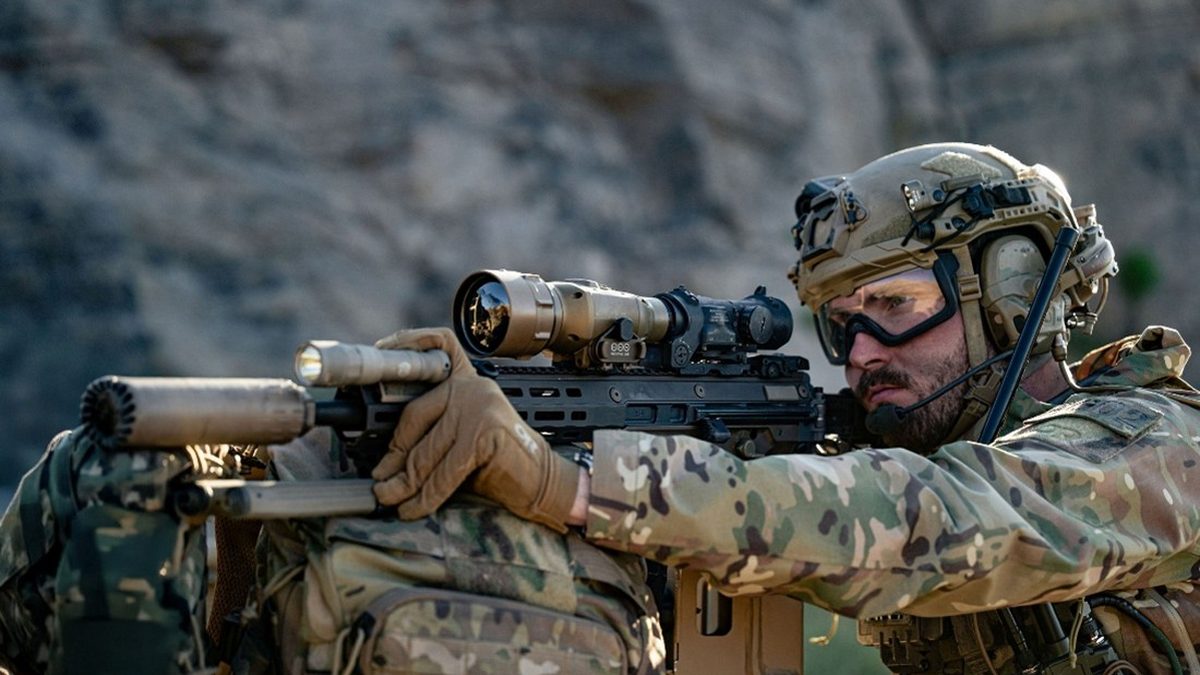
Photo: FN America press release, October 2025. The 6.5 x 43 mm LICC Individual Weapon System on test. Copyright FN America, LLC; reproduced for editorial reporting. Use does not imply endorsement.
The Missing STANAG: The Small Arms Test NATO Never Standardised
NATO has no published standard that assesses whether a candidate small arm wins defined tactical scenarios. Proof, interchangeability and quality are standardised through AEP-97, AOP-4172 and STANAG 4107; capability is not. ISC publishes a concept draft for the missing document, a vignette-based assessment STANAG called V-BAM, attached in full to this analysis.
Technical Summary
A vignette is a written tactical scenario: terrain, threat, force type, mission, engagement-range band and level of enemy protection. Vignette-based selection writes those scenarios down before candidates are solicited, then trials weapons with representative soldiers against mission outcomes inside them. NATO has no standard for that process. The Alliance standardises proof and inspection through AEP-97, ammunition interchangeability through AOP-4172 and its sister publications, quality assurance through STANAG 4107 and the Allied Quality Assurance Publications, and item-level evaluation through the D/14 handbook. Each lane answers a different question from the one the enemy asks.
This assessment closes ISC’s vignette-selection series by publishing the missing document itself: a concept draft for a NATO Standardization Agreement on Vignette-Based Assessment of dismounted combat weapon systems, V-BAM, attached in full below. The draft carries a two-page STANAG cover, a covering Allied Engineering Publication skeleton, an eight-vignette NATO core set with a mandatory four-climate environmental envelope, a catalogue of eight further vignettes harvested from current allied requirements, and a tender bridge that converts mission outcomes into award criteria European procurement law already accepts.
Tested against a Battlefield Mission in four climates, the modified SA80 A2 returned 99.40 percent reliability across 126,000 rounds. The unmodified A1, in the same trial design, returned 6 percent in Kuwait. UK parliamentary record, ISC assessment
| Assurance lane | NATO instrument | Status |
|---|---|---|
| Proof and inspection | AEP-97 under STANAG 4823 (Multi-Calibre Manual of Proof and Inspection) | Covered |
| Ammunition interchangeability | AOP-4172 under STANAG 4172 and sister calibre publications | Covered |
| Quality assurance | STANAG 4107 and the AQAP suite | Covered |
| Munitions safety | AC/326 publications, AASTP series, AAS3P-22 | Covered |
| Item-level evaluation | D/14 Handbook, AC/225(DSS)-D(2018)0006 | Covered |
| Tactical capability in defined scenarios | No NATO standard on the public record | Missing |
Attachment: the V-BAM concept draft
The full concept draft, STANAG cover plus covering publication skeleton, eight-vignette core set, environmental envelope, candidate catalogue and tender bridge, is published free alongside this article: Draft STANAG 4XXX / AEP-XXX, Vignette-Based Assessment Methodology (V-BAM), concept illustration. It is an ISC concept paper for analytical discussion, not an official NATO document; publication numbers are placeholders pending any NATO Standardization Office tasking.
Analysis of Effects
The gap is structural rather than careless. Award law prefers criteria that can be pre-published and mechanically scored, so tenders drift toward the compliance matrix; the UK government’s own guide to NATO procurement describes standard bids as evaluated only for technical compliance and price. Specification compliance also works as a legal shield, a point the G36 litigation settled in open court when the manufacturer prevailed while the ministry withdrew the rifle for failing military requirements. And capability has no institutional owner: NATO’s dismounted soldier community runs ammunition interchangeability and soldier capability analysis as separate working groups, so the question of whether a candidate wins its vignettes has no address. The live record shows the consequence. Project GRAYBURN, a 17-year commitment to replace the SA80 family, is framed at concept stage as seven checklist characteristics without a single mission, threat or range band.
The method itself is proven, and Britain proved it. The SA80 A2 acceptance campaign of 2001 fired a Battlefield Mission profile in four climates, Alaska, Brunei, Kuwait and Warminster, against a pre-published 90 percent reliability floor. The A2 returned 99.40 percent across 126,000 rounds and 840 missions; the unmodified A1, in the same trial design, returned 6 percent in Kuwait against a 55 percent all-climate average, which is why the draft mandates per-environment floors rather than fleet averages. Current allied requirements supply the growth path. The draft’s candidate catalogue converts the XM8 carbine decision, the Finland and Sweden Arctic rifle framework, the L403A1 suppressed raid configuration, the US Precision Grenadier System’s counter-defilade problem and the counter-drone ammunition wave into ready-made assessment scenarios, each recording the national requirement that evidences it.
Personnel and Safety Considerations
Nothing in a vignette standard trades away the safety lanes. Ammunition Safety and Suitability for Service assessment under AAS3P-22, proof and inspection under AEP-97 and the AC/326 safety publications remain absolute preconditions in the draft, and no vignette score can offset a safety non-compliance. The personnel case runs the other way: per-environment reliability floors exist because soldiers deploy to theatres rather than averages, and the difference between a 95 percent and a 6 percent hot-climate weapon, as the 2001 Kuwait serials showed, is measured in soldiers’ lives. Hazard classification of any candidate’s ammunition natures remains a national qualification matter outside this standard’s scope.
Data Gaps
Several boundaries are flagged rather than asserted. The current D/14 handbook, AC/225(DSS)-D(2018)0006, is not publicly searchable in full, so the claim that no NATO standard owns scenario-based capability assessment is made on the public record only. No NATO Standardization Office tasking for such a standard is publicly visible, and none is claimed. The reported STANAG 4884 interchangeability effort for the 6.5 x 43 mm cartridge rests on manufacturer statements alone. The drafting timeline in the concept paper is a planning assumption, and every publication number in it is a placeholder.
Key Questions
What is vignette-based selection of military small arms?
It is selection against written tactical scenarios rather than a specification list alone. A vignette defines terrain, threat, force type, mission, engagement-range band and protection level; candidate weapons are then trialled with representative soldiers against mission outcomes, such as first-hit probability under load, inside each scenario.
Does NATO have a standard for testing small arms tactical effectiveness?
Not on the public record. NATO standardises proof through AEP-97, ammunition interchangeability through AOP-4172, quality assurance through STANAG 4107 and item-level evaluation through the D/14 handbook of 2018, but no published Allied standard assesses whether a candidate weapon achieves mission outcomes in defined tactical scenarios.
What would a NATO vignette assessment standard contain?
The ISC concept draft pairs a short STANAG cover with a covering publication holding an eight-vignette core set, a mandatory four-climate environmental envelope with per-environment floors, a measures-of-effectiveness catalogue, statistical design minima, a procurement bridge compatible with Directive 2009/81/EC, and five-yearly through-life re-assessment.
References
Source-evaluated under NATO STANAG 2022 (Reliability A–F / Accuracy 1–6). Tier 1 = government primary source; Tier 2 = quality news / specialist defence media; Tier 3 = authoritative aggregator / encyclopaedia.
- T1UK Hansard – Written answers, SA80A1/SA80A2 (Battlefield Mission, four climates, reliability results), 22 July 2002. (Reliability A / Accuracy 1)
- T1Defence Equipment & Support – Project GRAYBURN pipeline notice 2026/S 000-002873, Find a Tender, 13 January 2026. (Reliability A / Accuracy 1)
- T1GOV.UK – Navigating NATO procurement (Lowest Compliant Bid and Best Value award mechanics), accessed August 2026. (Reliability A / Accuracy 1)
- T1House of Commons Defence Committee – SA80 A2 trial results, appendix to the Minutes of Evidence (Secretary of State letter, 12 November 2001). (Reliability A / Accuracy 2)
- T1NATO Standardization Office – STANREC 4785 Edition 2 (cites the D/14 Handbook, AC/225(DSS)-D(2018)0006), 30 August 2021, via public mirror. (Reliability A / Accuracy 2)
- T2FN America – FN delivers LICC weapon system test samples to IWTSD (imagery source; 6.5 x 43 mm LICC programme and STANAG 4884 effort), 8 October 2025. (Reliability B / Accuracy 2)
Corrections & updates welcome. If you hold open-source data that refines or corrects any parameter in this article, please contact [email protected] citing the specific claim and your source. Verified corrections will be incorporated and credited in the revision history. AI-assisted technical assessment based on open-source material. Not a formal intelligence product.