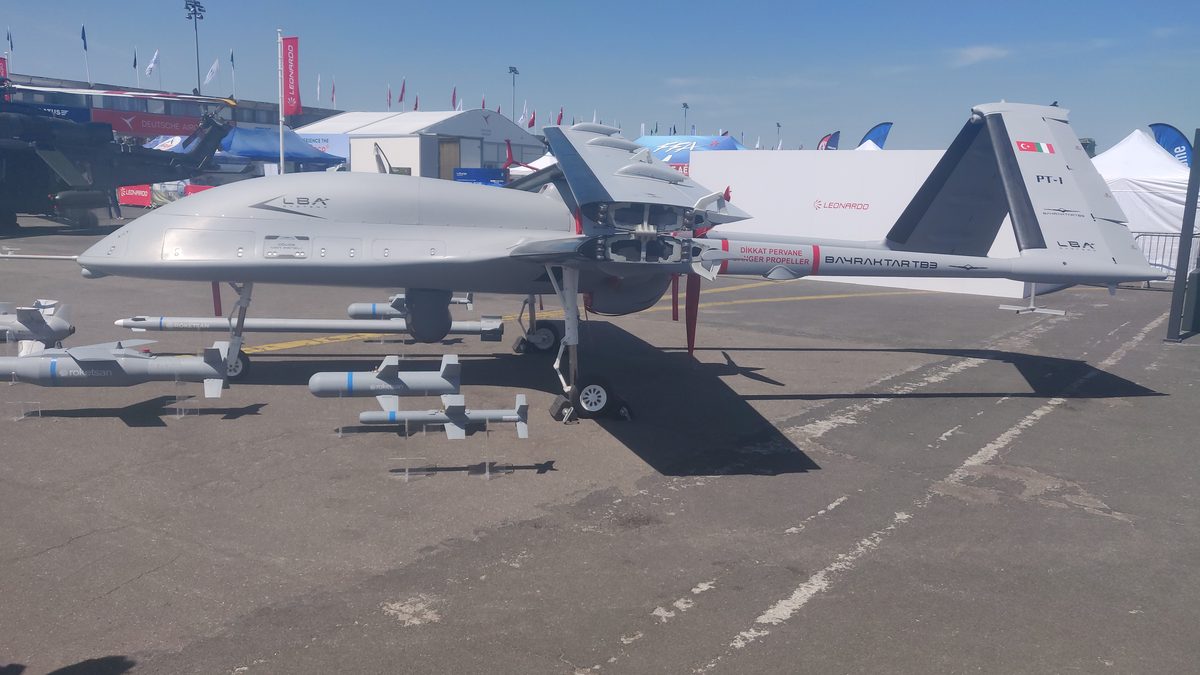
A Bayraktar TB3 with wings folded at the Paris Air Show 2025, the platform on which the Astore Levante is based. Photo: Tpe.g5.stan, CC0 1.0, via Wikimedia Commons.
Astore Levante: Baykar and Leonardo Take the Bayraktar TB3 into European Service
LBA Systems, the equal joint venture between Italy's Leonardo and Türkiye's Baykar, declared full operational readiness at the Farnborough International Airshow on 21 July 2026 and unveiled its first product, the Astore Levante. The aircraft is a European-built Bayraktar TB3 fitted with Leonardo sensors, mission systems and a ground control station, with the first Italian delivery due by the end of 2026.
Technical Summary
The Astore Levante is a re-badged and re-equipped Bayraktar TB3, a carrier-capable unmanned combat aerial vehicle (UCAV) developed by Baykar. LBA Systems retains the TB3 airframe and autonomy stack, then substitutes a Leonardo payload package. Leonardo has named the LEOSS-T electro-optical and infrared (EO/IR) turret, the BriteStorm expendable electronic-warfare system and an IFF428 identification-friend-or-foe unit for the type, with an Osprey 30 or Gabbiano T-80UL active electronically scanned array (AESA) radar and a SAGE electronic-support-measures (ESM) suite offered as options. Leonardo also supplies the ground control station (GCS) and leads European qualification and certification against the NATO military unmanned-aircraft airworthiness standard STANAG 4671, the gate that decides whether the type can enter service with a NATO air arm.
Baykar quotes a maximum take-off weight (MTOW) of 1,450 kg for the TB3 and a payload of up to 280 kg carried across six external hardpoints, with endurance in excess of 24 hours. The wing folds for shipborne operations. The TB3 completed its first take-off and landing aboard the Turkish landing helicopter dock TCG Anadolu on 19 November 2024, which is the capability Leonardo markets when it says the Astore Levante can work from short-runway carriers. Propulsion is a Turkish Engine Industries (TEI) turbo-diesel, either the PD-170 or the higher-rated PD-200 that Baykar has introduced for the naval airframe. A 14 m wingspan and roughly 8.4 m length place the type in the medium-altitude, long-endurance (MALE) bracket.
Astore Levante / Bayraktar TB3 baseline (open sources)
| Class | Medium-altitude, long-endurance UCAV; folding wing for shipborne use |
| Maximum take-off weight | 1,450 kg |
| Payload | Up to 280 kg across six hardpoints |
| Endurance | Greater than 24 hours |
| Wingspan / length | 14 m / approx. 8.4 m |
| Powerplant | TEI PD-170, or the higher-rated PD-200 on the naval airframe |
| Astore Levante sensors | Leonardo LEOSS-T EO/IR, BriteStorm EW, IFF428; optional Osprey 30 / Gabbiano T-80UL AESA radar; Leonardo GCS |
| Turkish munitions on TB3 | Test-fired: MAM-C/L/T, Cirit, KEMANKES-1. Listed options: L-UMTAS, Kuzgun |
| First carrier landing (TB3) | TCG Anadolu, 19 November 2024 |
A 280 kg payload across six hardpoints lets the TB3 airframe carry the full Baykar munitions family. The export question for the Astore Levante is therefore not whether it can strike, but whose guided weapons a European operator will be cleared to hang under it. ISC Defence Intelligence assessment
Leonardo ile Baykar'in ortak girisimi LBA Systems, Farnborough Airshow'da ASTORE LEVANTE adli yeni insansiz hava aracini tanitti. Bayraktar TB3'un Avrupa, NATO ve Italya pazarina gore ozellestirilen versiyonu, Leonardo'nun Ronchi dei Legionari tesisinde uretiliyor.
SavunmaTR (@SavunmaTR), 20 July 2026
Analysis of Effects
For weapons, ordnance, munitions and explosives (WOME) planners, the load-out is the point of interest. In Turkish service the TB3 has test-fired the MAM-C, MAM-L and MAM-T smart micro munitions, the Cirit 70 mm laser-guided rocket and the KEMANKES-1 loitering munition. The L-UMTAS long-range anti-tank missile and the Kuzgun modular air-to-ground family appear in Baykar's stated load-out as further options rather than demonstrated firings. The MAM-L is a roughly 22 kg-class glide weapon with selectable warheads, including high-explosive fragmentation, thermobaric and tandem shaped-charge variants for armour. The MAM-T adds wings and a satellite-and-inertial guidance package to push stand-off range into the tens of kilometres. None of these energetics figures should be read as precise: published net explosive quantity (NEQ) values for the MAM series are not authoritative, so warhead mass and fill are recorded below as data gaps.
The open question is what the Astore Levante actually carries in Italian and wider European service. Leonardo's own guided-weapons and effector portfolio, rather than the Turkish munitions family, is the more probable integration path for a NATO customer, both for supply-chain reasons and to avoid end-use friction. Roketsan has already shown it can make a Western bomb body smart on a Baykar platform, as seen with the TEBER-83 guidance kit on the Mk 83 for the Akinci, so the reverse substitution of a European seeker or weapon onto a Turkish airframe is technically routine. That choice matters for ammunition interoperability: a European TB3 firing European effectors draws on a different logistics, qualification and hazard-classification chain than a Turkish TB3 firing Roketsan stores. Until Leonardo names the weapons it will qualify, the strike fit is a design intention, not a delivered capability.
WOME scope note
This assessment covers the platform and its industrial arrangement. It does not certify any specific munition integration. Guided-weapon warhead masses, net explosive quantity (NEQ), hazard division (HD) and compatibility group (CG) for the Astore Levante fit are not in the public record and are treated as data gaps. Any munition qualified for the type carries its own hazard classification for storage and transport under the relevant national and NATO explosives-safety regime, for example the Allied Ammunition Storage and Transport Publication AASTP-1 Edition C for quantity-distance.
Personnel and Safety Considerations
For ammunition technicians and explosives-safety staff, the practical work sits downstream of the announcement. A European TB3 that reaches Italian squadrons will need arming and de-arming procedures, flight-line and magazine explosives-safety cases, and quantity-distance (QD) calculations tied to whichever guided weapons are finally certified. None of that is defined yet. Where the Turkish munitions family is retained, its hazard division and compatibility group have to be re-evidenced against Italian and NATO storage and transport rules rather than assumed from Turkish documentation. Where Leonardo effectors are substituted, existing Italian safety cases for those stores offer a shorter route to a licensable flight-line load-out.
Data Gaps
Several load-bearing details remain unconfirmed in open sources: the Italian order quantity beyond the reported two air vehicles with two options; which of the named Leonardo radar and mission-system options are actually fitted to the first Astore Levante airframes; the guided weapons Leonardo intends to qualify for European service; and the warhead mass, NEQ, hazard division and compatibility group for any munition in the fit. Each is flagged here rather than asserted.
Key Questions
What is the Astore Levante?
The Astore Levante is a European-built Bayraktar TB3 unmanned combat aerial vehicle. LBA Systems, the equal joint venture of Italy's Leonardo and Türkiye's Baykar, keeps the TB3 airframe and autonomy, then fits Leonardo sensors, mission systems and a ground control station. It was unveiled at the Farnborough International Airshow on 21 July 2026.
Who is buying the Astore Levante and when?
The launch customer is the Italian Air Force. Leonardo has begun building a first batch and expects to deliver to the Italian end-user by the end of 2026. Reporting points to an initial two air vehicles with options for two more, and Leonardo has signalled interest from the Italian Navy for the same carrier-capable configuration.
What weapons can the Astore Levante carry?
The Bayraktar TB3 airframe carries up to 280 kg across six hardpoints and has test-fired MAM-C, MAM-L and MAM-T smart munitions, the Cirit laser-guided rocket and the KEMANKES-1 loitering munition. Which guided weapons Leonardo will qualify for European service is not yet public, so the strike fit remains a design intention.
References
Source-evaluated under NATO STANAG 2022 (Reliability A–F / Accuracy 1–6). Tier 1 = primary source; Tier 2 = quality news / specialist defence media; Tier 3 = authoritative aggregator / reference.
- T1Leonardo S.p.A. – Leonardo and Baykar's LBA Systems JV achieves full operational readiness, 21 July 2026. Primary corporate source (Reliability B / Accuracy 2).
- T2FlightGlobal – Leonardo building first Astore Levante UAVs for Italian air force, 22 July 2026. (Reliability A / Accuracy 2).
- T2Army Recognition – Italian Leonardo Brings Bayraktar TB3 Drone to European Market with Astore Levante, July 2026. (Reliability B / Accuracy 2).
- T2Anadolu Agency (AA) via Turkish Minute – Baykar-Leonardo drone venture becomes operational, starts production, 22 July 2026. (Reliability B / Accuracy 2).
- T2Türkiye Today – Bayraktar TB3 debuts in Europe as Astore Levante at Farnborough, 22 July 2026. (Reliability C / Accuracy 3).
- T2TURDEF – LBA Systems Displays Bayraktar TB3 Astore Levante UCAV, July 2026. Named Leonardo payload set and TB3 munitions test history (Reliability B / Accuracy 2).
- T3GlobalMilitary.net – Bayraktar TB3 specifications reference, 2026. (Reliability C / Accuracy 3).
Corrections & updates welcome. If you hold open-source data that refines or corrects any parameter in this article, please contact [email protected] citing the specific claim and your source. Verified corrections will be incorporated and credited in the revision history. AI-assisted technical assessment based on open-source material. Not a formal intelligence product.