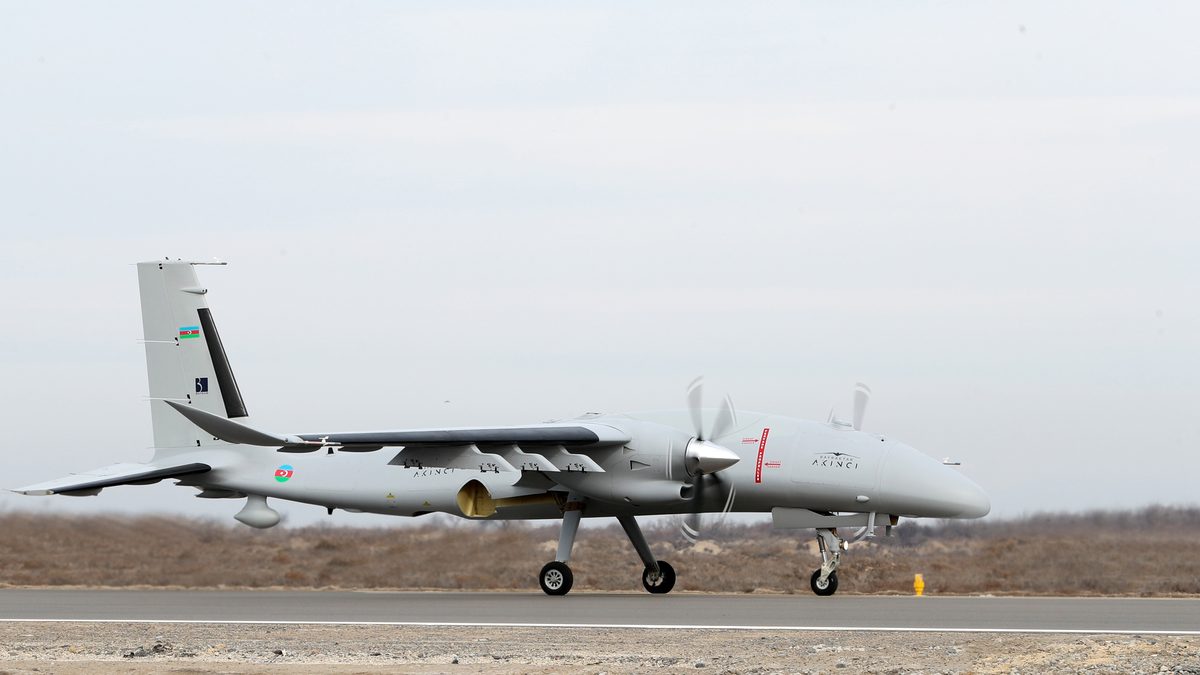
Bayraktar AKINCI (Azerbaijani Air Force). President.az / Roman Ismayilov, CC BY 4.0. Cropped for format. Illustrative platform image; not the TEBER-83 test round.
TEBER-83: ROKETSAN Makes the Mk 83 Smart on the Bayraktar AKINCI
Technical Summary
ROKETSAN's TEBER-83 is a strap-on guidance kit that converts the 1,000 lb-class Mk 83 general-purpose (GP) bomb into a precision-guided munition (PGM). It is the newest member of the TEBER family, which already fields the TEBER-81 for the 250 lb-class Mk 81 and three TEBER-82 configurations for the 500 lb-class Mk 82, including stubby-wing and deployable-wing variants. The kit replaces the bomb's tail and nose with a guidance section, a control-actuation section and aerodynamic surfaces, leaving the warhead body and explosive fill unchanged. Baykar announced the first firing test from the Bayraktar AKINCI uncrewed combat aerial vehicle (UCAV) on 8 May 2025, reporting a strike on a stationary target with minimal deviation.
Like the rest of the family, TEBER-83 uses dual-mode guidance: an inertial navigation system (INS) coupled to a global navigation satellite system (GNSS) receiver flies the bomb through midcourse, and a semi-active laser (SAL) seeker provides terminal homing against designated or moving targets. ROKETSAN quotes a circular error probable (CEP-50) of under three metres for the TEBER family when all guidance modes are combined, and four selectable guidance modes for use against fixed and opportunity targets. An adjustable proximity fuze with a 2 to 15 m burst-height setting is offered as an option for airburst effect. The most visible difference on the TEBER-83 is a set of body strakes, added to generate the extra lift the heavier Mk 83 airframe needs for stable, extended glide.
The bomb body does not change. The TEBER-83 changes how it arrives: an unguided ballistic drop becomes a glide weapon with a sub-three-metre aimpoint, released from a UCAV that need never overfly the target. ISC Defence Intelligence assessment
Baseline parameters (open sources)
| Guidance kit | ROKETSAN TEBER-83, dual-mode INS/GNSS midcourse plus semi-active laser (SAL) terminal seeker |
| Host store | Mk 83 general-purpose bomb, 1,000 lb nominal class; total mass ~447 to 470 kg, of which ~202 kg (445 lb) Tritonal high-explosive fill |
| Host store dimensions | ~3.0 m length, ~350 mm (14 in) body diameter |
| Accuracy (family figure) | CEP-50 under 3 m with INS/GNSS and laser combined |
| Guidance modes | Four selectable (INS/GNSS, laser, combined, opportunity) |
| Proximity fuze | Optional adjustable airburst, 2 to 15 m burst height (family feature) |
| Moving-target capability | Laser mode, slow-moving targets (family figure) |
| Standoff / glide range | Family band ~2 to 28 km, dependent on release altitude and speed; winged variants reach further |
| First AKINCI firing test | 8 May 2025, stationary target with minimal deviation |
| Integrated / planned platforms | F-16, Bayraktar AKINCI, Aksungur; planned ANKA-III, Kızılelma, KAAN |
Analysis of Effects
The military value of TEBER-83 is the pairing of a large warhead with precision delivery from an attritable, long-endurance platform. The Mk 83 carries roughly 202 kg of Tritonal high-explosive fill, several times the charge weight of the MAM-series glide munitions and the smaller TEBER-81/82 kits that the AKINCI has carried to date. That mass matters against the target set ROKETSAN and Baykar cite for the weapon: hardened structures, fortified command posts, bridge piers, hangars and surface vessels, where blast and fragmentation effects scale with net explosive quantity (NEQ). A 250 lb or 500 lb weapon may hit precisely yet under-deliver against a reinforced concrete or below-grade target that a 1,000 lb charge will defeat.
Range is the second effect, and the one the marketing language compresses into the word "extends." An unguided Mk 83 follows a ballistic arc, so the release point sits close to the target and the launch aircraft must fly into the threat envelope. A glide kit lets the same bomb be released at altitude and stood off, trading height and airspeed for horizontal range while the INS/GNSS solution holds the aimpoint. ROKETSAN has not published a confirmed TEBER-83 standoff figure. For the family, open sources quote roughly 2 to 28 km depending on release altitude and speed, with winged TEBER-82 variants reaching further; the strake-equipped TEBER-83 should sit within that band rather than beyond it until a winged version appears. Released from the AKINCI's service ceiling of around 40,000 ft, even the baseline glide keeps the UCAV outside many short-range air-defence engagement zones.
Personnel and Safety Considerations
For weapons, ordnance, munitions and explosives (WOME) personnel, the salient point is that TEBER-83 leaves the explosive train of the host bomb intact. The Mk 83 fill, its fuze well geometry and its hazard classification are governed by the bomb, not the kit; the guidance section adds its own electrical initiation, control actuators and, in some configurations, a thermal battery, each of which carries its own storage, handling and electromagnetic-environment considerations. Where the optional proximity fuze is fitted, its 2 to 15 m airburst function adds further arming and safe-separation requirements. The generic Mk 83 fill is Tritonal at about 202 kg, but whether the Turkish-produced bodies in this role retain a Tritonal-class fill or use an insensitive-munition (IM) compliant fill such as a polymer-bonded explosive (PBX) is not established in open sources, and should be confirmed against the national ammunition data before any hazard-division (HD) or compatibility-group (CG) assumption is carried forward. Build-standard and fuzing detail for the test rounds have not been released.
Data Gaps
The following parameters are not confirmed in open sources and are recorded as data gaps: TEBER-83 specific standoff range and glide profile (only family figures are public); the explosive fill variant of the Turkish-produced Mk 83 in this role, and therefore its precise HD and CG; the seeker laser pulse-repetition-frequency coding and designation arrangements used in the AKINCI test; the fuze type and arming logic of the test rounds; production status, unit cost and order quantity; and whether a winged TEBER-83 variant, mirroring the stubby-wing and deployable-wing TEBER-82 configurations, is in development.
References
Source-evaluated under NATO STANAG 2022 (Reliability A–F / Accuracy 1–6). Tier 1 = government primary source; Tier 2 = quality news / specialist defence media; Tier 3 = authoritative aggregator / encyclopaedia.
- T1ROKETSAN – TEBER Guidance Kit (product page), accessed June 2026. (Reliability A / Accuracy 2)
- T1TÜBİTAK-SAGE – HGK Precision Guidance Kit (HGK-83 reference), accessed June 2026. (Reliability A / Accuracy 2)
- T2Anadolu Agency – Türkiye's Akinci UCAV completes firing test with homegrown guidance kit, 8 May 2025. (Reliability B / Accuracy 1)
- T2TurDef – Akinci UCAV Drops ROKETSAN's New TEBER-83 Guided Bomb, 8 May 2025. (Reliability B / Accuracy 2)
- T2TurDef – ROKETSAN's proximity fuse is tested on Mk-82 and TEBER, 2025. (Reliability B / Accuracy 2)
- T2Daily Sabah – Türkiye's Akinci UCAV completes firing test with domestic guidance kit, 8 May 2025. (Reliability B / Accuracy 2)
- T3Wikipedia – Mark 83 bomb (warhead and dimensions) and Baykar Bayraktar Akinci (platform specifications), accessed June 2026. (Reliability C / Accuracy 3)
Corrections & updates welcome. If you hold open-source data that refines or corrects any parameter in this article, please contact [email protected] citing the specific claim and your source. Verified corrections will be incorporated and credited in the revision history. AI-assisted technical assessment based on open-source material. Not a formal intelligence product.