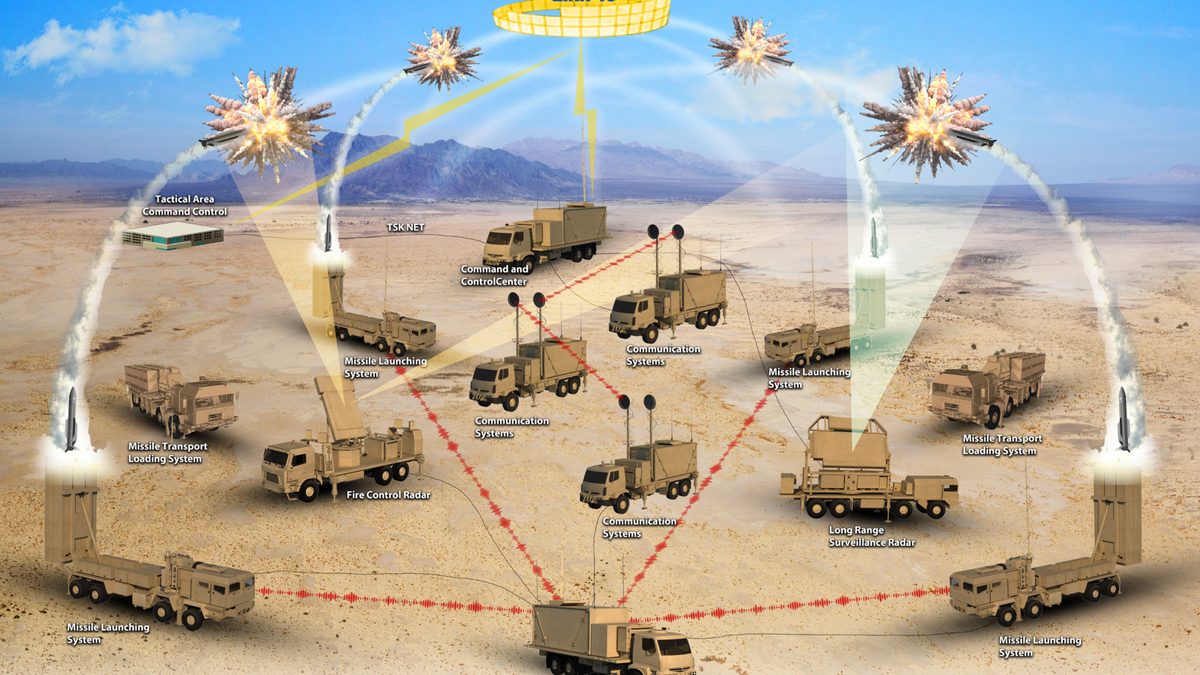
SİPER system architecture: distributed launchers, radars and command nodes under a Link-16 network. Image from the ASELSAN SİPER product datasheet (SST-SİPER/E001). © ASELSAN. Reproduced for editorial analysis; all rights remain with ASELSAN.
SİPER Enters Service as the Upper Layer of Türkiye’s Steel Dome Air Defence Shield
Technical Summary
SİPER, Turkish for Trench, is Türkiye’s indigenous long-range, high-to-medium-altitude surface-to-air missile (SAM) system and forms the upper layer of the Steel Dome (Çelik Kubbe) air and missile defence architecture. It was developed under the Presidency of Defence Industries (SSB) by a national partnership: ASELSAN for radars, command and control (C2) and seekers, ROKETSAN for the missiles and propulsion, and TÜBİTAK SAGE for the warheads. The Block-1 missile entered service in October 2024 after more than one hundred firings. The first ten-vehicle system was delivered to the Turkish Armed Forces on 27 August 2025, and battery-level operational acceptance was completed and the system formally inducted into the Steel Dome in early January 2026. Block-1 reaches beyond 100 kilometres and to more than 20 kilometres altitude against fighter aircraft, cruise missiles, air-to-surface munitions, helicopters and drones, known in service as uninhabited aerial vehicles (UAVs).
The programme was launched in 2018, originally linked to the Hisar-U concept. A first long-range firing beyond 100 kilometres took place in December 2022 at the Sinop test range on the Black Sea, final qualification followed on 13 May 2023, and the mass-production contract for SİPER and the wider Hisar family was signed on 15 December 2023 with a value reported above 1.5 billion US dollars and deliveries planned across 2025 to 2029. A follow-on package reported at 6.5 billion US dollars in late 2025 continues to expand the Steel Dome inventory. On export, Turkish sources reported a SİPER delivery to an undisclosed buyer in May 2026. Indonesia is separately linked to a Turkish air-defence package marketed locally as the Trisula-U, which sits within the wider Hisar and SİPER family alongside Czech sensor elements rather than a confirmed standalone SİPER Block-1 sale.
Missile Variants
| Variant | Range | Altitude | Propulsion | Terminal effect | Status |
|---|---|---|---|---|---|
| Block-1 | 100+ km | 20+ km | Two-stage solid (boost + dual-pulse) | HE fragmentation, proximity fuze | In service |
| Block-2 | 150+ km | 30+ km | Single-stage solid, higher thrust | HE fragmentation | Advanced testing |
| Block-3 | 180 to 200+ km | +30 km class | In development | In development | Development |
| SİPER-A | Terminal, ~40 km class | Atmospheric | Multi-stage + divert thrusters | AESA RF seeker, hit-to-kill | Announced |
| SİPER-4 | Exo-atmospheric, beyond 100 km | Above the Kármán line | Multi-stage + kill vehicle | IR seeker, hit-to-kill | Announced |
Block-1 baseline (open sources)
| Length | 5.4 m |
| Diameter | 370 mm |
| Range | More than 100 km |
| Altitude | More than 20 km |
| Propulsion | Two-stage solid: boost plus dual-pulse sustainer |
| Guidance | Satellite and inertial navigation (GPS/INS), two-way data link, active RF seeker |
| Warhead | High-explosive fragmentation with calculated-delay proximity fuze |
| Canister | 6450 x 850 x 800 mm (common to Block-2) |
| Coverage | 360 degrees; up to 100 simultaneous tracks (ASELSAN datasheet) |
| Search radar | Reported 500 to 600 km detection |
| Battery | About 14 vehicles; up to 20 missiles guided, about 10 targets engaged |
The Block-1 search radar is reported to detect targets at 500 to 600 kilometres, and a single standard battery of roughly fourteen vehicles can guide up to twenty missiles against about ten simultaneous targets across full 360 degree coverage. ISC Defence Intelligence assessment, open sources
The long-range and high-altitude power of STEELDOME, SİPER. (ÇELİKKUBBE’nin uzun menzil ve yüksek irtifadaki gücü SİPER.)
ASELSAN (@aselsan) 9 July 2026
Analysis of Effects
As an air-defence effector, the SİPER Block-1 kill chain rests on a blast-fragmentation warhead paired with a proximity fuze rather than on a direct-contact strike. The reported configuration is a high-explosive fragmentation warhead with a calculated-delay proximity fuze, so the round is designed to detonate within lethal radius of a manoeuvring aerial target and defeat it with a controlled fragment pattern, not to require a body-to-body impact. Propulsion is a two-stage solid rocket motor, a boost stage followed by a dual-pulse sustainer that holds energy in reserve for terminal manoeuvre beyond 100 kilometres. Block-2 is a clean-sheet design rather than a stretch: it moves to a larger 420 millimetre diameter single-stage motor of higher thrust, trading the two-stage arrangement for a higher-energy monoblock design that lifts reach past 150 kilometres and ceiling above 30 kilometres. Both blocks share a common canister, which keeps the logistics tail single even as the missile inside it changes. Battery-level acceptance firings at the Sinop range demonstrated detection, tracking and interception of a high-speed manoeuvring target while multiple friendly and adversary aircraft signatures were present, a test of the identification friend or foe (IFF) discrimination that a long-range layer needs in shared airspace.
The announced SİPER-A and SİPER-4 variants change the terminal mechanism entirely. Both move from blast-fragmentation to hit-to-kill, defeating a ballistic target by direct kinetic impact with a small or absent explosive charge and divert thrusters for end-game manoeuvre. SİPER-A is described as an atmospheric terminal interceptor with an active electronically scanned array (AESA) radio-frequency (RF) seeker, working to roughly the 40 kilometre class against short-range ballistic missiles (SRBMs) and some medium-range ballistic missiles (MRBMs), in the family of the US Patriot Advanced Capability 3 (PAC-3). SİPER-4 is an exo-atmospheric kill vehicle with multi-stage propulsion and an infrared (IR) seeker, reaching beyond the 100 kilometre Kármán line in the conceptual class of the US Terminal High Altitude Area Defense (THAAD) and the Standard Missile 3 (SM-3). For the weapons, ordnance, munitions and explosives community, the shift from an energetic warhead to a kinetic kill vehicle removes the fragment-lethality and proximity-fuzing problem, but replaces it with a far harder guidance and closing-velocity engineering challenge that only a handful of nations have solved.
Personnel and Safety Considerations
SİPER is a canisterised round that combines a solid rocket motor with, in the Block-1 case, a high-explosive fragmentation warhead, so its storage and transport classification is governed by both energetic elements together, not by the warhead alone. A complete long-range SAM of this type is normally handled at Hazard Division 1.1 (mass explosion hazard) unless national qualification testing supports a lower division, and the Net Explosive Quantity (NEQ) is set by the combined propellant and warhead fill rather than by either on its own. Türkiye has not published the United Nations hazard classification, the NEQ, or the compatibility group for the round, so the figures cited here are an analytical inference from the missile class and are flagged as such. The common 6450 by 850 by 800 millimetre canister gives logistical commonality across Block-1 and Block-2 and serves as the storage, transport and launch container, which simplifies the licensed-facility picture but concentrates the energetic content of each launcher. The hit-to-kill SİPER-A and SİPER-4 rounds carry little or no bursting charge, so their hazard profile is dominated by the rocket motor rather than by a warhead fill.
Data Gaps
Türkiye has not disclosed the United Nations hazard classification, Net Explosive Quantity or compatibility group for any SİPER round, so the storage and transport figures in this assessment are inferences from the missile class rather than confirmed values. The warhead mass, fragment count and lethal radius are not in open sources. Block-3, SİPER-A and SİPER-4 remain at development or concept maturity, and their range, altitude and seeker figures are announced intentions rather than demonstrated performance. Contract quantities of missiles and batteries are not itemised, the reported 6.5 billion US dollar late-2025 package is not fully broken down, and the identity of the May 2026 export customer is undisclosed. ISC assesses only open-source material and has seen no test data or the classified requirement.
Key Questions
What is the SİPER air defence system?
SİPER is Türkiye’s indigenous long-range, high-to-medium-altitude surface-to-air missile system, developed by ASELSAN, ROKETSAN and TÜBİTAK SAGE under the Presidency of Defence Industries. It forms the upper layer of the Steel Dome shield and engages aircraft, cruise missiles, air-to-surface munitions and drones out beyond 100 kilometres.
Is SİPER in service, and how far does it reach?
The SİPER Block-1 missile entered service in October 2024 and was formally inducted into the Steel Dome in early January 2026, after the first battery was delivered on 27 August 2025. Block-1 reaches beyond 100 kilometres and to about 20 kilometres altitude, while the Block-2 now in testing extends past 150 kilometres.
How do SİPER-A and SİPER-4 differ from Block-1?
SİPER-A and SİPER-4, announced on 7 May 2026, are ballistic-missile-defence variants that use hit-to-kill kinetic interception rather than a blast-fragmentation warhead. SİPER-A is an atmospheric terminal interceptor in the 40 kilometre class, and SİPER-4 is an exo-atmospheric kill vehicle reaching beyond the 100 kilometre Kármán line.
References
Source-evaluated under NATO STANAG 2022 (Reliability A–F / Accuracy 1–6). Tier 1 = government primary source; Tier 2 = quality news / specialist defence media; Tier 3 = authoritative aggregator / encyclopaedia.
- T1ASELSAN – SİPER Long Range Air and Missile Defense System (product datasheet, SST-SİPER/E001), 2021. (Reliability A / Accuracy 1)
- T1ROKETSAN – SİPER Long-Range Air and Missile Defense System (product catalogue), 2024. (Reliability A / Accuracy 1)
- T2Army Recognition – Türkiye integrates SİPER-1 long-range air defense system into Steel Dome network, January 2026. (Reliability B / Accuracy 2)
- T2TURDEF – SİPER-A and SİPER-4 as Counters to Ballistic Missile Threats, May 2026. (Reliability B / Accuracy 2)
- T2Türkiye Today – Türkiye’s SİPER Block-2 air defense missile system nearing deployment, 2025. (Reliability B / Accuracy 2)
- T3Wikipedia – SİPER, accessed 10 July 2026. (Reliability C / Accuracy 3)
- T1ASELSAN – REDET Radar Electronic Support (ES) / Electronic Attack (EA) Systems (datasheet), 2022. (Reliability A / Accuracy 1)
Corrections & updates welcome. If you hold open-source data that refines or corrects any parameter in this article, please contact [email protected] citing the specific claim and your source. Verified corrections will be incorporated and credited in the revision history. AI-assisted technical assessment based on open-source material. Not a formal intelligence product.