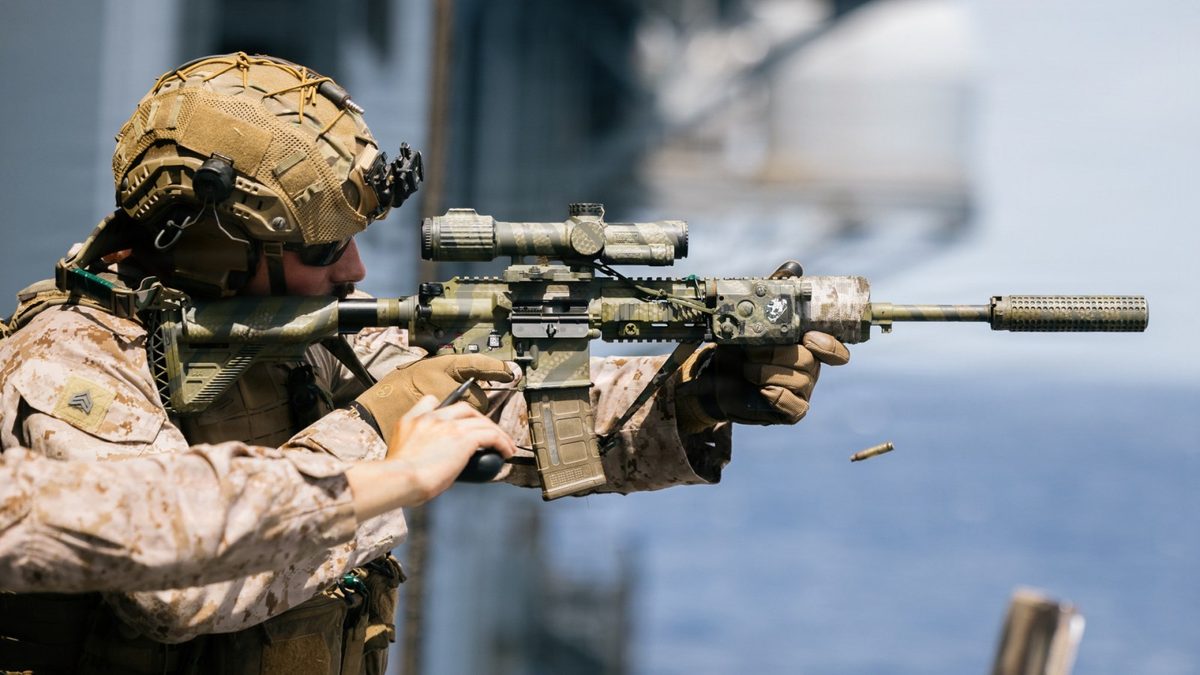
U.S. Marine Corps photo by Sergeant Joseph Helms (public domain): Marines training with the M27 Infantry Automatic Rifle. Sourced via The War Zone.
US Marine Corps moves to sole-source a fragmenting 5.56mm anti-drone cartridge from Drone Round LLC
Technical Summary
Marine Corps Systems Command (MARCORSYSCOM) posted a sole-source intent notice in early June 2026 to award an Indefinite Delivery, Indefinite Quantity (IDIQ) contract to Drone Round LLC of Gilbert, Arizona, for the 5.56x45 mm "L Variant" multi-projectile anti-drone cartridge. The award is estimated for December 2026. The notice identifies the round as the only kinetic munition currently meeting the United States Marine Corps (USMC) minimum capability requirement for immediate counter-small Unmanned Aircraft System (c-sUAS) defence at close range.
The L Variant departs from a conventional single-projectile ball nature. On firing, the projectile separates into five sub-projectiles that disperse as a shotgun-like cloud, raising hit probability against small, agile first-person-view (FPV) drones out to a stated effective range of about 100 metres. Its central advantage is logistical rather than ballistic: the cartridge is a drop-in nature for current-issue 5.56 mm weapons, including the M27 Infantry Automatic Rifle, M4 and M4A1 carbines, requiring no upper-receiver change, magazine change or platform modification. A related 7.62x51 mm pair, designated the K and L variants, is reported to be in testing.
One separating 5.56 mm projectile becomes a five-segment cloud at the muzzle, trading the single-point accuracy of ball ammunition for the area coverage a rifleman needs to hit a manoeuvring drone inside 100 metres. ISC technical assessment, 15 June 2026
Analysis of Effects
In Weapons Technical Intelligence (WTI) terms the L Variant is a frangible, segmenting small-calibre nature optimised for terminal area effect rather than penetration. Substituting a single four gram-class 5.56 mm projectile for five lighter sub-projectiles trades retained energy and effective range for a wider terminal pattern. That is a deliberate design choice for the close-in c-sUAS problem, where the target is a sub-two-kilogram airframe at tens of metres and a near miss with a single ball round achieves nothing. The approach mirrors the logic of shot ammunition while keeping the service rifle as the firing platform.
The interchangeability argument is the strategically significant part. Because the cartridge keeps the 5.56x45 mm NATO chamber and magazine interface, it sits inside the existing Standardization Agreement (STANAG) 4172 framework and the in-service ammunition supply chain. The USMC therefore gains a counter-drone capability without fielding a new weapon, a new calibre or a new logistics tail. That contrasts sharply with the wider Alliance debate over the United States Army move to 6.8x51 mm, where a new calibre fractures interchangeability. The L Variant is a reminder that meaningful capability can be delivered at the cartridge level alone.
Personnel and Safety Considerations
A multi-projectile nature changes the range-safety calculation. Five dispersing sub-projectiles widen the surface danger zone (SDZ) relative to a single ball round, even though each fragment carries less energy and shorter range, so live-fire ranges and training danger-area templates will need revision before the nature is issued. The cartridge is inert, with no explosive fill, so Net Explosive Quantity (NEQ) is not applicable; storage and transport hazard classification should follow the standard small-arms cartridge assignment, most plausibly Hazard Division (HD) 1.4, Compatibility Group S, though the formal classification for this specific nature is not published and is recorded here as a data gap.
Data Gaps
Key technical parameters remain unconfirmed in open sources: individual sub-projectile mass and construction, muzzle velocity, the dispersion pattern and pattern density at the stated 100 metre effective range, and the projectile separation mechanism. The confirmed Hazard Division and Compatibility Group, the quantity to be procured and the contract ceiling value are not stated. The full System for Award Management (SAM.gov) sole-source notice text, including any technical annexes, is not reproduced in open reporting.
References
Source-evaluated under NATO STANAG 2022 (Reliability A–F / Accuracy 1–6). Tier 1 = government primary source; Tier 2 = quality news / specialist defence media; Tier 3 = authoritative aggregator / encyclopaedia.
- T1Soldier Systems Daily – USMC Issues Sole Source Notice for 5.56mm Anti-Drone Rounds, 8 June 2026. (Reliability A / Accuracy 1)
- T2The War Zone – Anti-Drone 5.56mm Rifle Rounds That Break Into Multiple Projectiles Sought By Marines, 4 June 2026. (Reliability B / Accuracy 2)
- T2DefenseMagazine.com – The USMC Is Adapting Standard 5.56mm Weapons for Close-Range Drone Defense, June 2026. (Reliability B / Accuracy 2)
- T2Drone Round Defense (manufacturer of record) – Anti-Drone Ammunition: 5.56 and 7.62x51 product information, accessed 15 June 2026. (Reliability B / Accuracy 2)
- T3The Firearm Blog – [SHOT 2026] Drone Round Defense Multi-Projectile Anti-Drone Ammo, 2026. (Reliability C / Accuracy 3)
Corrections & updates welcome. If you hold open-source data that refines or corrects any parameter in this article, please contact [email protected] citing the specific claim and your source. Verified corrections will be incorporated and credited in the revision history. AI-assisted technical assessment based on open-source material. Not a formal intelligence product.