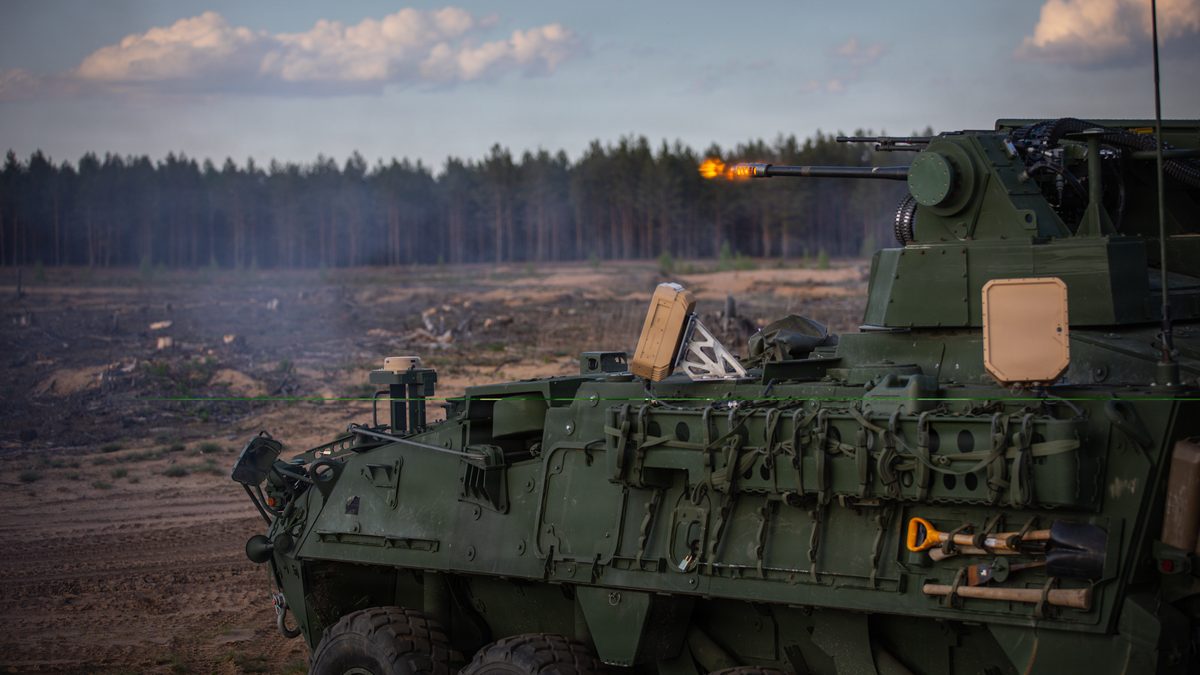
Illustrative: a US Army Maneuver Short-Range Air Defense system conducts counter-uncrewed aerial system live fire during Project Flytrap, Pabradë Training Area, Lithuania, 14 May 2026. US Army photo by Sgt. Max Elliott (DVIDS, public domain); use does not imply endorsement. Not an image of the RWS UDD product.
RWS Builds a Light 7.62mm Round to Engage Drones Over Cities
Technical Summary
RWS, exhibiting at Eurosatory 2026 within Beretta Defense Technologies, has launched its Urban Drone Defence (UDD) family, a kinetic counter-uncrewed aerial system (C-UAS) ammunition line in 7.62x51mm NATO calibre. The line is built around two natures. UDD Light fires a 1 gram projectile for engagements out to 100 metres in densely populated urban areas, and UDD Heavy fires a 3.7 gram projectile for targets out to 300 metres in suburban and rural settings. Both natures are offered with a tracer option. The concept has deep roots: RWS traces it to the Cold War era 7.62x51mm DM18 polymer training cartridge fielded with the Bundeswehr, a 0.7 gram plastic projectile launched at around 1,200 metres per second whose very low sectional density shed energy fast and cut the training danger zone to a few hundred metres. The UDD was shown publicly for the first time at Enforce Tac 2025 before its wider Eurosatory 2026 launch.
Both projectiles are polymer bodies fitted with a tombac semi-jacket, the high-copper brass alloy commonly used for small arms ammunition (SAA) jackets to control bore wear and obturation. RWS states the rounds carry an X-ray detectable projectile and use its patented SINTOX lead-free primer composition, and that the family complies with EU Registration, Evaluation, Authorisation and Restriction of Chemicals (REACH) requirements. RWS describes the natures as suitable for externally powered machine guns operating at high cyclic rates, which points to integration with remote weapon stations (RWS-type mounts) used in fixed-site and vehicle C-UAS roles.
A standard 7.62x51mm ball projectile weighs roughly 9.5 grams. By dropping projectile mass to 1 gram for the urban nature, RWS forces rapid velocity decay, which is the whole point: a round that loses energy fast shortens the hazard footprint behind a missed shot. ISC technical assessment
Analysis of Effects
The design logic is hazard management, not raw lethality. RWS quotes a muzzle velocity of up to 1,300 metres per second for the light nature, yet states the projectile shape is deliberately not optimised for retention so that velocity, and therefore residual energy, bleeds off fast. The contrast the company draws is stark. A conventional full metal jacket 7.62x51mm round can throw a surface danger area out to roughly 5,000 metres, whereas RWS puts the danger zone of the light counter-drone nature at around 500 metres and the heavier nature at up to 1,300 metres. That order-of-magnitude cut in the background footprint is the whole point when firing upward at small drones above streets and critical national infrastructure. A light polymer projectile sheds velocity quickly through aerodynamic drag, so the residual energy of a round that misses, or of fragments and the round on descent, falls away over a much shorter distance. The two-mass approach lets a user trade reach against background risk: the 1 gram nature for the tightest urban geometry, the 3.7 gram nature where 300 metre reach matters and the surroundings are more forgiving.
As energetic stores these are conventional small arms cartridges. The projectile carries no high-explosive fill, so terminal effect is purely kinetic, and the only energetics present are the propellant charge and the SINTOX primer in the cartridge case. Packaged SAA of this type is normally assigned to United Nations Hazard Division (HD) 1.4, Compatibility Group (CG) S, written 1.4S, with a low net explosive quantity (NEQ) per round driven by the propellant charge, although the precise HD and CG depend on the final packaging configuration and were not stated by RWS. The lead-free primer and REACH compliance also matter for the indoor and urban ranges where police and public-security users will train, where heavy-metal primer residue is a recognised occupational concern.
Personnel and Safety Considerations
Reduced background risk is not the same as non-lethal. A 7.62 calibre projectile, even at 1 gram, remains a lethal kinetic store at close range, and any C-UAS engagement over a populated area still demands a defined surface danger zone and a positive backstop assessment. The X-ray detectable projectile is a useful forensic and range-clearance feature, easing recovery and post-incident accounting of where rounds came to rest. Users should treat published maximum engagement ranges of 100 and 300 metres as effective engagement envelopes rather than maximum hazard ranges, which RWS did not publish.
Data Gaps
Several parameters needed for a full technical and safety appraisal remain unpublished: the ballistic coefficient and energy at range of each projectile; a formal surface danger area template, as distinct from the indicative danger-zone figures RWS has quoted; propellant type and charge mass, and therefore NEQ per round; the confirmed HD and CG for each packaging configuration; demonstrated terminal effect against representative drone airframes; and the specific weapon stations or mounts qualified for the externally powered, high cyclic rate use case. RWS has stated a muzzle velocity for the light nature and indicative danger zones for both natures, but full ballistic and energy-on-target data are not in the open record. Performance figures here are derived from the open-source launch material and standard small arms ballistics, and are not independently verified.
References
Source-evaluated under NATO STANAG 2022 (Reliability A–F / Accuracy 1–6). Tier 1 = government primary source; Tier 2 = quality news / specialist defence media; Tier 3 = authoritative aggregator / encyclopaedia.
- T1Shephard Media – Eurosatory 2026: RWS launches urban counter-drone ammunition range, 14 June 2026. (Reliability A / Accuracy 1)
- T2all4shooters – Anti-drone ammunition: 7.62x51 NATO UDD cartridge from RWS, 22 November 2025 (quoting Dr Florian Pfaff, RWS Director of Product Management & R&D). (Reliability B / Accuracy 2)
- T2EUR-Lex (European Union) – Regulation (EC) No 1907/2006 (REACH), consolidated text, consolidated 2014. (Reliability B / Accuracy 2)
- T2UNECE – UN Recommendations on the Transport of Dangerous Goods (Model Regulations), accessed 15 June 2026. (Reliability B / Accuracy 2)
- T2Army Recognition – Eurosatory 2026 daily news coverage, June 2026. (Reliability B / Accuracy 2)
- T3Wikipedia – 7.62x51mm NATO, accessed 15 June 2026. (Reliability C / Accuracy 3)
Corrections & updates welcome. If you hold open-source data that refines or corrects any parameter in this article, please contact [email protected] citing the specific claim and your source. Verified corrections will be incorporated and credited in the revision history. AI-assisted technical assessment based on open-source material. Not a formal intelligence product.