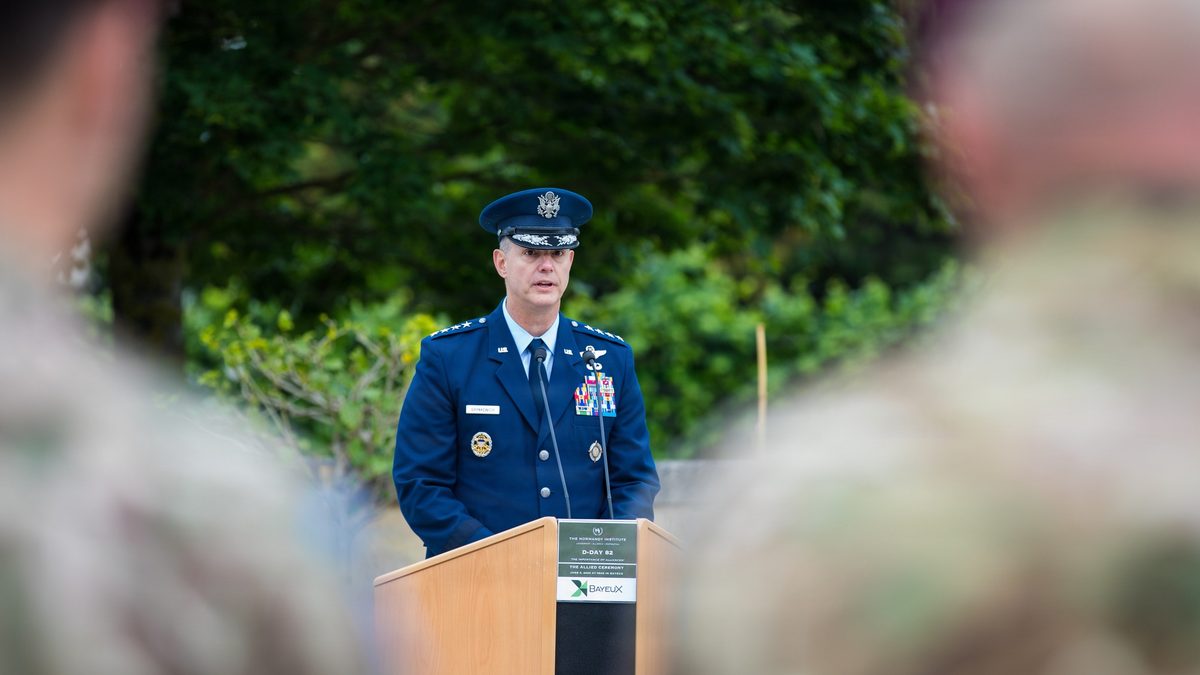
U.S. Air Force Gen. Alexus G. Grynkewich, Commander of U.S. European Command, at the D-Day 82nd-anniversary Allied ceremony, Bayeux, 3 June 2026. U.S. Army photo by Sgt. 1st Class Brenden Delgado / DVIDS (public domain, VIRIN 260604-A-NF551-3575).
SACEUR Says Russia Is Not Seeking Conflict With NATO. Several European Capitals Disagree.
What the commander actually said
Speaking at the ILA Berlin Air Show on 11 June 2026, NATO's Supreme Allied Commander Europe, US Air Force General Alexus G. Grynkewich, gave an assessment that cut against the loudest strand of European political rhetoric. Russia, he said, is not currently seeking a fight with the alliance. He grounded the judgement in intelligence he watches daily, not in hope.
Grynkewich took the role in July 2025, succeeding General Christopher Cavoli, and he holds the EUCOM command in parallel. His remarks paired a calm reading of Russian intent with a firm statement of deterrent intent of his own. An attack on the Baltic states, he argued, would fail, and Moscow knows it would fail, which is precisely why it has not tried. If the need arose, he added, all 32 allies are ready to respond tonight.
Russia is not looking for a conflict. They understand that we are a defensive alliance, and they know we have a range of asymmetric advantages that are difficult for them to compete with. We will continue to stay one step ahead. Gen. Alexus G. Grynkewich, SACEUR, ILA Berlin, 11 June 2026
The posture shift behind the reassurance
The timing matters more than the soundbite. Grynkewich spoke days after the United States confirmed it is thinning the forces it commits to European defence in order to weight the Indo-Pacific and the contest with China. Reporting around the announcement points to a plan that cuts the F-16 and F-15E fighters available to NATO in Europe from roughly 150 to 100, reduces maritime patrol aircraft from 26 to 15, withdraws all eight European-assigned air-to-air refuelling tankers, and reassigns a cruise-missile submarine, a carrier with supporting warships and one of the two bomber groups previously earmarked for the continent.
Allied chiefs met at Mons on 2 and 3 June 2026 to map the gaps. Grynkewich's public message to Europe and Canada was blunt: fill them, and fill them with capability that can be bought, fielded, scaled and sustained quickly. He singled out long-range fires and uncrewed systems. The candour is the story. A commander reassuring the public about Russian intent, while asking allies to backfill American airframes and hulls at speed, is describing a posture in transition rather than a settled balance.
The counter-clock: Berlin's 2029 warning
Against this sits a sharper European framing. In mid-June 2026 the Inspector of the German Army, Lieutenant General Christian Freuding, warned that Russia could hold the capability to threaten or invade a NATO member by 2029, possibly sooner. He was careful to present this as alliance consensus rather than national alarm. In his words, 2029 is not a German timeline; it is NATO-agreed intelligence, and all 32 partners accept the assessment. Defence Minister Boris Pistorius has used aligned language to justify a Bundeswehr shift toward a high-readiness force.
The two statements are less contradictory than they first appear, because they answer different questions. One reads present intent. The other reads future capability. A military commander assessing what Moscow wants to do this year can sit comfortably beside a force planner assessing what Moscow might be able to do by the end of the decade. The friction is not in the intelligence so much as in how each judgement is packaged for public consumption.
| Dimension | SACEUR framing (Grynkewich) | Berlin framing (Freuding / Pistorius) |
|---|---|---|
| Question answered | Current Russian intent toward NATO | Future Russian capability against NATO |
| Time horizon | Now, near term | By 2029, possibly earlier |
| Core message | Deterrence holds; Russia avoids a losing fight | Rearm now to deny a future option |
| Policy pull | Steady deterrent posture, allied backfill | Accelerated spending and readiness |
| Shared ground | Credible deterrence is the variable that keeps intent low. Both depend on it. | |
Reading the divergence
The French-language commentary that surfaced this contrast used it to ask three pointed questions. Each deserves a straight answer rather than a reflexive one.
Has the threat been exaggerated for political purposes? There is an observable gap in emphasis, not a gap in facts. A near-term invasion frame and a current-intent frame can both be honest while pulling public opinion in different directions. High-threat language is useful to those who must defend rising budgets, deeper EU defence integration and sustained support for Ukraine through real economic cost. Acknowledging that incentive is not the same as alleging fabrication. The capability concerns that drive the 2029 figure are real, and so is the political utility of repeating them.
Are some European elites maintaining a climate of fear to accelerate integration? This is a legitimate debate rather than a settled charge. Threat narratives have plainly helped justify PESCO, common procurement and the wider strategic-autonomy push. They have also helped hold a coalition together through a long war. Incentives run in several directions at once: political cohesion, an industrial base hungry for orders, and transatlantic signalling all reward a louder threat. None of that makes the eastern flank wrong. Estonian, Latvian, Lithuanian and Polish concern is rooted in geography and lived history, not in a Brussels memo.
Do European publics share their leaders' appetite for confrontation? Here the realist critique lands its cleanest blow. The danger it identifies is not a Russian column crossing a border tomorrow. It is Europe locking itself into open-ended confrontation, paying disproportionate energy, industrial and fiscal costs, while the United States reorients toward Asia. A sober threat assessment, and room for diplomacy, are not concessions to Moscow. They are the difference between deterrence and drift.
Where the caution is warranted
A realist reading is not a benign one. Grynkewich's own words contain the caveat: deterrence is what keeps intent low, and deterrence is a wasting asset if the backfill of American capability stalls. Russia's conduct in Ukraine shows revisionist aims and a tolerance for force that the alliance cannot wish away. The risks that survive his assessment are hybrid pressure, reconstitution of Russian land forces once the Ukraine commitment eases, miscalculation, and the temptation to test Article 5 if NATO ever looks divided or hollow.
Those risks are not abstract. A 10 June 2026 investigation by Danish broadcaster DR, with Norway's NRK, Sweden's SVT and Estonia's Delfi, used satellite imagery to map new barracks, depots and military towns near the borders of Finland, Norway and the Baltic states. Analysts cited in the work judge the sites could eventually host up to 115,000 troops in the northwest, with the Petsamo base near Norway growing from about 7,000 to 17,000 and forces facing Finland rising from roughly 20,000 to as many as 80,000. The investigation's own conclusion reinforces the distinction this article draws: while Russia is pinned in Ukraine the near-term threat stays limited, but the infrastructure is being laid now for rapid reconstitution once the fighting ends. Stockholm has voiced a more cautionary line than Mons on Russian intent. The eastern flank reads the same Russia through a shorter fuse, and it has earned the right to.
References
Source-evaluated under NATO STANAG 2022 (Reliability A–F / Accuracy 1–6). Tier 1 = government primary source; Tier 2 = quality news / specialist defence media; Tier 3 = authoritative aggregator / encyclopaedia. This is an open-source, AI-assisted assessment, not a formal intelligence product.
- T1U.S. Senate Committee on Armed Services – SASC hearing on U.S. European Command and U.S. Transportation Command posture for FY 2027, March 2026. (Reliability A / Accuracy 2)
- T2Associated Press via The Washington Times – NATO weighs options to defend Europe as the U.S. plans for conflict elsewhere, 12 June 2026. (Reliability B / Accuracy 2)
- T2The Philadelphia Inquirer – U.S. plan said to pull a third of the fighter jets it provides NATO for Europe, 12 June 2026. (Reliability B / Accuracy 2)
- T2Kyiv Independent – ‘It’s NATO-agreed intelligence’ — German army chief warns Russia will be prepared to attack NATO by 2029, June 2026. (Reliability B / Accuracy 2)
- T2Politico via Caliber.Az – German army chief warns Russia could attack NATO by 2029, June 2026. (Reliability B / Accuracy 2)
- T2Euronews – US withdraws long-range military capabilities from NATO, 12 June 2026 (drawdown figures: fighters 150 to 100, maritime patrol 26 to 15, tankers). (Reliability B / Accuracy 2)
- T2The War Zone (TWZ) – Russia building new infrastructure for major troop deployments along NATO's northern flank, June 2026. (Reliability B / Accuracy 2)
- T2Meduza – Joint investigation maps Russia's military buildup along its NATO border (DR / NRK / SVT / Delfi), 10 June 2026. (Reliability B / Accuracy 2)
- T3Wikipedia – Alexus Grynkewich, accessed 14 June 2026 (biographical and command background). (Reliability C / Accuracy 3)
Corrections & updates welcome. If you hold open-source data that refines or corrects any claim in this article, please contact [email protected] citing the specific claim and your source. Verified corrections will be incorporated and credited in the revision history. AI-assisted strategic assessment based on open-source material. Not a formal intelligence product.