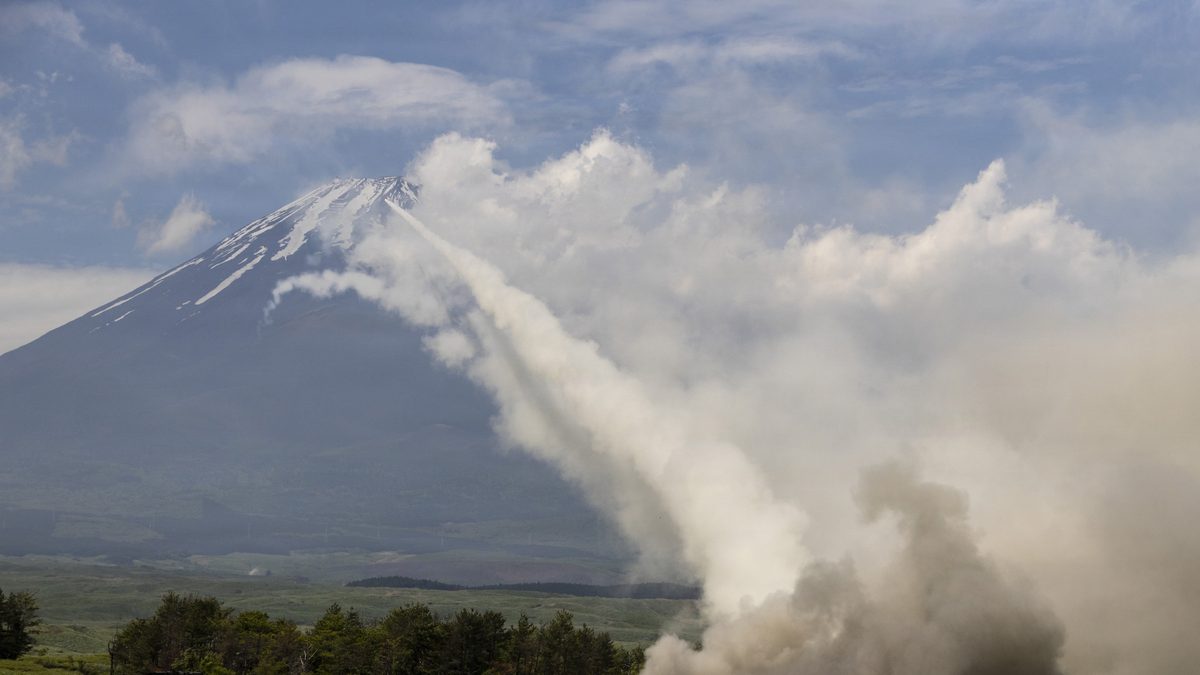
U.S. Marines fire an M142 HIMARS during 3rd Battalion, 12th Marines live-fire training near Mount Fuji, 20 May 2026. U.S. Marine Corps photo by Lance Cpl. Skilah Sanchez (DVIDS, public domain). Illustrative of the MFOM launcher family, not the DSFT rocket itself.
General Dynamics Static-Tests a 4.75-inch Rocket Motor for the US Army Direct Support Fires Programme
Technical Summary
General Dynamics Ordnance and Tactical Systems (GD-OTS) announced on 12 June 2026 the successful static (ground) testing of 4.75-inch solid rocket motor prototypes developed for the United States Army Direct Support Fires Technology (DSFT) programme. The work supports the US Army Combat Capabilities Development Command (DEVCOM) Aviation and Missile Center (AvMC) rapid-prototyping initiative. GD-OTS also built and delivered a 30-round DSFT launch pod prototype, designed by DEVCOM AvMC, in support of the Army Concept Focused Warfighting Experiment held in March 2026.
The 4.75-inch calibre equates to roughly 120 mm, an intermediate diameter sitting between the 70 mm (2.75 inch) Hydra-70 family and the 227 mm Guided Multiple Launch Rocket System (GMLRS). DSFT is intended to demonstrate a low-cost artillery rocket compatible with existing launchers and producible at scale, the stated aim being to mass fires and increase magazine depth. GD-OTS says it stood up production capability at Lincoln, Nebraska and Camden, Arkansas within 15 months and delivered motor prototypes to DEVCOM AvMC and several industry partners during that period.
If the 30-round Direct Support Fires pod shares the form factor of a standard launch pod container, which holds six GMLRS rockets, the packing density points to a fivefold increase in rounds per pod, trading individual rocket reach for sheer volume of fires. ISC open-source assessment, 14 June 2026
Analysis of Effects
A 4.75-inch solid rocket motor in this role would most plausibly use a composite solid propellant, for example a hydroxyl-terminated polybutadiene (HTPB) binder with an ammonium perchlorate oxidiser and aluminium fuel, cast into a case sized for low unit cost and volume production. Static testing characterises the motor internal ballistics, namely chamber pressure, the thrust-time profile and burn duration, against analytical predictions before any flight test. GD-OTS has not published the motor total impulse, burn time, propellant formulation, achievable range, or whether the round is unguided, course-corrected or precision-guided; these are recorded below as data gaps. The programme language of low cost, mass fires and magazine depth points to a quantity-over-precision design point, distinct from the precision-guided GMLRS.
DSFT reflects a clear post-2022 lesson: large-scale conventional war consumes rockets and tube artillery faster than precision-only inventories can sustain. A cheap, mass-producible 4.75-inch rocket compatible with fielded launchers offers commanders depth of fires without every round carrying the cost of a precision-guidance kit. The 15-month stand-up of production at two sites is itself the significant claim, evidencing the Army emphasis on rapid industrialisation as much as on the munition. The round is sized for the existing MLRS Family of Munitions (MFOM) launch pod, so it can fire from the M270 Multiple Launch Rocket System and M142 High Mobility Artillery Rocket System already in service rather than from a bespoke launcher. General Dynamics is also not the only contender for the calibre, since the US Army has run a parallel 4.75-inch motor effort with Anduril Industries, a deliberately multi-vendor approach to widen the industrial base. GD-OTS states the systems are scheduled to feature in a Massed Fires Demonstration in September 2026.
Personnel and Safety Considerations
As a solid-propellant motor in development, the principal WOME considerations are the energetic hazards of the propellant grain during testing, transport and storage. Composite propellants are typically assigned to Hazard Division 1.3 (fire hazard with minor blast or fragment effect) when packaged without a warhead, though a complete all-up round with a warhead and fuze fitted would be reclassified accordingly. The announcement does not state Hazard Division, Compatibility Group, net explosive quantity (NEQ) or warhead configuration, so all are data gaps. Static-test stands apply standard quantity-distance (QD) controls keyed to the motor NEQ; the absence of published energetic data prevents any independent quantity-distance assessment here.
Data Gaps
Open sources do not yet establish: the propellant formulation and motor total impulse; burn time and thrust-time profile; the rocket effective range and guidance mode; warhead type, NEQ and fuzing; the firing rate and reload cycle of the 30-round pod; unit cost and planned production rate; and the contract vehicle and value. GD-OTS reports a successful static test, but detailed performance results have not been independently published.
References
Source-evaluated under NATO STANAG 2022 (Reliability A–F / Accuracy 1–6). Tier 1 = government primary source; Tier 2 = quality news / specialist defence media; Tier 3 = authoritative aggregator / encyclopaedia.
- T1General Dynamics Ordnance and Tactical Systems – GD-OTS Press Releases and News (corporate newsroom), June 2026. (Reliability A / Accuracy 2)
- T2Defence Industry Europe (Martin Chomsky) – General Dynamics tests 4.75-inch rocket motor prototypes for U.S. Army Direct Support Fires Technology program, 12 June 2026. (Reliability B / Accuracy 2)
- T1US Army Combat Capabilities Development Command (DEVCOM) – DEVCOM Aviation and Missile Center: programme owner, Direct Support Fires Technology, 2026. (Reliability A / Accuracy 3)
- T3GD-OTS Missiles and Rockets – Hydra-70 (2.75-inch) Rocket Systems: calibre lineage reference, 2026. (Reliability B / Accuracy 3)
- T3Encyclopaedic reference – M270 MLRS launch pod container (six GMLRS rockets): comparison baseline, 2026. (Reliability C / Accuracy 3)
- T2The War Zone (TWZ) – Smaller Rockets To Provide Key Artillery Firepower Boost Sought By Army (MFOM launcher compatibility), 2026. (Reliability B / Accuracy 2)
- T1Anduril Industries newsroom – Developing the Future of Precision Fires and Affordable Mass: Anduril’s 4.75-inch Rocket Motor for the U.S. Army, 2026. (Reliability B / Accuracy 2)
Corrections & updates welcome. If you hold open-source data that refines or corrects any parameter in this article, please contact [email protected] citing the specific claim and your source. Verified corrections will be incorporated and credited in the revision history. AI-assisted technical assessment based on open-source material. Not a formal intelligence product.