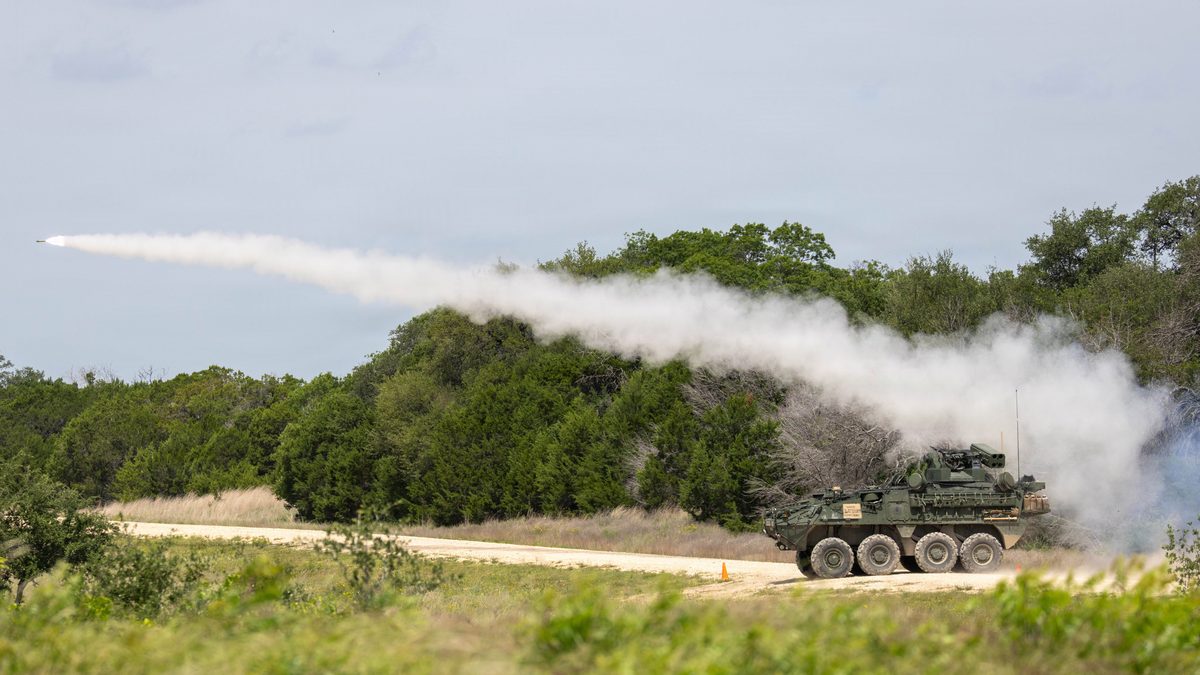
A U.S. Army Stryker air-defence vehicle launches an FIM-92 Stinger during 6-56 Air Defense Artillery Regiment live-fire training, 5 May 2026. U.S. Army photo by Spc. Patrick Connery (DVIDS, public domain). Illustrative; the Brazilian package is man-portable.
Brazil Cleared for 100 FIM-92K Stinger Block I Missiles in $330 Million US Foreign Military Sale
Technical Summary
On 11 June 2026 the United States Department of State approved a possible Foreign Military Sale (FMS) to Brazil for 100 FIM-92K Stinger Block I missiles and associated equipment, at an estimated total value of 330 million US dollars. The Defense Security Cooperation Agency (DSCA) notified the US Congress the same day. Beyond the 100 missiles, the package covers gripstocks (the reusable shoulder-fired launch unit), integration support, and US Government and contractor engineering, technical and logistics support. RTX Corporation and Lockheed Martin are named as the principal contractors. The State Department states the sale will not alter the basic military balance in the region.
The FIM-92 Stinger is a man-portable air-defence system (MANPADS): a shoulder-launched, passive infrared and ultraviolet homing surface-to-air missile in the very short range air defence (VSHORAD) class. The all-up round is a 70 mm (2.75 inch) diameter missile roughly 1.5 m long and weighing about 10 kg, fired from a disposable launch tube clipped to the reusable gripstock. The typical engagement envelope reaches a slant range near 4,800 m and altitudes up to roughly 3,500 m, with a terminal velocity around Mach 2.2. The specific FIM-92K guidance-section and fuzing configuration is not given in the notification and is recorded below as a data gap.
One hundred missiles for 330 million dollars places the package near 3.3 million dollars per round including all support and gripstocks, a figure that reflects a constrained, recently restarted production line rather than the missile unit cost alone. ISC open-source assessment, 14 June 2026
Analysis of Effects
The Stinger engages low-altitude, fast-moving aerial targets: fixed and rotary-wing aircraft and, increasingly, uncrewed aerial systems (UAS). The Block I standard introduced a two-colour (infrared and ultraviolet) rosette-scan seeker and a ring-laser-gyro reference unit, improving discrimination against flares and background clutter compared with earlier single-colour reticle seekers. The K suffix marks a datalink-equipped derivative. Open sources describe the FIM-92K as adapted for launch-platform integration, able to take target cueing over a datalink and engage in lock-on-after-launch mode from an external sensor track rather than relying on the seeker's own acquisition alone. The warhead is an annular blast fragmentation type of roughly 3 kg with an impact fuze and a self-destruct timer. The missile leaves the tube on a small ejection motor before the dual-thrust flight motor ignites at a safe distance from the firer, a soft-launch feature that allows engagement from confined positions. For Brazil the stated drivers are territorial air defence and counter-narcotics interdiction of low-flying aircraft, rather than a conventional state air threat. Brazil already fields a mixed very short range air-defence inventory, including the Swedish Saab RBS 70, in service since 2014, and the Russian 9K338 Igla-S. The Stinger buy therefore adds a Western infrared-homing layer and US interoperability rather than a wholly new capability.
The sale draws on a Stinger production line that RTX only recently restarted after years of dormancy. Original Stinger production wound down in the 2000s, and the surge demand created by Ukraine after 2022 exposed how thin the remaining industrial base had become, particularly for obsolete seeker components. RTX has been re-establishing that supply chain under US Army modernisation contracts, so 100 missiles for an export customer compete directly with US and allied replenishment for finite early-line output. The notification carries the standard DSCA assurance that the sale will not adversely affect US defence readiness, but it does not quantify a delivery schedule.
Personnel and Safety Considerations
A complete Stinger round combines a solid-propellant rocket motor and an explosive warhead in a single sealed launch tube. For storage and transport the all-up round is commonly assigned to Hazard Division 1.2 (fire and non-mass explosion hazard) or, depending on configuration, Hazard Division 1.1, within a Compatibility Group appropriate to guided missiles. The notification does not state the transport classification, so the exact Hazard Division and Compatibility Group are a data gap. Routine WOME considerations for MANPADS stockpiles centre on physical security and accounting, since MANPADS are a recognised proliferation concern, alongside thermal and shock control of the rocket motor and seeker electronics, and Battery Coolant Unit (BCU) shelf-life management, which governs how long a gripstock stays ready to fire.
Data Gaps
Key parameters absent from the open-source record include: the FIM-92K seeker software standard and whether a proximity fuze is fitted for the counter-UAS role; warhead net explosive quantity (NEQ) and exact fill composition; the assigned Hazard Division and Compatibility Group for the delivered configuration; the number of gripstocks, training rounds and Battery Coolant Units in the package; the delivery schedule and first-delivery year; and whether the buy is drawn from new production or existing US stocks. ISC has not independently verified per-round pricing, which is derived here by dividing the stated package value by the missile count.
References
Source-evaluated under NATO STANAG 2022 (Reliability A–F / Accuracy 1–6). Tier 1 = government primary source; Tier 2 = quality news / specialist defence media; Tier 3 = authoritative aggregator / encyclopaedia.
- T1US Department of State, Bureau of Political-Military Affairs – Brazil – FIM-92K Stinger Missiles, 11 June 2026. (Reliability A / Accuracy 1)
- T1Defense Security Cooperation Agency (DSCA) – Major Arms Sales: FIM-92K Stinger Block I Missiles, June 2026. (Reliability A / Accuracy 1)
- T2Army Technology – US clears potential $330m FIM-92K Stinger missiles sale to Brazil, June 2026. (Reliability B / Accuracy 2)
- T2Defence Industry Europe – US State Department approves possible $330 million Brazilian purchase of FIM-92K Stinger Block I missiles, June 2026. (Reliability B / Accuracy 2)
- T3Army Recognition – US FIM-92K Stinger Missile Sale Gives Brazil New Shield Against Low-Altitude Air Threats, June 2026. (Reliability C / Accuracy 3)
- T3A. Parsch, Directory of U.S. Military Rockets and Missiles – Raytheon/General Dynamics FIM-92 Stinger (FIM-92K datalink and lock-on-after-launch derivative), 2026. (Reliability B / Accuracy 3)
- T1Saab – Saab signs contract for RBS 70 with Brazilian Army, 2014. (Reliability A / Accuracy 2)
Corrections & updates welcome. If you hold open-source data that refines or corrects any parameter in this article, please contact [email protected] citing the specific claim and your source. Verified corrections will be incorporated and credited in the revision history. AI-assisted technical assessment based on open-source material. Not a formal intelligence product.