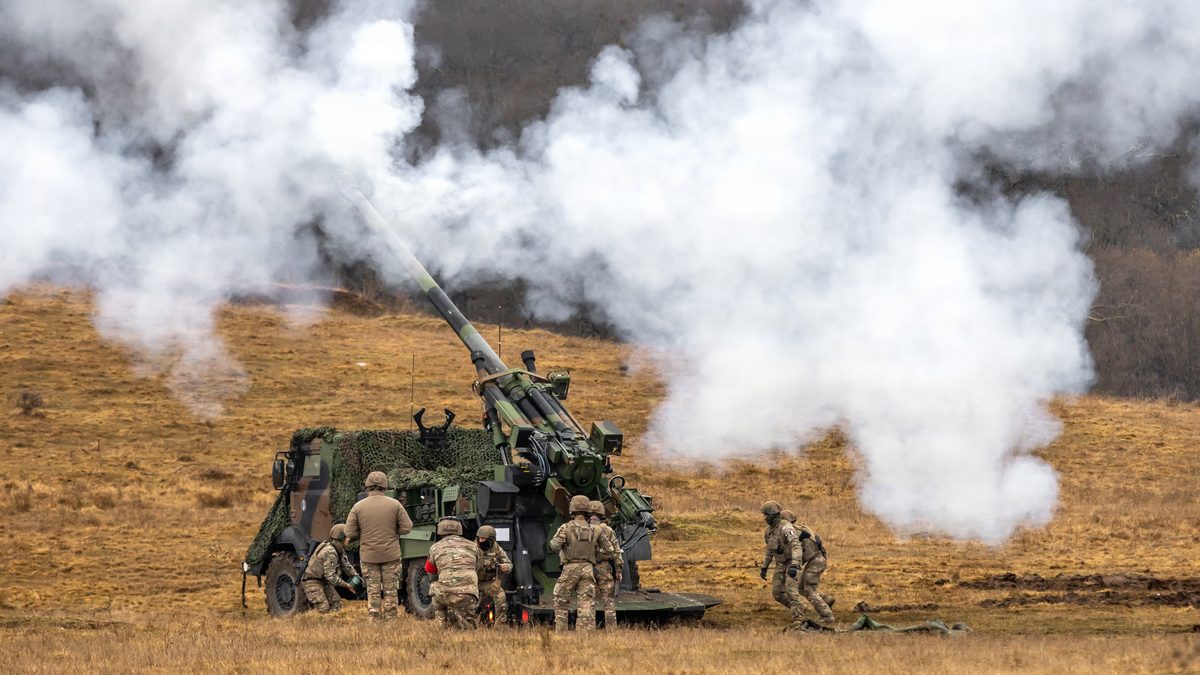
A French CAESAR 155mm self-propelled howitzer conducts a live fire during NATO exercise Dynamic Front 26, Cincu, Romania, February 2026. U.S. Army photo by Capt. Regina Koesters (public domain).
JAQ and the 155mm Question: Is the EU Duplicating a System NATO Already Has?
Technical Summary
On 30 March 2026 the European Defence Agency (EDA) announced it would coordinate the Joint Ammunition Qualification (JAQ) programme, a €50 million pilot funded by the European Commission under the European Defence Industry Programme (EDIP). JAQ starts with 155 mm artillery ammunition, the calibre Member States flagged as their replenishment priority, and its stated aim is mutual recognition: a round qualified in one participating state should not have to be fully re-qualified in another. Twenty-seven EU Member States are listed as participants on EDA’s announcement; Norway, which joined earlier EDA ammunition-procurement work, is a plausible associate but is not named among the JAQ participants in open sources. The headline figure is reported in the EDIP work programme as €33 million in 2026 and €17 million in 2027.
That objective is reasonable on its face. European armed forces fire shells across a fleet of howitzers (PzH 2000, CAESAR, Krab, M109, Archer and others) and the war in Ukraine exposed how slow and expensive duplicate national testing can be. The harder question, and the one a Weapons, Ordnance, Munitions and Explosives (WOME) reader should ask first, is this: NATO has standardised 155 mm ammunition for decades. So what exactly is JAQ buying that the Alliance does not already provide, and is the EU about to fund a parallel bureaucracy on top of one that already works?
NATO can already tell you a French shell will chamber and fire in a German gun. What it cannot do is force Berlin to accept Paris’s national safety certificate. That gap, not the shell, is what €50 million is buying. ISC assessment
How JAQ is meant to work
JAQ is a pilot, and EDA acts as the implementing entity under a Contribution Agreement with the European Commission. The work runs in three broad strands. The first is mapping: cataloguing the national qualification procedures, 155 mm artillery systems and ammunition types in use across the participating states. The second is joint testing of representative 155 mm components, the projectile, fuze, propellant charge and primer, spanning live firing, environmental work (climate chambers, vibration and drop testing), chemical analysis, and validation of range, pressure, fragmentation, fuze function and platform compatibility. The third is a programme of regular secure workshops, targeted at around six a year and including firing events, where national authorities compare procedures and align on common approaches.
This is not EDA’s first move into shared testing. The Agency has spent two decades on Test and Evaluation work, maintaining the EDSTAR standards database and linking European test centres to cut duplication, and JAQ applies that model to ammunition. It also sits on top of the EU’s crisis-response stack: the Act in Support of Ammunition Production (ASAP) for manufacturing capacity, and the European Defence Industry Reinforcement through Common Procurement Act (EDIRPA) and EDA’s Collaborative Procurement of Ammunition for joint buying. JAQ adds the layer those tools left open, the qualification and certification step, which is where the comparison with NATO becomes sharp.
What NATO already provides (the duplication case)
The case that JAQ duplicates existing effort is not weak, and it rests on a stack of mature instruments. NATO standardisation of 155 mm ammunition is among the most developed in the Alliance:
- STANAG 4425 sets the procedure for determining the degree of interchangeability of NATO indirect-fire ammunition, with the technical detail carried in Allied Ordnance Publication AOP-29. This is the document that defines the standard 155 mm projectile and the 23-litre chamber the system is built around.
- The Joint Ballistics Memorandum of Understanding (JBMoU), signed in 2009 by the United States, France, Germany, Italy and the United Kingdom, exists expressly to maximise interchangeability of the participants’ 155 mm weapon and ammunition systems. It is the reason modern 52-calibre ordnance is designed to a common ballistic baseline.
- STANAG 4107 and the Allied Quality Assurance Publications it mandates, in particular AQAP-2070, already provide a NATO Mutual Government Quality Assurance (GQA) process. AQAP-2070 lets one nation’s quality authority perform assurance on a defence product on behalf of another. Mutual recognition of quality work, in other words, is not a new idea the EU has just invented.
- Governance is already owned and resourced: NATO’s AC/326 (munitions safety) and AC/327 (life-cycle management, which owns STANAG 4107 and the AQAP suite) are standing bodies with two decades of published output.
Read together, the critique writes itself. The Alliance has a standard for the shell, a treaty for its ballistics, a mechanism for one nation to accept another’s quality assurance, and committees to run all of it. A €50 million EU programme that sets up its own workshops, its own consortia and its own future "European Ammunition Qualification and Certification System" looks, from this angle, like a second institution being stood up beside one that already exists, with the inevitable overhead of new meetings, new contracts and new staff.
Where the NATO system actually stops (the EU’s defence)
The evenhanded answer is that the NATO instruments above standardise different things from what JAQ targets, and the gap between them is real. Two distinctions matter.
First, interchangeability is not qualification. STANAG 4425, AOP-29 and the JBMoU establish that components from different nations are physically and ballistically compatible: a shell will chamber, the breech will close, the round will fly. They do not certify that a given lot of ammunition is safe and accurate on a given platform. As commentators on NATO’s ammunition-interoperability problem have noted, a NATO-standard shell still has to be qualified on each gun to confirm performance and safety. That gun-by-gun, nation-by-nation qualification is exactly the duplicated cost JAQ is trying to attack.
Second, AQAP-2070 mutual GQA covers quality assurance, not ammunition performance qualification, and its acceptance is voluntary and bilateral rather than automatic. A national safety authority retains ultimate legal responsibility for what it releases into service, and currently rebuilds much of the qualification evidence itself rather than accepting a partner’s certificate wholesale. NATO never closed that loop because it standardises the product and the QA process, not the sovereign certification decision.
The narrow gap JAQ aims at
NATO answers "will this shell work in that gun, and is the supplier’s quality system sound?" JAQ aims at a different question: "can a qualification certificate issued by one state’s safety authority be trusted enough that another state skips its own re-test?" That is a certification-recognition problem, not a standardisation problem, and it is one the existing STANAGs were never written to solve.
NATO instrument versus the JAQ gap
| Instrument | What it already does | What it does not do |
|---|---|---|
| STANAG 4425 / AOP-29 | Defines 155 mm interchangeability and the standard projectile/chamber | Does not qualify a lot as safe and accurate on a specific platform |
| JBMoU (2009) | Common ballistic baseline across five major producers | Five signatories only; not a certification-recognition regime |
| STANAG 4107 / AQAP-2070 | Mutual Government Quality Assurance between nations | Covers QA process, not performance qualification; voluntary, bilateral |
| AC/326, AC/327 | Own munitions safety and QA standardisation | Do not compel mutual acceptance of national qualification certificates |
| EDA JAQ (2026) | Targets mutual recognition of national qualification testing | Pilot only; no certificates issued yet; EU, not Alliance-wide |
So is JAQ duplication? A measured verdict
Partly yes, and partly no, and the honest position holds both at once. The duplication risk is genuine: JAQ creates EU-badged workshops, consortia and a future certification system in a domain where NATO already runs the standards and the QA mechanism, and it does so inside a separate institutional lane (the EU and EDA) from the Alliance bodies that have historically owned this work. If JAQ ends up rebuilding STANAG-equivalent technical baselines under a new label, it will have spent public money to re-state what AOP-29 already says. There is also a membership mismatch worth flagging: JAQ is open to EU Member States, while the deepest 155 mm standardisation tool, the JBMoU, includes the United States and the United Kingdom, who sit outside the EU programme. A European framework that diverges from, rather than builds on, the JBMoU baseline would actively reduce interoperability with two of the largest Western producers.
The legitimate-gap case is equally real: NATO standardisation stops at interchangeability and QA, and never delivered automatic cross-border acceptance of national qualification certificates. That is a sovereignty problem more than a technical one, and the EU has a lever NATO lacks, namely a single legal and budgetary framework (EDIP, sitting within a €1.5 billion 2025 to 2027 envelope) through which it can fund joint testing and, in time, bind members to mutual recognition. Whether €50 million and a pilot can actually move national safety authorities off self-qualification is the open question. The duplication charge will be answered not by the press release but by whether JAQ explicitly anchors itself to STANAG 4425, AOP-29 and AQAP-2070 rather than reinventing them.
Data Gaps
Several points are not yet established in open sources as of June 2026, and readers should treat them as gaps rather than settled facts: the precise annual budget split across 2026 and 2027; whether JAQ outputs will be formally referenced back to the relevant STANAGs and AOP-29 or developed as standalone EU documents; how a JAQ qualification certificate would interact legally with each national safety authority’s residual responsibility; what coordination, if any, exists between EDA and NATO’s AC/326 and AC/327 to prevent divergent baselines; and whether non-EU JBMoU signatories (the United States and United Kingdom) will have any associated status. EDA has named 27 participating Member States but has not published a detailed work breakdown.
References
Source-evaluated under NATO STANAG 2022 (Reliability A–F / Accuracy 1–6). Tier 1 = government / primary source; Tier 2 = quality news / specialist defence media; Tier 3 = authoritative aggregator / encyclopaedia. The NATO-instrument references (4 to 8) are listed to substantiate that an existing 155 mm standardisation and mutual-QA system already operates.
- T1European Defence Agency – EDA to coordinate ammunition qualification tests, 30 March 2026. (Reliability A / Accuracy 1)
- T1European Commission, Defence Industry and Space – EDIP: forging Europe’s defence, accessed June 2026. (Reliability A / Accuracy 1)
- T1Council of the EU – European Defence Industry Programme: Council gives final approval, 8 December 2025. (Reliability A / Accuracy 1)
- T1NATO Standardization Office – STANAG 4425: Procedure to Determine the Degree of Interchangeability of NATO Indirect Fire Ammunition (with AOP-29), record accessed June 2026. (Reliability A / Accuracy 1)
- T1US Department of State, Treaties and Other International Acts Series – Joint Ballistics Memorandum of Understanding (155 mm interchangeability), 2009. (Reliability A / Accuracy 1)
- T1NATO – STANAG 4107: Mutual Acceptance of Government Quality Assurance and Usage of the AQAPs, record accessed June 2026. (Reliability A / Accuracy 1)
- T1NATO – AQAP-2070: NATO Mutual Government Quality Assurance (GQA) Process (PDF), accessed June 2026. (Reliability A / Accuracy 1)
- T2Modern War Institute, West Point – Guns and Ammo: The Ukraine War and NATO’s Ammunition Interoperability Problem, accessed June 2026. (Reliability B / Accuracy 2)
- T2Defence Industry Europe – European Defence Agency to coordinate €50 million programme to harmonise 155 mm ammunition testing, March 2026. (Reliability B / Accuracy 2)
- T2European Security & Defence – New Artillery Agreement Formalised (JBMoU background), April 2021. (Reliability B / Accuracy 2)
Corrections & updates welcome. If you hold open-source data that refines or corrects any parameter in this article, please contact [email protected] citing the specific claim and your source. Verified corrections will be incorporated and credited in the revision history. AI-assisted technical assessment based on open-source material. Not a formal intelligence product.