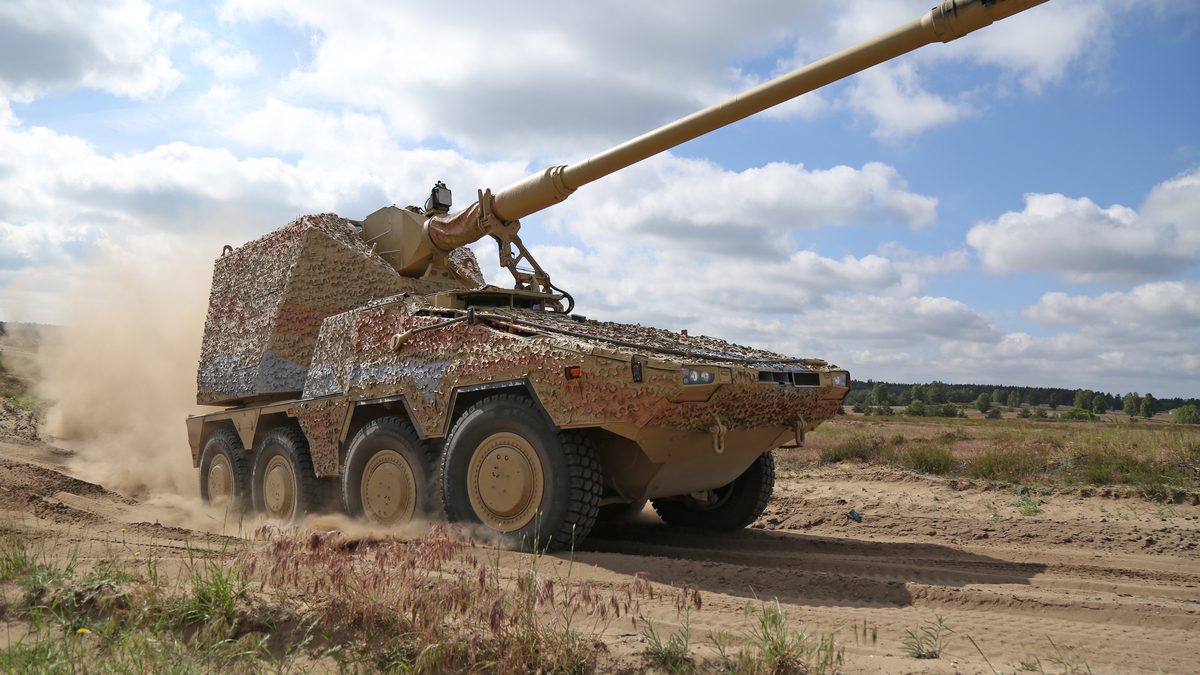
RCH 155: the Boxer-mounted 155mm self-propelled howitzer the UK has ordered to replace its donated AS90 fleet. Image: Rheinmetall / KNDS.
DIP on the Brink: The WOME Programmes Waiting on the Money
Technical Summary
The United Kingdom defence crisis moved from political dispute into institutional alarm this week. Defence Secretary John Healey resigned on 11 June 2026, telling the Prime Minister that the draft Defence Investment Plan (DIP) “falls well short of what is required for defence and the country at this dangerous time”. Armed Forces Minister Al Carns resigned hours later, calling the plan “neither transformative enough nor sufficiently funded”. The Chief of the Defence Staff (CDS), Air Chief Marshal Sir Richard Knighton, took the unusual step of writing directly to the Prime Minister about the proposed settlement. Sky News reports that the letter followed an offer of around £13bn in additional defence funding that the military judges insufficient, and that hopes for a major DIP announcement this week have collapsed back into continuing negotiations between the MoD, the Treasury and Number 10. The letter is secret, and reports that the CDS left open the possibility of resignation if the final figure proved “indefensible” should be treated with caution, but the direction of travel is no longer in doubt. The story is now on the front pages, which usually means the gap was too big to keep buried.
For the weapons, ordnance, munitions and explosives (WOME) community this is not a Westminster story. It is a stockpile story. A defence budget is, in the end, a schedule of munitions natures, propellant tonnages, interceptor counts and energetic-fill lines that either get funded or do not. The DIP is the document that converts the 2025 Strategic Defence Review (SDR) from ambition into ordered quantities. Until it is signed, the central WOME commitments of the SDR, from the “always on” munitions pipeline to the seven thousand long-range weapons, sit as policy intent rather than placed contracts. Every week of delay is a readiness decision taken by default.
Soldiers, ships, aircraft and missiles cannot be generated by future percentage targets alone. When a defence budget can no longer carry the threat assessment, the crisis stops being fiscal and becomes strategic. ISC assessment, 12 June 2026
The Money: What Is Actually In Dispute
The UK’s planned core defence spending for 2025/26 is approximately £62.2bn, around 2.3 per cent of GDP. The Ministry of Defence (MoD) assesses that it needs roughly an additional £28bn over the next four years to meet forecast costs and move towards the “warfighting readiness” the SDR demands. The Treasury is reported to have opened at around £12bn, with the Chancellor later offering close to £13bn; the Prime Minister was said to be pushing for nearer £18bn. Healey’s resignation letter set its own marker, stating that current plans implied just under 2.7 per cent of GDP by 2030 and that he would not accept a DIP that failed to reach 3 per cent by that date.
The gap between those figures is the whole argument, and its WOME consequences are linear. As one published reading of the options put it, a settlement near £12bn means cuts; near £18bn means deferrals and delays; near £15bn means a mixture of both, with the force still not in good shape by 2030. For munitions, “deferral” is not a neutral word. A deferred energetics factory is a propellant line that does not exist when a future order is placed. A stretched buy is a stockpile that refills more slowly than it would be expended. Open-source assessments already judge that UK stocks would sustain only weeks of high-intensity combat, below SDR aspiration.
The NATO Maths: What the DIP Should Be Against UK GDP
The argument inside Whitehall is conducted in cumulative four-year uplift figures, which conveniently obscure the scale of the commitment the UK has already signed. The cleaner test is the NATO target measured against UK GDP. At the Hague summit in June 2025 every ally except Spain signed up to spend 5 per cent of GDP on defence and security by 2035, split into at least 3.5 per cent of GDP on core defence and up to 1.5 per cent on defence-related resilience, with a progress review in 2029. The UK signed that pledge. The Prime Minister went further at the time, stating the UK expected to reach 4.1 per cent on defence and security by 2027.
UK nominal GDP for 2025 was £3,037bn (ONS), so each single percentage point of GDP is worth roughly £30.4bn a year. The table applies the NATO benchmarks to that figure. These are illustrative at 2025 GDP; because GDP grows over the decade, the cash sum required in 2035 will be larger still.
| Benchmark (share of GDP) | Annual spend at 2025 GDP | What it represents |
|---|---|---|
| 2.0% | £60.7bn | The old NATO floor, now superseded |
| ~2.3% (core MoD, 2025/26) | £62.2bn (actual) | The current core defence budget |
| 2.6% (UK target by 2027) | £79.0bn | The near-term commitment |
| 3.0% | £91.1bn | The longer-term ambition Healey set as his red line for 2030 |
| 3.5% (NATO core target, 2035) | £106.3bn | The mandatory core-defence share the UK has signed |
| 4.1% (PM’s 2027 claim) | £124.5bn | Defence and security combined, as stated at The Hague |
| 5.0% (NATO full target, 2035) | £151.8bn | Core defence plus 1.5% defence-related |
The numbers expose the gap the front-page argument is really about. Reaching the NATO core target of 3.5 per cent at today’s GDP would mean roughly £106bn a year, around £44bn above the current £62.2bn core budget. Even measured against the more generous NATO-defined share of about 2.6 per cent, the climb to 3.5 per cent is close to £27bn of additional annual spending. Set that beside the live dispute: the MoD says it needs about £28bn over four years simply to meet forecast costs, and the Treasury has offered nearer £13bn over the same period. Those are cumulative multi-year figures worth a few billion a year of new money. The UK is fighting resignations over an uplift that does not, on its own, even reach the NATO core target it has already promised allies it will hit.

The calculation in one line
| 1% of UK GDP (2025) | ≈ £30.4bn / year (GDP £3,037bn, ONS) |
| NATO core target 3.5% | ≈ £106.3bn / year |
| Current core defence budget | £62.2bn / year (~2.3%) |
| Annual gap to 3.5% core | ≈ £44bn / year at 2025 GDP |
| MoD ask vs Treasury offer | +£28bn vs ~£13bn, both over four years |
The WOME Programmes Awaiting the DIP
The following programmes are the WOME-relevant elements of the SDR whose funding profile, order quantities or delivery schedule depend on the DIP settlement. Maturity reflects how firmly each is committed today, not its eventual importance. “Funded” means money is on contract; “designed” means announced with a defined shape but no firm delivery plan; “concept” means stated SDR intent awaiting the implementation detail the DIP is meant to provide.
| Programme / WOME line | What the DIP must settle | Status |
|---|---|---|
| Munitions investment (£6bn this Parliament) | Confirm and protect the SDR pledge of about £6bn for munitions, including £1.5bn for an “always on” production pipeline | Announced |
| Six new energetics & munitions factories | Capital profile and siting for at least six UK plants making propellants, explosives and pyrotechnics; the energetic-fill bottleneck | Announced |
| Up to 7,000 long-range weapons | The delivery plan still missing one year after the SDR: funding, build rate, in-service dates across missiles and guided munitions | SDR intent |
| GMLRS & Extended-Range GMLRS | Sustain the circa £800m, ten-year guided-rocket replenishment; M31 GMLRS first deliveries due Q2 2026, ER-GMLRS from 2028 | On contract |
| 155mm artillery ammunition | Stockpile-depth funding behind the BAE Systems 155mm shell orders and the “always on” 155mm line | On contract |
| RCH 155 self-propelled howitzers (72) | Hold the circa £1bn Rheinmetall-KNDS buy (first deliveries 2028) replacing the AS90 fleet donated to Ukraine; restores the towed-to-SP fires gap | On contract |
| Ground-based air defence & interceptors | Expansion of a thin UK air-defence network: interceptor stockpiles and counter-drone effectors | SDR intent |
| Anglo-German deep precision strike missile | The new jointly developed long-range missile flagged in the SDR; development funding and UK order share | Announced |
| Attritable / one-way effect munitions (Project ASGARD) | The “lots of cheap munitions” half of the Army’s tenfold lethality goal: loitering and drone-launched guided weapons | SDR intent |
| Complex air-launched weapons | More weapon types and longer reach on Typhoon and F-35B; deep-magazine buys of stand-off natures | Announced |
| Nuclear deterrent energetics (Dreadnought, warhead) | Ring-fenced funding for the circa £41bn Dreadnought programme and the sovereign warhead effort; specialist energetics base | Protected |
WOME scope note
This article treats “munitions” in the full WOME sense: not only complete rounds but the energetic materials, propellants and fuzing supply chains beneath them. The SDR’s headline pledge of six new energetics and munitions factories matters more than any single missile buy, because an “always on” warm production base is what allows quantities to be surged without years of cold-start lead time. Figures are open-source and, where they originate in pre-publication reporting of a settlement that is not yet public, are flagged as such.
Analysis of Effects
The “always on” concept is the centre of gravity for WOME readiness, and it is the part most exposed to a thin settlement. Under the present batch-order model, energetic and munitions lines run, then fall dormant, and tooling and skilled crews are lost between orders. A warm base of propellant, explosive-fill and pyrotechnic plants holds that capacity ready, so a future order translates into rounds in months rather than years. That resilience is bought with capital now. If the DIP defers the factory programme, the SDR’s surge ambition becomes undeliverable on the timeline the threat assessment assumes, regardless of how many launchers are eventually bought.
The industrial base is already moving in the right direction, which is exactly why funding certainty matters. BAE Systems has invested more than £150m in its UK munitions sites since 2022 and is targeting a sixteenfold increase in 155mm shell output once a new explosive-filling facility at Glascoed in South Wales is operational. The same effort includes a continuous-flow propellant process, developed over five years, that removes the need for nitrocellulose and nitroglycerine, easing a globally constrained energetics supply chain. That facility’s opening slipped by about six months after a mid-2025 decision to double its planned capacity, which is the point in miniature: the energetic-fill line is the long-lead bottleneck, and a deferred or stop-start capital signal is what turns a months-long surge into a multi-year one. Ukraine’s war has shown that daily consumption in high-intensity fires runs well ahead of peacetime output, so depth, not just the launcher count, is the metric that decides the fight.
The guided-rocket and 155mm lines show the other failure mode, which is depth. Replenishment of GMLRS is on contract and the first deliveries are due this quarter, with Extended-Range rounds following from 2028; the RCH 155 howitzer buy and successive BAE 155mm shell orders point the same way. None of that solves magazine depth on its own. A modern fires fight consumes precision and bulk natures faster than a peacetime industrial base can replace them, and if stockpile-depth funding is the line that gets stretched to balance the DIP, the UK keeps the firing platforms while quietly accepting that it cannot keep them fed. That is a readiness decision dressed as an accounting decision.
What President Trump Is Likely To Say at the Summit
President Trump drove the 5 per cent bargain at The Hague and is expected at the 2026 summit in early July. The following is an assessment of his likely posture, drawn from his documented positions rather than any forecast of his exact words. The UK arrives in an awkward spot: it co-signed the 5 per cent pledge, yet it cannot publish the very plan that is meant to show its “credible, incremental path” to get there, and its own draft reportedly delivers under 2.7 per cent core by 2030 against a mandatory 3.5 per cent core by 2035.
He is unlikely to attack London with the bluntness he aimed at Madrid, which refused the target outright. At The Hague he called Spain’s decision to stay at 2 per cent “terrible” and warned “they’ll end up paying double” through trade. The UK has signed up, so the more probable line is that pledges are worthless without delivery, that the 2029 review will separate the serious from the rhetorical, and that allies should front-load spending now rather than bank on 2035. The UK’s public turmoil, two ministerial resignations and a CDS letter, hands him a ready example of an ally that talks rearmament while failing to fund it. Expect him to claim credit for forcing the 5 per cent commitment and to apply transactional pressure linking allied spending to the reliability of US backing.
The exposure for the UK is the distance between signature and delivery. A 4.1 per cent claim made in 2025 and a core budget near 2.3 per cent in 2026, with no published plan to bridge them, is exactly the kind of gap a burden-sharing argument is built to exploit.
The Signal to New Recruits
Funding decisions are recruiting decisions, and the current signal is mixed. On one side, an unfunded or back-loaded DIP tells a prospective soldier, sailor or aircrew that the institution describes this as the most dangerous period in a generation while declining to resource the readiness that statement implies. When the Defence Secretary and the Armed Forces Minister both resign rather than defend the settlement, that is the loudest possible internal message about whether the force will be asked to carry strategic risk without the kit, munitions depth and sustainment to make it survivable. For a service already wrestling with retention and a hollowed force, that is a retention test as much as a recruiting one.
On the other side, the WOME element of the plan is one of the clearest positive signals available. The SDR commitment to at least six new energetics and munitions factories and an “always on” production base is projected to generate over a thousand skilled jobs, and it points to long-term careers for ammunition technicians, explosives engineers, propellant chemists and munitions-surveillance staff. If the DIP funds that base, it offers a credible industrial and trades story to recruit into. If it defers it, the message to a school-leaver weighing a defence-sector future is that the orders, and the careers behind them, remain hypothetical. The munitions enterprise is where the recruiting signal and the readiness signal are the same signal.
Personnel and Safety Considerations
WOME capability is not only steel and energetics; it is people who can store, account for, prove, surveil and dispose of it safely. A stop-start industrial base erodes the explosives-trades skill pool just as surely as it erodes machine tooling, and ammunition technicians, explosives engineers and surveillance staff are slow to regenerate once lost. A back-loaded settlement that funds platforms before the supporting munitions enterprise risks fielding launchers without the assured-supply, storage and through-life surveillance capacity that NATO standards and UK explosive-safety regulation require. The safety case for a credible stockpile is a funded enterprise, not a target percentage.
Data Gaps
Several load-bearing facts in this story are not yet on the public record and are treated as reported claims rather than confirmed figures: the exact contents of the CDS letter to the Prime Minister and any conditional reference to resignation; the final headline number of the settlement, variously briefed as £12bn, £13bn, £15bn or £18bn over four years; and the per-programme allocations within the DIP, which determine which WOME lines are funded, deferred or cut. The seven-thousand long-range weapons figure remains an SDR aspiration without a published implementation plan. The plan’s timing is itself now uncertain: an announcement expected this week has slipped back into negotiation, and it is reported as unlikely to appear much before the NATO summit in early July 2026, which the Prime Minister has confirmed as the backstop date. Two figures circulating in commentary have been left out of this assessment because they could not be confirmed against a primary source: a specific extended-range GMLRS range figure, and a headline cash value for the sovereign nuclear-warhead programme. ISC will update this assessment once the DIP is published.
References
Source-evaluated under NATO STANAG 2022 (Reliability A–F / Accuracy 1–6). Tier 1 = government primary source; Tier 2 = quality news / specialist defence media; Tier 3 = authoritative aggregator / encyclopaedia.
- T1House of Commons Library – Strategic Defence Review 2025: Key points and paper series, 2025. (Reliability A / Accuracy 1)
- T1NATO – The Hague Summit Declaration (5% of GDP by 2035: 3.5% core, 1.5% related), 25 June 2025. (Reliability A / Accuracy 1)
- T1Office for National Statistics – Gross Domestic Product (GDP): UK nominal GDP £3,037bn (2025), 2026. (Reliability A / Accuracy 1)
- T2Al Jazeera – NATO commits to major defence spending hike sought by Trump, 25 June 2025. (Reliability B / Accuracy 2)
- T2CBS News – UK defence chief John Healey resigns, says funding plan ‘falls well short’, 11 June 2026. (Reliability B / Accuracy 2)
- T2Royal United Services Institute (RUSI) – John Healey resigns as defence secretary over MoD funding row, 11 June 2026. (Reliability B / Accuracy 2)
- T2BFBS Forces News – The Defence Investment Plan: Who should get what, and what could be sidelined?, 11 June 2026. (Reliability B / Accuracy 2)
- T2LBC – Read in full: Armed Forces Minister Al Carns’ resignation letter, 11 June 2026. (Reliability B / Accuracy 2)
- T2Sky News (via MSN) – Military chief warns Starmer as defence plan funding row deepens, 12 June 2026. (Reliability B / Accuracy 2)
- T2UK Defence Journal – Britain’s plan for 7,000 new long-range weapons still waiting, 2026. (Reliability B / Accuracy 2)
- T2The Engineer / BAE Systems – BAE Systems technology investment delivers major boost to UK munitions production (sixteenfold 155mm, Glascoed, nitrocellulose-free propellant), 2025. (Reliability B / Accuracy 2)
- T2The Defense Post – British Army signs deal for 72 RCH 155 howitzers to replace AS-90 fleet, 18 May 2026. (Reliability B / Accuracy 2)
Corrections & updates welcome. If you hold open-source data that refines or corrects any parameter in this article, please contact [email protected] citing the specific claim and your source. Verified corrections will be incorporated and credited in the revision history. AI-assisted technical assessment based on open-source material. Not a formal intelligence product.