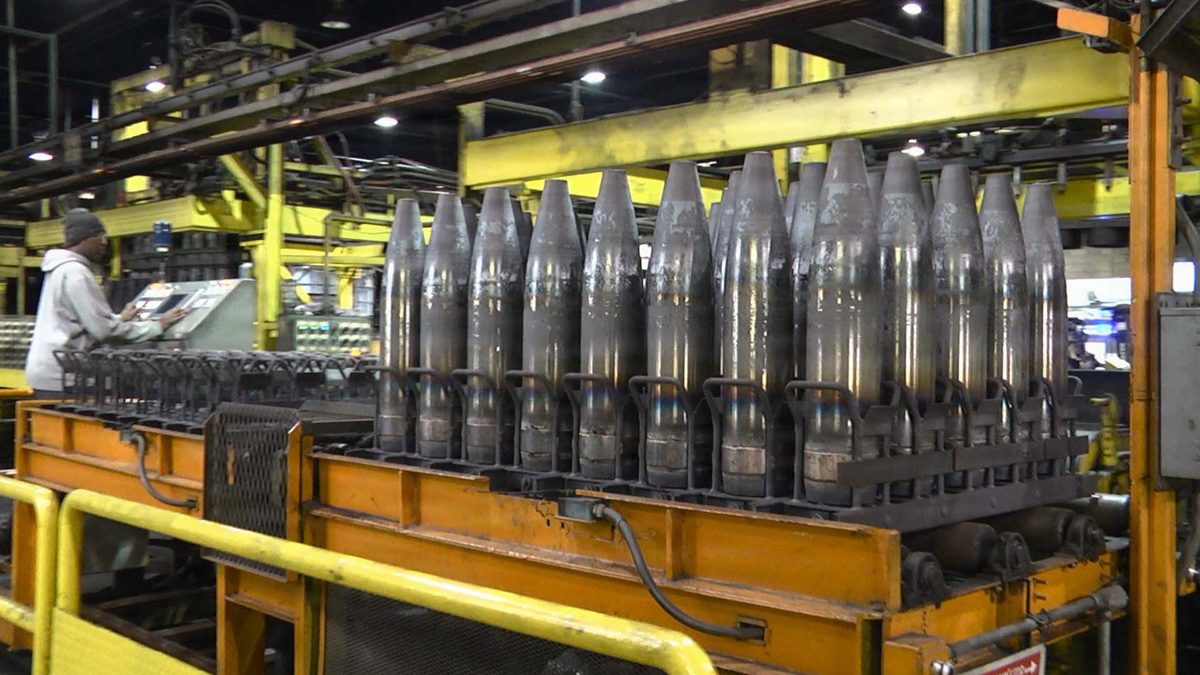
Illustrative: 155mm artillery projectile bodies on the production line at Scranton Army Ammunition Plant. U.S. Army photo by Dori Whipple via DVIDS, public domain. Appearance of U.S. Department of Defense visual information does not imply DoD endorsement.
Australia Commits A$72 Million to Second 155mm M795 Projectile Forging Line at Maryborough
Technical Summary
The Australian government signed an A$72 million contract on 8 June 2026 with Rheinmetall NIOA Munitions (RNM) to establish a new forging capability for 155mm M795 projectile bodies at the contractor-owned, contractor-operated forge in Maryborough, Queensland. The line is planned to begin operating by the end of 2028 at an initial rate of 15,000 forged projectile bodies per year, with capacity to scale to higher volumes. Canberra states that the award gives Australia two sovereign large-calibre forging capabilities by the end of 2028, supporting the Australian Defence Force (ADF) and offering export potential to allied supply chains. The announcement falls under the Guided Weapons and Explosive Ordnance (GWEO) Plan, backed by A$26 billion to A$36 billion over the decade through the 2026 Integrated Investment Program.
The M795 is the standard United States 155mm high explosive (HE) projectile, pairing a high-fragmentation steel body with a nominal 10.8 kg trinitrotoluene (TNT) bursting charge. A filled, unfuzed M795 is classified Hazard Division (HD) 1.1, Compatibility Group (CG) D, with a Net Explosive Quantity (NEQ) of approximately 10.8 kg TNT equivalent per round. The Maryborough contract covers the metal-parts forging stage only: no energetic material is processed at a forge, and projectile filling, fuzing and final assembly sit elsewhere in the supply chain. Rounds produced from these forgings will support the M777A2 Lightweight Towed Howitzer (39-calibre) and the AS9 Huntsman self-propelled howitzer (52-calibre) in ADF service. In a parallel award, the government committed A$9.2 million to Thales Australia to modernise the naval 5-inch (127mm) production line at Benalla, Victoria, adding automated equipment and lathes.
The new forge is planned to deliver an initial 15,000 forged 155mm M795 projectile bodies per year from the end of 2028, giving Australia two sovereign large-calibre forging capabilities under the GWEO Plan. Australian Department of Defence, 8 June 2026
Analysis of Effects
Forged projectile bodies are one of the recognised chokepoints in global 155mm output, alongside energetics supply and fill capacity. Body forging requires dedicated presses, heat treatment and quality control regimes that take years to establish, which is why most expansion announcements since 2022 have centred on this stage. By duplicating the forging step domestically, Australia removes a single point of failure in its supply chain and reduces lead times that would otherwise depend on congested United States and European forge capacity. The initial 15,000 rounds per year figure should be read as a body-production rate, not a complete-round delivery rate; complete-round output remains constrained by fill, fuze and propelling-charge availability.
Interoperability is the second effect. The M795 is the standard projectile of the United States Army and is qualified across the 39-calibre and 52-calibre platforms the ADF operates. Producing a United States standard projectile body in Queensland positions RNM to feed allied stockpile rebuilds, a point NIOA Group leadership made explicitly in welcoming the award. For context, an initial rate of 15,000 rounds per year remains modest against observed high-intensity consumption in Ukraine, where comparable quantities have been expended in days. The scale-up provision in the contract is therefore the operative clause for defence planners.
Personnel and Safety Considerations
The forging stage presents conventional heavy-industry hazards (hot metal, presses, heat treatment) rather than explosives hazards, and the Maryborough forge does not require explosives licensing or explosion safety quantity-distance (QD) siting for this work. Explosives safety obligations attach downstream: filled M795 rounds are HD 1.1 D and any future Australian fill, storage or proof activity must be sited and licensed accordingly. Body quality is itself a safety parameter. Forging defects, wall-thickness deviations or heat-treatment faults can produce premature break-up in bore or muzzle bursts, so lot acceptance, proof firing and metallurgical surveillance under the applicable quality assurance standards are integral to the capability, not an administrative afterthought. Up to 50 skilled positions will be created during construction and initial operation, with upskilling of the existing Maryborough workforce.
Data Gaps
Open sources do not state: whether the A$72 million covers forging only or includes machining and finishing of bodies; whether output will be the TNT-filled M795 or the insensitive munitions variant M795A1 (IMX-101 fill); where Australian-forged bodies will be filled and with what energetics source; the relationship between the new line and the existing RNM forging capability at the same site; firm export customers; and the scale-up ceiling beyond 15,000 bodies per year. The contract value is reported in Australian dollars; no United States dollar equivalent was given in the source material.
References
Source-evaluated under NATO STANAG 2022 (Reliability A–F / Accuracy 1–6). Tier 1 = government primary source; Tier 2 = quality news / specialist defence media; Tier 3 = authoritative aggregator / encyclopaedia.
- T1Australian Department of Defence, Defence Ministers – Australia fires up second artillery forging capability, 8 June 2026. (Reliability A / Accuracy 1)
- T2Asia Pacific Defence Reporter – Australia expands artillery manufacturing with $72 million deal, 8 June 2026. (Reliability B / Accuracy 2)
- T2Defence Industry Europe – Australia signs $72 million Rheinmetall NIOA contract to establish 155mm projectile forging capability in Queensland, June 2026. (Reliability B / Accuracy 2)
- T2Defence Connect – Government expands sovereign artillery manufacturing capacity with $72m contract, June 2026. (Reliability B / Accuracy 2)
- T2Australian Defence Magazine – Rheinmetall NIOA Munitions to manufacture M795, June 2026. (Reliability B / Accuracy 2)
- T3Army Technology – Australia signs deal for new artillery forging line in Queensland, June 2026. (Reliability C / Accuracy 3)
Corrections & updates welcome. If you hold open-source data that refines or corrects any parameter in this article, please contact [email protected] citing the specific claim and your source. Verified corrections will be incorporated and credited in the revision history. AI-assisted technical assessment based on open-source material. Not a formal intelligence product.