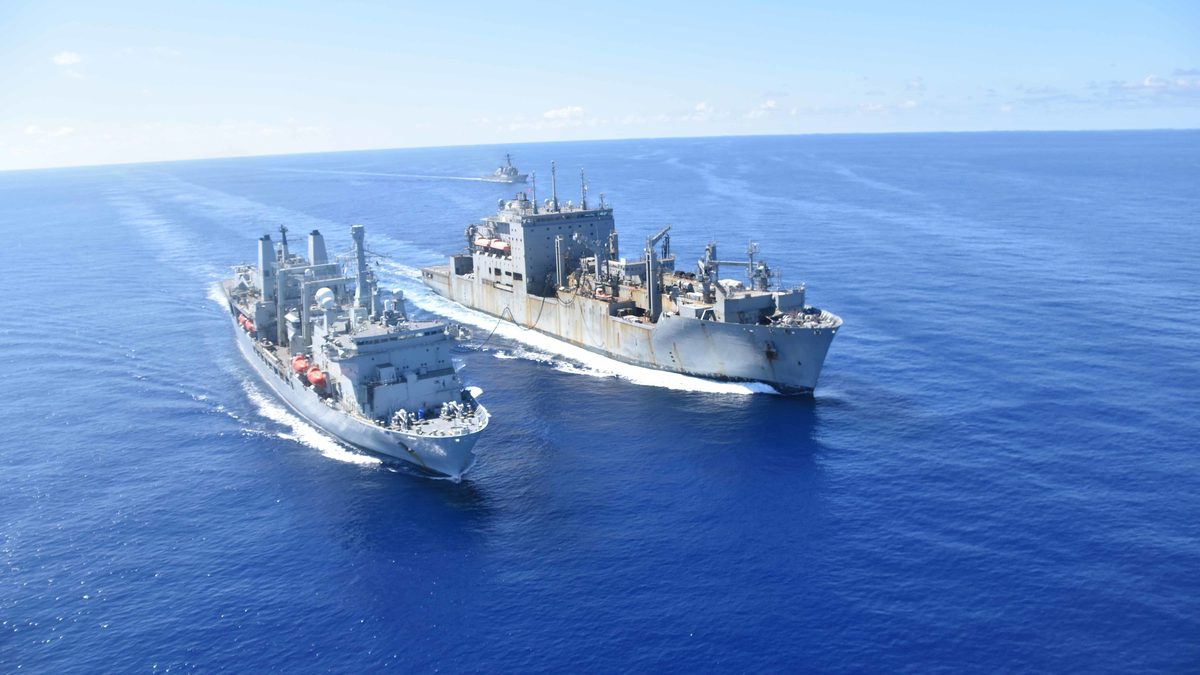
USNS Alan Shepard (T-AKE 3) conducts an underway replenishment with RFA Fort Victoria (A387), East China Sea, August 2021, during the UK Carrier Strike Group deployment: the allied dependency the Fleet Solid Support programme exists to end. US Navy photo by Pat Garber, via DVIDS (public domain). The appearance of US Department of Defense visual information does not imply or constitute DoD endorsement.
Building RFA Resurgent: three yards, 9,000 cubic metres of munitions space, and the question STO(N) asked in 2013
Technical Summary
RFA Resurgent, first of three Fleet Solid Support (FSS) ships, is now in fabrication across three yards in two countries. Navantia UK is erecting the two forward modules at Appledore. The three central modules containing the main cargo holds will be built at Harland & Wolff in Belfast. The two aft modules, machinery spaces and superstructure, are being cut in Cádiz. All seven modules will be integrated in Belfast, where test blocks for Ship 2 are already in fabrication. The NUK Seahorse blocks barge arrived at Appledore in early June 2026. Defence Equipment & Support (DE&S) placed the £1.6 billion manufacture contract with Team Resolute (Harland & Wolff, Navantia UK and designer BMT) in January 2023; Navantia UK bought Harland & Wolff out of administration in January 2025. Commodore Sam Shattock, the Royal Fleet Auxiliary’s head of service, named the first ship at the Appledore steel-cutting ceremony on 3 December 2025. DE&S expects her in service by 2031, with all three ships accepted by 2032.
The ships themselves are the largest dry stores vessels the Royal Fleet Auxiliary (RFA) has ever operated: 216 m long, 34.5 m beam, displacing 39,000 tonnes, with around 9,000 cubic metres of hold volume for ammunition, spares and provisions. The comparison with RFA Fort Victoria, the ship they replace, depends on the baseline. She embarks roughly 6,250 cubic metres of solids in total, about 3,400 cubic metres of it ordnance, alongside some 12,500 cubic metres of fuel for issue. The FSS therefore carry roughly half as much again in dedicated dry capacity, and nearly three times the narrower solid stores figure sometimes quoted for her. They are also dry cargo ships only: task group fuel will come entirely from the Tide-class tankers, where Fort Victoria could issue both. Two cost decisions made early in the programme shape everything that follows. The 5-tonne heavy replenishment rigs were deleted, leaving three rigs passing 2.5-tonne loads. And the automated weapon handling system fitted in the Queen Elizabeth-class carriers was removed from the specification, so every pallet of cargo will move by conventional mechanical handling equipment and lifts, exactly as in Fort Victoria today. A core ship’s company of 101 RFA personnel, with accommodation for around 80 more, will operate them.
The design deleted the automated handling system to save money. Every pallet in 9,000 cubic metres of cargo space will move by forklift, lift and human judgement. The ship assumes a trained stores department; the last one documented exactly this risk in 2013 and was integrated out anyway. ISC open-source assessment, June 2026
Baseline specification (open sources)
| Length / beam / displacement | 216 m / 34.5 m / 39,000 tonnes |
| Cargo | ~9,000 m³ dry stores: munitions, spares, provisions; no bulk fuel issue (Fort Victoria: ~6,250 m³ solids plus ~12,500 m³ liquids) |
| Replenishment at sea (RAS) | 3 rigs, 2.5-tonne loads (NATO heavy-RAS class); vertical replenishment (VERTREP) via Chinook-capable flight deck |
| Stores handling | Conventional mechanical handling equipment and lifts; carrier-style automation deleted |
| Complement | 101 core RFA crew; berths for ~80 augmentees |
| Self-defence | 2 × 30 mm guns, 2 × Phalanx close-in weapon systems, force-protection weapons |
| Programme | £1.6 bn contract (Jan 2023); first steel Dec 2025; in service by 2031, all three by 2032 |
The Department That No Longer Exists
When the RFA last ran purpose-built ammunition ships at full stretch, their storerooms and magazines were not the RFA’s alone. Fort Grange (renamed Fort Rosalie in June 2000) and Fort Austin sailed with a three-part complement: RFA officers and ratings, a Royal Navy air department, and an embarked civilian stores department drawn from the Royal Naval Supply and Transport Service (RNSTS), known on board as the STO(N) (Supply and Transport Officer (Naval)) department. Published Falklands-era complements list around 36 STO(N) civilians per ship. These were career armament supply professionals from a service formed in 1965 out of the Admiralty’s stores, victualling and armament supply directorates, a service whose December 1981 establishment return listed some 13,000 staff across the Royal Naval Armament Depots, stores depots and naval base organisations. In 1982 it supplied the Falklands Task Force and took up more than 50 merchant ships from trade; the Permanent Under Secretary signalled afterwards that without the RNSTS the outcome “might well have been jeopardised”.
The RNSTS was wound up in 1994 and its shore functions dispersed: through the Naval Bases and Supply Agency, launched in December 1996 with 13,350 staff, into the Warship Support Agency, the Defence Logistics Organisation and finally DE&S. The armament depots became today’s seven Defence Munitions sites, holding around 1,100 civilian staff at the last published count in 2018. Commodity storage and distribution, including munitions freight, went to Leidos in 2015 under the 13-year, £6.7 billion Logistic Commodities and Services Transformation contract. The embarked departments outlived the parent service. STO(N) departments continued afloat as DE&S organisations embedded in RFA hulls, running second-line stockholdings of several thousand line items, the ship’s explosive safety management system and replenishment serials; by 2013 the department in RFA Fort Victoria stood at around 19 DE&S personnel at high readiness.
ISC holds the primary record of what happened next, published in full in March 2026. A May 2013 national consultation selected full integration as its preferred option: STO(N) civilian posts removed and every function absorbed into the RFA. The department’s formal written warnings identified the Weapons, Ordnance, Munitions and Explosives (WOME) competence gaps, the Package Examination Room capability that would lapse, and the port-entry consequences of sailing without Government Authorised Explosives Representative (GAER) qualified staff. The account closure direction followed in August 2013. Duties passed to the RFA’s own small logistics branch, today recruited as Logistics Supply Officers and Supply Chain Operatives, with RFA deck hands undertaking mechanical forklift truck work and replenishment load building. The forklifts are themselves specialist equipment carrying their own training and maintenance burden. No like-for-like seagoing armament supply profession was ever reconstituted.
| Date | Step | Where the competence went |
|---|---|---|
| 1965 | RNSTS formed from Admiralty supply directorates, including Armament Supply | Unified civilian profession, depot floor to sea service |
| 1982 | Falklands campaign: RNSTS supplies the Task Force; STO(N) departments embarked | Proven under operational conditions |
| 1994 | RNSTS abolished | Shore functions into Naval Support Command; STO(N) departments continue afloat under DE&S lineage |
| 1996 | Naval Bases and Supply Agency launched (13,350 staff) | Later Warship Support Agency, DLO, then DE&S (2007) |
| 2013 | Full integration: STO(N) civilian posts removed from RFA ships | Written warnings on WOME competence filed and unheeded; duties pass to RFA logistics branch |
| 2015 | LCS(T) contract: Leidos takes commodity storage and distribution | Explosives storage retained by DE&S Defence Munitions |
| 2031 | RFA Resurgent due in service | Embarked stores department: plan unpublished |
Analysis of Effects
The industrial half of the programme is the good-news story. Belfast employed roughly 50 people when Harland & Wolff entered administration in 2019; the yard now employs around 450, recruits 50 to 60 apprentices a year, and has absorbed close to £100 million of investment in panel lines and Navantia’s digital shipyard model. Delivering three ships will require around 800 tradespeople plus 400 programme staff on the site. The seagoing workforce that must operate those ships tells a different story. RFA strength fell from about 2,300 in December 2010 to 1,750 in May 2023, a decline of roughly a quarter. In June 2025 the Commons was told that only six of eleven RFA ships were operational and that skilled cadres were understaffed by 30 to 50 per cent. RFA officers struck for the first time in the service’s history in August 2024. A pay settlement followed in January 2025, yet RMT members walked out again for 24 hours on 12 May 2026. There are recovery signs: outflow has fallen from around 15 per cent to under 10 per cent a year, the workforce is growing again, and an additional ship, RFA Tiderace, is due to be crewed later in 2026.
The solid stores skills base is the sharpest edge of this problem. Fort Victoria, the RFA’s only solid support ship since Fort Austin and Fort Rosalie were withdrawn in 2021 and sold to Egypt, has not transferred solid stores at sea since early 2022 and was laid up at Liverpool in late 2024 for want of a crew; the 2025 Carrier Strike Group deployed to the Indo-Pacific leaning on a Norwegian auxiliary for solid support. Her refit from September 2026 and possible return in 2027 is explicitly framed by the head of service as the means to generate suitably qualified and experienced personnel for the FSS ships. The arithmetic is demanding. Three ships at 101 core crew each, with rotation, training and shore margins, implies a trained pool several times that figure, and within it a stores department able to plan, stow, account for and issue the contents of the largest RFA magazines ever built. By first-of-class delivery in 2031, the service will have had at most four years of single-ship regeneration to rebuild a competence that once rested on a dedicated profession.
Personnel and Safety Considerations
Regulation has not relaxed to match the thinner workforce. The Defence Ordnance, Munitions and Explosives Safety Regulator (DOSR), within the Defence Safety Authority, requires duty holders to discharge ordnance, munitions and explosives (OME) responsibilities through suitably qualified and experienced personnel (SQEP) under DSA 02.OME; storage and processing practice sits in DSA 03.OME Part 2, successor to the withdrawn JSP 482. Afloat explosives practice still rests on JSP 862, the MOD Maritime Explosives Regulations, extant under the Defence Maritime Regulator and the Naval Authority but published only on internal portals, while dangerous goods movement falls under JSP 800 Volume 4b. The STO(N) departments worked across all three regimes at once, and that interface knowledge left with them. RFA vessels operate under BRd 875 with Maritime and Coastguard Agency oversight through the annual Document of Compliance audit. The shore interface remains professionally strong: Defence Munitions Gosport staff run ammunitioning at Portsmouth’s Upper Harbour Ammunition Facility, and the rebuilt £67 million Glen Mallan jetty, completed in January 2022, embarks munitions road-delivered from DM Glen Douglas for the carriers. None of those civilian specialists sails with the ship.
At sea the workload lands on the embarked department: stowage planning and compatibility segregation across 9,000 cubic metres of mixed natures, magazine inspection and environmental routines, explosives accounting, building and breaking replenishment loads, and feeding a carrier air wing’s weapons demand at tempo, potentially during combat operations. A loaded solid support ship is in effect a floating second-line depot of the DE&S inventory: armament stores, the naval support load of stores and spares, chilled and frozen victuals for the fleet, and humanitarian assistance and disaster relief (HADR) stores. She supports the carrier group, overseas units and disaster response tasking, and issues WOME stores to embarked Royal Marines and to the helicopter flight embarked from RNAS Culdrose. Deleting the automated handling system held down unit cost and pushed the burden back onto people: pallets move by forklift and lift under human supervision. The design therefore assumes precisely the kind of trained, current, explosives-aware stores department that the service has not had to generate at scale since the last STO(N) department was stood down.
Data Gaps
The MoD has not published the departmental breakdown of the 101-strong core complement, so the planned size and trade structure of the FSS stores department is unknown. The current RFA strength figure for 1 April 2026 sits in statistical annexes rather than the published bulletin and is not quoted here. There is no open-source evidence that the WOME National Occupational Standards competences removed at integration were later acquired by RFA personnel, or that the regulatory framework was amended to match the changed manning; JSP 862 itself is portal-only, so afloat stowage and licensing detail cannot be assessed from public sources. The number of RNSTS civilians embarked across the 1982 Task Force is not recorded in accessible sources. Ship 3 remains under contract but subject to credible cancellation rumours; termination would yield modest savings since the contractor would recover costs incurred.
References
Source-evaluated under NATO STANAG 2022 (Reliability A–F / Accuracy 1–6). Tier 1 = government primary source; Tier 2 = quality news / specialist defence media; Tier 3 = authoritative aggregator / encyclopaedia.
- T2Navy Lookout – Building RFA Resurgent: inside the Royal Navy’s Fleet Solid Support ship programme, 8 June 2026. (Reliability B / Accuracy 2)
- T1Defence Equipment & Support – Devon ceremony marks start of construction for first Fleet Solid Support ship, 3 December 2025. (Reliability A / Accuracy 1)
- T1Hansard, House of Commons – Royal Fleet Auxiliary (Report on Commissioner), 3 June 2025. (Reliability A / Accuracy 1)
- T2Navy Lookout – RFA head of service outlines workforce recovery and plan to return ships to sea, 21 May 2026. (Reliability B / Accuracy 1)
- T1GOV.UK, Defence Safety Authority – DSA 02.OME: Defence Ordnance, Munitions and Explosives Regulations, current edition. (Reliability A / Accuracy 1)
- T1Hansard, House of Commons Written Answers – Royal Navy Stores Depots (RNSTS establishment and STO(N) organisations), 22 December 1981. (Reliability A / Accuracy 2, historical)
- T2ISC Defence Intelligence – The Warnings Were on Record: How STO(N) Integration Hollowed Out RFA Solid Support Competence, 10 March 2026; publishes the 2013 STO(N) integration documents in full. (Reliability B / Accuracy 1, primary documents)
- T3Naval Technology – RFA Fort Victoria, Auxiliary Oiler Replenishment Ship, project profile (6,250 m³ solids; 12,500 m³ liquids). (Reliability C / Accuracy 2)
Corrections & updates welcome. If you hold open-source data that refines or corrects any parameter in this article, please contact [email protected] citing the specific claim and your source. Verified corrections will be incorporated and credited in the revision history. AI-assisted technical assessment based on open-source material. Not a formal intelligence product.