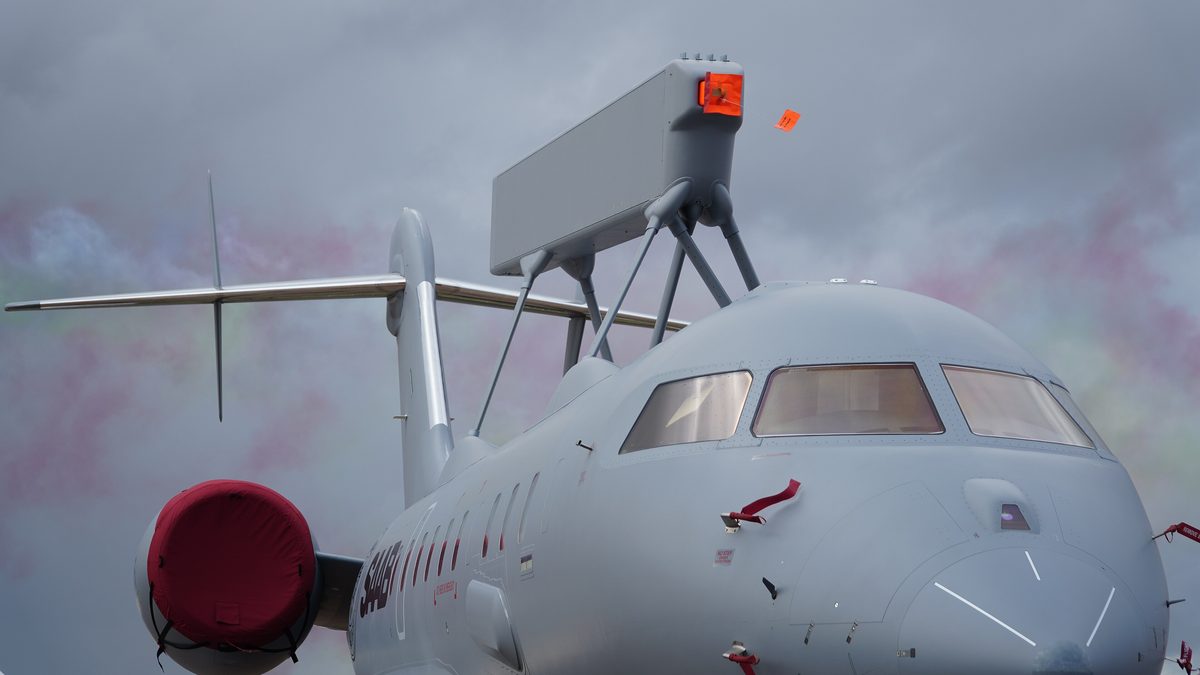
Saab GlobalEye at the Royal International Air Tattoo, 2023. Photo: Nick (intrepidexplorer82) via Wikimedia Commons / Flickr, CC BY 2.0. Cropped to 16:9 by ISC.
Saab GlobalEye: Ten Firm Orders, Three Nations, and the ‘Ten Nations’ Myth
Key takeaways
Firm orders total 10 aircraft across three nations: UAE (5, delivered), Sweden (3, in production), France (2, on contract).
Canada is the most advanced prospect as preferred supplier for about 6 aircraft, but no contract is signed.
A reported NATO E-3 replacement selection (10 to 12 aircraft) is not a confirmed order; Saab has denied any signed contract.
The “ten nations” claim conflates firm customers, prospects, and Erieye radar operators. It does not describe ten firm orders.
The order book at a glance
Saab’s GlobalEye is having a strong year in the market for Airborne Early Warning and Control (AEW&C) aircraft. The headlines are loud, the pipeline is real, and a fresh selection by Canada has put the platform on front pages. The order book itself is narrower than the coverage suggests. As of June 2026, Saab holds firm contracts for ten aircraft across exactly three nations. Everything else is interest, negotiation, or a media report that the company has not confirmed.
The distinction matters because procurement language is routinely blurred. A firm order is a signed contract with committed deliveries, payments, and timelines. Interest is something softer: an expression of interest, a selection as preferred supplier, an offer on the table, or an exploratory conversation. Those softer states may convert into firm orders. They may also stall for years, or evaporate. This assessment sorts the GlobalEye picture into those two buckets and explains where a widely repeated “ten nations” figure comes from.
Firm orders: ten aircraft, three customers
Three nations have placed contracted GlobalEye orders. The United Arab Emirates (UAE) is the launch customer and the only operator with aircraft fully in service. Sweden, the home nation, has aircraft in production. France joined the customer base at the end of 2025.
| Customer | Firm aircraft | Status | Value | Deliveries |
|---|---|---|---|---|
| UAE | 5 | In service; deliveries complete | Over USD 2.5bn cumulative across multiple contracts | 2020 to 2024 |
| Sweden | 3 (plus options for up to 2 more) | In production | Ordered 2022, third exercised from option | From 2027 |
| France | 2 (plus options for 2 more) | On firm contract | ~SEK 12.3bn / ~USD 1.3bn | 2029 to 2032 |
| Total firm | 10 | Three nations |
The UAE built its fleet through a 2015 baseline contract and later follow-on orders, taking delivery of all five aircraft between 2020 and September 2024. Sweden ordered two aircraft in 2022 through its defence materiel agency (FMV), then exercised an option for a third, with the contract holding options for up to two further aircraft. France signed on 30 December 2025 through the Direction Generale de l’Armement (DGA), the French defence procurement agency, for two aircraft plus ground equipment, training, and support, valued at roughly SEK 12.3 billion (about USD 1.3 billion), with deliveries planned for 2029 to 2032 and an option for two more.
Add the three together and the firm total is ten aircraft across the UAE, Sweden, and France. No further firm GlobalEye orders were confirmed at the time of writing.
The platform, briefly
Understanding why GlobalEye keeps reaching shortlists helps explain the momentum. The aircraft pairs Saab’s Erieye Extended Range radar with a multi-domain command-and-control suite, mounted on a Bombardier business-jet airframe rather than a large airliner. That combination gives buyers air, maritime, and ground surveillance from one platform, with long endurance and lower operating cost than the larger Boeing AWACS aircraft it competes against. The smaller airframe also widens the choice of usable runways.
Platform baseline (open sources)
| Airframe | Bombardier Global 6000 / 6500 business jet |
| Primary radar | Saab Erieye ER (Extended Range), S-band AESA with gallium nitride modules |
| Coverage | Multi-domain: air, maritime surface, and ground |
| Class advantage | Business-jet endurance and runway flexibility; lower operating cost than E-3 or E-7 |
| Competitor displaced | Boeing E-7A Wedgetail (Canada and reported NATO competitions) |
Canada: preferred, not contracted
Canada is the single most advanced prospect, and the reason GlobalEye is in the news. At the CANSEC defence exhibition in late May 2026, the Government of Canada named Saab the preferred supplier for its future AEW&C capability, opening detailed negotiations for a requirement reported at up to six aircraft under a programme valued above CAD 5 billion. Canadian reporting framed the choice as a win for GlobalEye over Boeing’s E-7A Wedgetail, and Saab moved quickly to line up industrial partners, including a teaming arrangement with Canadian training and simulation firm CAE alongside airframe supplier Bombardier.
Preferred supplier is a strong position. It is not a contract. Saab itself was explicit on this point.
Saab has stated that no contract has been signed and no order has been received for Canada’s future AEW&C capability. The selection opens negotiations; it does not close a sale. ISC summary of Saab and Government of Canada statements, May 2026
Negotiations of this size routinely run for months and occasionally collapse over price, industrial offsets, or schedule. Until Canada and Saab put a signature on a contract, the six aircraft belong in the interest column, even if the column heading reads “advanced.”
The NATO question and the wider interest list
Beyond Canada sits a longer list of countries at earlier stages. The most consequential is NATO itself. In April 2026, European defence media reported that the NATO Support and Procurement Agency (NSPA) had selected GlobalEye to replace the alliance’s ageing E-3 Sentry AWACS fleet, with figures of ten to twelve aircraft cited. Saab’s media relations head stated that the company had provided information to NATO but had not signed a contract or received a formal order. The report is significant, and most analysts now treat Boeing’s E-7 as eliminated from that competition, but a reported selection without a signed contract is exactly the kind of claim this assessment keeps out of the firm-order count.
Several other nations have been linked to GlobalEye through interest, pitches, or early evaluation. ISC rates these as lower-confidence open-source signals rather than confirmed positions.
| Prospect | Reported stage | Confidence |
|---|---|---|
| UAE, Sweden, France | Firm contracts, 10 aircraft | Contracted |
| Canada | Preferred supplier, negotiating (~6 aircraft, >CAD 5bn) | Advanced |
| NATO (NSPA) | Reported E-3 replacement selection; Saab denies any order (10 to 12 reported) | Reported |
| Germany | Interest reported; bid described as well placed for national AEW&C needs | Interest |
| Greece, Poland, Denmark | Named in reports as European prospects evaluating or interested | Interest |
| Qatar, Saudi Arabia | Pitched or offered; regional fit and UAE commonality cited | Interest |
Why the ‘ten nations’ figure misleads
A claim that GlobalEye has “ten nations” behind it circulates in commentary and marketing-adjacent coverage. It does not describe ten firm orders or even ten committed nations. The figure most likely blends several different things: the three firm customers, the advanced Canadian prospect, the reported NATO selection, the handful of interested European and Gulf states, and operators of Saab’s related Erieye radar, which equips earlier and smaller surveillance aircraft flown by a wider group of countries. Counting current operators, future prospects, and Erieye users together produces a large round number that conflates four different categories of certainty.
The honest count is simpler. Ten aircraft. Three nations. One advanced prospect that has signed nothing.
Data gaps and caveats
This is an open-source assessment and carries the usual limits. The interest list for Germany, Greece, Poland, Denmark, Qatar, and Saudi Arabia rests on media reporting of varying reliability and has not been confirmed by the governments concerned or by Saab. The NATO quantity of ten to twelve aircraft is a press figure, not a published contract value. Option conversions for Sweden and France are not guaranteed and depend on future funding decisions. Cumulative UAE contract value is an aggregate of several deals rather than a single published number. Platform parameters in the specification box are general open-source attributes; detailed radar range, crew, and endurance figures are not itemised in this assessment. For authoritative status on any individual order, Saab’s official press releases and the relevant national procurement agencies remain the primary sources.
References
Source-evaluated under NATO STANAG 2022 (Reliability A–F / Accuracy 1–6). Tier 1 = government or company primary source; Tier 2 = quality news / specialist defence media; Tier 3 = authoritative aggregator / encyclopaedia.
- T1Government of Canada, Defence Investment Agency – The Government of Canada selects preferred supplier for Airborne Early Warning and Control discussions, 27 May 2026. (Reliability A / Accuracy 1)
- T1Saab – Saab receives order for GlobalEye from France, 31 December 2025. (Reliability A / Accuracy 1)
- T1Saab – Canada engages Saab as preferred supplier of future AEW&C capability, May 2026. (Reliability A / Accuracy 1)
- T2Breaking Defense – France finalizes $1.3B USD contract for 2 Saab GlobalEye radar planes, December 2025. (Reliability B / Accuracy 2)
- T2FlightGlobal – Saab denies contract has been signed for NATO GlobalEye order despite media reports, April 2026. (Reliability B / Accuracy 2)
- T2Shephard Media – Saab delivers fifth and last GlobalEye to UAE, September 2024. (Reliability B / Accuracy 2)
Corrections & updates welcome. If you hold open-source data that refines or corrects any figure in this article, please contact [email protected] citing the specific claim and your source. Verified corrections will be incorporated and credited in the revision history. AI-assisted open-source assessment based on company press releases, government announcements, and specialist defence media. Not a formal intelligence product.