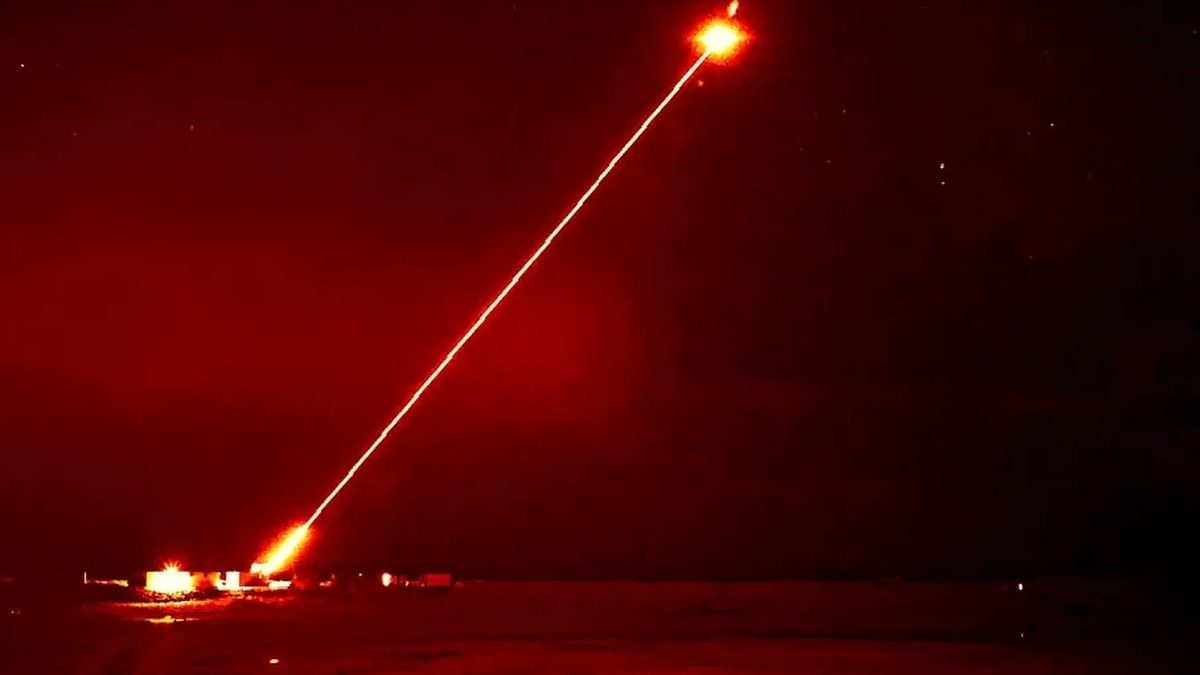
DragonFire high-power firing at the MOD Hebrides Range, January 2024. UK MOD © Crown copyright 2024, Open Government Licence v3.0, via Wikimedia Commons.
DragonFire Goes to Sea: Britain’s £316m Naval Laser and the Economics of Counter-Drone Defence
Capability in brief
DragonFire is the United Kingdom’s first operational-class laser directed-energy weapon (LDEW). It engages targets at the speed of light, using a tightly focused 50-kilowatt-class beam to burn through a drone, a missile body or a vulnerable component until the target fails. After roughly a decade in the laboratory, the system crossed into a funded naval programme in November 2025, when the Ministry of Defence (MoD) awarded MBDA UK a £316 million contract to place the weapon aboard a Royal Navy Type 45 air-defence destroyer by the end of 2027.
The number that makes DragonFire matter is not its power rating. It is the running cost. The MoD puts a single firing at about £10, close to the cost of running a domestic heater for an hour, against the hundreds of thousands of pounds a guided interceptor missile costs. For a navy facing cheap one-way attack drones in the Red Sea and the Black Sea, that ratio is the whole argument.
The precision required is equivalent to hitting a £1 coin (23 mm) from a kilometre away, and the MoD states that a single shot costs around £10, the equivalent of running a heater for an hour. UK Ministry of Defence, on DragonFire
How the weapon works
DragonFire is a line-of-sight weapon. It can engage any target the beam director can see, and nothing it cannot. The system combines the output of tens of optical fibres into one high-intensity beam, then holds that beam on a single aim point until the structure fails, for example by burning into a warhead or a control surface. A turret carries the laser alongside an electro-optical camera and a second, lower-power laser used for imaging and tracking. The beam director, the precision-pointing assembly that keeps the spot steady against ship motion and atmospheric turbulence, is the hardest part of the engineering, and Leonardo UK leads it. QinetiQ supplies the laser source and beam-combination technology. The Defence Science and Technology Laboratory (Dstl) runs the programme for the MoD. The full power approach stays classified, though the laser sits in the 50-kilowatt class.
The economics of the beam
Against a saturating drone attack, magazine depth matters as much as lethality. A missile-armed destroyer carries a finite number of interceptors and cannot reload at sea. A laser offers what the MoD calls almost limitless shots, for as long as the ship can generate power. Precision is the enabler. The MoD describes the pointing accuracy as equivalent to hitting a £1 coin, about 23 millimetres, from a kilometre away, which lets the beam strike the most vulnerable part of a fast mover rather than relying on a fragmentation pattern. The trade is inherent to every laser. Effect falls away in fog, heavy rain and dust, and it depends on dwell time on target, so directed energy complements kinetic interceptors rather than replacing them.
From demonstrator to programme
DragonFire was unveiled at the Defence and Security Equipment International (DSEI) exhibition in 2017, the product of roughly £100 million in early contracts shared between the MoD and the UK DragonFire consortium. Low-power tracking trials in the Outer Hebrides followed in 2022, with the first high-power firings later that year. In January 2024 the system achieved a UK first, engaging aerial targets with its high-power beam at the MoD Hebrides Range. In April 2024 the MoD used reformed procurement rules to pull the in-service date forward to 2027, five years ahead of the original 2032 plan, and ministers said an early version could be offered to Ukraine. Further funding in March 2025 widened the goal to four destroyers rather than one. The decisive result came that November. In trials at the Hebrides Range DragonFire tracked and destroyed drones flying at up to 650 kilometres per hour, about 404 miles per hour, and demonstrated above-the-horizon engagement, reportedly firing more than 300 shots. On the strength of that result the MoD signed the £316 million, 29-month contract with MBDA UK for a DragonFire Minimum Deployable Capability (MDC), sustaining close to 600 jobs across the UK.
Two ships, then four
The procurement detail is easy to blur, and worth getting right. The £316 million contract funds an MDC for an initial two Type 45 destroyers, with the first ship fitted before the end of 2027. That sits inside a broader ambition, announced separately in March 2025, to equip four of the Royal Navy’s six Type 45s. Beyond the fleet, the UK envisages the same core technology on British Army vehicles, including the Wolfhound, and on future Royal Air Force platforms such as the Tempest combat aircraft, with demonstration concepts raised for a Type 23 frigate and a land vehicle. QinetiQ’s work has also fed a sovereign Australian laser effort. Power supply is a problem in its own right, and a Flywheel Energy Storage System (FESS) developed jointly with the United States is in the mix to meet the weapon’s heavy electrical demand.
Limitations and open questions
Several parameters stay outside the public record. The operational range is classified. Earlier reporting referenced high-power firings at ranges up to around 2.1 miles, roughly 3.4 kilometres, but that is a historical data point rather than a stated capability. The MDC is, by its name, a minimum capability, so its magazine, rate of engagement and performance against faster or stealthier threats than a 650 km/h drone are not established in open source. Two variables are most likely to move the 2027 date: integration risk on a Type 45 that is taking other upgrades at the same time, and the maturity of shipboard power storage.
References
Source-evaluated under NATO STANAG 2022 (Reliability A–F / Accuracy 1–6). Tier 1 = government primary source; Tier 2 = quality news / specialist defence media.
- T1 GOV.UK: Advanced future military laser achieves UK first, 19 January 2024. (Reliability A / Accuracy 1)
- T1 GOV.UK: New procurement rules help rapid fitting of military laser to Royal Navy ships, 12 April 2024. (Reliability A / Accuracy 1)
- T1 Royal Navy: £316m deal for Royal Navy’s first laser weapon after successful high-speed drone trials, 20 November 2025. (Reliability A / Accuracy 1)
- T2 Defense News: UK Royal Navy to equip MBDA’s drone-frying lasers by 2027, 20 November 2025. (Reliability B / Accuracy 2)
- T2 Naval Technology: DragonFire laser weapon fired over 300 shots in recent test, November 2025. (Reliability B / Accuracy 2)
- T2 Navy Lookout: DragonFire directed energy weapon to be fitted to four Royal Navy warships by 2027, 26 March 2025. (Reliability B / Accuracy 2)
- T2 BBC News: DragonFire: UK laser could be used against Russian drones on Ukraine front line, 12 April 2024. (Reliability B / Accuracy 2)
Corrections & updates welcome. If you hold open-source data that refines or corrects any parameter in this article, please contact [email protected] citing the specific claim and your source. Verified corrections will be incorporated and credited in the revision history. AI-assisted technical assessment based on open-source material. Not a formal intelligence product.