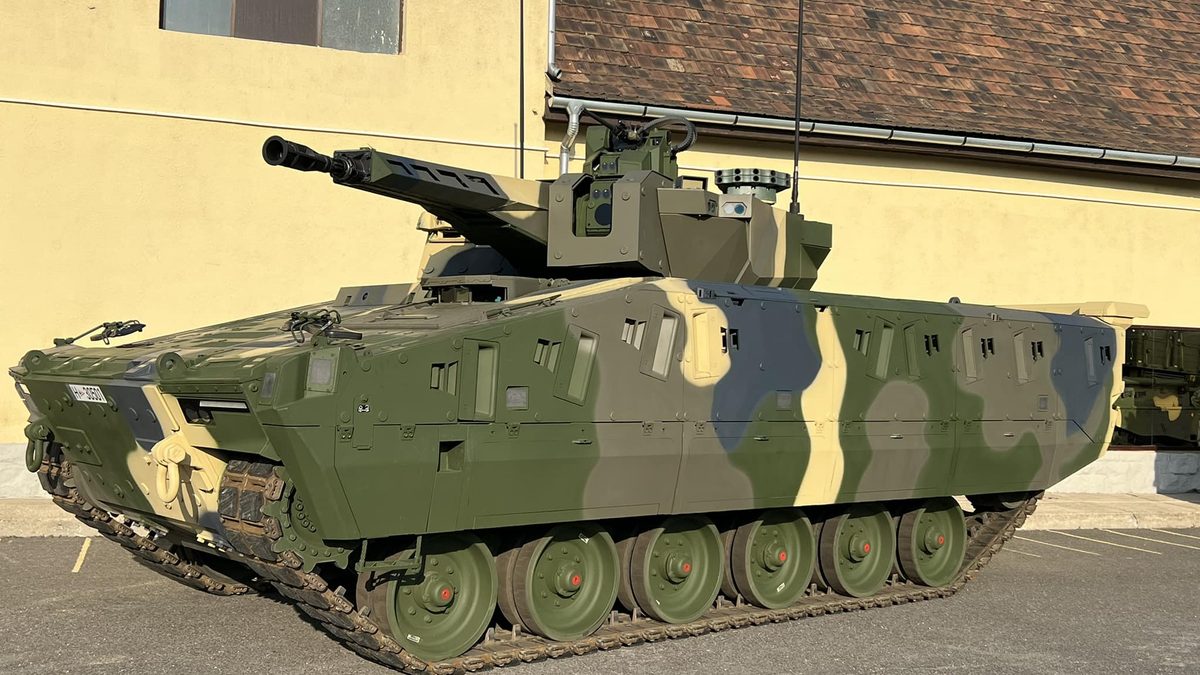
A Hungarian Army Lynx KF41 infantry fighting vehicle. Hungary hosts the existing European Lynx production line. Romania’s order adds a third manufacturing centre. Photo: Lukas1325 via Wikimedia Commons, CC BY-SA 4.0 (cropped to 16:9). Primary reporting: Rheinmetall corporate release, 2 June 2026.
Rheinmetall's EUR5.7bn Romania Package Embeds SAFE-Funded Airburst Ammunition on NATO's Eastern Flank
Technical Summary
Rheinmetall has confirmed the largest international contract package in its history: a 5.7 billion euro award from Romania's Directorate General for Armaments (DGArm), signed on 29 May 2026 and announced on 2 June. The package spans 298 Lynx combat vehicles, SKYRANGER air-defence systems built on the same Lynx chassis, two offshore patrol vessels (OPVs) and two diver-support vessels, and, the line most relevant to a Weapons, Ordnance, Munitions and Explosives (WOME) reader, medium-calibre ammunition for both the air-defence systems and the armoured personnel carriers (APCs). The orders are funded through the European Union's Security Action for Europe (SAFE) instrument, with deliveries scheduled from 2028 to 2030 and more than half of production to take place in Romania or with local firms.
The platforms have taken the headlines, but the ammunition line is what gives the air-defence element its teeth. SKYRANGER in its Lynx-mounted baseline is armed with a 30 mm x 173 revolver cannon, and its principal counter-air nature is the programmable airburst round known in Rheinmetall's family as AHEAD (Advanced Hit Efficiency And Destruction), a Kinetic Energy Time Fuzed (KETF) cartridge. Rather than relying on a direct hit, the round is programmed at the muzzle to eject a dense payload of tungsten sub-projectiles at a calculated point ahead of the target, forming a cone of fragments through which a fast, small aerial target must fly.
The SKYRANGER round does not need to hit the drone. A muzzle programmer sets the fuze so the shell ejects a cone of tungsten sub-projectiles directly into the target's flight path. ISC technical assessment
Analysis of Effects
The 30 mm x 173 KETF round is the technical heart of the air-defence buy. A muzzle measuring device reads each round's velocity and inductively programs the time fuze, so the ejection of the tungsten sub-projectiles is timed to place the fragment pattern just short of the target. Against uncrewed aircraft, loitering munitions and light helicopters, this delivers a probability of kill that contact-fuzed rounds cannot match at the same ammunition cost, which is why programmable medium-calibre airburst has become the affordable layer of Europe's counter-drone response. The well-documented 35 mm AHEAD round ejects 152 tungsten sub-projectiles; the 30 mm x 173 round is of the same order. Rheinmetall’s published datasheet for the 30 mm x 173 Air Burst Munition (ABM), the Kinetic Energy Time Fuzed PMC308 nature, specifies 162 pre-fragmented tungsten sub-projectiles of approximately 1.24 g each, expelled by a 0.5 g ejection charge. Whether that specific nature is the one contracted for Romania is not stated in the announcement.
The pairing itself is not new. Rheinmetall first showed a Skyranger turret integrated on the Lynx chassis on its own channel in March 2021, and the configuration the company displayed then is the closest public image of what the Romanian air-defence variant will look like.
Here we are - as requested: Lynx with Skyranger 30mm #Lynx #KF41 pic.twitter.com/jhjJWz3jBt
— Rheinmetall (@RheinmetallAG) March 22, 2021
The medium-calibre ammunition for the APC fleet supports a different effect, suppression and defeat of light armour and dismounts from the Lynx turret, and its calibre is not separately stated in the announcement. The strategic reading is the more important one. By funding the ammunition alongside the launchers under SAFE, and by localising more than half of production inside Romania, the deal addresses the recurring weakness of European air defence, which has been buying sensors and effectors while under-resourcing the magazine depth that sustains them. A SKYRANGER turret with no programmable rounds in the ready racks is a sensor, not a weapon. Tying the natures to the platforms in one instrument is a deliberate correction of that pattern.
Personnel and Safety Considerations
Medium-calibre fixed ammunition of this class is normally assigned to Hazard Division (HD) 1.2 or 1.3 with a Compatibility Group (CG) appropriate to fixed rounds containing propellant and an energetic or sub-projectile payload, though the precise HD and CG for each nature in this order are not disclosed. The programmable airburst round carries a small expelling charge and an electronic time fuze, so its safety case turns on the fuze's safety-and-arming logic and on electrostatic and electromagnetic robustness, qualified under the NATO STANAG 4187 fuzing-safety framework and the relevant Allied Quality Assurance Publications (AQAP). For magazines and depots, the consequential figure is the aggregate Net Explosive Quantity (NEQ) held once stockpiles build toward war reserve levels, rather than the modest per-round NEQ. Local production also raises a standardisation question: rounds made in Romania must remain interchangeable to the governing NATO standard so they function identically across allied guns.
Data Gaps
The announcement does not break the 5.7 billion euro figure down by line, so the share attributable to ammunition is unknown. Order quantities, the nature mix between programmable airburst, high-explosive tracer and kinetic rounds, and the exact calibre of the APC ammunition (whether 30 mm or 35 mm) are not stated. The SKYRANGER variant and cannon calibre for Romania are inferred from the baseline configuration and not confirmed in the release. Per-round and aggregate NEQ, HD and CG by nature, and whether ammunition is produced in Romania or supplied from existing Rheinmetall lines are all undisclosed.
References
Source-evaluated under NATO STANAG 2022 (Reliability A–F / Accuracy 1–6). Tier 1 = government or manufacturer primary source; Tier 2 = quality news / specialist defence media; Tier 3 = authoritative aggregator / encyclopaedia.
- T1Rheinmetall AG · Major historic contract from Romania worth EUR5.7 billion, 2 June 2026. (Reliability A / Accuracy 1)
- T1Rheinmetall AG · ABM/KETF 30 mm x 173 ammunition (PMC308) datasheet (D127e0823). (Reliability A / Accuracy 1)
- T2Breaking Defense · Rheinmetall locks in wide-ranging weapons package with Romania, 2 June 2026. (Reliability B / Accuracy 2)
- T2Defence Industry Europe · Rheinmetall secures EUR5.7 billion Romanian defence orders for combat vehicles, air defence and naval vessels, 2 June 2026. (Reliability B / Accuracy 2)
- T2Soldier Systems Daily · Romania orders Lynx combat vehicles, vessels and air-defence systems worth EUR5.7 billion, 4 June 2026. (Reliability B / Accuracy 2)
- T3The Romania Journal · Rheinmetall signs EUR5.7 billion contracts with Romanian MoD, 2 June 2026. (Reliability C / Accuracy 3)
Corrections & updates welcome. If you hold open-source data that refines or corrects any parameter in this article, please contact [email protected] citing the specific claim and your source. Verified corrections will be incorporated and credited in the revision history. AI-assisted technical assessment based on open-source material. Not a formal intelligence product.