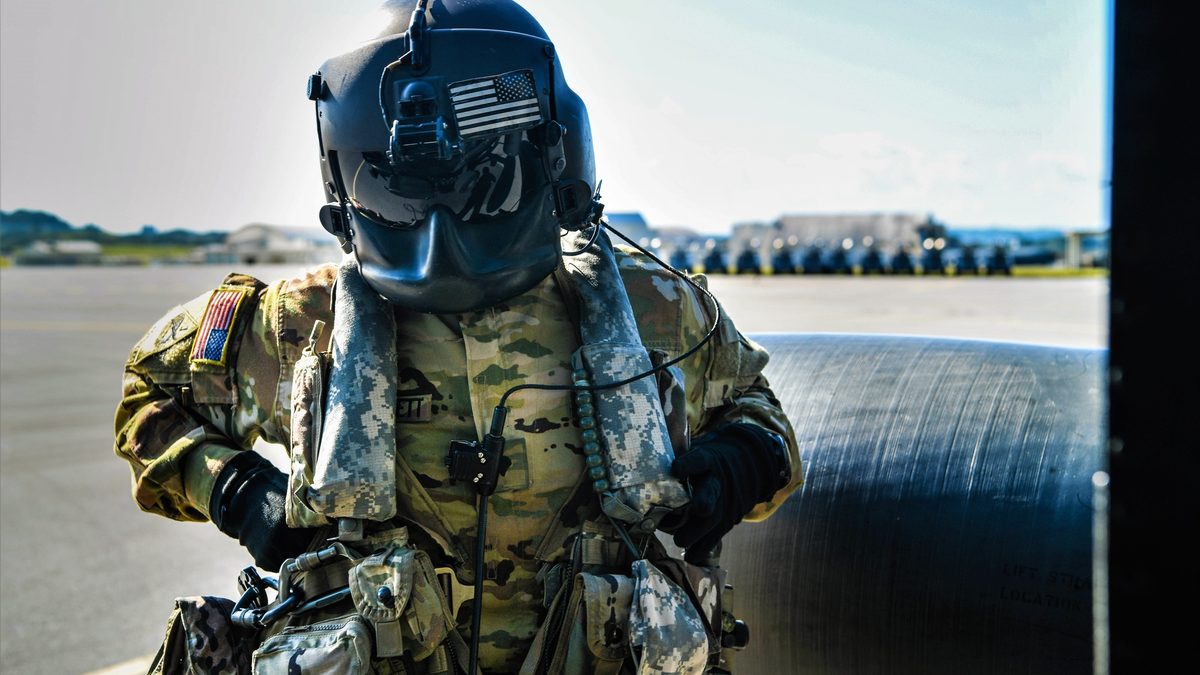
U.S. Army aviation supports Sensor-to-Shooter training via Link 16 during exercise Orient Shield 21-1. Photo: Maj. Elias Chelala / U.S. Army Japan / DVIDS / Public Domain.
NATO's Digital High Ground: Inside the JAPCC Tactical Data Link Campaign
What JAPCC Has Approved
The Joint Air Power Competence Centre (JAPCC), NATO's Kalkar-based centre of excellence for air and space power, has approved a Tactical Data Link (TDL) campaign aimed squarely at the community that builds and runs the Alliance's digital networks. The campaign carries the title "Connecting the Alliance at Every Level" and launches through a six-page tri-fold flyer built for high-visibility events and senior leadership engagement. Its message is direct: Multi-TDL Networks (MTN) and Joint Data Network (JDN) training are operational priorities, and the Alliance needs a credible, qualified workforce to deliver them.
The campaign rests on four stated pillars. Operational impact: secure, jam-resistant data links strengthen command and control and speed up informed decision-making. Training evolution: current Level 2 and Level 3 courses support workforce readiness, but emerging JDN requirements point to a NATO Level 4 capability that does not yet formally exist. Alliance interoperability: the effort is reinforced through the flyer, JAPCC Journal content, a forthcoming White Paper and a dedicated TDL web page. Strategic visibility: the whole package is framed as visible NATO investment in digital battlespace capability, with measurable outcomes attached.
Secure, jam-resistant Tactical Data Links strengthen command and control and enable faster, informed decision-making. JAPCC Tactical Data Link Campaign, 2026
Why a Data Link Is Command and Control
Strip away the jargon and a data link is the mechanism that lets a fighter, a frigate, a ground-based air defence battery and an airborne early-warning aircraft share one picture of the battle in near real time. That shared picture has a name: the Common Tactical Picture (CTP), and in the air domain the Recognised Air Picture (RAP). When a sensor on one platform detects a track, the link puts it on every other participant's screen within seconds, with no human reading a contact report over voice. This is what turns a collection of national platforms into a coalition force. Remove the link and you are back to voice nets, telephones and luck.
That is why the JAPCC frames TDL as the digital backbone rather than a supporting bearer. Modern concepts such as Multi-Domain Operations (MDO) and sensor-to-shooter targeting assume the data is already moving. The link is the precondition for command and control (C2), not an accessory to it. In a contested electromagnetic environment, where jamming and spoofing are routine, the quality of that backbone, its resistance to interference and its ability to hold a coherent picture, becomes a measure of combat power in its own right.
The Architecture: Link 16, Link 22 and JREAP
Link 16 is the workhorse. Standardised under NATO Standardization Agreement (STANAG) 5516 and carried by Joint Tactical Information Distribution System (JTIDS) and Multifunctional Information Distribution System (MIDS) terminals, it is a secure, jam-resistant, time-slotted link operating in the L-band between 960 and 1,215 MHz. It uses Time Division Multiple Access (TDMA), giving each participant assigned time slots, and a frequency-hopping waveform that spreads transmissions pseudo-randomly across 51 centre frequencies to resist jamming. Its J-series messages carry tracks, orders, electronic warfare data and text at effective rates up to roughly 115 kbps depending on configuration. Its principal limitation is geometry: Link 16 is fundamentally line-of-sight.
Link 22 is the beyond-line-of-sight complement, the product of the multinational NATO Improved Link Eleven (NILE) programme run by seven nations: Canada, France, Germany, Italy, the Netherlands, the United Kingdom and the United States. Standardised under STANAG 5522, it is designed to replace the ageing Link 11 while staying compatible with Link 16 message formats. Each NILE network runs over High Frequency (HF, 2 to 30 MHz) for beyond-line-of-sight reach out to around 300 nautical miles, or Ultra High Frequency (UHF, 225 to 400 MHz) for line-of-sight links. Where Link 16 delivers a dense local picture, Link 22 carries a coherent picture over the horizon.
The third element is the Joint Range Extension Applications Protocol (JREAP), standardised under STANAG 5518 and the United States MIL-STD-3011. JREAP wraps Link 16 J-series messages so they can travel over networks never designed for tactical data: satellite, point-to-point serial and Internet Protocol (IP) bearers. JREAP-A passes a token across a serial channel such as a satellite link; JREAP-B handles point-to-point connections; JREAP-C carries the same messages over IP networks. The effect is strategic reach: a track generated by a sensor in one theatre can populate a commander's screen on another continent.
Gateways and the Multi-TDL Network
No single link does everything, which is the whole point of the campaign's focus on Multi-TDL Networks. A gateway is the translator that lets Link 16, Link 22, JREAP and legacy links exchange data without losing fidelity, forwarding a track from one network onto another so the picture stays whole. Stitch these together and you have the MTN, feeding upward into the Joint Data Network that fuses the air, maritime and land pictures into a single joint operating picture. Holding that architecture together is a human role: the Joint Interface Control Officer (JICO), responsible for designing, configuring and managing the network so that every participant both contributes to and reads from the same CTP. The JICO and the supporting interface-control team are where network engineering and operational art meet, and where a campaign about "interoperability" stops being abstract.
The Training Pipeline and the Workforce Gap
This is what the campaign is really about. The JAPCC describes a tiered qualification structure. Level 1 gives foundational TDL awareness at unit level. Level 2 produces link operators who can set up systems, handle message formats, work Link 16 and JREAP, and apply the Operational Tasking Data Link (OPTASK Link) order that configures a network. Level 3 qualifies TDL Managers in network design, interoperability planning and mission-specific configuration across multiple domains. The campaign's own training-evolution pillar then states the problem plainly: current Level 2 and Level 3 provision supports readiness, but JDN requirements now point to a Level 4 capability that NATO has not yet formalised.
The forthcoming White Paper, "Optimising Multi-Tactical Datalinks in MDO: Benchmarking Pathways to Mission Success," is the vehicle for that argument. It identifies gaps across systems, training and coordination, and sets out benchmarking pathways toward Alliance-wide integration, including the case for a NATO-level joint interoperability and data-link training institution in place of a patchwork of national courses. The training crests on the campaign page tell the same story: five providers feeding a common standard, between them delivering manager, operator and interface-specialist qualifications. A companion JAPCC article, "Centralised Command, Distributed Control, Disconnected Training?", sharpens the point further, arguing that the distributed operations seen since 2022 are only ever as good as the training behind the people who run the networks.
What To Watch
Three markers will show whether this is rhetoric or resourcing. First, publication of the benchmarking White Paper, and whether it names a concrete Level 4 or training-institution proposal that nations can actually fund. Second, the JAPCC's Joint Air and Space Power Conference in Essen on 22 to 24 September 2026, a natural platform to put TDL workforce questions in front of senior leadership. Third, whether any of this converts into a standing NATO requirement with a budget line, which is the difference between a flyer and a force-generation programme. The hardware side of interoperability is largely solved on paper through the STANAG suite; the campaign is, in effect, an admission that the harder problem is people. One caveat for readers: the White Paper text is pre-publication, and the exact content of any Level 4 syllabus is not yet in the public domain, so the workforce proposal should be read as direction of travel rather than settled doctrine.
References
Source-evaluated under NATO STANAG 2022 (Reliability A–F / Accuracy 1–6). Tier 1 = government / primary institutional source; Tier 2 = specialist defence media or programme office; Tier 3 = authoritative aggregator / encyclopaedia.
- T1Joint Air Power Competence Centre – JAPCC Tactical Data Link Campaign, 31 March 2026 (updated 13 May 2026). (Reliability A / Accuracy 1)
- T1Joint Air Power Competence Centre – Connecting the Alliance at Every Level (TDL flyer), 2026. (Reliability A / Accuracy 2)
- T1Joint Air Power Competence Centre – Centralised Command, Distributed Control, Disconnected Training?, 2025. (Reliability A / Accuracy 2)
- T2NILE Programme Office – Link 22: About the NATO Improved Link Eleven (NILE) Programme, 2024. (Reliability B / Accuracy 2)
- T3Wikipedia – Link 16, accessed 5 June 2026. (Reliability C / Accuracy 3)
- T3Wikipedia – Joint Range Extension Applications Protocol (JREAP), accessed 5 June 2026. (Reliability C / Accuracy 3)
Corrections & updates welcome. If you hold open-source data that refines or corrects any parameter in this article, please contact [email protected] citing the specific claim and your source. Verified corrections will be incorporated and credited in the revision history. AI-assisted technical assessment based on open-source material. Not a formal intelligence product.