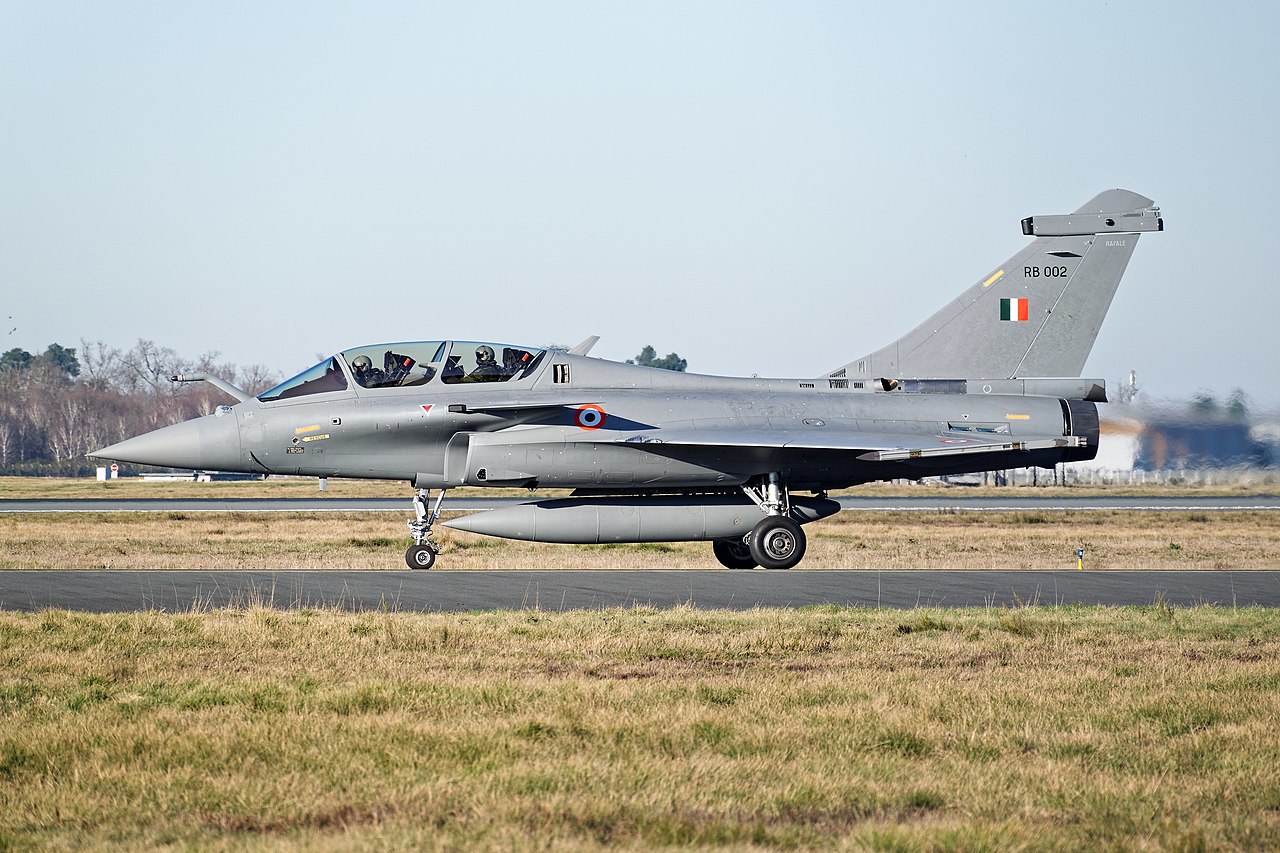
An Indian Air Force Rafale. India's existing 36-jet fleet flies French and European weapons; the new 114-jet buy is about whether the next tranche can carry Indian munitions. Photo: Dylan Agbagni, released under CC0 / public-domain dedication, via Wikimedia Commons.
India's 114-Rafale Letter of Request Turns on One Demand: the Interface Control Document
Technical Summary
India has issued a formal Letter of Request (LoR) to France for 114 additional Rafale fighters under the Indian Air Force (IAF) Multi-Role Fighter Aircraft (MRFA) requirement, with reporting dating the request to the start of June 2026. The government-to-government package is valued at around ₹3.25 lakh crore, roughly US$39 billion, though published estimates have ranged from US$33 billion to US$40 billion depending on scope and exchange-rate assumptions. The buy comprises 88 single-seat and 26 twin-seat aircraft. If a contract follows, it would lift India's total Rafale fleet to 176 airframes.
The headline figure is not the story. For the IAF the decisive term is technical and contractual: access to the Rafale's Interface Control Document (ICD). New Delhi wants the engineering data that governs how stores and systems talk to the aircraft, so that Indian engineers can integrate domestic munitions, the BrahMos-NG cruise missile and the Astra family of air-to-air missiles among them, without paying Dassault and its European suppliers to certify each weapon. India has signalled the ICD condition is non-negotiable, to the point of declining the deal if Paris withholds it.
Without Interface Control Document access, India would again be locked out of arming its own combat fleet with its own missiles. That is the exact dependency the existing 36-jet Rafale force already lives with. ISC Defence Intelligence, open-source assessment
Why the Interface Control Document Decides This Deal
An ICD is the master specification for the electrical, mechanical, data-bus and software interfaces between an aircraft and everything it carries. On a modern fighter, adding a weapon is not a matter of bolting it to a pylon. The store has to be recognised by the stores-management system, powered and armed through a defined data interface (the function a standard such as MIL-STD-1760 performs on Western platforms), released safely across the flight envelope, and cleared through electromagnetic-compatibility and store-separation trials. All of that is then written into the aircraft's Operational Flight Program (OFP), the mission software that actually flies and fights the jet.
When the buyer has no ICD access, only the original manufacturer can do that work. Each new weapon becomes a paid, multi-year integration programme controlled by the original equipment manufacturer (OEM), with the customer unable to set the timetable or audit the result. This is the so-called integration tax. India already lives with it: its 36 in-service Rafales fly French and European weapons such as the Meteor, SCALP and MICA missiles and the Hammer guided bomb, and New Delhi cannot add an indigenous missile to those jets at will.
With ICD-level data, the Defence Research and Development Organisation (DRDO), Hindustan Aeronautics Limited (HAL) and Indian test agencies could qualify and certify home-built weapons on the platform themselves. That compresses timelines, removes recurring OEM fees, and, more strategically, lets India field new munitions on its largest Western fleet without foreign sign-off. The same access underpins sovereign mission-software updates rather than waiting on a French release cycle.
ICD or Source Code? The Layers of Access
It helps to separate two things India could ask for. The ICD defines interfaces: the electrical and mechanical connections, the avionics data bus (the role that standards such as MIL-STD-1553 perform for data and MIL-STD-1760 for stores on Western types), power and discrete signals, the stores-management system (SMS) protocol, and the store-separation data a weapon needs for safe release. Operational Flight Program source code is a different and far more sensitive layer: the core flight and mission logic, the sensor fusion, and the proprietary implementation that makes the jet fight the way it does.
India appears to be prioritising the first over the second, which is the pragmatic position. With ICD-level data, an integrator can build a weapon to the published interface without ever seeing inside the mission computer. The everyday analogy is the gap between a detailed interface specification with hardware pin-outs and the proprietary software sitting behind it. You can connect to the one without owning the other.
What ICD access buys India: the chain from pylon to cleared weapon that the DRDO, HAL and Indian test agencies could own in country, rather than commissioning Dassault for each store.
The Indigenous Weapons Set
The munitions India wants on the Rafale read as a deliberate list, spanning air dominance, deep strike and the suppression of enemy air defences. The figures below are publicly reported design or test values and are not independently verified by ISC. Reporting also names the Rudram anti-radiation series and other domestic stores beyond the headline pair of BrahMos-NG and Astra.
| System | Role | Reported parameters | Status |
|---|---|---|---|
| BrahMos-NG | Supersonic cruise missile, land and anti-ship strike | Launch mass near 1.3 to 1.6 tonnes against roughly 2.5 tonnes for the original air-launched BrahMos; reported range in the region of 290 km; speed around Mach 3.5 | In development |
| Astra Mk1 | Beyond-visual-range air-to-air missile (BVRAAM) | Active-radar guidance; reported reach around 80 to 110 km | In service |
| Astra Mk2 | Extended-range BVRAAM | Reported range around 140 to 160 km | In development and test |
| Astra Mk3 (Gandiva) | Long-range BVRAAM | Solid-fuel ducted ramjet propulsion; reported range beyond 300 km | In development |
| Rudram series | Anti-radiation missile, SEAD and DEAD | Reported variants from Rudram-1 near 150 km to longer-ranged Rudram-2 and a developmental Rudram-3 | In development and test |
| SAAW | Smart Anti-Airfield Weapon, precision glide | 120 kg class; runway, shelter and airfield targets from standoff range | In production |
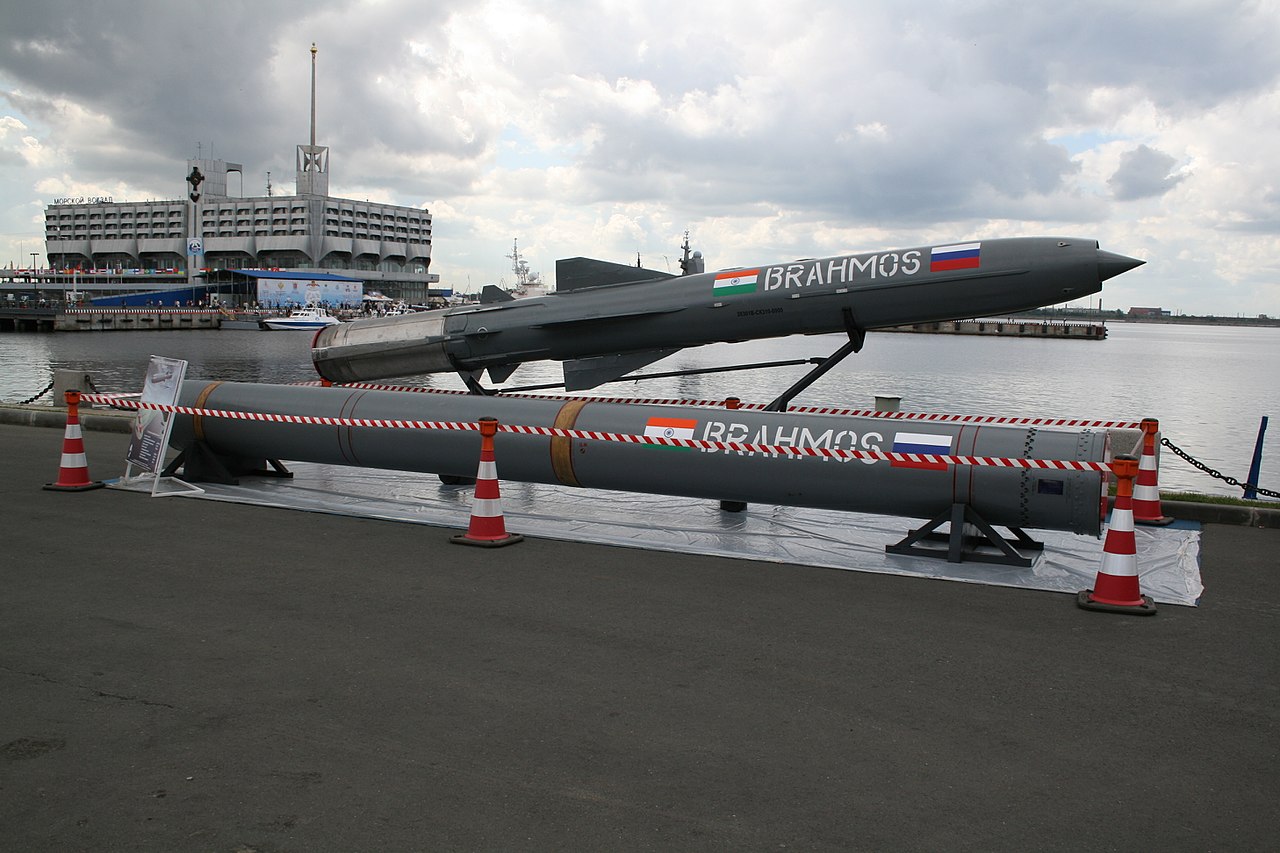
The standout is BrahMos-NG. The weight saving over the original air-launched round matters operationally: where a Su-30MKI carries a single first-generation BrahMos, the lighter NG is intended to let a fighter such as the Rafale carry more than one, multiplying the supersonic-strike volley a single sortie can deliver. The Astra line, meanwhile, is the route by which India reduces reliance on the European Meteor for its long-range air-to-air punch.
The integration logic is about mix, not just addition. A supersonic BrahMos-NG would sit alongside the subsonic, low-observable SCALP already cleared on the type, giving a planner both a fast multi-shot standoff weapon and a stealthy one on the same airframe. The Astra family lets the IAF blend indigenous and European rounds in a single beyond-visual-range loadout rather than leaning on the Meteor alone, while Rudram extends the fleet into the suppression of enemy air defences. None of this comes free of engineering risk. Each store still has to be cleared across the full flight envelope and made to behave with the Rafale's SPECTRA electronic-warfare suite and RBE2 active electronically scanned array (AESA) radar, which is exactly the work ICD access would let India lead.

Industrial and Programme Structure
Of the 114 aircraft, India intends that 94 be assembled in country, with the balance, reported as 18 to 20 airframes, delivered in fly-away condition from France. That would make India the first place the Rafale is built outside French soil. Final assembly is reported to be heading for the Dassault Reliance Aerospace Limited (DRAL) facility at Nagpur, with Dassault also standing up maintenance, repair and overhaul (MRO) capacity in India so the fleet can be sustained domestically rather than shipped back to Europe.
Indigenous content is described as a phased climb, beginning at roughly 25% and targeted to reach 50 to 60% by the end of the production run, although reported targets vary between outlets. The aircraft standard is reported as the Rafale F4, with India seeking a tailored configuration that Indian outlets label F4*, and a possibility that later tranches move to the future F5 standard. Each of these points sits inside the very negotiation the LoR opens, alongside price, delivery schedule, sustainment and the weapons-integration terms. France is expected to respond within two to three months with its position on pricing, technology transfer and production, after which formal talks begin.
There is a domestic precedent for the model. The C-295 transport, assembled by Tata and Airbus at a final assembly line in Vadodara, showed that India can stand up a Western-origin production line and raise indigenous content over time. A Rafale line at Nagpur, paired with the MRO base, would extend that pattern to a frontline combat type and a far larger value chain.
Strategic Context
The pull is capacity. The IAF is operating about 29 fighter squadrons against a sanctioned strength of 42.5, a gap widened by the retirement of older Soviet-era types and slow domestic replacement. A 114-aircraft injection, equivalent to roughly eight to ten squadrons, on top of the 36 IAF Rafales delivered from 2020 and the 26 Rafale Marine jets contracted for the Indian Navy, would carry the national Rafale total to 176 and give India a single large Western fleet to standardise training, basing and sustainment around. If ICD access is granted, the same sovereign-integration work could carry over to the Navy's carrier-borne Rafale Marine fleet, giving both services a common weapons pathway. Routing the buy government-to-government, rather than through a fresh multi-vendor contest, is intended to cut intermediaries and shorten the path to signature, with first deliveries not expected before the end of the decade.
Data Gaps
Several material points remain open at the time of writing. No Tier 1 primary document, the text of the LoR itself, is in the public domain, so all figures here rest on secondary reporting. The in-country build split is reported variously between about 90 and 96 aircraft assembled in India, with both 94 built against 20 fly-away and 96 against 18 appearing in coverage, which does not yet reconcile cleanly across sources. Indigenous-content targets differ between outlets, from an opening figure near 25% to an end-state of 50 to 60%. The airframe standard (F4, the India-specific F4*, or a later move to F5) is not contractually confirmed. The weapon parameters in the table are reported design or test figures, not ISC-verified, and per-aircraft BrahMos-NG carriage on the Rafale is unconfirmed. The central unknown is whether France will grant ICD access at all, and if so at what depth: full interface data sufficient for sovereign integration, or a narrower window that still leaves Dassault in the certification loop.
References
Source-evaluated under NATO STANAG 2022 (Reliability A–F / Accuracy 1–6). Tier 1 = government primary source; Tier 2 = quality news / specialist defence media; Tier 3 = authoritative aggregator / specialist forum. Note: no Tier 1 primary document (the LoR text) is public at the time of writing; the strongest available sources are Tier 2 reporting.
- T2BusinessToday – 114 Rafales for IAF: India sends Letter of Request to France, 1 June 2026. (Reliability B / Accuracy 2)
- T2Aerotime – India approves $39 billion purchase of 114 Rafale jets, 2026. (Reliability B / Accuracy 2)
- T2Defence Security Asia – India's US$39 Billion Rafale Mega-Deal Triggers Indo-Pacific Airpower Shift, 2026. (Reliability B / Accuracy 2)
- T2ThePrint – Rafale deal to be inked in 2026, final assembly line in Nagpur, 2026. (Reliability B / Accuracy 2)
- T3Indian Defence Research Wing (IDRW) – India Seeks Access to Rafale Interface Documents for Astra and BrahMos-NG Integration, 2026. (Reliability C / Accuracy 3)
- T3defence.in – India Places ICD Access as a Non-Negotiable Condition for 114 Rafale MRFA Deal, 2026. (Reliability C / Accuracy 3)
Corrections & updates welcome. If you hold open-source data that refines or corrects any parameter in this article, please contact [email protected] citing the specific claim and your source. Verified corrections will be incorporated and credited in the revision history. AI-assisted technical assessment based on open-source material. Not a formal intelligence product.