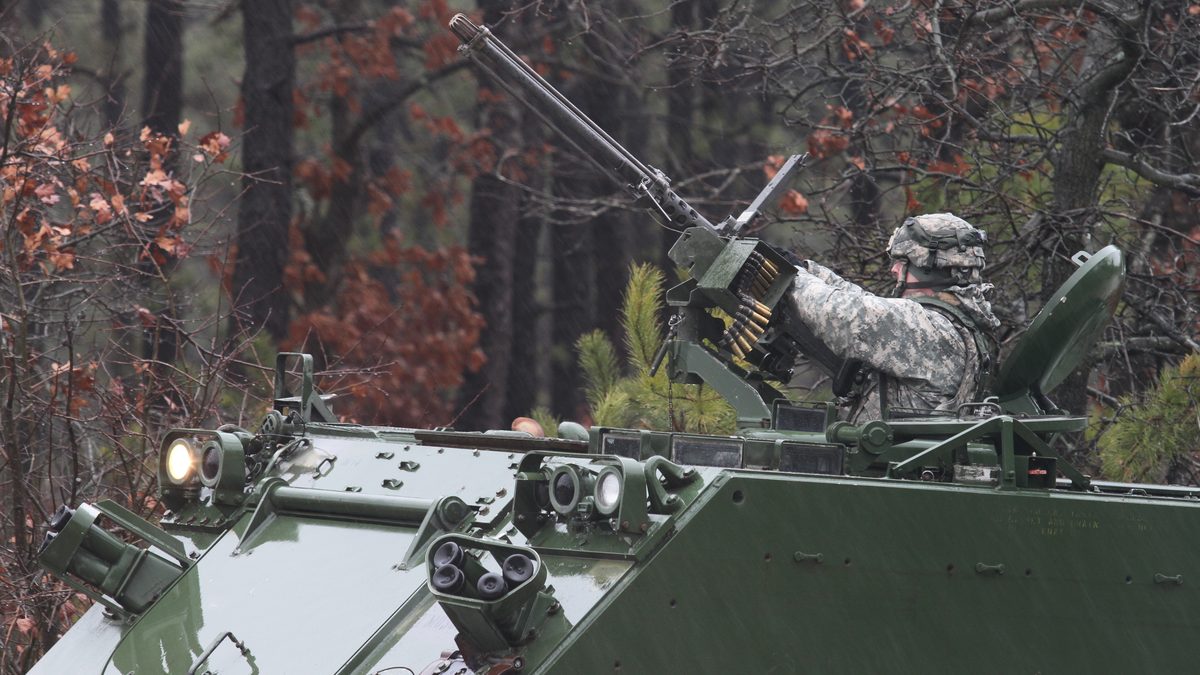
A U.S. Army soldier mans a .50-calibre M2 Browning heavy machine gun atop an M113 carrier. U.S. Army photo by Spc. Michael McDevitt (public domain) via Wikimedia Commons.
Three Calibres, One Standard: NSPA Tenders a Complete NATO Small Arms Family
Technical Summary
The NATO Support and Procurement Agency (NSPA) has published three Future Business Opportunity (FBO) notices, numbered 26LBS039, 26LBS040 and 26LBS041, that together describe a complete infantry small arms family. The set runs from an individual weapon through a section machine gun to a platoon or company heavy machine gun, each tied to a NATO standard calibre and a common delivery horizon of 30 November 2026. Each notice is issued for information only under NSPA Procurement Operating Instruction 4200-01, so none yet amounts to a solicitation. Read together, though, they point to one coordinated requirement rather than three unrelated buys.
The quantities are modest. FBO 26LBS039 seeks an estimated 100 individual weapons in 5.56 × 45mm NATO, described as an M4 style or equivalent ambidextrous AR-15 design with a 14.5 inch barrel, rails, 30 round magazines, a sling and a blank firing attachment. FBO 26LBS040 covers eight 7.62 × 51mm NATO medium machine guns, a two man section weapon, belt fed using disintegrating link and fitted with rails and a bipod. FBO 26LBS041 lists ten 12.7 × 99mm NATO heavy machine guns of M2 pattern, a two man platoon or company weapon, also belt and link fed. Every line item is quality assured to AQAP 2131 and includes tools, gauges and spares.
| FBO | Weapon | Calibre | Est. qty | Key features |
|---|---|---|---|---|
| 26LBS039 | Individual weapon (rifle) | 5.56 × 45mm NATO | 100 | M4 style / equivalent, ambidextrous AR-15, 14.5 in barrel, rails, 30 rd magazines, sling, BFA |
| 26LBS040 | Medium machine gun | 7.62 × 51mm NATO | 8 | Two man section weapon, belt / disintegrating link fed, rails and bipod, BFA |
| 26LBS041 | Heavy machine gun | 12.7 × 99mm NATO (0.50 in) | 10 | M2 style, two man platoon / company weapon, belt / disintegrating link fed, BFA |
One hundred 5.56mm rifles, eight 7.62mm machine guns and ten 12.7mm heavy machine guns, all to a single AQAP 2131 quality standard and a common 30 November 2026 delivery horizon. NSPA Future Business Opportunities 26LBS039, 26LBS040 and 26LBS041
A Textbook NATO Calibre Triad
The three calibres map cleanly onto NATO's small arms ammunition standards. The 5.56 × 45mm round is governed by Standardization Agreement (STANAG) 4172, the 7.62 × 51mm by STANAG 2310 and the 12.7 × 99mm by STANAG 4383. Specifying all three in one tranche means that rounds drawn from allied stockpiles will chamber and function in these weapons without modification. For any force that may fight or train alongside other NATO members, that is the difference between resupplying from a neighbour's pallet and being logistically stranded.
Interoperability runs past the cartridge. Both machine guns are specified as belt fed using disintegrating link, the standard NATO feed method: 7.62mm weapons use the M13 link described under STANAG 2329, and 12.7mm weapons the M9 pattern link. The rifle's 30 round magazine and AR-15 lineage sit within the most widely fielded magazine pattern in the alliance. Nothing in the specification is exotic, and that is the point. The buyer is selecting the mainstream of NATO small arms rather than a national niche, which keeps ammunition supply, spares and training pipelines inside the alliance ecosystem.
What the Specification Reveals
The platform language is deliberate. The rifle is "M4 style or equivalent" and the heavy machine gun "M2 style", phrasing that keeps competition open across several manufacturers while fixing the controls, manual of arms and accessory interfaces a trained soldier already knows. Both the AR-15 / M4 and the M2 Browning pattern are produced by multiple NATO suppliers, so neither line locks the buyer to a single source. The medium machine gun carries no named pattern at all. It is defined by role and function instead, a two man section weapon in 7.62mm with bipod and rails, a description that fits the FN MAG and M240 class without mandating it.
Two details point toward intended use. Every weapon includes a blank firing attachment (BFA), and every line carries tools, gauges and spares assured to AQAP 2131, the Allied Quality Assurance Publication that sets NATO quality assurance requirements for final inspection and test. A BFA and a full spares and gauge package are the marks of a force that will train hard on its weapons, not simply store them. That pattern is consistent with a new unit standing up, or a training establishment being equipped, and the small numbers, 100 rifles against single figures of machine guns, reinforce the reading. ISC assesses this interpretation as plausible but not confirmed, since the notices do not state the end user or the purpose.
One Vendor Could Now Cover the Whole Triad
The timing is hard to ignore. On 2 June 2026 FN Herstal announced the FN ARKA, a new 5.56 × 45mm NATO rifle that widens its range. Until now FN was the obvious contender for the two machine gun lines but not the rifle. The FN MAG, fielded by more than 90 nations under designations including the L7, C6, Ksp 58 and the United States M240, effectively defines the 7.62mm two man section weapon that FBO 26LBS040 describes. For the heavy line, FN builds M2 pattern 12.7mm guns in its FN M2HB-QCB and faster firing FN M3 series, squarely inside the scope of FBO 26LBS041. The 5.56mm individual weapon was the one gap in that line up, and the ARKA closes it.
FN Herstal showed the rifle in its own launch announcement, which carries the official product video:
According to FN, the ARKA pairs AR-15 ergonomics with the short-stroke gas piston and mechanical lineage of the FN SCAR, which is in service with more than 20 armed forces. It is offered with a 14.5 in standard barrel or an 11.25 in close quarters barrel, M-LOK handguards, a long Picatinny top rail, fully ambidextrous controls including the bolt catch, an adjustable gas block, and a choice of selective fire or semi-automatic triggers in black or flat dark earth. FN lists blank firing attachments and simulation kits among its accessories. That description reads almost line for line against FBO 26LBS039, which calls for an M4 style or equivalent ambidextrous AR-15 in 5.56mm with a 14.5 in barrel, rails and a blank firing attachment.
| Calibre | 5.56 × 45mm NATO |
|---|---|
| Operating system | Short-stroke gas piston (FN SCAR lineage) |
| Architecture | AR-15 ergonomics; fully ambidextrous controls and bolt catch; T-shaped charging handle; forward assist |
| Barrel options | 14.5 in standard, or 11.25 in close quarters (CQC) |
| Handguard / rail | Short or long M-LOK handguard; long Picatinny top rail |
| Trigger | Selective fire or semi-automatic only |
| Finish / furniture | FDE or black; any AR-compatible buttstock and pistol grip |
| Notable extras | Flow-through suppressor, blank firing attachment, simulation kits, FN SMARTCORE maintenance, FN VICTOR training |
| First public showing | Eurosatory, Paris, 15 to 19 June 2026 |
This remains a capability observation, not a prediction. NSPA has named no requirement owner and published no Request for Proposal, and several alliance manufacturers build to the same AR-15 and M2 patterns, so any eventual competition would be open. The narrower and more useful point is that a single NATO supplier can now offer an in-production answer to every line of this triad, in the right calibres, with the right feed systems, from one support chain.
Data Gaps
The notices are information only and disclose neither the end user nation or unit, nor an estimated contract value, nor a published Request for Proposal (RFP). The "LBS" element of the reference series is not explained in the documents and is not interpreted here. The medium machine gun is specified by role rather than by a named platform. FN ARKA specifications cited here are drawn from FN Herstal's own launch announcement and have not been independently tested. Each gap will likely close only if and when NSPA issues the corresponding RFP on its eProcurement portal, for which registration in the NSPA Source File is mandatory.
References
Source-evaluated under NATO STANAG 2022 (Reliability A–F / Accuracy 1–6). Tier 1 = government primary source; Tier 2 = quality news / specialist defence media; Tier 3 = authoritative aggregator / encyclopaedia. Primary sources are NSPA Future Business Opportunities 26LBS039, 26LBS040 and 26LBS041. All web sources accessed 2 June 2026.
- T1NSPA · Procurement Opportunities (eProcurement Future Business Opportunities). (Reliability A / Accuracy 1)
- T1NSPA · Vendor registration and the NSPA Source File. (Reliability A / Accuracy 1)
- T1NATO · Small arms and light weapons (SALW) and mine action. (Reliability A / Accuracy 2)
- T1NATO / ANSI · AQAP-2131C, NATO Quality Assurance Requirements for Final Inspection and Test. (Reliability A / Accuracy 2)
- T2GlobalSpec · STANAG 4172, interchangeability of 5.56mm x 45 ammunition. (Reliability B / Accuracy 2)
- T3Wikipedia · NATO cartridge (STANAG 2310, 4172 and 4383 mapping). (Reliability C / Accuracy 3)
- T2The Firearm Blog · Portugal signs small arms deal with FN via NSPA, 4 March 2019. (Reliability C / Accuracy 3)
- T2FN Herstal · FN expands rifle range with new FN ARKA, 2 June 2026. (Reliability B / Accuracy 2, manufacturer announcement)
- T2FN Herstal · FN MAG 7.62mm general purpose machine gun. (Reliability B / Accuracy 2)
- T2FN Herstal · Machine guns range, including FN M2HB-QCB and FN M3 .50 calibre. (Reliability B / Accuracy 2)
Corrections & updates welcome. If you hold open-source data that refines or corrects any parameter in this article, please contact [email protected] citing the specific claim and your source. Verified corrections will be incorporated and credited in the revision history. AI-assisted technical assessment based on open-source material. Not a formal intelligence product.