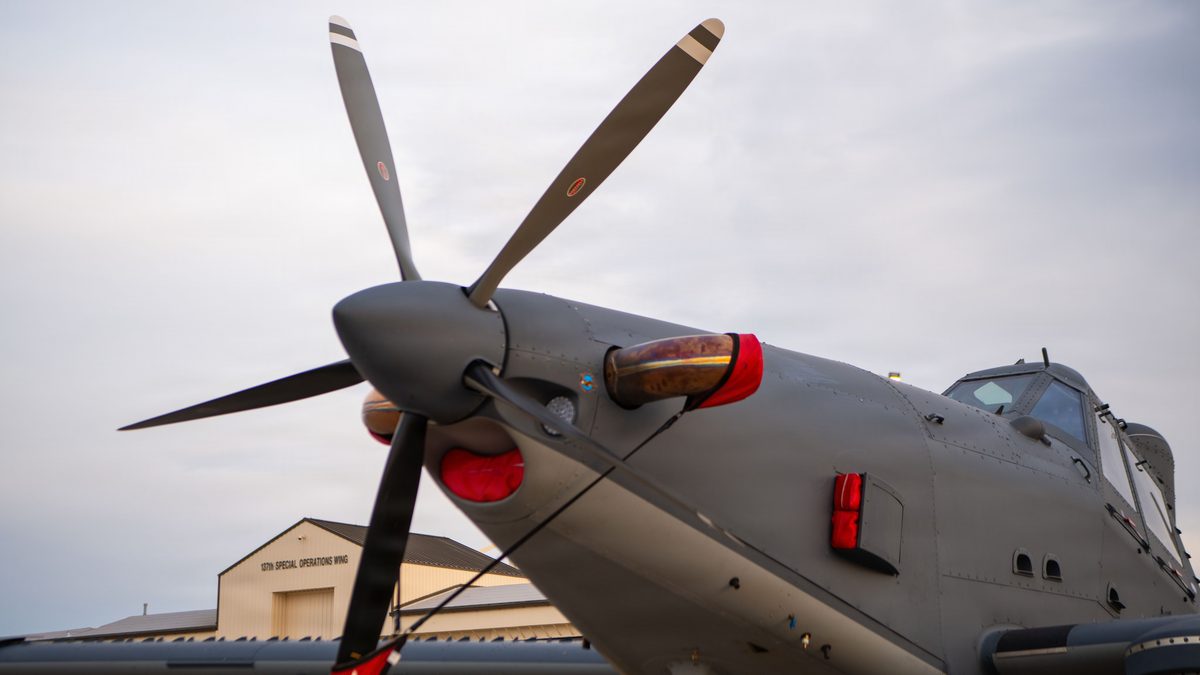
Photo: Staff Sgt. Erika Chapa / 137th Special Operations Wing / DVIDS / Public Domain. The appearance of U.S. Department of Defense visual information does not imply or constitute DoD endorsement.
A crop duster has become one of the more interesting procurement stories in Western air power. The OA-1K Skyraider II, profiled at length in a recent Afterburn documentary on the L3Harris production line, takes the rugged Air Tractor AT-802 agricultural airframe and turns it into a two-seat, ten-hardpoint armed reconnaissance aircraft for United States special operations. It is cheap to fly, lands almost anywhere, and loiters for hours with precision weapons on the wing. The natural question for a British audience follows quickly: should the United Kingdom buy something like it?
The short answer, set out in full below, is no. Not because the aircraft is poor, but because the strategic window it was designed for is closing, and Britain has already chosen to step through a different door. To understand why, it helps to be precise about what the Skyraider II is, why the Americans bought it, and what the United Kingdom's own defence planning now demands.
What the Skyraider II actually is
The OA-1K is built up from the Air Tractor AT-802, a single-engine turboprop better known for spraying fields and fighting fires. L3Harris militarises the airframe for the Armed Overwatch programme of United States Special Operations Command (SOCOM), the requirement that asked industry for a persistent, affordable aircraft to support Special Operations Forces (SOF) in irregular wars. Air Force Special Operations Command (AFSOC) formally named it Skyraider II in February 2025, a deliberate nod to the piston-engined A-1 of Vietnam.
The design choices tell you what it is for. It carries two crew in tandem, one flying and one running the sensors, communications and weapons. A Pratt & Whitney PT6A-67F turboprop of roughly 1,600 horsepower gives a patrol speed around 180 knots and an endurance past six hours, with a quoted loiter of six hours at a 200 nautical mile (370 km) radius. The combat load is about 6,000 lb across ten hardpoints, two on the centreline and eight under the wing. Typical weapons are the AGM-114 Hellfire missile, the GBU-12 Paveway II laser-guided bomb, and the Advanced Precision Kill Weapon System (APKWS), a laser-guidance kit that turns an unguided 70 mm rocket into a low-cost precision round. L3Harris has also been trialling longer-range strike weapons such as its Red Wolf missile, though published ranges for that munition remain manufacturer claims and are not independently verified.
Two features matter more than the brochure figures. First, the aircraft is built for austere operations: a tail-wheel undercarriage for rough strips, and a design that can be broken down to fit inside a single C-17 and reassembled to mission-ready status within a day. The new Block II variant, shown at SOF Week in May 2026, pushes that rapid deploy-and-reassemble idea further. Second, the survivability concept is bought, not flown. There are no ejection seats. Instead the crew sit inside an armoured composite tub and a steel roll-cage, behind ballistic glass, above self-sealing fuel tanks, with a missile approach warning system and chaff and flare dispensers fitted. When an OA-1K came down in a field near its Oklahoma training base in October 2025, both crew walked away unhurt, a small but real data point for a design that trades ejection seats for an armoured cell. That is a sensible fit for small-arms, heavy machine guns and the occasional shoulder-launched missile. It is not a fit for a modern integrated air defence system.
| Dimensions | Length 37.5 ft (11.4 m); wingspan 59.25 ft (18.1 m); height 13 ft (4.0 m) |
|---|---|
| Weights | Empty about 7,836 lb (no armour or weapons); maximum gross about 16,000 lb |
| Powerplant | One Pratt & Whitney PT6A-67F turboprop, about 1,600 hp; 5-blade Hartzell propeller |
| Performance | Max about 213 kn; patrol about 180 kn; stall about 91 kn; ferry range about 1,303 nmi; loiter about 6 hrs at 200 nm (370 km) |
| Sensors | WESCAM MX-15 and MX-20 electro-optical / infrared turrets on underwing pods |
| Self-protection | Armoured cockpit tub, steel roll-cage, ballistic glass, self-sealing tanks; AN/AAR-47 missile warning; AN/ALE-47 chaff and flare; no ejection seats |
| Armament | 10 hardpoints (2 centreline, 8 wing); AGM-114 Hellfire, GBU-12 Paveway II, APKWS 70 mm guided rockets |
| Deployability | Disassembles to fit one C-17 and reassembles to mission-ready in under a day; tail-wheel for austere strips |
| Operating cost | Reported under US$1,000 per flight hour, against tens of thousands for a fast jet |
Why the Americans bought it, and why the case is contested
The American logic was sound on its own terms. After two decades over Afghanistan and Iraq, AFSOC had been flying expensive fast jets and unarmed turboprops such as the U-28A Draco to watch over small teams on the ground. An armed AT-802 promised the same orbit time and a strike option at a fraction of the cost per flying hour, reported at under US$1,000 an hour against tens of thousands for a fast jet, from runways a jet could not use. SOCOM signed a contract worth up to US$3 billion in August 2022 for as many as 75 aircraft, with deliveries running toward the end of the decade. The first missionised OA-1K reached AFSOC in April 2025, and Initial Operational Capability (IOC) is expected around the end of fiscal year 2026.
The trouble is timing. In December 2023 the United States Government Accountability Office (GAO) told the Pentagon to slow the programme down and field a substantially smaller fleet, arguing that SOCOM had not justified the numbers against a force posture that has largely left protracted counter-insurgency behind. The pressure showed, and it has kept showing. The buy fell from 75 to 62 aircraft, then to 53 in the fiscal year 2027 budget request, with the annual order dropping from six airframes to just two, even as SOCOM maintains that its formal requirement is still 75. Eighteen aircraft had been delivered by May 2026, with 45 on contract. The criticism is not that the aeroplane fails at its job. It is that the job itself, persistent armed overwatch in permissive skies, is a smaller part of American strategy than it was when the requirement was written.
That is the inheritance any British buyer would take on. A platform optimised for the last war, bought into a shrinking mission set, by an ally that is itself trimming the order. None of that is disqualifying on its own. It does, though, set a high bar for a UK case, and Britain's own planning makes that bar higher still.
What Britain has actually decided to do
The United Kingdom has never operated a dedicated propeller-driven light attack aircraft in the modern era. It met its counter-insurgency air needs over Iraq and Afghanistan with fast jets, with the Tornado and Typhoon, and with the armed Reaper remotely piloted air system. Reconnaissance for special operations has come from manned intelligence-gathering aircraft such as the King Air-based Shadow, from rotary lift, and from contracted surveillance, not from an armed turboprop orbiting overhead. There is no British tradition here to revive, and no airframe gap labelled "light attack" waiting to be filled.
More to the point, the Strategic Defence Review (SDR) published in June 2025 sets a direction that runs almost exactly opposite to the Skyraider II concept. The review treats autonomous and uncrewed systems as an essential component of land warfare, commits around £4 billion to autonomous systems, and orders a Digital Targeting Web to connect sensors and shooters, with a minimum viable product in 2026 and fuller delivery by 2027, alongside a new Defence Uncrewed Systems Centre due to reach initial operating capability in February 2026. It leans on space-based and artificial-intelligence-enabled reconnaissance, on drone swarms, and on a recce-strike model that fuses data from satellites, uncrewed aircraft, ships and cyber sensors. The armed Protector RG1, the MQ-9B that replaces Reaper, entered Royal Air Force service in June 2025, the first large uncrewed aircraft cleared to fly in all classes of UK airspace, and now carries the persistent armed intelligence, surveillance and reconnaissance (ISR) role.
Read those choices together and the message is clear. When the United Kingdom wants an aircraft to loiter and strike in a low-threat environment, it now reaches for an uncrewed system that puts no aircrew at risk and feeds directly into the targeting network it is building. A manned, two-seat turboprop is not a complement to that vision. It is a step away from it.
The survivability problem the brochure cannot solve
There is a deeper reason for caution, and it comes from the war Europe is actually watching. The light attack aircraft's niche has always been permissive to lightly contested airspace, where the threats are rifles, machine guns and the odd shoulder-launched missile, and where survival depends on tactics: height, terrain, unpredictable orbits and a willingness to break off. Push the same aircraft into contested skies and the maths changes fast.
Ukraine has made the point in blood. Dense layers of man-portable air-defence systems (MANPADS) and short-range anti-aircraft fire made low-level daylight flying prohibitively dangerous for both sides within months, and pushed surviving manned aircraft to stand-off ranges that blunt the very advantage a loitering hunter is meant to provide. A turboprop at patrol speed, however well armoured its cockpit, is firmly inside that threat envelope. The missile warning system and the flares help against a single seeker. They do not let a slow aircraft live over a defended European or near-peer battlefield, which is precisely the environment the SDR is preparing British forces to fight in.
So the capability the Skyraider II offers is real, but it is the wrong shape for the threat that dominates UK planning. It is excellent where Britain is least likely to need a new manned platform, and dangerous where Britain is most likely to fight.
The loiter problem, and who should solve it

There is a stronger version of the pro-light-attack case, and it deserves to be met head on. Fast jets are poor loiterers. The F-35B that anchors British and carrier air power holds less internal fuel than the F-35A, roughly 6,130 kg against 8,280 kg, and works to a combat radius near 450 nautical miles that shrinks the longer it stays overhead. It was never built to circle low over troops for hours, and trials have marked it down on the very qualities close air support rewards: endurance on station, low-speed handling and a deep magazine. The aircraft that used to do that job for British and American land forces are gone or going. Britain retired the Harrier in 2010 and fielded no replacement for its persistence. The United States has tried for years to divest the A-10 and now expects to keep it only to around 2030.
So there is a real persistence gap above land forces, and a manned aircraft like the Skyraider II is one way to plug it. It is not the way that fits British strategy, because the same loiter-and-strike effect can now be had without putting a crew in a slow aircraft, and the United Kingdom is already buying the parts. Loitering munitions hand the land force its own organic precision strike. The Switchblade, which the UK has committed to procure, reaches out around 40 km with roughly forty minutes of flight, and heavier classes such as UVision’s Hero-120 carry an anti-armour warhead to about 60 km with an hour on the wing. Above them sits Protector, the armed MQ-9B, for the multi-hour overwatch and the repeat strikes a single munition cannot offer. The Army’s stated ambition, under its 20-40-40 design, is a drone in every section, with autonomous platforms working alongside the Apache.
That layered, uncrewed mix already covers the Skyraider II’s core mission, persistent eyes plus responsive fires for troops on the ground, while keeping aircrew out of the threat envelope and feeding the targeting network the review is building. The loiter problem is genuine. The answer Britain has chosen is not a crewed crop-duster.
The honest case for buying in
Fairness demands the other side be put properly. There is a narrow set of conditions under which a small UK light-attack capability would make sense, and it deserves to be stated without strawmanning.
The strongest argument is economy of effort in permissive theatres. Using a £100-million-class fast jet, or a high-demand Protector, to watch over a small team in a low-threat African or Middle Eastern deployment is poor value. An armed turboprop with a low cost per flying hour, able to work from a dirt strip and stay overhead for six hours, is a genuinely efficient tool for that specific job, and it keeps scarce high-end assets free for higher-end tasks. There is also a defence-diplomacy angle. The AT-802 family already serves with more than fifty nations, including Jordan, Egypt and the United Arab Emirates, and L3Harris holds export approvals for the international Sky Warden across twenty-plus countries. A platform partners can afford and sustain is a useful currency for building their capacity, training alongside them, and shaping a region without a large Western footprint. For a country that still runs standing commitments east of Suez and across Africa, that is not nothing.
The weakness of the case is that none of these tasks clearly requires a British-owned, British-crewed fleet. Persistent overwatch in permissive skies can be flown by Protector. Partner capacity can be built by enabling allied operators who already fly the type, by training and sustainment support, or by pooled arrangements, rather than by standing up a bespoke Royal Air Force (RAF) squadron with its own training pipeline, basing and through-life cost. The niche is real. The requirement for the UK to fill it with metal is not.
ISC assessment
No. The strategic moment has passed, and the money belongs elsewhere.
On the balance of evidence, the United Kingdom does not need to procure an OA-1K-class light attack platform as a capability priority. The aircraft is well made and the American requirement was rational, but it is optimised for permissive counter-insurgency, a mission set the UK is deliberately moving beyond and one its closest ally is itself scaling back.
Three findings drive the verdict. First, strategic fit: the SDR 2025 portfolio is built around uncrewed, autonomous and networked systems, and a manned turboprop pulls against that grain rather than reinforcing it. Second, survivability: the Ukraine evidence on MANPADS and layered air defence places a slow manned aircraft squarely inside the threat envelope of the contested fights Britain is preparing for. Third, opportunity cost: the same money does more for the UK inside the Protector fleet and the autonomous-systems and digital-targeting investment the review has already prioritised.
We assess only one defensible exception, and it is narrow: a small, optional capability for persistent SOF overwatch and partner-capacity building in genuinely permissive theatres. Even there, the cleaner route is to enable allied operators who already fly the type and to lean on uncrewed systems, rather than to stand up a bespoke British fleet. The honest recommendation is to watch the programme, keep the option open through allies, and invest at home in the uncrewed and networked capabilities that match the threat.
Confidence: Moderate to high on strategic fit and survivability; moderate on cost, where UK-specific through-life figures are not in the public domain. Key data gap: no published UK requirement, costing or operational analysis exists for a light-attack buy, so this assessment reasons from US programme data and stated UK strategy rather than from a British business case.
The Skyraider II is a reminder that good engineering and good strategy are different things. L3Harris has built a capable, affordable aircraft that answers a real American need. Britain's need, as its own review describes it, lies in uncrewed reach, networked targeting and survivability against a serious enemy. On that test, the answer to the question in the headline is a considered no.
Assessment & Evaluated References
Source reliability and information accuracy rated per NATO STANAG 2022 (Reliability A–F / Accuracy 1–6).
- “L3Harris OA-1K Skyraider II,” Wikipedia (consolidated programme history, specifications and contract data). en.wikipedia.org/wiki/L3Harris_OA-1K_Skyraider_II
- “OA-1K Skyraider II,” AFSOC fact sheet, United States Air Force. afsoc.af.mil
- U.S. Government Accountability Office, “Special Operations Forces: DOD Should Slow Acquisition of Armed Overwatch Aircraft Until It Conducts Needed Analysis,” GAO-24-106283, 15 Dec 2023. gao.gov/products/gao-24-106283
- “Slow Down Armed Overwatch Until SOCOM Justifies Fleet, GAO Says,” Air & Space Forces Magazine, 15 Dec 2023. airandspaceforces.com
- “SOCOM Halves OA-1K Armed Overwatch Buy for 2026,” Air & Space Forces Magazine. airandspaceforces.com
- “SOCOM budget for OA-1K drops from 62 to 53 planes” (FY2027 request; annual buy cut to two; requirement held at 75), Defense Daily. defensedaily.com
- Operating cost reported under US$1,000 per flight hour (vendor / AFSOC framing), The National Interest. nationalinterest.org
- “First OA-1K Skyraider II Handed Over To Air Force Special Operations Command,” The War Zone, 3 Apr 2025. twz.com
- “SOF Week 2026: AFSOC unveils deployable Block II OA-1K Skyraider II,” Shephard Media. shephardmedia.com
- “Air Tractor AT-802” (export operators and Sky Warden lineage), Wikipedia. en.wikipedia.org/wiki/Air_Tractor_AT-802
- “The Strategic Defence Review 2025: Making Britain Safer,” HM Government (published 2 June 2025; all 62 recommendations accepted), GOV.UK. gov.uk
- “Strategic Defence Review 2025: Key points and paper series,” House of Commons Library. commonslibrary.parliament.uk
- “Drones and the UK Strategic Defence Review 2025,” SALIENT. salient-hub.org
- “Protector RG1 UAV has officially entered RAF service” (16 June 2025; Military Type Certificate 29 April 2025), European Security & Defence. euro-sd.com
- “Contested Skies: Air Defense after Ukraine,” Modern War Institute, West Point. mwi.westpoint.edu
- “Projecting power with the F-35 (part 1): How far can it go?” (F-35B fuel, radius and persistence), ASPI The Strategist. aspistrategist.org.au
- “UK to buy Switchblade loitering munition,” Flight Global. flightglobal.com
- Loitering-munition characteristics: Switchblade 600 (Army Recognition) and UVision Hero-120 (Designation-Systems). armyrecognition.com / designation-systems.net
- “Congress Moves to Block A-10, F-15E Divestments in NDAA” (A-10 retained to ~2030), Air & Space Forces Magazine. airandspaceforces.com
- Afterburn Defense, “America’s Special Forces Newest Attack Aircraft: The OA-1K Sky Raider II,” YouTube (originating source; embedded above, showing the L3Harris line, cockpit and mission displays). youtu.be/uvAyxlmpBdk
- Hero image: DVIDS asset image:9656803 (VIRIN 260331-Z-NA392-1002), “OA-1K Skyraider II Oklahoma sunrise flightline photos,” Staff Sgt. Erika Chapa, 137th Special Operations Wing, published 3 May 2026. dvidshub.net/image/9656803. Public domain (17 U.S.C. § 105); editorial use with non-endorsement disclaimer.
- In-flight image: DVIDS asset image:9224668 (VIRIN 250625-F-OC707-9009), “Skyraider” (OA-1K take-off, developmental testing), Samuel King Jr., 96th Test Wing, Eglin Air Force Base, published 25 June 2025. dvidshub.net/image/9224668. Public domain (17 U.S.C. § 105).
This analysis is AI-assisted and based entirely on open-source, unclassified material. Figures and programme details are drawn from the cited sources and reflect reporting current to late May 2026; defence procurement decisions and contract numbers change, and readers should verify against primary sources before relying on any figure. Nothing here constitutes procurement, investment or legal advice. Imagery is U.S. Air Force / DVIDS, public domain; the appearance of U.S. Department of Defense visual information does not imply or constitute DoD endorsement.