One Owner for Britain's Sovereign Rifle Base: FN Browning Group Acquires Accuracy International
A Belgian-headquartered group has agreed to buy Portsmouth's Accuracy International, the specialist behind British forces' bolt-action sniper rifles. The deal places it alongside FN UK, the source of their machine guns, under a single foreign owner, just as the Army runs Project GRAYBURN, its first wholesale service-rifle competition in four decades.
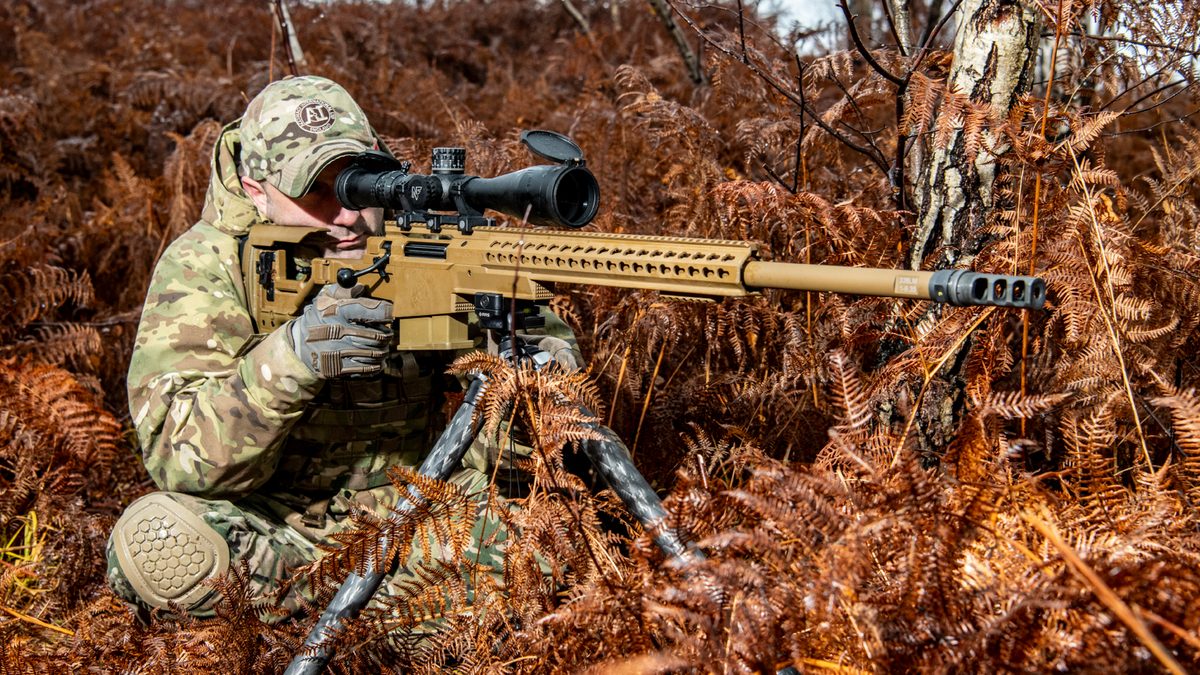
An Accuracy International AXSR multi-calibre bolt-action precision rifle. Image: Accuracy International, from the company’s product pages (accuracyinternational.com/axsr-mil). Reproduced with attribution to the rights holder; not an open-licence image.
FN Browning Group and Accuracy International announced a strategic acquisition agreement on 28 May 2026, datelined Portsmouth and Liège. Under the agreement the group, parent of FN Herstal, Browning and Winchester, will acquire the Portsmouth specialist in precision bolt-action rifle systems. No financial terms were disclosed. The transaction remains subject to customary regulatory approvals. Accuracy International will continue under its own brand, its engineering culture and its existing UK and United States manufacturing bases.
Accuracy International built the L96 sniper rifle that the British Army adopted as the L96A1 in 1985, and the .338 Lapua Magnum L115 that followed into service in 2008. The company says it has supplied rifles to more than 70 countries over its history, and to over 50 in the past five years. Its business is precision rifles end to end: the design and manufacture of bolt-action sniper and tactical systems for military and law-enforcement users, a parallel range for long-range and competition shooters, plus accessories, ammunition supply, repair and user training. The current line includes the multi-calibre AXSR and the AT-X, chambered from 6.5 Creedmoor and .308 Winchester up to .338 Lapua Magnum, with barrels cut-rifled in England. Every rifle it makes is bolt-action.
Two makers, one base
The release makes an industrial claim: together, it states, FN UK and Accuracy International are the United Kingdom’s only established manufacturers of machine guns and precision rifles for the UK armed forces. That is a combined statement about two complementary firms, not a description of either one. The machine guns belong to FN. Its British arm, FN UK (the former Manroy Engineering, acquired by FN in 2014), supplies the Army’s L7A2 general-purpose machine gun, the FN MAG, and the L111A1 .50 calibre heavy machine gun, and in 2025 won a ten-year contract from Defence Equipment & Support to upgrade and sustain the L111A1 fleet. Accuracy International makes precision bolt-action rifles, and only those: it builds no machine guns and no self-loading service rifles. With this agreement, the two capabilities sit within one group headquartered outside the UK.
FN Browning Group casts that concentration as a gain for British sovereignty. Its UK chief executive, Michelle Cantoni, said combining FN UK’s industrial capability with AI’s expertise reinforces the country’s ability to "design, develop, and sustain critical small-arms capabilities and skills onshore." The group’s chief executive, Julien Compère, tied the deal to UK strategic autonomy. Colonel Will Waugh, the Ministry of Defence’s Dismounted Close Combat team leader, was quoted in the same company release welcoming the combination and "continued access to cutting edge capabilities."
Inside the platform: the AXSR
The rifle in the photograph, the AXSR, is the company’s current multi-calibre flagship, and it shows why this is a sovereign-manufacturing question rather than a question of badges. The AXSR is a long-action bolt rifle built on a proofed EN24T steel action with a maraging-steel, six-lug bolt, bedded into an aluminium chassis. Its barrels are cut-rifled in England by AI, and a user can change calibre in minutes with the QuickLoc system, turning a hex key stored under the cheekpiece. Factory chamberings run 6.5 Creedmoor (1:8 twist), .308 Winchester (1:10), .300 Winchester Magnum (1:11) and .338 Lapua Magnum (1:9.35, on a 27-inch barrel), feeding from a 10-round magazine onto a 20/30 MOA STANAG 4694 rail. A 27-inch .338 build weighs about 7.4 kg with brake and empty magazine, and folds from roughly 1,265 mm to 1,050 mm for carriage. The lighter AT-X is its short-action sibling in 6.5 Creedmoor and .308, aimed at patrol and law-enforcement marksman work.
Bolt-action is a deliberate engineering choice, not a legacy one. With no gas system to foul or to disturb barrel harmonics, a bolt gun delivers the repeatable precision, often sub-minute-of-angle with match ammunition, that sniper, designated-marksman and anti-materiel roles depend on, and it holds zero through mud, sand and arctic cold where self-loaders are more readily upset. For engagements beyond 1,000 m with heavy match rounds it remains the professional default, and it is the niche Accuracy International has held for four decades. None of it competes with an assault rifle, which is the point that matters for what follows.
Why the timing matters
The agreement arrives while the British Army runs Project GRAYBURN, the programme to replace the SA80/L85 family that has been the standard service weapon for roughly 40 years. Reporting through early 2026 placed GRAYBURN at the concept stage, covering an estimated 150,000 to 180,000 rifles, with the L85A3 out-of-service date projected around 2030 and a contract award expected in late 2026 or early 2027. The Ministry of Defence has set an explicit requirement for UK manufacture to strengthen sovereign supply chains, alongside a demand that the new weapon defeat current and emerging body armour.
One distinction that must not blur
GRAYBURN is an assault-rifle competition. Accuracy International makes bolt-action precision and sniper rifles. The two do not overlap on product, and AI is not a GRAYBURN bidder. The link between this acquisition and GRAYBURN is industrial, not a product bid.
Declared and reported GRAYBURN contenders are assault-rifle makers: Beretta Defence Technologies (with Sako), Heckler & Koch offering the HK416 and HK433, and others, with SSS Defence confirming a bid in February 2026. The connection to this deal runs through the UK-manufacture requirement, which rewards onshore capacity. The group that now owns Accuracy International also owns FN UK, whose own assault-rifle designs (the SCAR family) have been raised in reporting as a possible entry. That is the part of the group with potential GRAYBURN relevance. Accuracy International is not.
What to watch: the foreign-ownership question
The open question is regulatory. A Belgian-headquartered group acquiring a UK sovereign sniper-rifle supplier is a plausible candidate for scrutiny under the National Security and Investment Act 2021, which lets the government call in, and if necessary attach conditions to, acquisitions touching defence and critical capabilities. Defence is one of the sectors subject to mandatory notification under that regime, and both firms supply the UK armed forces, so the transaction sits well within the kind of deal it was built to examine. No call-in had been announced at the time of writing. Whether the Investment Security Unit reviews the deal, and on what conditions, will shape both the completion timeline and the terms on which a single foreign owner holds the UK’s onshore small-arms base.
From a Portsmouth workshop to FN Browning Group
Accuracy International was founded by a group of British international target shooters, among them the Olympic gold medallist Malcolm Cooper. The company and FN date that founding to 1980, although some histories place the original Portsmouth workshop a little earlier, around 1978; either way, it has spent more than four decades in precision rifles. Its L96 win in 1985 made the company’s name. Export contracts followed, including Sweden’s PSG90 in 1991 and Germany’s G22 in 1995, with the L115A3 entering British service in 2008. AI received the Queen’s Award for Enterprise for International Trade in 2015. The firm weathered private-equity ownership and a 2005 administration before returning to founder and management control under directors including Tom Irwin, who is quoted on the FN agreement. That agreement closes a long arc: independence built, lost, regained, and now folded into a larger group.
ISC Commentary
The official framing is coherent on its own terms. Foreign capital, secured jobs, wider export reach through FN’s global network, and continuity of the Accuracy International brand are real benefits, and the MoD’s quoted welcome is a meaningful signal from the customer. Two long-standing UK suppliers gain scale and a route to more export markets.
The framing still deserves examination rather than repetition. Strategic autonomy is being claimed for a transaction that places both of Britain’s established onshore small-arms makers under one owner based outside the UK. Sovereignty of capability and sovereignty of ownership are not the same thing. Concentrating machine-gun and precision-rifle manufacture in a single foreign-owned group reads two ways: as resilience through scale, or as a narrowing of the onshore base to one corporate point of decision. The National Security and Investment Act is the instrument through which the UK can test that question and, if it chooses, condition any approval on continuity of supply, UK control of sensitive technology, and security of the Portsmouth manufacturing site.
For anyone watching GRAYBURN, the discipline is to keep the threads apart. This deal does not enter Accuracy International into the assault-rifle race. If the group holds a GRAYBURN card, it is FN’s own self-loading designs such as the SCAR, not anything from Portsmouth. What it does is sharpen the question the Army’s own UK-manufacture requirement already raises: when sovereign supply is the stated goal, how much does it matter who owns the sovereign supplier?