Ukraine Splits Largest-Ever 155 mm Buy Across Six Vendors: Full Platform Picture and the Reform Lineage
Ukraine’s Defence Procurement Agency (DOT) has signed contracts with six manufacturers for what Defence Minister Mykhailo Fedorov describes as the agency’s largest-ever batch of 155 mm long-range artillery shells. Competition shaved 16% off the original cost envelope. Fedorov says that money has been redirected into tens of thousands more rounds. This amended assessment adds the verbatim official statements from Fedorov and from Defence Procurement Agency Director Arsen Zhumadilov, the full list of North Atlantic Treaty Organisation (NATO)-standard 155 mm platforms in Ukrainian service that will fire the rounds, the wider industrial and reform context, and a corrected reference set with NATO Standardisation Agreement (STANAG) 2022 source ratings.
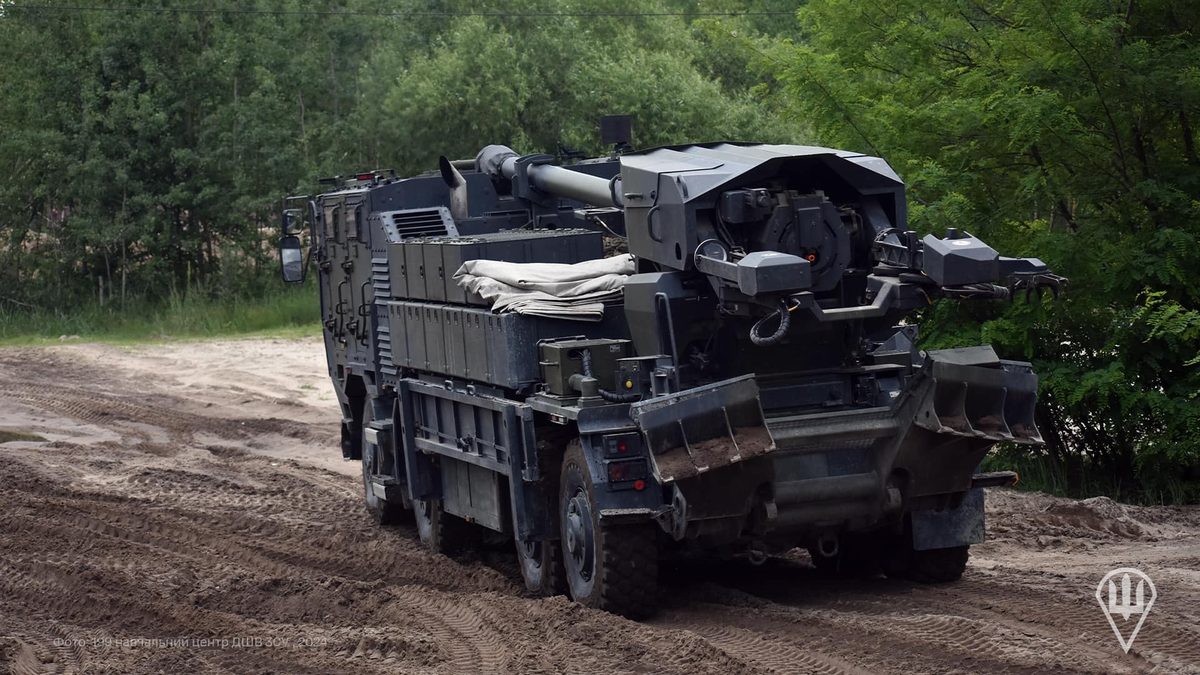
Above: Nexter CAESAR 8×8 155 mm self-propelled howitzer in service with the Ukrainian Air Assault Forces (DShV). One of at least nine NATO-standard 155 mm platforms in the Ukrainian Armed Forces fleet that will fire the rounds covered by the 25 May 2026 DOT six-supplier framework. Image credit: 199 Training Centre, Ukrainian Air Assault Forces, via Wikimedia Commons. Licence: CC BY 4.0.
At a glance
- Buyer: Defence Procurement Agency of Ukraine (DOT, the Derzhavnyi Operator Tylu, or State Operator of Rear)
- Item: 155 mm NATO long-range artillery projectiles. Family (high explosive, base-bleed, rocket-assisted, extended-range full-bore) not disclosed
- Suppliers: six winning manufacturers, identities withheld on stated security grounds
- Headline outcome: 16% saving against the original cost envelope, redirected into “tens of thousands” of additional rounds
- Delivery window: across calendar year 2026
- Strategic frame: pilot for competitive tendering of FPV, mid-strike and deep-strike unmanned aerial vehicles (UAVs) from summer 2026, via the Prozorro electronic transparency platform where security permits
- Reform context: direct response to documented 2022–2026 procurement irregularities, including the food rations, reactive armour and anti-drone arches cases
Official Statements
The announcement was published on the Ukrainian Ministry of Defence website and mirrored on Minister Fedorov’s Telegram channel on 25 May 2026.[1][2] Three named officials provided on-the-record commentary. The text below carries the source-language meaning as published in the English Ministry release. Minor wording variants appear in the Ukrainian release and in translations carried by Euromaidan Press, Interfax-Ukraine, Militarnyi and Censor.NET.[3][4][5][6]
“The Defence Procurement Agency DOT has completed the largest procurement by value in its history, contracting 155 mm long-range artillery rounds. 155 mm long-range artillery rounds are among the most urgently needed supplies on the front line.”
“Acting on the President’s directive, we are systematically scaling up competitive procurement in the defence sector to make weapons deliveries to the front line faster, more transparent, and more effective.”
Source: Ministry of Defence of Ukraine official release, 25 May 2026, mirrored on the minister’s Telegram channel t.me/zedigital, post 6803.“Six participants were selected as winners after providing the most economically advantageous bids and confirming their manufacturing capacity to execute the contracts within the specified deadlines. Competition and transparent conditions made it possible to save 16% of the initial amount, resulting in billions of hryvnias in savings.”
“This procurement is significant not only for its scale, but also for the quality of the competitive process. Thanks to the team’s efforts and strong competition among participants, we secured more favourable terms for 155 mm long-range artillery rounds.”
Source: Ministry of Defence of Ukraine official release, 25 May 2026.Implementation of the competitive-procurement model is deliberately gradual. Banik characterised it as “performing surgery on a beating heart”, with each step explained, verified and monitored rather than rushed in ways that create new procurement risk.
Source: paraphrase from Ukrainian-language coverage, Militarnyi and Censor.NET, 25 to 26 May 2026.Two policy points sit inside these statements and should not be lost in the headline. First, the “largest by value in its history” framing places this above any single previous DOT contract for 155 mm rounds, including the spring 2024 multi-supplier framework. Second, Fedorov’s reference to the President’s directive locates the model at the level of national-security policy rather than agency preference. The competitive-tender approach is intended to outlast the current ministerial team.[1][7]
The Six-Manufacturer Architecture
The six winning manufacturers are deliberately not named in the public release. Ukrainian reporting carries the explanation in plain terms. Identifying supplier locations and production volumes would create a Russian targeting list. It would also expose contractors operating in third countries to political pressure that DOT cannot guarantee its partners can withstand.[5][7] Ukrainian outlet Oboronka reports that “all domestic producers who confirmed their capability have received orders,” implying that the six is a mix of Ukrainian and foreign firms, predominantly NATO and European Union (EU) partners, with audited production lines.[8]
Per-supplier allocation is also withheld. The pattern in earlier DOT framework awards across 2024 and 2025 was a weighted distribution favouring vendors with the largest verified monthly throughput and the shortest first-delivery timeline. No public evidence at the time of writing suggests this round departs from that pattern. This is the single largest data gap in the announcement.
What the framework most likely covers
“155 mm long-range” is a procurement-language category rather than a single ordnance designation. Inside NATO inventories it groups several distinct projectile families that share the standard 155 mm bore and chamber but trade off range, accuracy and lethality differently:
- Base-bleed (BB) high explosive (HE) projectiles. A small gas-generating unit at the projectile base reduces drag and adds roughly 5 to 8 km of range over a conventional HE round. Typical mass ~46 kg. Explosive fill of TNT, Composition B, or Insensitive Munitions Explosive (IMX-101 / IMX-104) depending on the supplier. Hazard Division (HD) 1.1, Compatibility Group (CG) D when filled and fuzed.
- Extended-range full-bore (ERFB) designs. Improved aerodynamic profile (longer ogive, boat-tail) optimised for the 52-calibre tube. Typical example: the Nammo HE-ER family, advertised to 41 km from a 52-cal barrel.
- Rocket-assisted projectiles (RAP). A small solid-rocket motor extends range further but carries a typical accuracy penalty. Less common in current Western inventories but available in some Eastern European and South Korean stock.
- Specialist natures: smoke, illumination, training-practice. The headline “long-range” descriptor argues against a large smoke or illum share, but some inclusion would be consistent with a balanced front-line resupply.
Propellant is almost certainly supplied as modular charges (the M232 / M231 family or NATO Modular Artillery Charge System equivalents), allowing zone selection per gun system. Fuze type is not disclosed. A competitive long-range tender of this size typically mixes point-detonating (PD), proximity (variable-time) and multi-option electronic fuzes. The Hazard Classification is assessed at HD 1.1 CG D for filled and fuzed rounds, and HD 1.3 CG C for unfuzed propelling charges, pending supplier-specific confirmation.
Full Platform List: the NATO 155 mm Fleet in Ukrainian Service
The framework is calibre-defined, not platform-defined. Every NATO-standard 155 mm howitzer in Ukrainian Armed Forces (UAF) service can fire the contracted rounds, provided the supplier qualification under the Joint Ballistic Memorandum of Understanding (JBMOU) and STANAG 4425 is on the data package. That is the entire point of those two instruments. The fleet as of mid-2026 is unusually diverse for any single national army:
| System | Origin | Type / Calibre | UAF holding (open-source) | Tube life (nominal EFC) |
|---|---|---|---|---|
| M777 | US / UK (BAE Systems) | Towed, 39-cal | ~150 to 180 delivered from US, UK, Canada, Australia, India-routed | ~2,500 EFC (M776 cannon)[9] |
| M109A3 / A5 / A6 Paladin | US (BAE Systems) | Self-propelled, 39-cal | Dozens (US, Norway, Netherlands, Latvia, UK A5) | ~1,500 EFC (M284 cannon) |
| Panzerhaubitze 2000 (PzH 2000) | Germany (KNDS Deutschland) | Self-propelled, 52-cal | ~28+ (Germany, Netherlands, Italy) | ~4,500 EFC, with examples observed beyond 9,000[9][10] |
| CAESAR 6×6 / 8×8 | France (KNDS France) | Truck-mounted SPH, 52-cal | ~50 to 60 (France, Denmark, EU industry route) | ~2,000 to 2,500 EFC |
| AHS Krab | Poland (HSW) | Self-propelled, 52-cal (K9 chassis, BAE / Royal Ordnance turret heritage) | ~80+ (Polish donation plus Ukrainian funded order) | ~2,500 EFC |
| 2S22 Bohdana, wheeled and towed variants | Ukraine (KrAZ chassis plus state design bureau) | Wheeled SPH and towed, 52-cal | Domestic production scaling, claimed ~20+ per month in 2025; entering brigade service including the 17th National Guard Brigade[11] | Manufacturer-stated ~2,500 EFC, under battle qualification |
| Zuzana 2 | Slovakia (Konstrukta Defence) | Self-propelled wheeled, 52-cal | At least 16 (Slovakia, Norway-funded, Germany-funded packages) | ~2,500 EFC |
| Archer FH77 BW L52 | Sweden (BAE Systems Bofors) | Self-propelled wheeled, 52-cal | ~14 delivered (Sweden, UK-funded transfer) | ~2,500 to 3,000 EFC |
| FH70 | Tripartite UK / Germany / Italy | Towed, 39-cal | ~36 (Italian donation, German residual stock) | ~1,500 to 2,000 EFC |
| TRF1 (legacy presence) | France (Nexter heritage) | Towed, 39-cal | Limited French residual donation | ~1,500 EFC |
| DITA (assessed, unconfirmed) | Czech Republic (Excalibur Army) | Self-propelled wheeled, 52-cal autoloader | Trials and limited delivery reported, awaiting confirmation | ~2,500 EFC |
Three things follow from this table. The framework covers a fleet of at least nine confirmed and two assessed 155 mm platforms across six NATO and partner countries of origin, and no single supplier qualification package on its own covers all of them. The 39-calibre and 52-calibre split matters for the “long-range” framing, because 39-cal systems will not realise the upper-end ranges that BB and ERFB projectiles deliver from 52-cal tubes. And the Ukrainian Bohdana fleet is now large enough that domestic 155 mm production must be treated as a permanent supportability factor, not a wartime expedient.
Interoperability Burden: JBMOU, STANAG 4425 and the Lot-Tracking Problem
Awarding a single calibre across six suppliers is a transparency win and a logistics challenge. Each supplier’s rounds must satisfy JBMOU and STANAG 4425 interchangeability requirements so they can be safely fired from any NATO-pattern howitzer at the chamber pressures and twist rates the receiving gun was qualified to. The qualification work is not trivial. It covers chamber pressure curves at each charge zone, projectile mass and centre-of-gravity tolerances, rotating-band material and dimensions, and propellant temperature-coefficient behaviour from arctic to desert conditions.[12]
Where interchangeability is established, the fire-mission consequence is bounded by ballistic dispersion. A mixed-supplier lot will deliver a slightly wider mean-point-of-impact pattern than a single-supplier lot at the same range. Where interchangeability is not established, or where qualification is supplier-and-gun-pair-specific, the round must be allocated by lot to specific gun batteries. That pushes the burden onto the Brigade Artillery Headquarters and the Advanced Field Artillery Tactical Data System (AFATDS) equivalent in service, which must hold supplier-specific Modified Point Mass (MPM) ballistic data for each projectile-charge-fuze combination.
Operationally, the Ukrainian Armed Forces are already running this discipline at scale. The existing 155 mm fleet in service draws on stocks from at least ten NATO suppliers (United States, Germany, France, United Kingdom, Italy, Norway, Spain, South Korea-routed, Czech Republic, Poland). The six-supplier framework does not introduce a new problem. It formalises one Ukraine already manages.
Personnel and WOME Considerations
For deployed ammunition technicians (ATs and Petty Officer Ammunition Technical equivalents), Logistic Specialists and Explosive Ordnance Disposal (EOD) operators, three things change with a six-supplier framework.
Lot identification multiplies. The number of distinct lot numbers entering brigade ammunition holding areas (BAHAs) and pre-stocked first-line dumps will increase. Mixed-supplier pallets are statistically more likely. Crew drills for charge-bag separation, fuze-setting and zone-card verification need to assume mixed lots are present.
Hazard data sheets expand. Each supplier brings its own data package: HD and CG classification, Insensitive Munitions compliance evidence (STANAG 4439), transport classification under Accord européen relatif au transport international des marchandises dangereuses par route (ADR) and the Règlement concernant le transport international ferroviaire des marchandises dangereuses (RID), inhibitor and stabiliser chemistry for any extended-storage variants, and end-of-life disposal authorisations.
Render-safe assumptions cannot cross suppliers. EOD elements responding to a misfire, dud or post-blast forensic task should not carry fuze-state assumptions from one supplier’s data package across to another. Multi-option fuzes in particular have supplier-specific arming logic that is not always harmonised across the framework.
None of this is unmanageable. A force already running mixed-supplier 155 mm fires at scale since 2022 can absorb the additional administrative load. But the cost is real, and worth surfacing alongside the resilience benefit that motivated the diversification in the first place.
The Bigger Picture: Strategic, Industrial and Reform Context
From aid dependency to sovereign competitive procurement
The Fedorov framing of faster, more transparent, more effective is calibrated for a domestic audience as much as for Ukraine’s Western partners. The implicit policy position is that Ukraine cannot indefinitely calibrate its operational tempo to the political and stockpile timetables of donor nations. Direct procurement, where Ukrainian state funds buy projectiles from qualified suppliers at competitive prices, is the lever that detaches front-line resupply from donor delivery cycles. The 16% saving, expressed in “billions of hryvnias” by Zhumadilov, is the measurable proof point.[1][2]
Defence industrial base maturation
The framework complements three other strands of Ukrainian industrial development that have moved publicly during 2024 to 2026:
- Domestic 155 mm production. The Bohdana platform programme has been paired with a stated domestic propellant and projectile production push, with reported joint ventures involving European primes for body forging and energetics supply.[11]
- Nammo and Ukraine cooperation. Announced approximately May 2026, Nammo and a Ukrainian partner are progressing long-range 155 mm shell cooperation, building on Nammo’s HE-ER (41 km) family.[13]
- Rheinmetall, KNDS, Saab and Czech industry partnerships. Established across 2023 to 2025, covering body manufacture, propellant supply, modular charge production and ammunition technical assistance.[14]
NATO interoperability and the standardisation pivot
Each projectile bought under this framework reinforces the post-2015 and post-2022 Ukrainian pivot away from Soviet-pattern 152 mm calibre toward NATO-pattern 155 mm. The Bohdana programme, a Ukrainian-designed 52-calibre system on a domestic chassis, is the doctrinal locking-in. Ukraine has now built its own NATO-standard system, so any future regression to Soviet-calibre supply is an industrial reversal, not merely a procurement decision.
Global supply-chain resilience
The framework lands inside a sustained worldwide 155 mm shortage. The United States Army is pushing toward a stated production capacity of ~100,000 rounds per month by late 2026 through Watervliet Arsenal, the Holston Army Ammunition Plant, the Iowa Army Ammunition Plant, and the Scranton Army Ammunition Plant.[15] The European Defence Agency (EDA) collaborative ammunition procurement framework, the European Union’s Act in Support of Ammunition Production (ASAP), and the Czech-led initiative to deliver around 1.8 million rounds (various calibres) to Ukraine through 2026 sit alongside the Ukrainian buy.[16] The cumulative effect is that 155 mm supply is no longer a question of which donor nation is willing. It is a question of how much qualified production capacity exists worldwide.
The drone trajectory: what comes next
The Fedorov announcement is explicit that the competitive-tender model extends to FPV, mid-strike and deep-strike UAVs from summer 2026, with portions running through Prozorro where security permits. That matters. Drones are the area in which Ukraine holds the clearest asymmetric advantage, has the most fragmented supplier base, and historically has carried the most opaque procurement records. Importing the 155 mm framework’s competitive logic into the drone segment is a change with potentially larger savings, but also higher transparency-versus-security tension, because drone supplier identification is an even more sensitive targeting question than projectile supplier identification.
Anti-Corruption Reform Lineage
The framework is the operational test of a reform line that begins with documented 2022 to 2026 procurement irregularities: the food rations case, the reactive armour quality failures, and the anti-drone arches case. All three were investigated by Ukrainian anti-corruption authorities and reported in detail by Ukrainian and international media.[17] The structural answer is competitive tendering with multiple bidders, published rules, audited capacity assessments, and post-award performance monitoring. The 16% headline saving is the financial signal that the model can deliver more than transparency. It can deliver tonnage.
Outstanding Data Gaps
The DOT release deliberately constrains its disclosures. The following items remain unconfirmed in open source and should be treated as DATA GAP until further evidence emerges:
- Identities of the six winning manufacturers, and the split between Ukrainian and foreign firms.
- Per-supplier production share, in rounds and in value.
- Total contract value in Ukrainian hryvnia (UAH) or US dollars. The 16% saving figure is the only quantified number disclosed.
- Projectile family mix (HE, BB, ERFB, RAP, smoke, illumination).
- Explosive fill (TNT, Composition B, IMX-101, IMX-104, RDX-based, supplier-specific).
- Fuze type and arming logic (PD, time, proximity, multi-option electronic).
- Propellant family, and modular-charge interoperability with M232 / M231 / DM equivalents.
- First-delivery date and monthly throughput by supplier.
- Conformance evidence to JBMOU and STANAG 4425 at supplier-by-supplier level.
- Hazard Division and Compatibility Group disposition per supplier (assessed HD 1.1 CG D pending confirmation).
- End-user gun-system allocation across the eleven-platform fleet.
- Payment milestones tied to lot-acceptance testing protocols.
References
Disclosure. This is an AI-assisted technical assessment based on open-source material from named Ukrainian government and media sources, NATO standardisation references, and ISC’s own published technical analysis. It is not a formal intelligence product and contains no classified information. Acronyms: DOT (Defence Procurement Agency of Ukraine, Derzhavnyi Operator Tylu), JBMOU (Joint Ballistic Memorandum of Understanding), STANAG (Standardisation Agreement), UAF (Ukrainian Armed Forces), EFC (Effective Full Charge), HE (High Explosive), BB (Base-Bleed), ERFB (Extended-Range Full-Bore), RAP (Rocket-Assisted Projectile), HD (Hazard Division), CG (Compatibility Group), IM (Insensitive Munitions), AFATDS (Advanced Field Artillery Tactical Data System), EDA (European Defence Agency), ASAP (Act in Support of Ammunition Production), NABU (National Anti-Corruption Bureau of Ukraine), SAPO (Specialised Anti-Corruption Prosecutor’s Office), UAH (Ukrainian Hryvnia), UAV (Unmanned Aerial Vehicle), FPV (First-Person View).
ISC Commentary
This is the most consequential Ukrainian defence-procurement announcement of the year so far, and not because of the headline rounds count (which is sealed). It is consequential because of what it normalises. Competitive tendering of mission-critical ammunition, with audited capacity, a measurable saving, and a public outcome statement: that is the procurement-policy template a NATO ministry of defence would write for itself.
The risk picture is straightforward to describe. Six suppliers means six qualification packages, six lot-tracking burdens, and six EOD reference sets. At the gun line the administrative discipline is non-trivial; in the brigade ammunition holding area it grows in weight; in the EOD response cell it carries genuine operational consequence. None of it is unmanageable for a force that has run mixed-supplier 155 mm fires at scale since 2022, but the administrative cost is real and worth naming.
The strategic prize is larger than the rounds. If the Prozorro-mediated drone tender lands cleanly in summer 2026 with comparable savings, the model has crossed a threshold. Ukraine’s wartime procurement state will have established that audited competition outperforms opaque single-source dealing even under direct artillery fire. That is the lesson allied ministries of defence should study most carefully, because the procurement environment after a major war looks, in its constraints, very like the procurement environment Western treasuries are about to face.