Technical Summary
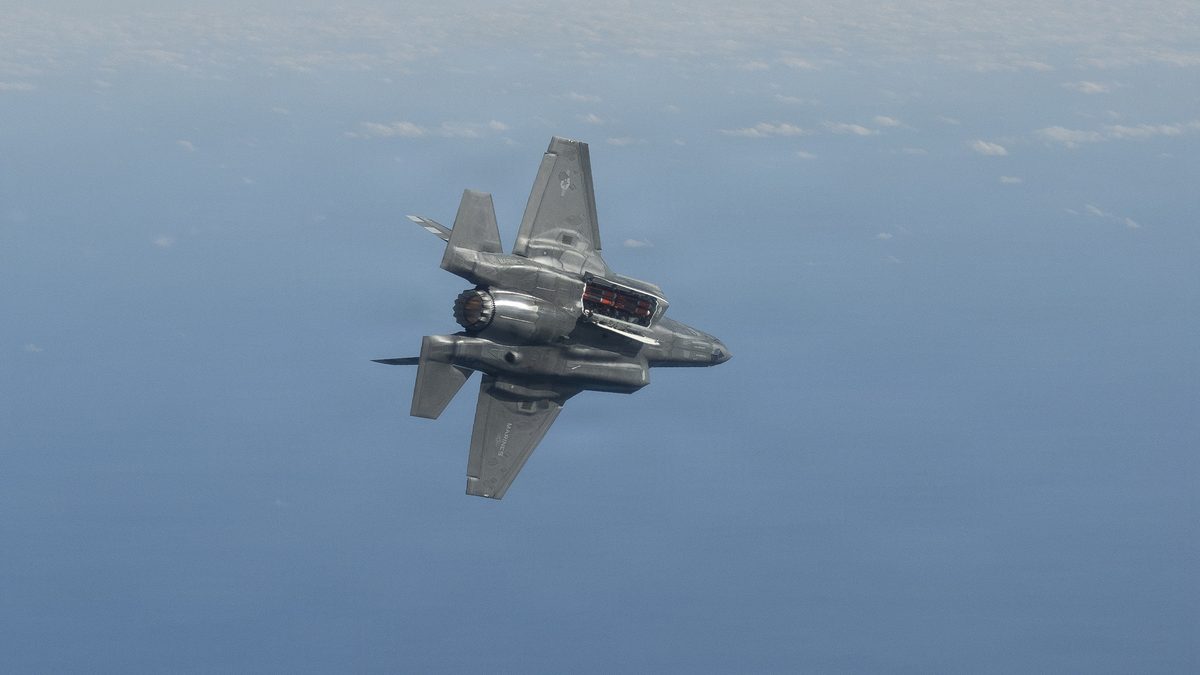
The F-35 Joint Program Office (JPO) released imagery on 21 May 2026 documenting the first developmental test flight of an F-35B Lightning II configured with four MBDA SPEAR 3 small-diameter stand-off cruise missiles. The sortie was flown on 20 January 2026 from the Pax River F-35 Integrated Test Force (ITF) at Naval Air Station Patuxent River, Maryland, by Lieutenant Commander Nick Baker RN of the Royal Air Force’s Air and Space Warfare Centre, who is currently deployed to the F-35 ITF. The airframe used was a US Marine Corps F-35B test aircraft. The missiles carried were inert, consistent with a first captive-carriage developmental test point.
The test is the opening developmental event in the F-35B / SPEAR 3 integration sequence and was conducted jointly by MBDA UK (weapon design authority), Lockheed Martin (airframe integrator) and BAE Systems (UK industrial partner and integration software lead). Subsequent test points have been publicly indicated as mission systems integration and jettison trials, with eventual live-firing and operational test still to follow. The 21 May 2026 imagery release is the JPO’s first public confirmation of a four-missile F-35B captive carriage configuration.
What SPEAR 3 Actually Is: the SPEAR Programme Context
SPEAR stands for Selective Precision Effects At Range. It is not the name of one weapon. It is a UK Ministry of Defence portfolio of air-to-surface precision-guided strike capabilities, formalised in the mid-2000s as part of the UK’s Complex Weapons strategy and structured into numbered Capability increments. Each Capability addresses a specific operational gap. The miniature cruise missile that flew at Pax River on 20 January 2026 is the deliverable for SPEAR Capability 3.
The SPEAR Capability set
| Capability | Weapon / system | Description | Status (2026) |
|---|---|---|---|
| SPEAR Capability 1 | Paveway IV (with upgrades) | 225 kg laser / INS-guided bomb with reduced-collateral fuzing, penetrator warhead and improved moving-target capability | In service |
| SPEAR Capability 2 | Brimstone 2 / Brimstone 3 | Dual-mode (semi-active laser + millimetric-wave radar) 50 kg-class rocket-powered missile | In service (Typhoon, Apache, ground-launched variants) |
| SPEAR Capability 3 | The miniature cruise missile that flew at Pax River on 20 January 2026 | ~80–90 kg turbojet-powered stand-off weapon, two-way datalink, >140 km range, multi-mode terminal seeker | In development and integration; F-35B is the primary platform |
| SPEAR Capability 4 | Storm Shadow mid-life upgrade | Longer-range deep-strike cruise missile enhancements (range, guidance, warhead options) | Ongoing |
| Higher capabilities | Future systems including FC/ASW (Future Cruise / Anti-Ship Weapon) | Next-generation deep-strike and anti-ship weapons under the UK–France co-development pathway | In concept / early development |
Why the “3” exists, and why it is often dropped
The “3” is a programme designation, not a version number of the missile itself. It identifies that this weapon was developed to satisfy Capability 3 of the broader SPEAR requirement set. The MoD introduced the Capability 3 requirement around 2009 for a roughly 100 kg-class weapon with turbojet propulsion, folding aero-surfaces for internal F-35 carriage, and a two-way datalink for in-flight retargeting: capabilities that neither Paveway IV nor Brimstone could provide. The £550 million Demonstration and Manufacture contract to MBDA UK in 2021 took the SPEAR Capability 3 requirement from concept into production representativeness, leading directly to the Typhoon launch in November 2024 and the Pax River carriage flight in January 2026.
MBDA markets the missile as simply SPEAR: clean product branding, similar to how the company markets Brimstone or Meteor. UK MoD, JPO and parliamentary documents retain “SPEAR 3” or the full “Selective Precision Effects At Range Capability 3” for contractual and technical precision. When the F-35 Joint Program Office released the Pax River imagery on 21 May 2026, the official caption used the long form: “four Selective Precision Effects At Range Capability 3, or SPEAR 3, missiles.” Media and analyst coverage consistently use “SPEAR 3” to avoid confusion with the wider SPEAR programme.
Naming convention by audience (2026)
| Context | Preferred name | Reason |
|---|---|---|
| MBDA marketing | SPEAR | Clean product branding |
| UK MoD / JPO official releases | SPEAR 3 or the full “Selective Precision Effects At Range Capability 3” | Contractual and technical precision |
| Media and analysis | SPEAR 3 | Avoids confusion with the broader SPEAR programme |
| Casual and recent usage | SPEAR | Increasingly common as the missile matures and other SPEAR capabilities are already fielded |
The most accurate professional description is therefore: SPEAR (Selective Precision Effects At Range) Capability 3 missile, a turbojet-powered miniature cruise missile developed by MBDA UK to meet the UK MoD’s SPEAR Capability 3 requirement, intended as the primary future stand-off precision strike weapon for the UK F-35B fleet. The “3” has never been part of the missile’s physical designation or part number. It is purely a reference to which line of the SPEAR requirement the weapon satisfies.
SPEAR 3 Weapon Architecture
SPEAR 3 (Selective Precision Effects At Range, Capability 3) is a small-diameter, network-enabled stand-off cruise missile derived from the Brimstone air-launched anti-armour missile family. It substitutes Brimstone’s solid-propellant rocket motor for a Hamilton Sundstrand TJ-150 turbojet engine and adds a folding wing kit and three deployable tail fins, extending the engagement range from Brimstone’s ~20 km to a published range in excess of 140 km, depending on launch altitude and flight profile. The TJ-150 is the same engine used in the AGM-154C-1 JSOW-ER and the ADM-160 MALD, providing a mature expendable-turbojet supply base.
SPEAR 3 Technical Data Pack: verified MBDA / open sources, May 2026
| Parameter | Specification | Notes / source |
|---|---|---|
| Manufacturer | MBDA UK | Primary contractor; design authority |
| Family | Brimstone derivative | Shared seeker lineage, distinct propulsion and airframe |
| Propulsion | Hamilton Sundstrand / Pratt & Whitney TJ-150 turbojet | Same engine family as AGM-154C-1 JSOW-ER and ADM-160 MALD; mature expendable-turbojet supply base |
| Mass | <90–100 kg (200–220 lb) | Excluding launcher hardware; enables four-missile internal carriage on F-35 |
| Length | 1.8–2.0 m (5.9–6.6 ft) | Internal-bay compatible; folding aero-surfaces stowed |
| Diameter | 180 mm (7.1 in) | Consistent across all MBDA-published data |
| Range | >140 km published | Stand-off; profile-dependent; some open-source claims up to ~150 km |
| Speed | High subsonic (~Mach 0.8–0.9) | Turbojet propulsion |
| Mid-course guidance | INS + GPS + two-way datalink | Network-enabled; supports in-flight target update, re-tasking and abort |
| Terminal guidance | Multi-mode seeker: millimetric-wave active radar + semi-active laser + combined modes | Inherited from Brimstone family; supports moving and fixed targets, fire-and-forget or man-in-the-loop |
| Warhead | Multi-effect: tandem-shaped penetrating charge plus blast-fragmentation | Low-collateral; exact mass not publicly disclosed (estimated below 48 kg GBU-53/B SDB‑II equivalent class) |
| F-35B launcher (tested) | Four-missile configuration in one internal weapons bay | 20 January 2026 Pax River sortie; validates low-observable internal carriage |
| Target set | SEAD/DEAD, integrated air defences, armoured vehicles, ballistic missile launchers, defended structures, small surface combatants | Network-enabled load-out persistence; supports coordinated swarming via datalink |
The SPEAR family also includes the SPEAR-EW variant, a SEAD-optimised electronic-warfare jamming and decoy payload that shares the SPEAR 3 airframe and launcher footprint, allowing mixed kinetic-and-non-kinetic loadouts within the same internal bay.
F-35B Internal-Bay Carriage Significance
The 20 January 2026 test demonstrated four SPEAR 3 missiles carried on a single F-35B airframe in the imagery released by the JPO. Open-source reporting from The Aviationist and FlightGlobal indicates the eventual carriage objective is up to eight SPEAR 3 missiles across both internal weapons bays, alongside a complement of AIM-120 AMRAAM air-to-air missiles. This is enabled by SPEAR 3’s sub-90 kg mass and 180 mm cross-section, which permits multi-missile carriage where larger weapons such as the 1,000 lb-class Paveway IV are restricted to single carriage per bay.
For the F-35B specifically, the short take-off and vertical landing (STOVL) variant operated by the Royal Navy and Royal Air Force from HMS Queen Elizabeth, HMS Prince of Wales and shore bases, the magazine-depth implication is significant. Current internal-bay loadouts for stand-off strike against fixed targets default to one Paveway IV per bay, with low-observability preserved. An eight-missile SPEAR 3 loadout would deliver an eightfold increase in stand-off precision strike magazine depth while keeping the airframe low-observable, opening operationally meaningful options for sustained anti-radiation, swarm-engagement and saturation strike profiles that the current sovereign weapon stack cannot support.
Programme Lineage and Timeline
The SPEAR 3 / F-35B integration test point at Pax River is the latest stage in a multi-platform development pipeline that began publicly with first launches from the Eurofighter Typhoon. The verified open-source timeline runs:
- November 2024: First live launch of SPEAR 3 from a Eurofighter Typhoon at the Vidsel test range in Sweden. Flown by 41 Squadron RAF (the Test and Evaluation Squadron) in cooperation with the BAE Systems flight test team. This was the first all-up missile release of the production-representative weapon configuration.
- 20 January 2026: First F-35B captive carriage test flight at Pax River F-35 ITF. Four inert SPEAR 3 missiles carried internally on a USMC F-35B test airframe. Pilot Lt Cdr Nick Baker RN.
- 21 May 2026: F-35 Joint Program Office releases the official test imagery via DVIDS, providing the first public visual confirmation of the four-missile F-35B carriage configuration.
- Next planned phases (publicly indicated): mission systems integration testing, jettison trials, ground-launched ejection sequencing, and subsequent guided live-firing trials. The Royal Air Force has publicly stated it is preparing for the “first ejections” phase of the test sequence.
The integration software for F-35B compatibility is being developed by BAE Systems’ UK F-35 integration team. This work draws on the UK’s status as a Level 1 partner in the F-35 programme and the country’s second-largest position (after the United States) in F-35 sustainment infrastructure. The Level 1 partner status grants the UK technical access to airframe systems necessary for sovereign weapon integration that is not extended to nations that joined the programme as Foreign Military Sales customers.
Personnel and Safety Considerations
For F-35B armament technicians and weapons load crews, the principal handling departure from the existing sovereign stack is the introduction of a small-diameter, turbojet-propelled missile with deployable wings and tail fins. Carriage on the F-35B internal launcher will require a dedicated stores adapter or multi-missile launcher distinct from the single-station Paveway IV and ASRAAM hardware currently in service. Loading procedures, fuze-state checks and turbojet-engine handling precautions will all require new entries in the Stores Loading Manual and the appropriate Technical Order series, and weapons load crew Authorised Equipment List training will need to be revised before the missile enters operational service.
For Quality Assurance staff operating under AQAP-2110 Edition D and STANAG 4107, SPEAR 3 represents a new UK-origin missile entering an existing US-led integrated stores configuration. Receiving Quality Assurance on UK-delivered articles destined for partner-nation F-35 fleets (Italy, Germany prospectively) will require Government Quality Assurance Representative arrangements appropriate to the UK’s status as the design authority, with corresponding Mutual GQA delegations under AQAP-2070.
For Range Safety Officers and weapons release authorities, the live-firing phase (not yet conducted from F-35B) will need updated jettison envelope data, minimum-arming distances, no-drop zones for the turbojet propulsion section, and revised range hazard arcs that account for the longer-than-Brimstone engagement footprint. The presence of a network-enabled two-way datalink means that range Electromagnetic Environmental Effects (E3) clearances will also need to be reviewed for any test profile that includes mid-course target updates.
Data Gaps
The publicly released material does not specify:
- Whether the four-missile configuration imaged at Pax River represents a single-bay or split-bay carriage layout.
- The specific multi-missile launcher hardware (designation, supplier, certification status) used to enable internal carriage of four SPEAR 3s on the F-35B.
- Software block compatibility: whether SPEAR 3 integration depends on Block 4, Tech Refresh 3 (TR-3), or a later F-35 software release.
- Planned operational test (OT) date and the lead UK frontline squadron for first-of-type training.
- Production-contract value, UK MOD missile-quantity commitment, and the in-service date for SPEAR 3 in operational RAF and Royal Navy F-35B units.
- Italian and German formal commitment status: evaluation, letter-of-request, or contract.
- Performance differences between the Typhoon-launched and F-35B-launched configurations attributable to launch altitude, internal-bay release dynamics and aircraft attitude at launch.
- Network architecture for the two-way datalink in F-35B operational concepts (Link 16, MADL, or dedicated UK sovereign waveform).
The DVIDS asset metadata, JPO imagery release and the public coverage by The Aviationist, FlightGlobal, Naval Lookout and Militarnyi constitute the authoritative open-source record at this stage. Further detail is likely to surface in NAVAIR test-event milestone briefings, UK MOD Defence Equipment and Support disclosures, MBDA press releases, parliamentary questions to the Secretary of State for Defence, and subsequent DVIDS releases as the test sequence progresses.
References
- F-35 Joint Program Office (via DVIDS). “F-35B achieves first flight with the UK’s precision long-range strike missile.” Image ID 9700531, VIRIN 260120-O-DD272-5045. Photo: Dane Wiedmann, F-35 ITF / Lockheed Martin. Released 21 May 2026. dvidshub.net.
- The Aviationist. “SPEAR 3 Missile Flies On Board F-35B Lightning II for the First Time.” 22 May 2026. theaviationist.com.
- FlightGlobal. “MBDA’s Spear miniature cruise missile makes debut flight aboard F-35B.” May 2026. flightglobal.com.
- Navy Lookout. “Stand-off weapon demonstration shows F-35B integration still alive despite years of delays.” May 2026. navylookout.com.
- Militarnyi. “F-35B Fighter Jet Successfully Tested With New Spear 3 Missile.” 23 May 2026. militarnyi.com.
- MBDA. SPEAR family product page. mbda-systems.com.
- MBDA. SPEAR Product Data Sheet (2018, current edition linked from the SPEAR family product page). Canonical OEM technical reference for the SPEAR 3 and SPEAR-EW configurations.
- Aerospace Global News. “Typhoon undertakes live firing test of MBDA’s Spear next-generation miniature cruise missile.” November 2024. aerospaceglobalnews.com.
- CSIS Missile Threat. “SPEAR 3.” Center for Strategic and International Studies. missilethreat.csis.org.
- MBDA and UK Ministry of Defence. “MBDA and UK MOD renew complex weapons partnership” (PMA2). Farnborough International Airshow announcement, July 2024. mbda-systems.com.
- UK Defence Journal. “UK secures £6.5 billion complex weapons deal with MBDA.” 2024. ukdefencejournal.org.uk.
- Pratt & Whitney. TJ150 turbojet engine specification. prattwhitney.com.
- Think Defence. SPEAR Missile reference paper. thinkdefence.co.uk.
- ISC Defence Intelligence. “Lockheed Awarded US$879M for F-35 Lot 18-19 Aircraft Armament Equipment.” 19 May 2026.
AI-assisted technical assessment based on open-source material from the F-35 Joint Program Office (via DVIDS), The Aviationist, FlightGlobal, Navy Lookout, Militarnyi, MBDA, Pratt & Whitney, Aerospace Global News, CSIS Missile Threat, UK Defence Journal, and ISC Defence Intelligence archive material. Not a formal intelligence product. Source ratings applied per NATO STANAG 2022 (Reliability A–F, Accuracy 1–6). All content open source and unclassified.
ISC Commentary: Why this matters for UK sovereign capability
SPEAR 3 is the load-bearing element of the UK’s sovereign F-35B weapon stack. Today the UK’s in-service F-35B payload is functionally limited to ASRAAM (short-range air-to-air, infrared) and Paveway IV (laser/INS guided bomb). The integration of Meteor (beyond-visual-range air-to-air) and SPEAR 3 (medium-range stand-off strike) is what closes the gap between the F-35B as a US-dependent platform and the F-35B as a fully sovereign UK strike asset. The 20 January captive carriage test is the first hardware-on-airframe milestone of that closure on the strike side.
The Portfolio Management Agreement renewal (PMA2) announced at Farnborough 2024 explicitly named SPEAR 3 as a future F-35B weapon. The Pax River sortie shows the programme is delivering on that commitment within the post-PMA2 18-month window. The export pathway (Italy and Germany are both evaluating SPEAR 3 for their F-35 and Typhoon fleets) gives the UK industrial base a partner-nation multiplier on the unit-cost equation that no US-only weapon offers.