Executive Summary
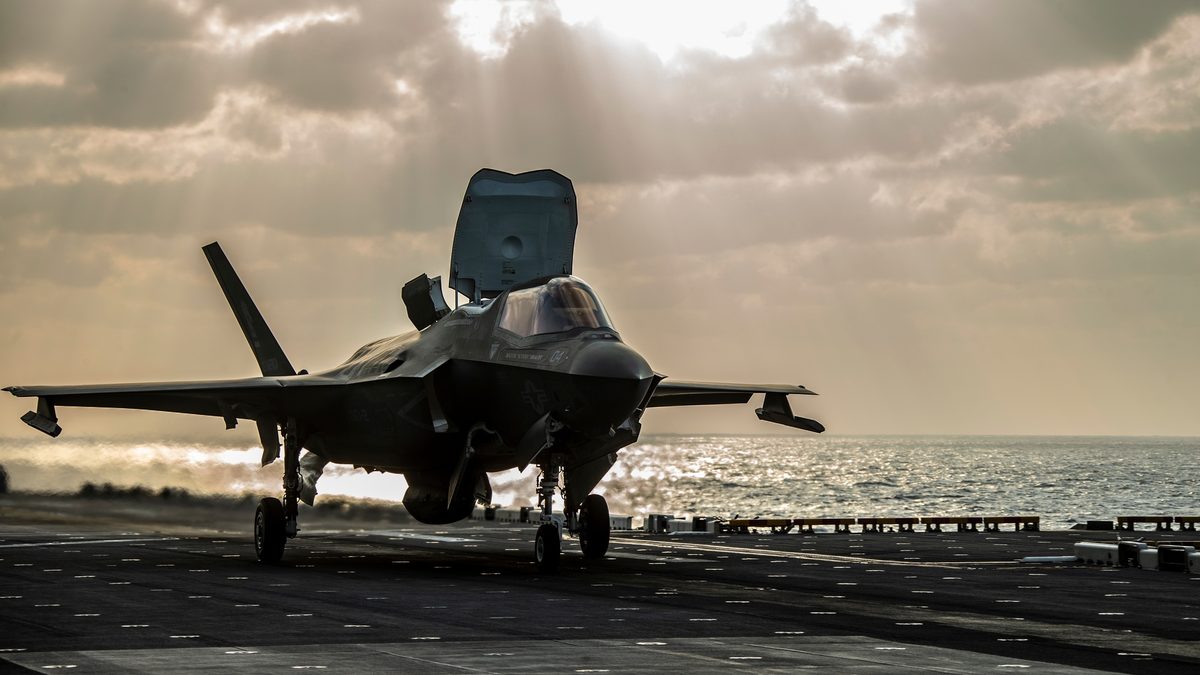
On 18 May 2026 Naval Air Systems Command (NAVAIR) issued order N0001926F0233 against basic ordering agreement N0001924G0010, awarding Lockheed Martin Aeronautics a firm-fixed-price US$879,098,832 order for Lot 18-19 production and delivery of F-35 aircraft armament equipment, the integrated carriage-and-release chain that mates every cleared weapon to the F-35A, F-35B and F-35C. The order represents roughly 3.6 per cent of the US$24.29 billion overall Lot 18-19 production deal that the F-35 Joint Program Office and Lockheed Martin finalised in late September 2025 for 296 airframes (148 per lot). That 296-aircraft buy now resolves to 210 F-35A, 52 F-35B and 34 F-35C, at an average flyaway cost of about US$82.4 million across variants and customers, with first deliveries from the new lots slated to begin in 2026. Over 53 per cent of the armament order's obligated value is non-US: US$333.6 million is Foreign Military Sales (FMS) money and US$139.2 million sits with non-US Department of War partners under the tiered Lightning II partner model. Work runs through February 2030.
Programme Context: Lot 18-19 Within the Wider Production Cliff
Lots 18 and 19 are the production blocks that pivot the F-35 line from Technology Refresh 3 (TR-3) maturation into Block 4 weapons integration. The TR-3 hardware baseline, an Integrated Core Processor with roughly 25 times the compute of the legacy TR-2 plus expanded memory, an open mission systems architecture and a new panoramic cockpit display, is the bedrock for the Block 4 software capability set. The US Government Accountability Office's September 2025 report (GAO-25-107632) confirms that the Department of War has reconstituted Block 4 as a separate major subprogram with a reduced capability scope, completion no earlier than 2031 and cost growth of at least US$6 billion against the original estimate; capabilities that require the upgraded engine are deferred to undefined efforts in the mid-2030s, and Lockheed Martin has stated that modernisation work could run to 2032. The Director of Operational Test and Evaluation reports that no combat-capable TR-3-configured F-35s were delivered in fiscal year 2025; combat-capable TR-3 deliveries are now expected to begin in 2026, roughly three years late, with dedicated operational testing planned for mid-to-late fiscal 2026. In late May 2026 the House Armed Services Committee described Block 4 as underfunded and pressed for completion of the Power and Thermal Management System analysis (targeting 62 to 80 kW) needed to host the full Block 4 weapons and sensor set, with a report due in December 2026. Lot 18-19 armament hardware therefore has to support both the Block 3F cleared stores set that the global fleet currently flies and the Block 4 stores set as it phases in across the operational life of the airframes delivered in this block.
The non-competed prime award reflects the structural reality of fifth-generation stores integration: every BRU-, LAU- and pylon part number is qualified to a specific airframe configuration, software drop and aerodynamic envelope. Substituting a notional second source mid-block would force a full Stores Compatibility Matrix requalification cycle, which conservatively runs eighteen to thirty-six months for a single weapon-pylon-software combination. The trade space NAVAIR has accepted is competition for cost discipline.
The Carriage-and-Release Chain: Hardware Architecture
"Aircraft armament equipment" in the F-35 context is the structural and electromechanical chain between the airframe and the released weapon. The major elements covered by an order of this scope are:
- BRU-67/A and BRU-68/A pneumatic parent ejector racks: the bomb release units that carry GBU-12, GBU-31, GBU-32, GBU-49 and other JDAM/Paveway-class stores in the internal weapons bays and on external hardpoints. Pneumatic ejection (rather than legacy pyrotechnic cartridge actuation) gives cleaner separation, lower in-bay debris signature and more flexibility across release velocity envelopes.
- LAU-147 pneumatic suspension and release missile launchers: the internal-bay launcher for AIM-120 AMRAAM today and the AIM-260 Joint Advanced Tactical Missile (JATM) as Block 4 integration matures.
- LAU-151/A external rail launchers (the Marvin Engineering production unit), supporting external AIM-9X Sidewinder Block II carriage on the outboard wing stations once stealth is no longer the operating constraint.
- Six external pylons (three per wing) plus four internal stations and one centreline gun station, 11 weapon stations in total, rated to a combined 18,000 lb (~8,165 kg) of ordnance, with the inboard external stations qualified to 5,000 lb (2,268 kg) class stores or external fuel tanks.
- GAU-22/A 25 mm four-barrel Gatling gun installations: internally mounted in the port wing root of the F-35A with 181 rounds of PGU-47/U Armor-Piercing Explosive (APEX) ammunition, or externally pod-mounted on the F-35B and F-35C with 220 rounds. The PGU-47/U combines a tungsten-alloy penetrator core with a small high-explosive charge; the gun system was declared "effective" only in 2024 after several years of pointing-accuracy remediation.
- Adapter rails and ancillary release products: the bridging hardware between standard NATO 14-inch lug spacing and bespoke F-35 carriage geometries for stores including GBU-39/B Small Diameter Bomb (SDB-I), GBU-53/B StormBreaker (SDB-II), the Joint Strike Missile (JSM) and SPEAR 3.
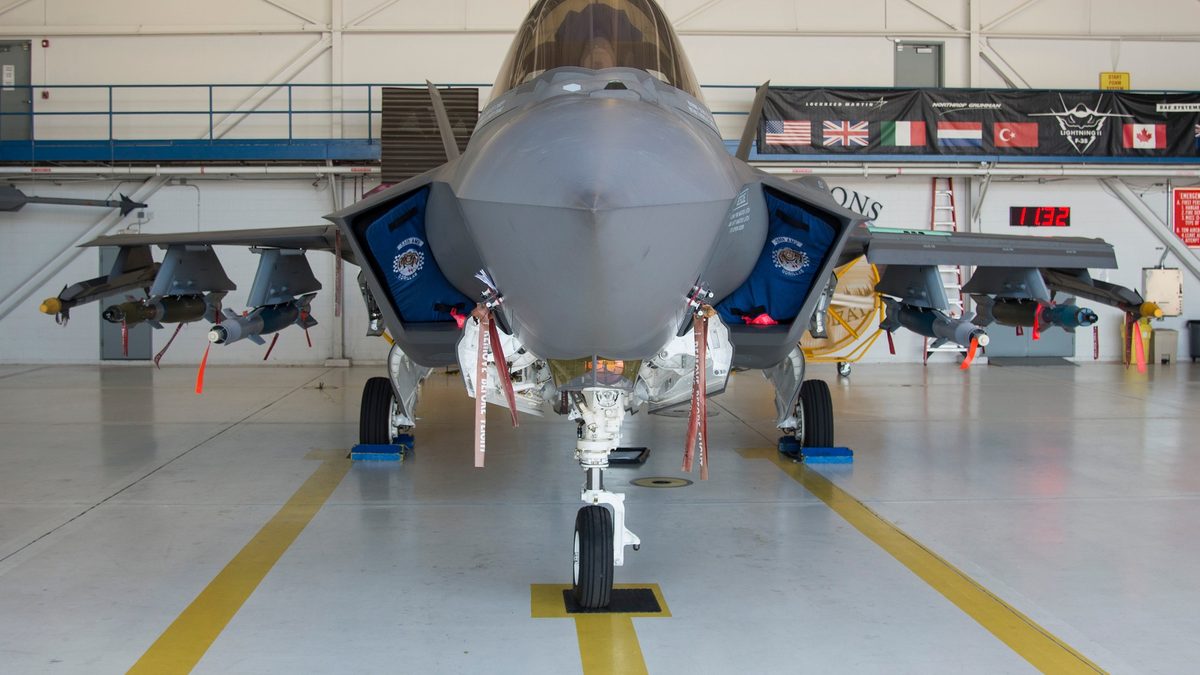
The dominant carriage-and-release supplier underneath the prime is L3Harris, which inherited the Exelis F-35 line and has shipped well over 1,300 carriage and release systems to date. The 25 mm gun system is produced by General Dynamics Ordnance and Tactical Systems. This supply-chain depth is one of the reasons the prime award is sole-source: the BRU/LAU industrial base does not contain a credible second qualified producer for fifth-generation stealth carriage.
Cleared Stores and the Block 4 Integration Pathway
The armament hardware bought under this order has to underwrite a stores set that is mid-transition. Current Block 3F clearance covers the legacy precision-guided munitions inventory; Block 4, layered atop TR-3 once full certification clears, opens the magazine to the next-generation set. The matrix below summarises the principal stores and where they sit in the integration pathway as of mid-2026:
| Weapon | Class | Carriage | Status (mid-2026) |
|---|---|---|---|
| AIM-120D-3 AMRAAM | BVR air-to-air | Internal LAU-147 | Block 3F operational |
| AIM-9X Block II Sidewinder | WVR air-to-air | External LAU-151/A rail | Block 3F operational |
| AIM-260 JATM | Long-range A2A | Internal LAU-147 successor | Block 4 integration, counter-PL-15/R-77M |
| GBU-12 Paveway II (500 lb) | Laser-guided bomb | BRU-68/A internal/external | Block 3F operational |
| GBU-31 / GBU-32 JDAM | 2,000 lb / 1,000 lb | BRU-67/68 internal | Block 3F operational |
| GBU-39/B SDB-I (250 lb) | Small Diameter Bomb | BRU-61 four-place rack | Block 3F operational |
| GBU-53/B StormBreaker (SDB-II) | 250 lb tri-mode | 8 internal + 8 external | USN IOC declared Feb 2026 |
| AGM-88G AARGM-ER | SEAD/DEAD | External pylon | Block 4 integration |
| JSM (Joint Strike Missile) | A2S/A2G stand-off | Internal bay carriage | Block 4, Kongsberg, five-nation NATO base |
| SPEAR 3 | Networked A2S stand-off | Internal bay (UK lead) | Block 4 integration (MBDA) |
| GAU-22/A, PGU-47/U APEX | 25 mm cannon | Internal A / external pod B,C | Operational since 2024 effectiveness gate |

The single-sortie firepower implication for an F-35 with the GBU-53/B fully integrated is significant: eight internal plus eight external StormBreaker carriage gives a 16-weapon load against networked moving targets, each with a tri-mode seeker (millimetre-wave radar, imaging infrared, semi-active laser) and an approximately 40 nm (~74 km) glide range against a 105 lb shaped-charge warhead.
The AIM-260 row sits one technology generation forward and is moving on a separate timeline. A live AIM-260A was photographed on a US Navy F/A-18F in mid-May 2026; procurement began in fiscal 2026, with a proposed rise to about US$2.9 billion in fiscal 2027. The missile has not yet reached initial operational capability and is being fielded on the F/A-18 and F-22 ahead of the F-35, meaning the LAU-147 successor station on Lot 18-19 airframes is being built ready for a weapon whose F-35 integration sits behind two other carriers.
Industrial Base and Supply-Chain Exposure
The US$879 million armament order is the visible top of an extended industrial pyramid:
- Lockheed Martin Aeronautics (Fort Worth, TX): airframe-level structural integration, pylon mating, qualification flight test.
- L3Harris (legacy Exelis line, Salt Lake City, UT): BRU-67/A, BRU-68/A and LAU-147 pneumatic carriage and release subsystems.
- Marvin Engineering Co (Inglewood, CA): LAU-151/A external rail launchers.
- General Dynamics Ordnance and Tactical Systems (Williston, VT): GAU-22/A gun system and Australian-produced 25 mm cannon ammunition under offset programmes.
- RTX (Raytheon Missiles & Defense): AIM-120 AMRAAM, AIM-9X Sidewinder, AGM-88G AARGM-ER, GBU-53/B StormBreaker; integration touchpoints to carriage hardware on every release qualification.
- Lockheed Martin Missiles & Fire Control (Orlando, FL): AIM-260 JATM, JASSM-ER, LRASM, corporate twin to the Aeronautics prime.
- Boeing Defense, Space & Security: SDB-I, JDAM tail kits and ancillary stores.
- Kongsberg Defence & Aerospace (Norway) and MBDA UK: JSM and SPEAR 3, the two principal European-origin internal-carriage weapons for Block 4.
The energetic-materials base sitting underneath this picture remains heavily exposed to single-source nodes. Holston Army Ammunition Plant in Kingsport, Tennessee is still the dominant Western producer of military-grade RDX and HMX (with developmental CL-20 capacity) feeding the warheads in the StormBreaker, JDAM, Paveway and SDB families. ISC has previously documented the strategic risk this concentration creates; the Lot 18-19 armament order is silent on that exposure but cannot insulate the fielded munition stockpile from it. Open-source assessments after the Operation Epic Fury campaign against Iran indicate multi-year replenishment timelines, into 2029, to rebuild key interceptor and stand-off stocks. The carriage hardware bought under this order is outpacing the magazine behind it.
The F-35I Adir Configuration: A Bidirectional Feedback Loop
The Israeli F-35I "Adir" is the only F-35 variant where a partner nation has secured contractual authority to replace and supplement core systems beyond the standard FMS modification envelope. The principal Israeli deltas, all relevant to a Lot 18-19 hardware buy:
- Indigenous electronic warfare suite: Elbit Systems replaces the baseline BAE Systems EW suite under a plug-and-play architecture engineered to accept Israeli sensors, jammers and countermeasures without compromising the low-observable signature.
- Indigenous weapons integration in the internal bay: Rafael Spice 1000 and Spice 2000 precision-guided bombs, Rampage supersonic air-to-surface, Delilah stand-off cruise missile, Python-5 imaging-infrared dual-band air-to-air, and Derby radar-guided air-to-air, all qualified for stealth carriage. The one-ton penetration bomb specifically engineered to fit the F-35I internal bay is a national variant not available to other F-35 operators.
- Extended-range fuel programme: external fuel tanks (and reporting of conformal tank development) demonstrated operationally in the strike series against Iranian targets during the 2024-2025 cycle, with single-sortie radius well beyond the standard F-35A combat profile.
- Litening 5 electro-optical pod option: Rafael's targeting pod as an addition to the baseline Electro-Optical Targeting System.
The feedback loop runs in both directions. USAF officials have publicly conceded that the Israeli range-extension work has informed a renewed US service-level requirement for additional fuel capability on the F-35A, a requirement that has surfaced in Pacific theatre posture planning. Israeli combat use of the airframe against the integrated S-300, S-400 and S-350-class threat environment over the Levant and Iran has fed lessons-learned back through the Joint Program Office on EW suite performance, signature management under sustained operations and integration of allied technologies. The recent Israeli decision to take the TR-3 and Block 4 baseline alongside the global fleet (rather than diverging entirely) reinforces that the Lot 18-19 armament hardware will mate not only to standard configurations but also to a national variant that uses much of the same BRU/LAU plumbing while carrying a fundamentally different magazine. Israel's approval in May 2026 of a fourth F-35I squadron (within a US$119 billion multi-year force buildup) signals continuing FMS demand into Lots 20 and beyond.
Strategic Implications: Allied Fleet and Pacific Posture
The non-US share of the obligated value, FMS US$333.6 million plus non-DoW partner US$139.2 million, together 53.8 per cent of the order, tracks the global distribution of the fielded F-35 fleet:
- Japan: 147 ordered (105 F-35A + 42 F-35B), the largest non-US fleet, anchoring Indo-Pacific air dominance from Misawa and out of Kaga-class converted carriers.
- Israel: 75 ordered, fourth squadron approved May 2026, the only combat-tested non-US fleet.
- United Kingdom: F-35B fleet expanding toward 138 airframes, organic to Queen Elizabeth-class carriers.
- Italy: F-35A and F-35B, with the B variant on ITS Cavour.
- South Korea: 60 F-35A on order, around 40 delivered, expanding into a follow-on tranche.
- Australia: 72 F-35A fleet complete, Pacific theatre integration with US, UK and Japan carrier strike groups.
- Norway, Denmark, Netherlands, Belgium, Poland, Finland, Switzerland, Romania, Germany, Greece, Czech Republic: European F-35A operators across the NATO eastern and northern flank, all dependent on the same Lot armament baseline for stores carriage on Block 4-era weapons such as JSM and SPEAR 3.
By 2035 over 300 US and allied F-35s are planned to operate routinely across the Indo-Pacific. The Lot 18-19 armament order is a structural underwrite of that distributed-stealth posture: every airframe in the block needs hardware-qualified BRU, LAU and pylon hardware to mate the Block 4-era cleared stores set, and the FMS-funded share of this order is what keeps allied airframes interoperable with the US carriage-and-release standard rather than forking into national-only configurations.
Personnel and Safety Considerations
For armament technicians and weapons load crews, the principal risks during Lot 18-19 transition are configuration drift (legacy versus refreshed BRU/LAU part numbers in the same maintenance hangar) and FMS-specific loading deltas. Loading documentation will need cross-checking against the latest Stores Loading Manual revisions and Technical Order 1F-35*-33 supplements before any operational sortie carries a refreshed pylon. Where Block 3F and Block 4 software drops cohabit in the same wing, configuration deconfliction between airframes becomes a daily flight-line discipline rather than an engineering edge case.
For Quality Assurance staff working under AQAP-2110 Edition D and STANAG 4107, refreshed armament hardware introduced via FMS routes still falls under Government Quality Assurance Representative (GQAR) acceptance regimes in the receiving nation. The absence of competition in the prime contract does not reduce downstream Receiving Quality Assurance obligations; it intensifies them, because there is no alternate source from which conformity can be cross-validated. NATO partners taking Lot 18-19 hardware should expect to apply full Type 1 and Type 2 release safety re-certification cycles to any pylon or adapter design refresh and to demand updated Stores Compatibility Matrices before training profiles are flown.
Range Safety Officers and weapons release authorities should expect updated jettison envelope data, minimum-arming distances and centre-of-gravity windows where fuze well or strake geometry has changed. Any unique-to-Lot-18 pylon-aircraft combination must be validated against the live envelope before training profiles are flown. For F-35I operators, the additional layer is national-weapon clearance: Spice, Rampage and Delilah loading procedures do not flow from US technical orders and are governed by parallel Israeli documentation.
Data Gaps
The contract notice does not specify:
- Production split between Lot 18 and Lot 19 armament hardware quantities.
- Which FMS partners' shares are bundled into the US$333.6 million FMS line.
- Whether the order includes any GAU-22/A gun system block upgrades or remains airframe-mate hardware only.
- Part-number-level design changes versus Lot 17 baseline.
- Any AIM-260 JATM or new stand-off weapon adapter line items.
- Lot-specific weight and centre-of-gravity adjustments that would feed into revised stores clearance envelopes.
- Any allocation to the F-35I unique internal-bay penetration weapon carriage geometry.
The Department of War contract notice is the authoritative public record at this stage. Further detail is likely to surface in NAVAIR Lot 18-19 milestone briefings, partner-nation parliamentary disclosures and Government Accountability Office reporting on the F-35 programme.
References
- US Department of War. Contracts for 18 May 2026. Contract notice N0001926F0233.
- Air & Space Forces Magazine. "F-35 Deal for Lots 18 and 19 Covers 296 Fighters at $24.3 Billion." 30 September 2025.
- The Aviationist. "JPO and Lockheed Martin Finalize F-35 Contract for Lots 18 and 19." 30 September 2025.
- Janes. "US DoD, Lockheed Martin finalise contract for nearly 300 F-35s." 2025.
- L3Harris Technologies. Release Systems Product Catalog. 2020.
- General Dynamics Ordnance and Tactical Systems. GAU-22/A 25mm Gatling Gun product brochure.
- The Aviationist. "U.S. Navy Reaches Initial Operational Capability for GBU-53 SDB II." 21 February 2026.
- Defence Security Asia. "Israel's F-35I 'Adir' to Get TR-3, Block 4 Upgrades in Major Modernization Deal." 2025.
- The War Zone. "Israel's F-35s Are Getting External Fuel Tanks." 2024.
- Air & Space Forces Magazine / Warrior Maven. "F-35 Block 4 Brings Next Generation Weapons AIM-260, AARGM-ER and StormBreaker."
- US Government Accountability Office. F-35 programme reporting on Block 4 / TR-3 schedule.
- ISC Defence Intelligence. "Raytheon GBU-53/B StormBreaker Lot 12: $708.9M Contract for NATO Multi-Nation FMS." 28 April 2026.
- ISC Defence Intelligence. "Israel approves fourth F-35I and second F-15IA squadrons in opening tranche of $119bn force buildup." 6 May 2026.
- ISC Defence Intelligence. "Germany's NOK 3.5 bn JSM Follow-On Cements Five-Nation NATO Stand-Off Strike Base." 18 May 2026.
- ISC Defence Intelligence. "U.S. Navy Awards $585M Sole-Source Contract for F-35 Helmet Displays." 6 April 2026.
- US Government Accountability Office. F-35 Joint Strike Fighter: Actions Needed to Address Late Deliveries and Improve Future Development (GAO-25-107632). September 2025.
- Defense News. "Lockheed Martin expects F-35 tech upgrades to last through 2032." 16 September 2025.
- The Aviationist. "First Photo Emerges Of AIM-260A JATM Missile Carried By A U.S. Navy F/A-18F Super Hornet." 15 May 2026.
- Defense Daily / Aviation Today. "F-35 Program And Lockheed Martin To Finish F-35 PTMS Analysis Soon, As HASC Argues Block 4 Underfunded." 28 May 2026.
- The War Zone. "Plans To Finally Give F-35 External Fuel Tanks Emerge In New Air Force Budget." 2026.
AI-assisted technical assessment dated 30 May 2026, based on open-source material from the US Department of War contract notice dated 18 May 2026 and cross-referenced against Joint Program Office, NAVAIR, Government Accountability Office (GAO-25-107632), Lockheed Martin, L3Harris, General Dynamics Ordnance and Tactical Systems, RTX, Air & Space Forces Magazine, Defense News, Janes, The Aviationist, The War Zone and ISC Defence Intelligence archive material. Programme cost, schedule and procurement-number figures are drawn from open-source reporting, carry varying confidence, and may be revised. Not a formal intelligence product. Source ratings applied per NATO STANAG 2022. All content open source and unclassified.
ISC Commentary
The headline number is not the story. The two structural features that matter for analysts are the 53.8 per cent non-US share of obligated value and the deliberate sole-source structure. The first tells you that European, Pacific and Israeli FMS customers are now carrying the fiscal weight of the F-35 armament line at a level that materially insulates the US service procurement budget against any single Lot pause. The second tells you that the carriage-and-release industrial base, L3Harris, Marvin Engineering, GD-OTS, is treated by NAVAIR as a strategic monopoly to be sustained rather than competed.
The Israeli feedback loop is the most under-reported element of the wider F-35 enterprise. National-variant work on EW, internal-bay penetration weapons and range extension is not staying inside the F-35I production line; it is shaping baseline US Air Force requirements for Pacific posture. For NATO procurement officers, the practical implication is that the Block 4 stores envelope they buy into will increasingly reflect lessons learned in Israeli combat operations, alongside the US service requirements.
The exposed flank remains energetics. RDX and HMX feed for the StormBreaker, JDAM and Paveway warheads that this armament chain releases continues to depend on a Holston AAP base that ISC has been tracking since the Iran War munitions consumption crisis of March 2026. Carriage hardware is necessary but not sufficient; the magazine has to exist behind it.