Lithuania $214M AIM-9X Block II FMS: 152 Missiles for NASAMS Eastern Flank
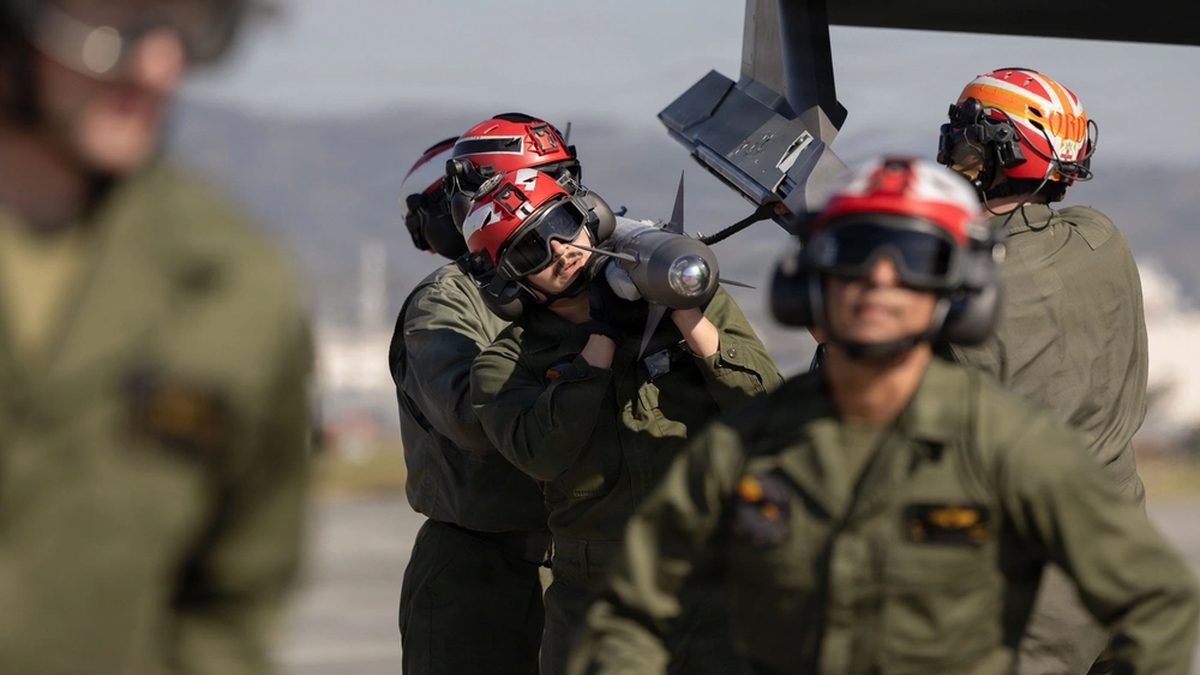
U.S. Marines with VMFA-242, MAG-12, 1st Marine Aircraft Wing, load an AIM-9X Sidewinder missile onto an F-35B Lightning II at MCAS Iwakuni, Japan, 8 April 2026. Photo: Cpl. Cecilia Campbell / DVIDS / Public Domain. The appearance of U.S. Department of Defense visual information does not imply or constitute DoD endorsement.
Technical Summary
The United States (US) Department of State has approved a possible Foreign Military Sale (FMS) to Lithuania of AIM-9X Block II Sidewinder missiles and associated equipment, with an estimated total value of United States Dollars (USD) 214 million. The Defense Security Cooperation Agency (DSCA) notified the United States Congress of the case on 22 April 2026. The package comprises 152 AIM-9X Block II tactical all-up-rounds (AURs), eight (8) AIM-9X Block II tactical guidance units (TGUs) for spares and replacement, and six (6) AIM-9X Block II Captive Air Training Missiles (CATMs). It also covers contractor logistics support, training, integrated logistics support, US Government engineering and technical support, and publications and technical data. The principal contractor is RTX (formerly Raytheon Technologies). The AIM-9X procurement supplements an earlier 2022 case valued at USD 19.5 million which delivered 16 AIM-9X Block II rounds and 2 TGUs, bringing Lithuania's cumulative AIM-9X holdings under FMS to 168 rounds when both cases complete.
The missiles are intended for use as the short-range engagement layer of Lithuania's National Advanced Surface-to-Air Missile System (NASAMS) batteries, where the AIM-9X complements the AIM-120 Advanced Medium-Range Air-to-Air Missile (AMRAAM) family. The AIM-9X Block II AUR weighs approximately 85.3 kilograms (kg) gross, with a 9.4 kg WDU-17/B annular blast fragmentation warhead containing approximately 3.18 kg of PBXN-3 high explosive, initiated by an active optical (laser) target detector and an electronic safe-and-arm fuze (DSU-15A/B class). Propulsion is by the Hercules / Aerojet Mk 36 reduced-smoke solid rocket motor, hazard division (HD) 1.3 / Compatibility Group (CG) C; the warhead section is HD 1.1 CG E.
Analysis of Effects
The Lithuanian case has both operational and industrial significance. Operationally, 152 additional AIM-9X rounds materially deepen the magazine of NASAMS short-range engagements at a point on the North Atlantic Treaty Organization (NATO) eastern flank where the air-defence threat ranges from rotary-wing and fixed-wing manned aircraft to cruise missiles and one-way attack uncrewed aerial systems (OWA UAS). The AIM-9X Block II provides imaging-infrared (IIR) seeking, lock-on after launch (LOAL), high off-boresight engagement, and a datalink that allows mid-course updates from the launcher fire-control system; in surface-launch mode from the NASAMS canister, the round still benefits from these features but pays the kinematic penalty of a low-altitude vertical launch profile. Practical engagement envelopes from a NASAMS canister are not the same as from an air-launched configuration; published data suggests slant ranges of approximately 9 to 18 kilometres (km) depending on target geometry, altitude, and closing speed. Industrially, the case continues a sustained pull on the AIM-9X production line at RTX's Tucson, Arizona, facility, where cumulative recent FMS demand from Poland, the Netherlands, Germany, Romania, the Republic of Korea, and now an enlarged Lithuanian case has driven a multi-year backlog. Lot delivery slots into NATO eastern-flank states will continue to compete with US Navy and US Air Force replenishment requirements through the late 2020s.
Personnel and Safety Considerations
For storage and ammunition technicians, AIM-9X Block II rounds are stored as complete AURs in their CNU-431/E or equivalent shipping/storage containers. The dual hazard signature (HD 1.1 CG E warhead, HD 1.3 CG C motor) requires that quantity distance (QD) calculations apply the controlling hazard division (HD 1.1) for explosives safety, while compatibility group mixing rules dictate segregation from incompatible items. CATMs do not contain energetic materials and are inert for training; they must be visibly distinguished from tactical AURs to prevent inadvertent live-load events — Lithuanian unit standing operating procedures (SOPs) should reflect the standard NATO marking and colour-coding conventions. For Explosive Ordnance Disposal (EOD) personnel, the principal hazards on a fired-but-failed or recovered round are (a) the WDU-17/B warhead, particularly if the active optical target detector has fired but the warhead has not initiated, indicating a partial fuze function, and (b) the Mk 36 motor, particularly if propellant grain integrity is unknown after impact, fire, or extended environmental exposure. Render-safe procedure (RSP) and improvised explosive device disposal (IEDD) techniques are restricted and not addressed here.
Data Gaps
DATA GAP: The DSCA notice does not specify the lot year of production for the 152 rounds, nor the planned delivery schedule. DATA GAP: It is not stated whether the rounds are configured for surface-launch from NASAMS canisters at delivery or whether modification is required at the unit level. DATA GAP: It is not confirmed whether the eight TGUs are spares for existing rounds in inventory or new-build to support the larger fleet. DATA GAP: The case does not specify the proportion of US-produced versus partner-produced subcomponents (RTX Tucson is the AUR integrator, but the WDU-17/B warhead, Mk 36 motor, and seeker are sourced from a tiered supply chain). DATA GAP: Lithuania's ammunition storage facility (PES) capacity for the additional 152 rounds at HD 1.1 controlling hazard division is not in the open record.
AI-assisted technical assessment based on open-source material. Not a formal intelligence product. All hazard division and compatibility group attributions are open-source baselines and must be confirmed against the controlling munition data sheet for any operational task.
Image credit: DVIDS asset 9606716 (VIRIN 260408-M-PK775-1060) — dvidshub.net. Public domain (17 U.S.C. § 105).