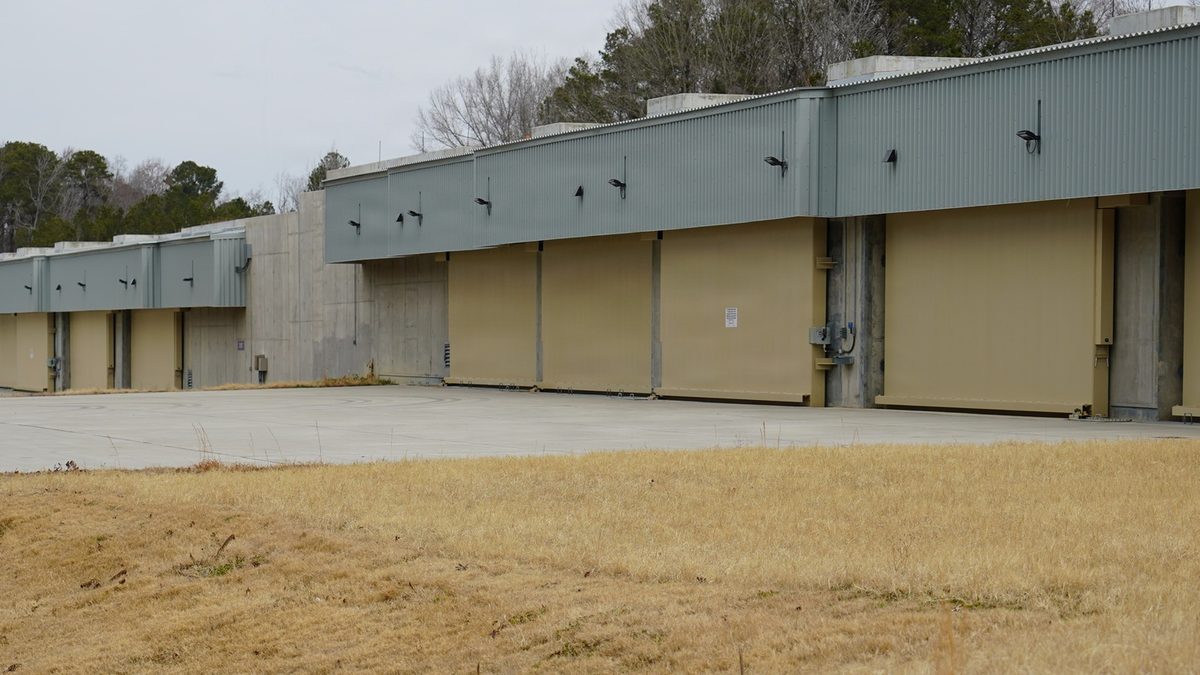
New ordnance magazines under construction, Naval Weapons Station Yorktown, March 2026. Photo: Max Lonzanida, US Navy (public domain, via DVIDS).
USN Establishes PAE Munitions: Tomahawk, SM-3 and AMRAAM Under Single Acquisition Authority
Technical Summary
The Department of the Navy on 11 May 2026 stood up Portfolio Acquisition Executive (PAE) Munitions, a single enterprise authority that consolidates naval strike, air-to-air, and surface-warfare weapons procurement under one acquisition construct.[1] The reorganisation collapses the former Program Executive Office Unmanned Aviation and Strike Weapons (PEO U&W) and elements of Program Executive Office Integrated Warfare Systems (PEO IWS) into a four-pillar structure: Weapons Industrial Base, Air Weapons, Surface Weapons, and Advanced Capabilities and Innovation. Mr Paul Mann has been named Interim PAE Munitions.
The migrated programmes include Precision Strike Weapons (PMA-201), the Tomahawk Weapons System (PMA-280), Direct and Time Sensitive Strike (PMA-242), Air-to-Air Missiles (PMA-259), Strike Planning and Execution Systems (PMA-281), the Aerial Targets Program (PMA-208), Surface Ship Weapons (IWS 3.0), Terminal Defense System (IWS 11.0), and the NATO Seasparrow programme (IWS 12.0).[1] Standard Missile-3 (SM-3) is scheduled to transition from the Missile Defense Agency (MDA) to PAE Munitions in FY2028 for production and sustainment.
PAE Munitions is one of three new portfolio executives announced the same day (alongside PAE Aviation (Vice Admiral John Dougherty) and PAE Mission Systems (Mr Jim Day)) bringing the Department of the Navy total to nine. Approximately 70 per cent of personnel and functions associated with the migrated portfolios shift from the legacy Systems Commands (SYSCOMs) to the PAE structure.[2]
The PAE Operating Model
PAEs are not renamed PEOs. Under the Warfighting Acquisition System (WAS) reform programme directed by the Secretary of War, each PAE holds direct authority over the program offices, the technical authority chain, contracting (including head-of-contracting authority in many cases), and sustainment — true cradle-to-grave ownership. Capability Trade Councils sit inside each PAE to run disciplined, data-driven cost/schedule/performance trades, with explicit priority on time-to-field. Each PAE is also formally accountable for active management of its industrial base: capacity modelling, supply-chain risk, and supplier diversification.[2]
Performing the Duties of Assistant Secretary of the Navy for Research, Development and Acquisition (ASN RDA) Jason Potter set out the rationale at the Acquisition Research Symposium & Innovation Summit at the Naval Postgraduate School the same week:
"There is a singular focus across the Department of War on the munitions industrial base and scaling up critical munitions programs. We’re seeing results as deliveries of key components and munitions rise above contract rates for the first time in several years."[1]
That statement, if borne out by component-level data, suggests industrial throughput is now exceeding nominal contract baselines; an inflection point not seen since the Iran War depletion exposed magazine shortfalls in late 2025.
Mr Mann's first public framing pointed to the operating tempo expected of the new construct:
"We must relentlessly execute programs and drive significantly faster production rates of effective, high quantity, affordable munitions for our operational forces."[1]
Mr Mann tied that execution mandate directly to current strategy:
"We must adapt faster than our adversaries and directly enable CNO Fighting Instructions and our National Defense Strategy."[1]
Analysis of Effects
For WOME practitioners, the practical effect is the unification of disparate weapon families (cruise missiles, surface-to-air interceptors, air-to-air missiles, and ship self-defence rounds) under a single acquisition signature. This matters because each system spans different Hazard Divisions (HD) and Compatibility Groups (CG):
- Tomahawk Block V (BGM-109): HD 1.1 D unitary warhead variants; HD 1.2 D submunition variants where fielded.
- AIM-120 AMRAAM: HD 1.1 E rocket-motor classification; separate HD 1.1 D warhead.
- NATO Seasparrow ESSM Block 2: HD 1.2 D rocket-motor classification with HD 1.1 D blast-fragmentation warhead.
Consolidated portfolio management permits centralised industrial-base modelling for shared energetic materials (HTPB-based composite propellants, HMX-loaded warhead fills, and electronic safe-and-arm device (ESAD) fuze components) rather than programme-by-programme rationing during a surge. Where two programmes use the same Class 1.3 propellant grain, the same RDX/HMX fill, or the same booster lead, the Weapons Industrial Base pillar can now allocate against a single supply curve rather than competing tasking orders. Coordinated requalification under STANAG 4439 Insensitive Munitions criteria can also propagate substitutions faster, provided pooled testing resources are stood up across pillars rather than left siloed inside individual programmes.
Pillar-Specific Impact
- Air Weapons: AIM-120 AMRAAM family, AIM-9X Sidewinder, future air-to-air interceptors; potential integration of air-launched hypersonic and next-generation strike payloads.
- Surface Weapons: SM-2 / SM-6 family, ESSM Block 2, naval gun systems, CIWS evolution and terminal defence variants — previously split across IWS 3.0, IWS 11.0 and IWS 12.0.
- Advanced Capabilities and Innovation: Likely home for hypersonic prototyping, directed-energy / kinetic munitions integration, and modular payload work that does not yet fit a programme-of-record line.
- Weapons Industrial Base: The pillar that owns shared energetics, common fuze and S&A components, and supplier-tier capacity planning across all of the above. From a WOME perspective this is the most consequential of the four.
Personnel and Safety Considerations
Ammunition technicians, magazine managers, and surface-warfare Weapon Control System (WCS) operators should monitor for downstream effects on stockpile composition. Acceleration under a single PAE risks compressing safety-case timelines if Qualified Performance Specification (QPS) review cycles for the in-service stockpile are foreshortened to match production tempo. Operators handling SM-3 Block IIA or Tomahawk Block V variants in afloat magazines should expect revised AOP-7 entry data and STANAG 4439 IM test reports as production lines re-qualify under accelerated schedules. The Weapons Industrial Base pillar is the locus to watch for shared component substitutions (fuze well assemblies, booster initiators, exploder lead assemblies) that may propagate across multiple programmes simultaneously.
The corollary risk is that pooled testing, an efficiency win when well-resourced, can become a single point of failure where one disqualifying IM result on a shared propellant grain ripples across the air, surface and advanced-capabilities portfolios at the same time. Practitioners should track which test facilities are nominated as the shared safety resource and how their throughput compares with the consolidated requalification load.
Data Gaps
DATA GAP: PAE Munitions budget envelope; total programme-of-record headcount transferred from the legacy PEOs (the 70 per cent transfer figure is an enterprise-wide WAS metric, not a PAE Munitions specific number); detailed transition plan for SM-3 from MDA to PAE Munitions beyond the FY2028 production-and-sustainment milestone; specific multi-year procurement (MYP) authorities granted to the new construct; and the formal integration mechanism between PAE Munitions and the Pentagon-wide Munitions Acceleration Council (MAC) priority list issued on 1 May 2026. Hazard-classification entries cited here are inferred from open-source variant data; Potential Explosion Site (PES)-specific Net Explosive Quantity (NEQ) aggregation under the new structure is not addressed in the announcement.
Reform Timeline (Department of the Navy PAEs)
- December 2025: First PAE stood up — Robotic and Autonomous Systems (RAS).
- 16 March 2026: Five further PAEs stood up — Industrial Operations, Marine Corps, Maritime, Strategic Systems Programs, Undersea.
- 11 May 2026: Three further PAEs stood up — Aviation, Mission Systems, Munitions (total now nine).[1,2]
- FY2028 (scheduled): SM-3 production and sustainment migrates from MDA to PAE Munitions.
References
- [1] US Navy. Navy Establishes Portfolio Acquisition Executive for Munitions: Postured to harness innovation, scale production, and deliver capability and capacity sooner. 11 May 2026. navy.mil/…/Article/4483399
- [2] US Navy. Navy Advances Acquisition Reform Strategy: Appoints Three New Portfolio Acquisition Executives. 11 May 2026. navy.mil/…/Article/4483312
- [3] Department of the Navy. Department of the Navy Launches PAE Mission Systems to Accelerate Warfighting Capability at Speed. 11 May 2026. navy.mil/…/Article/4483389
- [4] NAVAIR. Navy Establishes Portfolio Acquisition Executive for Aviation. 11 May 2026. navair.navy.mil/news/…/Mon-05112026-0943
- [5] DVIDS. Navy Establishes Portfolio Acquisition Executive for Munitions (mirror). 11 May 2026. dvidshub.net/news/564898
- [6] Breaking Defense. Navy unveils three new PAEs for aviation, mission systems, munitions. 11 May 2026. breakingdefense.com/2026/05/…
- [7] ClearanceJobs. Pentagon Sounds Alarm on Critical Weapons: Navy Launches Urgent Munitions Overhaul. 12 May 2026. news.clearancejobs.com/2026/05/12
- [8] AFCEA SIGNAL Media. Department of the Navy Establishes Three New Acquisition Executives. May 2026. afcea.org/signal-media/…
- [9] GlobalSecurity.org mirror of US Navy release, 11 May 2026. globalsecurity.org/…/usn02.htm
AI-assisted technical assessment based on open-source material. Not a formal intelligence product. Source reliability A–2 (named institutional sources, corroborated). Hero image: New ordnance magazines onboard Naval Weapons Station Yorktown, photo by Max Lonzanida, US Navy, March 2026 — public domain, sourced via DVIDS. Image used for illustration; not associated with PAE Munitions establishment ceremony.