Ten Thousand Guided Rockets: Israel’s $992M APKWS-II Buy and the Industrialisation of Mid-Tier Precision
A 1 May DSCA notification clears 10,000 Advanced Precision Kill Weapon System All Up Rounds to Israel under emergency authorities. The headline weapon is unremarkable. The headline number is not, and what it implies for how Western air-to-ground precision is now being stocked, trained and sustained matters more than the round itself.
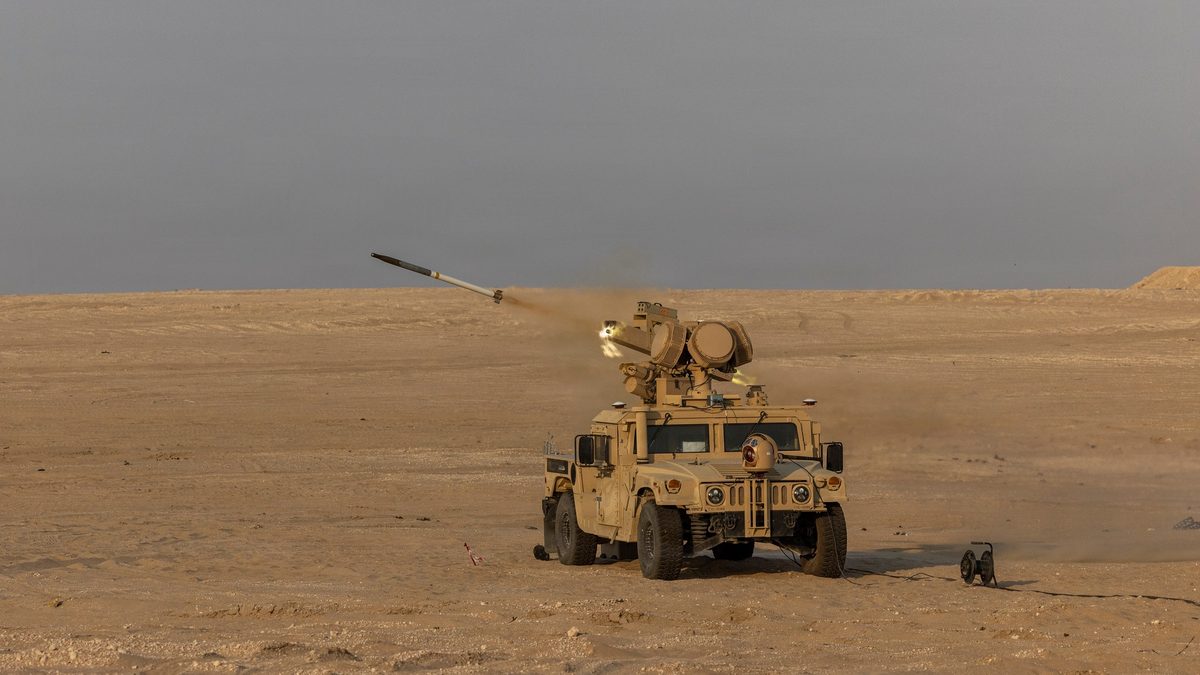
An Electronic Advanced Ground Launcher System (EAGLS) counter-UAS fires an Advanced Precision Kill Weapon System (APKWS) Hydra-70 rocket during Exercise Sky Shield, Kuwait, 4 December 2025. The same family of rounds is at the centre of the 1 May 2026 Israeli FMS notification. U.S. Army photo by Joseph Kumzak — DVIDS, Public Domain.
The Notification
On 1 May 2026, the U.S. State Department, acting through the Defense Security Cooperation Agency (DSCA), issued a Foreign Military Sales (FMS) congressional notification covering Israel’s requested purchase of 10,000 Advanced Precision Kill Weapon System-II All Up Rounds (APKWS-II AURs) at an estimated total package value of USD 992.4 million. The non-major defence equipment items in the package include test and support equipment, technical data, spare and repair parts, publications, training and training equipment, transportation, and U.S. Government and contractor engineering, technical and logistics support.
The Israeli case did not arrive in isolation. Three FMS notifications were issued the same day for the same family of munitions:
- Israel — 10,000 APKWS-II AURs, USD 992.4M.
- Qatar — 10,000 APKWS-II AURs (advanced single-variant configuration), USD 992.4M.
- United Arab Emirates — 1,500 APKWS-II guidance sections in an air-to-air configuration, USD 147.6M.
The combined APKWS sub-package totals approximately 21,500 rounds and guidance sections at USD 2.13 billion, sitting inside a wider USD 8.6 billion announcement that also covered Patriot for Qatar (USD 4.01B) and the Integrated Battle Command System (IBCS) for Kuwait (USD 2.5B). All three APKWS notifications were issued under emergency authorities, which the State Department invoked to set aside the customary 15- to 30-day congressional review window. That procedural choice is itself a data point: emergency invocation is not used for routine sustainment buys. It is used when delivery timing is judged to matter operationally.
What APKWS-II Actually Is
It helps to be precise about the article. APKWS-II is not a missile. It is a laser-guidance kit(the WGU-59/B mid-body guidance section, designed and produced by BAE Systems at its primary production facility in Hudson, New Hampshire) that converts an existing, in-stockpile 2.75-inch (70 mm) Hydra-70 unguided rocket into a precision-guided round. The kit is mid-body: it is screwed in between the rocket motor at the rear and the warhead at the front. Nothing else changes. The motor, the warhead and the launcher are the same hardware that has been in Western inventory in volume for more than half a century.
In 2025 BAE Systems unveiled a dual-mode variant adding a passive imaging-infrared seeker (nose-mounted) to the existing semi-active laser guidance, enabling pseudo-fire-and-forget tactics against swarming uncrewed-aircraft systems and cruise missiles. The imaging IR seeker takes terminal guidance after initial laser designation. A proximity-fuze option further enhances counter-UAS lethality. The dual-mode variant was in qualification as of early 2026 and is the configuration most directly relevant to the air-to-air sections in the UAE notification. Backward compatibility with existing Hydra-70 motors, warheads, and launchers is preserved.
The completed assembly is the “All Up Round” (AUR) referred to in the DSCA notification. Its U.S. designations,AGR-19/20/21, vary with warhead fit. A typical configuration uses the M151 10-pound high-explosive fragmentation warhead, the M423 point-detonating fuze, and the Mk 66 Mod 4 rocket motor, fired from M260 (7-tube) or M261 (19-tube) launchers on rotary-wing platforms, or the LAU-68F/A and LAU-131A/A on fixed-wing aircraft.
| Parameter | Value |
|---|---|
| Round type | 2.75-inch (70 mm) semi-active laser-guided rocket (precision-guided munition) |
| Guidance section | BAE Systems WGU-59/B mid-body kit; Distributed Aperture Semi-Active Laser Seeker (DASALS) |
| Guidance section length / mass | WGU-59/B (rotary-wing) / WGU-59A/B (fixed-wing); 47 cm (18.5 in) / 4.4 kg (9.8 lb); flip-out wings, span 24.3 cm (9.55 in) |
| Total All-Up Round length | ~1.87–1.91 m (73.8 in) depending on warhead |
| Total All-Up Round mass | ~14.8–15.8 kg (32.6–35 lb) depending on warhead |
| Maximum velocity | ~Mach 1.5 (briefly, post-burnout) |
| Seeker / engagement mode | DASALS distributed optics across four flip-out wings; Lock-On After Launch (LOAL) standard; designating laser must be maintained until impact (or per optimised trajectory) |
| Compatible warheads | M151 (HE-FRAG, 10 lb); M282 (multi-purpose penetrator, 4.5 kg); Mk 152 (HE) |
| Compatible rocket motor | Mk 66 Mod 4 solid-rocket motor |
| Effective range | ~1.5–5 km (rotary-wing); ~2–11 km (fixed-wing); air-to-air variant ~6 km |
| Circular Error Probable (CEP) | Reported ≤0.5 m to designated laser spot under nominal conditions |
| Hazard classification (notional) | HD 1.1 E for AUR; storage and transport per ADR/IMDG class 1 |
| Compatible platforms | AH-64, AH-1Z, MH-60, UH-60, OH-58, MQ-9, A-10, F-16, F/A-18, AV-8B, KC-130J Harvest HAWK, Apache and Tiger user fleets, AT-6, Super Tucano, EAGLS ground launcher |
| Designations (U.S.) | AGR-19/20/21 (warhead-dependent) |
| Integrator / OEM | BAE Systems (Hudson, NH); Hydra-70 motor: General Dynamics; warheads: multiple suppliers |
Two technical points are worth dwelling on because they explain why this kit, of all kits, scales the way it does.
First, the DASALS principle. Rather than placing the laser seeker in the nose (which is where the warhead lives on a 2.75-inch rocket) APKWS-II distributes four small optics around the leading edges of the flip-out wings. The wings deploy approximately half a second after launch, after the round has cleared the launcher. The four-optic array sees the laser spot in flight; an onboard processor fuses the inputs and steers the round. This architecture is what allowed BAE Systems to graft a precision seeker onto the Hydra-70 family without touching the warhead, the motor or the launcher. The kit became compatible with everything that already fired Hydra-70 the day it was certified.
Second, the cost economics. Open-source unit-cost estimates for APKWS-II AURs sit in the USD 22,000–30,000 band. AGM-114 Hellfire variants sit at roughly USD 150,000. AGM-179 Joint Air-to-Ground Missile (JAGM) is around USD 220,000. AIM-9X Sidewinder is approximately USD 450,000. APKWS-II is therefore an order of magnitude cheaper per shot than the rotary-wing missile category against which it competes for target sets. It is not a Hellfire. It does not have a Hellfire’s warhead, range or seeker autonomy. But against the threats it can service, the unit-economics gap is the entire point.
Why Ten Thousand Is The Story
Stockpile depth, not novelty, is the centre of gravity of this notification. Ten thousand rounds is not a shelf-stocking buy. It is a deep magazine sized for repeated employment across multiple platforms, multiple theatres and a sustained operational tempo. That number stands against a backdrop in which Israeli air operations since late 2023 have demonstrated three consistent demand signals.
The first is distributed targets at low unit value. Single-vehicle technicals, dispersed launch teams, individual one-way attack drones, light watercraft, fortified observation posts, and small mobile groups do not justify a USD 150,000 Hellfire shot if a USD 25,000 round can be made to do the work. APKWS-II is the round that makes that arithmetic close.
The second is magazine capacity per sortie. A standard M261 19-tube launcher carries nineteen 2.75-inch rounds. An AH-64E configured for a counter-distributed-targets profile can carry up to seventy-six rounds across four launchers, against perhaps eight Hellfire-class weapons in the equivalent loadout. Per sortie, that is roughly an order-of-magnitude shift in precision shots taken per launch cycle, assuming the targeteering can keep up.
The third is counter-uncrewed-aerial-system (C-UAS) employment. APKWS-II has been used in active C-UAS operations in the Red Sea theatre by U.S. Navy F/A-18s, with reported successful engagements against Houthi one-way attack systems. The Israeli stockpile request comes against a domestic threat picture in which dispersed UAS launches from multiple peripheries have been a consistent feature since 2024. The UAE’s parallel notification (1,500 guidance sections specifically in an air-to-air configuration) is the most explicit signal yet that the C-UAS use case is now driving APKWS demand. When a guided 70mm rocket costs less than the drone it shoots down, the cost-imposition curve begins to bend in the defender’s favour.
Plausibility check
Open-source claims that a single APKWS-II AUR costs less than a typical first-person-view (FPV) attack drone are overstated. Bulk-procured FPV airframes are reported in the low hundreds of dollars; APKWS-II is in the low five figures. The cost-imposition argument is genuine, but its true comparator is the medium-altitude long-endurance (MALE) and one-way attack class in the USD 20,000–200,000 band, not consumer-grade FPVs. ISC rates the headline “cheaper than the drone it shoots down” framing at F6 (Cannot be judged) without payload-specific data; the broader cost-imposition logic against MALE-class threats is rated B2 (Usually reliable / Probably true).
The U.S. Industrial Read-Across
For the United States, the more interesting story is on the supply side. BAE Systems’ Hudson, New Hampshire facility has been running a sustained capacity expansion on APKWS-II for roughly four years, with public statements indicating production rates approaching and then exceeding 2,000 kits per month by early 2026. The 21,500-round Middle East notification is therefore consistent with somewhere between 10 and 12 months of plant output at current rates — provided domestic U.S. service demand continues to be met in parallel, which is not a trivial caveat. Recent U.S. Navy indefinite-delivery / indefinite-quantity (IDIQ) contracts (Lots 13–17, up to 55,000 kits valued at approximately USD 1.74 billion) confirm sustained high-rate capacity through at least 2031.
Two procurement-side observations follow.
First, the Hydra-70 motor and warhead supply chain is now a strategic constraint on APKWS-II throughput in a way it was not before. The kit is the fast-moving part. The legacy Hydra-70 stockpile from which AURs are assembled is finite, and motor production and warhead loading have not historically scaled to anything like 2,000 rounds per month. Consumption at the rates implied by Red Sea operations and dispersed-target employment in the Levant runs against that constraint quickly. Watch the FY26 and FY27 budget lines for Mk 66 motor and M151 warhead procurement: this is where the bottleneck will or will not be resolved.
Second, the FMS pipeline is now a meaningful share of programme volume. APKWS-II foreign sales have run continuously since the early 2010s, but the cumulative 2024–2026 backlog (including Ukraine, Saudi Arabia, the Netherlands, Norway, Indonesia and now the trilateral Middle East package) is on a different scale. The implication is that BAE Hudson is no longer planning around U.S. Marine Corps and U.S. Navy demand alone. The plant is now a NATO-and-partner production node, and its expansion ceiling becomes a coalition-level question.
Hazards, Storage and Transport — The Logistics Tail
The DSCA notification commits the United States to providing “transportation” support; a routine line in FMS announcements, but a non-trivial logistics task at this volume. APKWS-II AURs are UN Class 1 explosives. The Mk 66 Mod 4 motor is loaded with extruded double-base solid propellant. The M151 warhead carries a Composition B-3 or equivalent HE fill. As fielded AURs the rounds carry a notional hazard classification of HD 1.1, Compatibility Group E, with the AUR Net Explosive Quantity (NEQ) controlled and assigned through the Joint Hazard Classification System (JHCS).
For the Israeli logistics footprint, ten thousand AURs is on the order of 10–12 ISO containers of UN Class 1 stores, depending on packaging configuration, plus storage at fielding bases under DSA 03.OME-equivalent IMD/IBD/PBD safety distances. None of this is exotic. All of it has to be planned, and the “training and training equipment” line in the FMS package is doing real work: APKWS-II is procedurally simple to employ but procedurally exact in storage, handling and laser-designation discipline.
The Wider Pattern — Mid-Tier Precision As An Inventory Class
Step back from the Israeli case and the 1 May notifications resolve into a clearer pattern. Western air-to-ground inventories are being rebuilt around three tiers of precision:
- Tier 1: exquisite: AGM-158 JASSM/LRASM, AGM-88 AARGM-ER, SM-6, Tomahawk, Storm Shadow / SCALP. Stand-off, complex, slow to build, expensive per shot.
- Tier 2: tactical missile: AGM-114 Hellfire variants, AGM-179 JAGM, AIM-9X, AIM-120 AMRAAM in air-to-ground roles, Brimstone. Mid-cost, reasonable supply, the mainstay of recent operations.
- Tier 3: mid-tier guided round: APKWS-II, GBU-39 Small Diameter Bomb (SDB), 70mm laser-guided variants from European and Israeli houses (Thales FZ275 LGR, Israel Aerospace Industries / Elbit competitors), guided 81mm and 120mm mortar rounds. Low cost, high volume, rotary-wing- and dispersed-target-heavy.
The strategic read is straightforward. Tier 1 is where credibility lives but is supply-constrained for the foreseeable future. Tier 2 is where most operations are fought but cost-per-shot is unsustainable against distributed targets at high tempo. Tier 3 is where the inventory rebuild is now happening fastest, because mid-tier precision is the only category in which Western industrial base can produce at the volumes operations are consuming. The 2025–2026 surge in APKWS demand (U.S. domestic plus FMS) is the operational evidence: it is the only precision category in which Western industrial bases are currently matching consumption rates without multi-year lead times.
Israel’s 10,000 AURs are not a strategic surprise. They are a representative sample of the bigger pattern: stocking the tier in which the magazine can still be filled.
Data Gaps and Confidence Assessment
The following are explicitly undisclosed in the public DSCA notifications and should be treated as data gaps in any downstream analysis:
- Specific warhead mix across the 10,000 Israeli AURs (M151 versus M282 versus Mk 152), the “advanced single-variant configuration” language used in the Qatari notification was not repeated in the Israeli text.
- Whether any portion of the Israeli AURs are configured for the air-to-air C-UAS role (as the UAE guidance-section package explicitly is) or remain in the conventional air-to-ground configuration.
- Delivery schedule and milestone profile: emergency authorities short-circuit the congressional review window but do not, on their own, accelerate production.
- Hydra-70 motor and warhead supply attribution: whether the AURs draw on existing U.S. Government-owned inventory or are produced fresh against this case.
- Net Explosive Quantity per AUR, controlled information, available only via JHCS and equivalent national entries.
- Israeli end-platform allocation across rotary-wing, fixed-wing and ground-launcher fits.
Source evaluation under NATO STANAG 2022: DSCA notification facts are rated A1 (Reliable / Confirmed); production-rate, capacity and unit-cost figures are rated B2 (Usually reliable / Probably true); threat-driver attribution and tier-rebuild framing are rated B3 (Usually reliable / Possibly true); the “cheaper than the drone” comparison is rated F6 (Cannot be judged) without payload data.
References & Further Reading
- U.S. Department of State, Bureau of Political-Military Affairs — “Israel: Advanced Precision Kill Weapon System”, 1 May 2026. https://www.state.gov/releases/bureau-of-political-military-affairs/2026/05/israel-advanced-precision-kill-weapon-system
- Reuters, “US approves military sales over $8.6 billion to Middle East allies”, 1 May 2026. https://www.reuters.com/world/middle-east/us-approves-military-sales-over-86-billion-middle-east-allies-2026-05-01
- The Defense Post, “US Approves Sale of APKWS to Israel, Qatar, and UAE”, 4 May 2026. https://thedefensepost.com/2026/05/04/apkws-israel-qatar-uae/
- Breaking Defense, “US clears $8.6 billion arms sales to Middle East countries, ‘waiving’ congressional review”, May 2026. https://breakingdefense.com/2026/05/us-clears-8-6-billion-arms-sales-to-middle-east-countries-waiving-congressional-review/
- FlightGlobal, “US invokes emergency powers for $2.1 billion APKWS sale to Middle East trio”, May 2026. https://www.flightglobal.com/munitions/2026/05/us-invokes-emergency-powers-for-2-1-billion-apkws-sale-to-middle-east-trio/
- BAE Systems — APKWS® laser-guidance kit product page. https://www.baesystems.com/en-us/product/apkws
- NAVAIR — APKWS programme page. https://www.navair.navy.mil/product/APKWS
- Designation-Systems.net — “BAE Systems AGR-19/20/21 APKWS II”. https://www.designation-systems.net/dusrm/r-19.html
- GlobalSecurity.org — APKWS programme overview. https://www.globalsecurity.org/military/systems/munitions/apkws.htm
- Wikipedia — Advanced Precision Kill Weapon System (collated technical baseline; CEP, ranges, dual-mode development, >100k production milestone). https://en.wikipedia.org/wiki/Advanced_Precision_Kill_Weapon_System
- Naval News / The War Zone — coverage of BAE Systems dual-mode laser/IR seeker variant and proximity-fuze testing (2025). https://www.navalnews.com/naval-news/2025/04/bae-systems-unveils-dual-mode-apkws-variant-at-sea-air-space-2025/
- DVIDS, “EAGLS live-fire validation”, Exercise Sky Shield, Kuwait, 4 December 2025. https://www.dvidshub.net/image/9475075/eagls-live-fire-validation
- Defence Safety Authority, DSA 03.OME (UK ordnance, munitions and explosives regulatory framework, supersedes JSP 482). https://www.gov.uk/government/organisations/defence-safety-authority
This analysis is AI-assisted, based exclusively on open-source unclassified material, and is intended for informational use. It does not constitute legal, procurement or investment advice. Source evaluations follow NATO STANAG 2022.
ISC Commentary
The temptation with FMS notifications is to read them as a transactional event: a country has bought a thing, here is how much it cost, end of analysis. The 1 May Middle East package is more interesting than that.
Three signals matter. First, the use of emergency authorities across all three APKWS cases on the same day is not an accident of timing; it is a procurement statement that the rounds are needed before the next Congress sits. Second, the trilateral pattern (Israel + Qatar + UAE) is a deliberate spread across the Gulf and Levant that signals coalition-wide air-to-ground precision capacity, not a single-country sustainment buy. Third, the volume (21,500 rounds and guidance sections) is now production-line scale, not stockpile-replenishment scale.
For the United Kingdom and for Western European partners watching this, the read-across is uncomfortable but useful. APKWS-II shows that mid-tier precision can be produced at industrial volume when the supply chain is set up to do it. CAMM, Brimstone, Spear 3 and Meteor are exquisite weapons in the Tier 1 and Tier 2 brackets; none of them is positioned as the European answer to APKWS. The question is not whether NATO needs a Tier 3 round — the U.S. and Israeli operational record now answers that, but which European industrial partner builds it, and at what rate. Until that question is answered, the magazine that fills fastest will keep being filled in New Hampshire.